
As expected, this sector is outperforming... And it's cheaper than its historical average... Everything housing-related is on fire... Paul Mampilly on why the housing boom will continue... The magic behind 1.5 million...
 One sector is outperforming the rest of the market today...
Retirement Millionaire subscribers aren't surprised by this news. As Dr. David "Doc" Eifrig explained in the October issue, this sector has historically outperformed the broad stock market. I'm talking about the consistent outperformance of small-cap stocks versus large caps.
It makes sense. It's easier for a company with $10 million in sales to sustain big annual growth rates in sales and profits than it is for, say, Wal-Mart – the world's largest retailer.
Normally, you have to pay a higher valuation for higher growth potential. But that's not the case today.
Before we discuss valuations, we'll share Doc's research from the October issue of Retirement Millionaire...
|
But it's important to invest in small caps the proper way. As Doc explained, for most investors, a safer way to make money in small-cap stocks is by buying a diversified basket of them than it is to try to cherry-pick individual companies...
Economists Eugene Fama and Kenneth French provide a quality data set to show this. If you created an annual portfolio of the 30% of stocks that are the smallest on the market and compare it with the largest 30%, the small stocks make a lot more money. One dollar invested in 1990 in small caps would be worth $30.52 today. A dollar invested in large caps would have grown to $12.05.
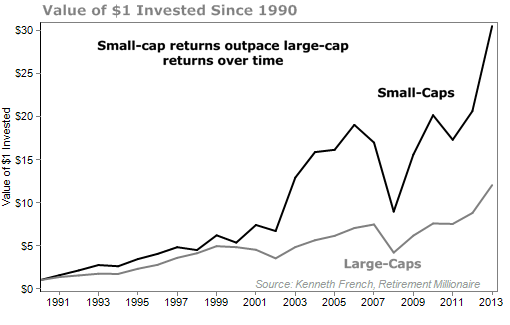
Taking a longer view, $1 invested in 1926 would be worth $5,203.43 in large caps... but $236,497.39 in small caps.
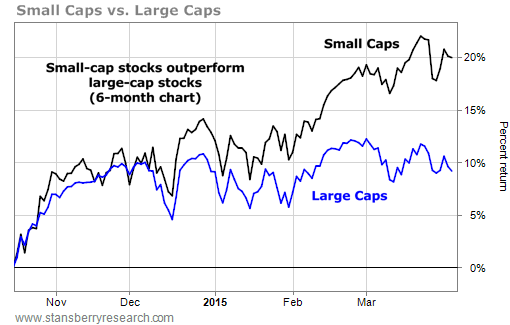
And while small-cap stocks generally outperform their large-cap counterparts over the long term, that wasn't the case in October...
|

With the recent underperformance comes undervaluation. As we said, small caps normally trade at a rich premium to large caps. But that premium is evaporating today. From the April issue of Retirement Millionaire...
|
Out of fairness to Doc's Retirement Millionaire subscribers, we won't share the name of the small-cap company he recommended this month. But as you can see from the chart below, small caps have outpaced large caps since October...
As we noted in Tuesday's Digest, homebuilder stocks are ripping higher as the U.S. housing market and general economy improve.
But it's more than just the homebuilders that are hitting new highs. Everything in the housing space is booming...
Mohawk Industries (carpet and flooring), American Woodmark (cabinets), Home Depot (home improvement), AAON (air conditioning), Masonite International (doors), and Smith AO (water heaters) – just to name a few – are trading at or near new highs today.
And Stansberry Research analyst Paul Mampilly thinks the trend will continue. As he explained in an e-mail to me today...
|
But why is the 1.5 million number so important? More from Paul...
|
And adding even more fuel to the bullish case on housing, the U.S. housing supply is getting old. From Paul...
|
Like Doc, Paul believes the U.S. economy is slowly grinding higher... And despite record-high stock prices, there are still plenty of opportunities to profit on the long side.
Now is also a good time to take advantage of any market selloffs to enter new positions, or "buy the dips."
It's also a great time to sell put options on high-quality stocks... and collect thousands of dollars of extra income as the market marches higher.
We've written thousands of words about selling puts, so we won't get into it again today. If you're not familiar with this conservative trading strategy, I encourage you to read the December 29 Digest.
New 52-week highs (as of 4/1/15): Global X China Financials Fund (CHIX), iShares China Large Cap Fund (FXI), Prestige Brands Holdings (PBH), and ProShares Ultra FTSE China 50 Fund (XPP).
In the mailbag, Porter responds to a subscriber's question about low oil prices and their effect on banks. Send your questions and comments to feedback@stansberryresearch.com.
"Porter, I can't help but wonder how much the banks will be affected by lower oil prices, if the oil prices remain low for an extended period of time. As you stated, jobs will be lost if there is too much supply for the demand. If I recall, many oil producers borrowed money from the banks to fund their equipment, labor, etc. in the pursuit of growing their oil production.
"It would be helpful to know which banks carry the largest percentage of notes, thus facing the most risk regarding these notes if oil production scales back long enough to where the note payment may be in jeopardy. I would assume that the major banks would be more at risk than the smaller, regional banks? Just speculation, but that may be a good research project for you, determining how long oil prices must remain low to put the notes at risk and which banks would be most at risk. I would want to short those banks, down the road, if oil prices stay low long enough." – Paid-up subscriber William Durst
Porter comment: I wouldn't worry about the banks as much as I would worry about the folks holding high-yield bonds. Most of the oil financing over the last cycle was done through the bond market, which, courtesy of the Federal Reserve, was giving money away nearly for free. A lot of those bonds are going to go bust.
Regards,
Sean Goldsmith
April 2, 2015
