

Big News From Steve Sjuggerud
Big news from Steve Sjuggerud... This longtime 'free money' opportunity is over... A change to Steve's 'blueprint'... An update on Fannie and Freddie... 'Make no mistake, this is far from over'... Trump's new Treasury Secretary doubles down on growth... Is tax reform in doubt?...
 We begin today with big news from our colleague Steve Sjuggerud...
Longtime readers know U.S. housing has been a centerpiece of his investment "blueprint" for years now.
Way back in 2008 – when most folks were panicking – Steve said the worst of the housing bust was over. Then a few years later, in early 2011, Steve turned all-out bullish. As he wrote in the January 28, 2011 edition of our free DailyWealth e-letter...
Home prices have crashed. And mortgage rates are at record lows. But incomes (nationwide) haven't fallen nearly as much... So homes are now more affordable than ever.
"Most people" out there will only tell you the bad news about housing... That's the way it goes in a bear market. People drive looking in the rearview mirror. Meanwhile, we have some darn compelling facts out there...
Home prices have fallen by a third... and mortgage rates are the lowest in history. Therefore, U.S. homes are more affordable than they've ever been. You can listen to "most people." Or you can choose to ignore them and stick to these facts.
Based on these facts alone, now may be one of the best times in American history – even the very best time – to buy a house.
Since then, Steve has reaffirmed his call again and again...
He has practically begged readers to take advantage of this "free money" opportunity before it was gone. And folks who took his advice have likely done well...
The U.S. Census Bureau reports the median price of both new and existing homes rose more than 30% in the last five years alone. And the National Association of Realtors reports more than 50% of the markets it tracks now have a median home price at or above previous all-time highs. In other words, in more than half the country's major metropolitan areas, home prices are now at or above their pre-housing-crisis highs.
But this morning, Steve made a major announcement...
In short, Steve says housing is no longer the "no brainer" investment it once was...
To be clear, Steve is NOT turning bearish... He still thinks housing is a great investment. He's personally still fully invested. And he expects to see big gains – possibly even another bubble – before it all ends.
But he believes we've now hit the "middle innings" of the boom, and the "free money" is behind us. As he explained in today's DailyWealth...
Before the housing bust in 2010-2011, I'd never invested in U.S. real estate – outside of my home – in my entire career. Real estate was never a "free money" opportunity... until it hit bottom.
I started buying property here in Florida. Investment property went from 0% of my investments in 2010 to the largest percentage of my investments today. So what's changing now? A lot...
First, as Steve showed, the massive imbalance between supply and demand is easing...
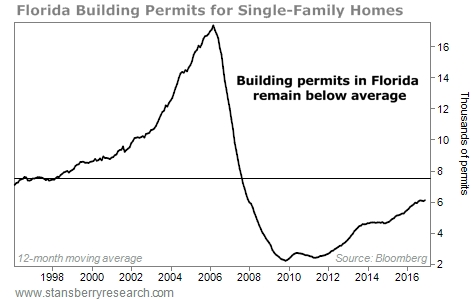
In 2010-2011, homebuilders in Florida practically stopped building new homes. The supply dried up. Meanwhile, families were still having babies. And people were still moving to Florida. I knew the end result had to be higher housing prices. It's Economics 101 – when there's no supply and plenty of demand, prices go up.
Now that situation is starting to reverse. You can see it in this chart of building permits for single-family homes in Florida... Building permits hit a record high in 2006... then fell to a record low in 2009. But the story is changing... Take a look at the far right of the chart:
More concerning, Steve notes housing sentiment is becoming euphoric again...
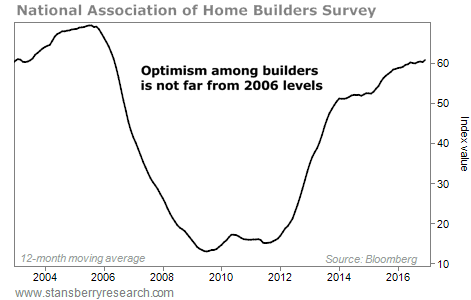
Optimism is back... both anecdotally and in the hard numbers...
Anecdotally, local realtors that I talk with are having their best February ever. And new homes and neighborhoods are popping up everywhere around here. Who's going to live in all these new homes?
Meanwhile, the numbers show optimism among builders is already not far off from its 2006 peak. Take a look:
Again, if you took Steve's advice over the past few years, he doesn't recommend selling... He believes the biggest gains are likely still ahead. But if you haven't acted yet, Steve says you now need to be more selective...
Since the bottom, I've basically told you, "Don't think, just buy." At that time, we were in the early innings of this new real estate boom. But now, we're finally in the middle innings...
I'm not saying "get out" just yet. Not at all... There's still plenty of upside. And the biggest gains tend to happen toward the end of major booms.
But the easy money is behind us now. The middle innings are here. It's finally time to think before you buy...
Switching gears, some Digest readers have asked for an update on Fannie and Freddie...
Last May, Porter and his team recommended going long shares of both Fannie Mae (FNMA) and Freddie Mac (FMCC) – the same companies he famously (and correctly) predicted were "zeros" back in 2008.
We explained the details behind this speculative recommendation in the November 23 Digest...
In simple terms, after the government bailed the companies out in 2008, the Obama administration changed the terms of the deal. As a result, the government has been collecting nearly all of the companies' profits, even though they've more than repaid their debts. And in recent years, Fannie and Freddie shareholders have been battling the government in various courts to overturn the policy and return the profits to their private owners.
Porter's team believed this created a massive speculative opportunity. If the plaintiffs won, shares of the two government-sponsored enterprises ("GSEs") would be worth nearly $20 each. That would represent an increase of nearly 10 times the share price back in May. On the other hand, if the government prevailed, shares would go to zero. As they explained in the May 2016 issue of Stansberry's Investment Advisory...
Let's get one thing straight: This is the mother of all speculations. It is not for your rent money. It's not even for your dog-food money. For asset-allocation purposes, you can put this in the same category as your plane tickets to Vegas.
While we think the plaintiffs (shareholders) will prevail, you need to understand this fact: Under the third amendment that currently governs the GSE bailouts, there will be no profits left over to ever pay common-equity holders...
However, the plaintiffs have a great case and a great shot of overturning the amendment that blatantly stole their property. Herein lies our opportunity. Fannie and Freddie shares currently trade around $1.75. That's less than one times earnings – a valuation typically reserved for companies in grave danger of bankruptcy. In other words, the market has priced these shares as if the plaintiffs have almost no chance of winning.
But November's election added a new twist to the situation...
Donald Trump's victory – and his incoming pro-business administration – meant a ruling in favor of the government wasn't necessarily "fatal" anymore. Most notable, Trump selected Steve Mnuchin to serve as U.S. Treasury Secretary.
Why was this important? Because Mnuchin is a mortgage-industry veteran and a former investor in both Fannie and Freddie, who has publicly said he doesn't support the government's controversial deal. In other words, the Trump administration could decide to settle directly with GSE shareholders regardless of what the courts decide.
And the market quickly took note... GSE shares nearly tripled from November to December – what Porter's team has dubbed the "Mnuchin Effect" – and had held most of those gains over the past few months.
But this week, shares plunged...
Shares of both Fannie and Freddie fell more than 30% on Tuesday following a ruling from the D.C. Circuit Court. As you can likely guess, the court ruled in favor of the government.
Porter and his team sent a detailed update on the situation to Stansberry's Investment Advisory subscribers yesterday. Because we know many Digest readers are following along, they've agreed to share a portion of it here today...
We felt from the beginning that the plaintiff's case was far stronger than the Treasury's. Various courts have issued rulings over the past few months. Some have gone our way... some have not. But we've really been waiting on the "Big One," the D.C. Circuit Court. Yesterday, the D.C. Circuit Court released its long-anticipated decision. And in a 2-1 vote, the court found on the Treasury's behalf...
We think these decisions violate the U.S. Constitution, and one of the three district judges sees things our way. In an unusual twist, Circuit Judge Janice Brown used her dissenting opinion to criticize her colleagues with extremely strong legal language:
- "The Court hides behind a false formalism, establishing a dangerous precedent for future acts of FHFA, the FDIC, and even common law conservators."
- "Now investors in regulated industries must invest cognizant of the risk that some conservators may abrogate their property rights entirely in a process that circumvents the clear procedures of bankruptcy law."
- "What might serve in a banana republic will not do in a constitutional one."
- "Plaintiffs... are betting the rule of law will prevail. In this country, everyone is entitled to win that bet. Therefore, I respectfully dissent from the portion of the Court's opinion rejecting the Institutional and Class Plaintiffs' claims."
Judge Brown is right. The rule of law did not prevail. Plaintiffs lost that "bet." But Brown's scathing indictment of her own court provides small consolation to those whose shares fell 36% yesterday.
So what's next?
As Porter's team explained, the D.C. Circuit Court's decision was a disappointment, but the other bullish catalyst – the Mnuchin Effect – remains...
While the legal cases have not gone shareholders' way, the Mnuchin catalyst is very much still in effect. Existing shareholders include some of Wall Street's most powerful investors – and Mnuchin's buddies – and a direct settlement with the Treasury or Congress is certainly in play at this point.
What will the settlement look like? There are too many possible outcomes to render a prediction. In all likelihood, the Treasury's win in the circuit court erased the potential for a tenfold gain. However, a settlement could still provide a windfall for investors... which is why we still see shares trading at around $3...
As we go to press, we're sitting on gains of 71%, with a stop loss in play at around a 33% gain. If you've had enough, feel free to sell and enjoy your 71% gains over nine months. In our official position, we are going to continue to hold shares, honor our stops, and see where the "Mnuchin Effect" takes us.
We'll also note Porter and his team are not alone in their bullish stance...
Notable investor (and Fannie and Freddie shareholder) Bruce Berkowitz – who was named fund manager of the decade from 2000 to 2009 – believes shareholders will ultimately prevail. As he told financial newspaper Barron's last night...
The Net Worth Sweep cannot be defended on its merits, and no Court has done so. Make no mistake – this is far from over. We firmly believe that the rights of preferred shareholders in these two enormously profitable, publicly traded companies will be upheld one way or another.
Speaking of Mnuchin, the newly confirmed Treasury Secretary gave his first interview on Wednesday...
And he reaffirmed the new administration's intention to do everything it can to jumpstart the economy. As the Wall Street Journal reported...
Treasury Secretary Steven Mnuchin laid out ambitious goals to secure a U.S. tax-code overhaul by August and to deliver economic growth at rates not seen in more than a decade.
Mr. Mnuchin... said slower economic growth since the financial crisis had primarily been an anomaly and a result of Obama administration policies that can be reversed. He said the Trump administration is aiming for a sustained 3% or higher annual growth rate, a projection not widely shared by other forecasters.
"We think it's critical that we get back to more normalized economic growth. More normalized economic growth is 3% or higher," Mr. Mnuchin said.
These comments were largely seen as bullish...
But Mnuchin also said the administration's goal to pass its tax-reform legislation before Congress leaves for recess in August was "ambitious"... and admitted it "could slip to later in the year."
As our colleague Scott Garliss noted in the Stansberry Newswire, this could create some uncertainty in the near term...
This was a leg of the "big three" that investors are expecting from the new administration's agenda: tax reform, regulatory reform, stimulus/infrastructure spending.
Granted I don't think most analysts have tax reform numbers built into estimates for this year, but this would still be damaging from a sentiment standpoint and would delay the effects...
It now seems less likely that President Trump is going to have the big tax announcement he promised a couple of weeks ago, when he addresses a joint session of Congress on February 28. Time will tell, but it certainly seems like a "sell the news" event.
New 52-week highs (as of 2/22/17): Industrial and Commercial Bank of China (1398.HK), Apple (AAPL), American Financial (AFG), AMETEK (AME), iShares MSCI BRIC Fund (BKF), Berkshire Hathaway (BRK-B), CommScope (COMM), Facebook (FB), First Trust Emerging Markets Small Cap AlphaDEX Fund (FEMS), Cedar Fair (FUN), Huntington Ingalls Industries (HII), PureFunds ISE Mobile Payments Fund (IPAY), JD.com (JD), 3M (MMM), PNC Financial Warrants (PNC-WT), Shopify (SHOP), Stanley Black & Decker (SWK), Two Harbors Investment (TWO), and W.R. Berkley (WRB).
Another busy day in the mailbag: More kudos on our recent "10x Project" event... more great feedback on Stansberry's Credit Opportunities... And several folks are upset by the latest from P.J. O'Rourke. Send your questions and comments to feedback@stansberryresearch.com.
"I really enjoyed the [10x Project] presentation and this sort of approach to stock picking is as close to my personality as you can get..." – Paid-up subscriber Len S.
"Hi Porter! It's about time I sent you a note to say thanks! I've been a reader for several years now and was quite happy to join the Alliance. When Credit Opportunities was announced, I was fortunate to be paying attention and have enjoyed it quite a lot. I was current on my reading when NRP was the topic in December 2015 and managed to get in and make the trades on target as recommended. Here's how my NRP trades worked out... Had to throw it all into a spreadsheet to figure it out. Looks like I bought for $6,840.89 (Dec-15), sold for $18,665.98 (Feb-17), and received an additional $1,248.76 of interest/dividends (less $20 reorg). All for a gain of $13,073.85!! Many, many thanks to you and ALL of your team!!" – Paid-up Stansberry Alliance member Steve G.
"While Mr. O'Rourke may be getting his panties in a wad over folks on the left becoming fanatic and overly romantic about the benefits of 'government,' they really aren't given much of a choice when boxed in a corner by our [xxxxxx] of a president." – Paid-up subscriber Bob S.
"Free speech is a gift and a right provided by our Constitution. You can use all your well thought out Thesaurus words to try to explain some sort of rationalization for Trump and the Congress's agenda but, the truth be told, we are dealing with a President that half pays attention to Fox news while eating breakfast. Then, he decides that the parts that he thinks he heard are 'real' news and, either, Tweets out or speaks as though these are facts. I.e. terrorist attacks in Sweden, alternative facts or the 'Mass Media' is the enemy. I doubt you'll print this but I thought that I would share anyway. Very scary situation if you take the time to really give it some thought." – Paid-up subscriber Bradley Stone
"Perhaps I'm in the minority of Stansberry subscribers in disagreeing with the thrust of P.J. O'Rourke's recent columns. I'm actually surprised if this is the case, as I would have thought Stansberry folks would be a bit more, er, sophisticated. I certainly agree that the government is just an organization, but whether we like it or not (and I don't, either), it's a very powerful organization, with the capacity to negatively affect all of our lives. And the president has much of that power. I think any president's power to do good is extremely limited, but his/her power to do evil is less so (e.g., George Bush and the Iraq invasion which led to the creation of ISIS, etc., etc.) The current occupant of the White House believes that three million illegals voted in the last election, that the crowds at his inauguration were the largest ever, and on and on. It worries me that a man who believes such provably false things has the nuclear football always within arm's reach.
"Am I 'hysterical' to worry about this? I don't think so. Of course, I realize that my worrying is probably unnecessary, but I am worried nonetheless. President Trump may turn out to be a great president, and I hope he does. But I think the press is only doing its job in pointing out his shortcomings, and I can't understand why Mr. O'Rourke finds them 'hysterical' to do so." – Paid-up subscriber Gary Burfoot
P.J. O'Rourke comment: Dear Mr. Burfoot, I don't think you're hysterical at all. You put your finger on a central problem in the American political system that people of all political persuasions should be worried about... Far too much power has accrued to the office of the president.
And as you point out, that power is more effective in doing ill than it is in doing good. I, too, have my hopes and fears about this administration. But one hope I have is that the current political controversy will help Americans rethink the office of chief executive and reduce its powers and prerogatives to the relatively modest level described in the U.S. Constitution.
Regards,
Justin Brill
Baltimore, Maryland
February 23, 2017