
China joins the currency wars... Nine central banks that have cut rates this year... The stubbornness of deflationary pressures... Where the bubbles are today... Corporate bond yields go negative... What happens in a zero-interest rate world?...
 In yesterday's Digest, we discussed how Australia – one of China's largest trading partners – cut rates to partake in currency wars. Today, China gets in on the game...
China's central bank, the People's Bank of China (PBOC), cut its reserve requirement ratio (deposits that banks must hold in reserves with the central bank) by 50 basis points from 20% to 19.5%. This is the PBOC's first cut of this kind since May 2012. The central bank did cut its benchmark lending rate by 40 basis points from 6% to 5.6% in November 2014.
Goldman Sachs estimates the cut is equivalent to about a $100 billion liquidity injection.
This is yet another central bank easing... It has become a panicked race to weaken currencies.
Today's move is also a major policy change for China. Just a month before the November interest rate cut, PBOC's chief economist, Ma Jun, said China wouldn't provide broad economic stimulus despite slowing growth. The country was worried more credit would flow to industries already suffering from excess capacity – like real estate.
It's clear China got spooked. Yesterday, the PBOC took measures to strengthen the yuan by manipulating its trading range. Today, it announced a surprise rate cut – the first since May 2012. The currency wars are on.
So far this year, 17 central banks have instituted some form of easing. Among the notable central banks to cut rates were...
1. Australia
2. Canada
3. China
4. India
5. Egypt
6. Pakistan
7. Peru
8. Russia
9. Turkey
Also, the European Central Bank began buying 60 billion euros of debt a month.
If you weren't clear on this point yet... Central banks are willing to do everything in their power to combat slow growth and create inflation.
Still, it's impressive how dominant deflationary pressures have been, given the massive inflationary forces at work in the world.
Take a look at this chart of mining giant Rio Tinto. The Federal Reserve started to print money in late 2008... But the price of this miner, which produces everything from coal to iron ore to copper, has stagnated for most of the time since then...
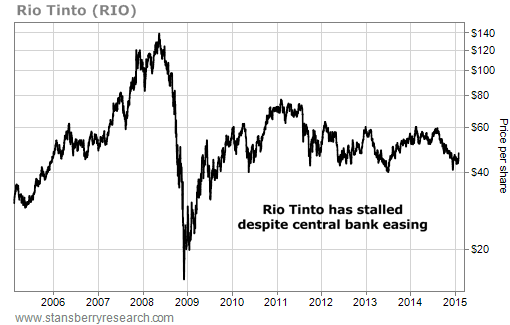 When central banks print up tons of new reserves and banks make additional loans, that money is going somewhere... But it's almost impossible to predict where. It's all about where people choose to put the money...
In the 17th century, the Dutch bought tulips. In the 1970s, people bought soft commodities, like corn. Over the past 15 years, people have been buying houses and drilling oil wells.
It's easy to see a bubble in hindsight. Predicting future bubbles proves more difficult...
I called Porter to chat about the madness in the markets today... He predicts the next two sectors to blow up will be student lending (college students now have $1 trillion in debt) and casinos (lots of casinos are being built around the world).
I'd present bonds as another area of madness in the markets today...
In yesterday's Digest, we noted government bonds from Germany, Denmark, Netherlands, Austria, Sweden, Finland, France, Belgium, and Switzerland all sport negative yields. That's nine major sovereigns with negative yields. According to the Wall Street Journal, 16% of the global government bonds have negative yields.
Today, short-term euro-denominated bonds from Swiss food company Nestlé have gone negative. That's a first for Nestlé, and it may be the first time in history the yield on a corporate bond maturing in more than one year has gone negative. You can now pay for the privilege of lending money to a good company.
Nestlé's bonds maturing in 2021 yield a paltry 0.33%.
Why would anyone pay for the privilege of buying bonds at these absurd prices?
And where does this end? We could easily see negative Treasury yields. As we said yesterday, there's a ton of capital in the world today... And that money is looking for the safety of high-quality bonds (and other assets) – even if yields are negative.
What happens to the global economy when people pay to hold the world's safe-haven asset? What happens to the pensioners? The retirees? How does the world function when there's no cost to capital?
It's comforting to see gold holding steady in the face of this madness. And though we've mentioned it plenty this year, we still recommend you own some physical gold as insurance against the further destruction of global currencies.
It's also important to understand the economics of what's happening... and the implications for the future. Financier and lawyer Jim Rickards predicted today's predicament in his first book, Currency Wars. It was scarily prescient.
And in his second book, The Death of Money, Rickards explains what happens after central banks do everything in their power to destroy their currencies (exactly as they're doing today).
We don't know a better book to explain what's happening in the market today. And we've arranged to give you a free copy (you pay the $4.95 shipping and handling). Plus, Rickards wrote a bonus chapter for Stansberry readers explaining the assets he thinks will flourish as this crisis worsens. You can get the full details here.
New 52-week highs (as of 2/3/15): Brookfield Property Partners (BPY), Anheuser-Busch InBev (BUD), Blackstone Group (BX), Esperion Therapeutics (ESPR), and Nuveen Municipal Opportunity Fund (NIO).
Another subscriber asks about gold... and the difference between gold stocks and gold bullion. We're bullish on both, but as you'll see today, the two have far different uses. Plus, a subscriber comments on why he doesn't want shares of world dominators going up... As always, send your questions and comments to feedback@stansberryresearch.com.
"With Stansberry analysts recommending gold, what are your thoughts on gold stocks vs. gold bullions? In previous articles, bullion seems to be preferred as it is a hard asset that is protects from currency devaluation resulting from QE. However, recent articles recommend gold stocks including index of junior gold miners." – Paid-up subscriber Phu Huynh
Hunt comment: Please... don't for one second confuse gold stocks with gold bullion. Gold bullion is wealth insurance. Buy it, take possession of it, and hope you never have to use it. It's real money... and has been for centuries.
Gold stocks are trading vehicles. In a monetary crisis, you can't pay for gasoline or food with gold stocks. You can with gold (and silver). Please see gold stocks only as a speculative trading vehicle. The vast majority of ordinary investors are best served buying gold bullion... and avoiding the volatility associated with gold stocks.
"Been accumulating gold since 2007 when it was "only" $700/oz. Glad I started back then. Even with gold at $1275 an ounce, I think it's still a bargain. And will continue to buy. I know it will always be worth something." – Paid up subscriber Gary A.
"I have told our grandchildren that if you want to be the next Buffett, buy dominators when they are recommend by you and your colleagues, and hope that their share price never goes up. Can you imagine how many additional shares your dividends will buy over the next 40 years? And how much more of the company you will own as the share buyback program buys IBM at $154.00 a share instead of $205.00 a share, as an example. About 25 to 50% more shares over your investing lifetime. Remember, historically 50% of total return comes from dividends." – Paid-up subscriber JHB
Regards,
Sean Goldsmith
February 4, 2015
