
China soars on mega merger rumors... And rumors of more central bank easing... Why China could double from here or fall in half... Has China been buying tons of gold?... Bringing the yuan to the global stage... What it means for you and the U.S. dollar... Cloud computing sends tech stocks soaring... Why 'boring' old IBM is still a contender... A special training session this Thursday...
 Chinese stocks are ripping higher again today...
And True Wealth subscribers are making even larger profits. As we've written many times, Steve Sjuggerud has been bullish on China since September.
For a good summary of his bullish thesis, you can reread the March 31 Digest. In short, China was cheap and the government was easing to boost the stock market and encouraging individuals to participate.
The Shanghai Stock Exchange was up another 3% today to a fresh seven-year high on speculation that the Chinese government would begin consolidating its state-owned enterprises – like oil giants PetroChina and China Petroleum & Chemical Corp ("Sinopec"), whose shares both rose 10%. (The Shanghai Stock Exchange limits stocks from rising or falling more than 10% in a single session.)
The Economic Information Daily, a Chinese newspaper, reported that the regulator of China's state assets may cut the number of state-owned enterprises from 112 to 40, though no companies were specifically mentioned.
The Chinese market got a further boost on rumors that the People's Bank of China ("PBOC"), the country's central bank, would make direct purchases of government debt. That's on top of the recent PBOC easing we wrote about in the April 21 Digest.
Coincidentally, Steve Sjuggerud wrote about China in today's DailyWealth. He cited our friend, Peter Churchouse, who is a 30-year veteran of investing in the Asian markets. Peter previously served as the head of research for Morgan Stanley in Asia. He recently told his subscribers, "Six months from now, China's market could double. Or it could be down 50%."
Chinese stocks are already up 100%, but they still aren't expensive, trading at a forward price-to-earnings ratio of 15. Still, we've seen a massive influx of individual investors into the mainland Chinese market. As Peter wrote in a recent note to his subscribers...
|
Take a look at this chart of the number of Chinese brokerage accounts being added every week back to 2007...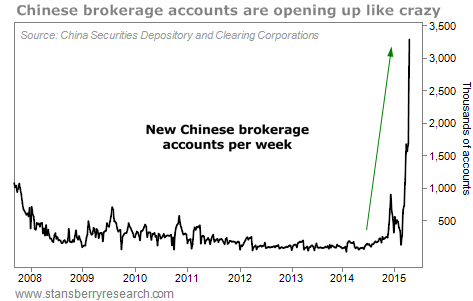 Steve concluded...
|
Steve is still long China. In particular, he likes H-shares listed in Hong Kong. In many cases, shares of the same companies trade both in Shanghai and Hong Kong. But they're much cheaper in Hong Kong right now. Steve calls it "the biggest anomaly in finance today." But we think China has larger plans than just boosting its stock market...
It's no secret that China has been challenging the U.S. for dominance in the global economic landscape. The country is buying U.S. real estate, businesses, stockpiling Treasurys... and, according to Bloomberg, it could be buying huge amounts of gold to back its currency (the yuan). And that could mean China will challenge the U.S. dollar's status as the world's reserve currency. From Bloomberg...
|
China is pushing to add the yuan to the International Monetary Fund's currency basket, known as the "Special Drawing Right." It currently includes only the U.S. dollar, euro, yen, and British pound. This would greatly increase the amount of yuan used in global trade. The IMF will meet in October to discuss the possibility. And last week, news service Reuters cited inside sources saying China was taking other steps to increase yuan convertibility. From Reuters...
|
"Once this is done, this will be a big step forward in opening China's capital account," one of Reuters' sources said. Every analyst Reuters contacted said the message was clear: China is trying to increase yuan convertibility and make its currency a major player in global finance. Steve has actually prepared an entire report about China's plans for the yuan... and why a major announcement in October could shift the global economic landscape in China's favor.
If you're on the right side of this shift, you can make huge profits. Whether you own stocks and bonds or just hold a savings account at your local bank, if Steve's thesis is correct, this will have massive implications for every American.
You can watch his free presentation right here.
Last week was a good one for tech investors...
On Friday, software giant Microsoft (MSFT) reported first-quarter revenue and earnings per share that crushed analyst expectations. Revenue rose 6% to $21.7 billion, topping expectations of $21.1 billion. Earnings clocked in at $0.61 per share, down from $0.68 per share in the first quarter of 2014, but well ahead of analyst expectations of $0.51 per share.
But arguably the biggest news from Microsoft was the company's cloud-computing division, which is on pace to generate $6.3 billion by the end of the year. Commercial cloud revenues grew 106% from the same quarter a year ago. CEO Satya Nadella noted that figure was the company's "seventh consecutive quarter of triple-digit revenue growth," adding that from the consumer side, its Office 365 service grew 35% from the previous quarter.
It was an outstanding announcement for Microsoft, which closed Friday up more than 10%. That's a huge move for a company worth nearly $400 billion. And it was Microsoft's biggest one-day jump since October 19, 2000, according to Barron's.
The cloud-computing trend made waves elsewhere in the market last week...
For the first time ever, Amazon announced the results from its cloud-computing division (Amazon Web Services, or "AWS") in its latest quarterly results.
The company's first-quarter sales rose 15% to $22.7 billion. Operating cash flow rose 47% to $7.8 billion from $5.4 billion in the same quarter of 2014.
But AWS generated $1.6 billion in the first three months of the year. And while Amazon typically announces large quarterly losses, operating income from AWS was $265 million in the quarter.
Again, Microsoft said its cloud-computing division would generate $6.3 billion by year's end... Amazon said a comparable figure for AWS is $5.2 billion. But Microsoft's number includes revenue from other online applications. Investment bank Deutsche Bank estimates Microsoft's apples to apples cloud services are one-tenth the size of Amazon's AWS.
Amazon executives expect AWS to rival the company's other businesses over time. For now, AWS is still growing 40% a year, versus 20% for Amazon as a whole.
Amazon shares screamed higher, closing Friday up more than 14%.
All of this movement toward the cloud is good news for Extreme Value World Dominator IBM (IBM).
While IBM is considered the old, stodgy tech company, its cloud products and services still generated $7.7 billion over the last 12 months. And the sector is growing at 75%, according to CFO Martin Schroeter.
As Extreme Value research analyst Mike Barrett told us via e-mail...
|
Extreme Value editor Dan Ferris plans to update subscribers on IBM's cloud-related services in tomorrow's weekly update.
Before we go today, a quick note about a special four-day live training event that Stansberry Short Report editor Jeff Clark is hosting...
Beginning Thursday, Jeff will tell you everything you need to know to improve your trading. He'll show you how to read between the lines on stock charts to recognize patterns that indicate a stock is ready to soar. He'll show you how to prepare for a potential downturn in the market... and how you could make huge profits from the event.
And he'll also share his favorite trading pattern. He has used this pattern time and time again to make a fortune for himself, his previous money-management clients, and his subscribers.
If you're an active trader, or even if you've just wanted to learn more about the topic, I urge you to sign up for Jeff's free training event. You can reserve your spot here.
New 52-week highs (as of 4/24/15): Blackstone Mortgage Trust (BXMT), CDK Global (CDK), WisdomTree Japan SmallCap Dividend Fund (DFJ), Dollar General (DG), SPDR S&P International Health Care Sector Fund (IRY), and PowerShares QQQ Fund (QQQ). In the mailbag, a question about entry prices and patience when it comes to investing. Send your thoughts to feedback@stansberryresearch.com. "Warren Buffett has famously said his holding period for quality companies is 'forever'. If I wanted to buy stock in a company (like Hershey) and hold it 'forever', is the entry cost of my initial purchase all that relevant, especially knowing that all dividends will be reinvested? Or does one patiently wait for the market price to come down, as Buffett did in buying his position in Coca Cola? What about the opportunity cost of NOT owning a capital efficient company like Hershey, even though the initial cost is higher?" – Paid-up subscriber James Fikes
Bryan Beach comment: It's true that the longer you intend to hold a position, the less important entry price is.
When we recommended Sears Holdings back in December, we expected to be out of the trade within six months. Getting the right entry price was critical. But with a company like Hershey, we didn't need to agonize over the stock chart before we bought. We knew it was a long-term investment that was trading at a fair price. We almost never check the share price because we know it's a great investment and we don't plan on selling.
The next time a stock you're watching goes up a few percent, think about the following example... Back on November 14, 1997, you could have bought 180 shares of Hershey for $5,000 (adjusted for splits). Today, that investment would be worth around $48,000, assuming you reinvested the dividends (which we always recommend).
But here's something to think about... In the five trading sessions that followed, Hershey's share price surged 11%. Just a week later, $5,000 would only have bought you 160 shares. Potential investors would have thought that they "missed the boat." But even after that run-up in price, buying five days later and reinvesting your dividends would have turned $5,000 into $43,000.
Sure, the returns are lower. But even in the second instance, you still beat the market. Having said that, we don't recommend buying great companies at any price. You can't completely ignore your entry price. Today, we're sitting on a 169% gain in Hershey. It's too expensive for investors to buy shares today, so we rate it a "hold" in the Stansberry's Investment Advisory portfolio.
Regards,
Sean Goldsmith
Baltimore, Maryland
April 27, 2015
