Could we see the euro below $1?... Greece is calling the EU's bluff... Goldman and Deutsche Bank are bearish... Why a certain type of fertilizer will soar in price... What Putin's disappearance could mean for Russia... Why Steve Sjuggerud is bullish on Europe...

How low will the euro fall? That's the question grabbing headlines today.
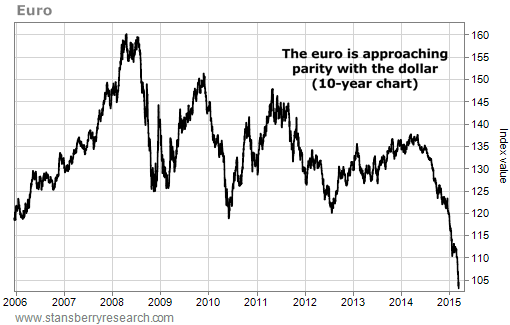
Today, the euro trades at $1.058 versus the U.S. dollar and is likely headed lower from here. But before we get into price predictions, Stansberry Research analyst Paul Mampilly sent us this note on why the euro is weakening...
|
The truth is out. The Greece bailout is a sham. Everyone knows it. You see, the game is that you're supposed to wink, nod, and pretend. But Greek Finance Minister Yanis Varoufakis is not playing the game. He's going for broke. That means the European Union (EU) will bail out Greece... It will forgive lots of debt, then put together a long-term plan to repair the Greek economy (which will cost even more money).
|
|
Last week – on the same day that "eurozone" finance ministers met in Brussels to discuss Greece's bailout – a German public television channel aired a documentary about the Greek debt crisis, featuring insight from Varoufakis. As he explained (according to an English translation of his comments)...
|
Clever people in Brussels, in Frankfurt, and in Berlin knew back in May 2010 that Greece would never pay back its debts. But they acted as if Greece wasn't bankrupt, as if it just didn't have enough liquid funds. In this position, to give the most bankrupt of any state the biggest credit in history, like third-class corrupt bankers, was a crime against humanity.
|
|
Paul went on to explain that the EU is stuck between a rock and a hard place... and Varoufakis knows it...
|
If they let Greece go, and make it exit the eurozone, all of the European banks that own euro-denominated Greek debt are in trouble. The old game of "lending" money to Greece to prop up the price of the country's debt on the books of German/European banks is no longer an option, because Varoufakis is calling the EU's bluff. This game of propping up the banks required someone in Greece to keep agreeing to it. But Varoufakis won't play that game.
If the EU wants to keep Greece, it will have to give Varoufakis and Greece what they are asking for: a cheaper euro, more flexibility to allow its economy to grow, debt forgiveness on the old bailouts and debts, and economic stimulus of some sort to jumpstart the economy.
|
|
The euro hit a high of nearly $1.60 against the dollar back in April 2008. Today, it's trading for less than $1.06 – a fall of 34%. And it's likely heading lower... Once Greece gets its deal, Spain, Portugal, Italy, and France will all want the same thing.
Paul thinks the euro could fall to $0.80 against the dollar, all the way back to where it was in 2000... or maybe even lower than that...
Investment bank Goldman Sachs said the euro could reach parity with the dollar in six months. (Goldman previously said we wouldn't reach parity until late 2016.) And it thinks the euro could fall as low as $0.80 by late 2017. From a recent research note...
|
We think this price action bears out one important thing we have been emphasizing, which is that – especially when controlling for the divergent paths of growth and monetary policy – short EUR/$ positioning just isn't stretched. If anything, it seems to us that the market continues to play catch-up with the strong dollar theme.
|
|
Likewise, Deutsche Bank lowered its euro forecast. The European banking giant said the euro would weaken to $0.85 by 2017. As analyst George Saravelos wrote...
|
European outflows have been even bigger than our initial expectations over the last six months. We now foresee a move down [for the euro] to $1.00 by the end of the year and a new cycle low of $0.85 by 2017.
|
|
While the stronger dollar weighs on many U.S. firms, it's a boon for certain foreign firms.
Stansberry International editor E.B. Tucker recently recommended a Polish fertilizer firm that produces its goods in Europe, meaning its costs are based in euros. It sells its goods and receives dollars... so its profits are even larger than normal right now.
But before we tell you about the company, a little background on fertilizer...
The markets continue to wait for news of what contract price China and India will pay for standard fertilizer (called muriate of potash, or "MOP") for this year's upcoming planting season. Usually, these contracts are worked out in January or February. But as of today, China hasn't finalized a deal.
China and India want to pay $305 a ton. Producers want to be paid $335 a ton. China and India can't develop potash mines. But their large populations require productive land... so they need lots of fertilizer. So it's a question of who will blink first.
No matter how the contracts are worked out this year, the world's changing demographics, increased population, and higher protein intake ultimately require more yield on less land... and that's only possible with more fertilizer.
In particular, one type of fertilizer is seeing greater demand than production capability already – specialty fertilizers like sulfate of potash (or "SOP"). SOP is a chloride-free fertilizer and is good for cultivation of crops like fruits, nuts, vegetables, potatoes, and tobacco.
Global production of SOP is about 10% of the global potash market. It amounts to nearly 6 million tons annually. But demand may be as high as 12 million tons, according to Potash Ridge Corp. President and CEO Guy Bentinck. "You can take all the SOP projects on the drawing board and it won't make a dent in that demand-supply deficit," Bentinck said.
International fertilizer giant Yara has said that SOP is hard to find. It's investing $1 billion in a future project and will likely look for more opportunities. Shares of the industry bellwether are up 50% in the last eight months.
Last month, E.B. and the
Stansberry International team uncovered a German company profitably producing specialty potash. The company, K+S, reported earnings last week that blew away expectations. Shares jumped 10% on the news. The company also improved its 2015 forecasts.
The great results are due to the fact that K+S produces a type of potash in high demand at a time when supplies aren't growing. The larger part of the potash market (MOP), has been down for nearly three years since a price-fixing partnership blew up. As E.B. explained in the February issue...
|
If you bought the best potash company in 2011, you still lost money. The price per ton was too high. It was a market extreme.
Today, four years later, the world still needs potash. The global population has grown by several hundred million during this time causing potash demand to rise. The BPC price-fixing partnership has disbanded and other producers have been badly damaged. Uralkali's Solikamsk-2 mine collapsed last November, pulling more than 3% of annual potash supply off the market. We've been told this supply will not return.
|
|
I asked E.B. to explain his strategy in
Stansberry International... and to tell us what he sees as opportunities in the future. Here's what he had to say...
|
The future is simple. The dollar is growing stronger every day. Everyone seems to have forgotten that the U.S. is only 25% of the world's GDP and isn't really growing. That means it's a great time to take those dollars of bloated value and exchange them for the best companies in the world.
We're buying the world's best companies at attractive prices. On Wednesday, we're publishing the March issue. We traveled to an EU country and we're recommending a company that makes a product that society has been consuming for 800 years... ever since this firm invented it.
The company has dominant market share and the stock has sold off, giving investors a great opportunity today. The company doesn't need to change the world... It just needs to keep doing what it has done so well for the last decade. And after visiting its headquarters, we think that's likely.
Every month, we go wherever we need to in an effort to find the best businesses in the other 75% of the world's commerce. And when those companies go on sale, we buy.
|
|
Sticking with today's international theme,
Global Contrarian editor Kim Iskyan sent us a note this morning about the unusual disappearance of Russian President Vladimir Putin. Putin disappeared from the public eye for an entire week before reappearing today. That spurred Kim to send along a note about a contrarian indicator in foreign markets...
|
In the next issue of Global Contrarian – due out March 23 – I discuss one of my favorite ways of looking for contrarian opportunities around the world through the lens of politics: Finding countries and markets where the unexpected departure of a key person in power (including death) could be a catalyst for asset revaluation. I call this the "Death Watch."
I'm giving you a preview of Death Watch because of Putin's recent disappearance. Until today, he hadn't been seen in public in more than a week. There was a lot of speculation that he might be ill or dead.
Unlike many other countries, what happens when a leader passes away in Russia isn't clear-cut. Constitutionally, the prime minister is supposed to take over and hold presidential elections within three months. But in practice, anything could happen in Russia... a lot of political figures could make a play for power. The possible outcomes are vast.
|
|
Given the concentration of power in Russia's government, Kim explained that Putin's absence had severe potential implications...
|
Putin (and the Russian presidency) personally holds a great deal of power. The notion of checks and balances of power between different arms of the government doesn't exist in Russia. And given Russia's size, geopolitical importance, and nuclear capabilities, what happens next matters.
It was unlikely that Russia's leader had passed away. Putin is 62 years old and apparently in good health. But given the uncertainty surrounding his recent disappearance, it makes sense to speculate on what his death would mean for Russia, for asset prices, and for the country's stock market.
|
|
Kim explained that it's morbid to anticipate a death and to try to gauge its effect on the market. But as his Global Contrarian subscribers know, one of his favorite key ingredients in an out-of-favor market is a potential catalyst for change that hasn't been widely acknowledged in the market...
|
In some markets – especially those where an authoritarian leader holds a lot of power – death can be a big driver of asset prices. So I'm willing to toe the line of bad taste if it means possibly finding a great contrarian opportunity. And markets hate uncertainty. In the absence of facts, investors often tend to assume the worst and sell. That suggests that, in the short term, any additional evidence that Putin was gone would probably have caused the Russian stock market to drop.
|
|
And while you might think that the end of Putin – a controversial and dangerous figure – would boost Russia's stock market, Kim explains that may not be the case, since we don't know who would replace him...
|
Foreign investors in Russia (and non-Russians in general) don't like Putin. They think he's corrupt, power hungry, and bent on conflict with the West. So you might think that Putin leaving the scene would be perceived as a good thing. But that would only be the case if there were a better alternative.
Russian stocks currently trade at a big discount to other emerging markets. Part of that is due to political risk and Putin's unpredictability. But the political opposition in Russia is extremely weak. There's no white knight ready to "save" Russia.
The uncertainty over what would come next in Russia could result in a sharper decline in the country's stock market following the initial shock. That uncertainty could affect sentiment in a lot of other markets. Given shaky market sentiment around the world now, it might not take much to trigger a broader correction... and the world's second-largest nuclear power suddenly being without a rudder might be enough.
|
|
While we're avoiding Russia for now, there are huge opportunities to profit in Europe today. As we explained in the
March 4 Digest, Steve Sjuggerud is super-bullish on Europe.
He believes European stocks will soar as European Central Bank President Mario Draghi carries out quantitative easing. And the eurozone's
low (and in many cases,
negative) interest rates make its equities even more attractive. As we wrote...
|
European stocks pay dividends of 3.9% today. Meanwhile, European government bonds pay next-to-nothing. German 10-year government bonds, for example, pay 0.38% interest.
The last time we saw a similar imbalance was in 2008. It was the first time German stocks yielded more than German bonds in 50 years. And German stocks doubled in two years after bottoming in 2009.
Importantly, today's setup is even more extreme than what we saw in 2008-2009. The difference between German stocks and bonds is massive. And it's not just Germany... We have this extreme setup across Europe. In Switzerland, the 10-year bond pays 0.02%, while the dividend yield in the Swiss stock market is 3.1%.
|
|
Steve believes his favorite way to play European stocks has 50% upside from here. Plus, you can collect a nearly 4% annual dividend along the way.
To access the latest issue of
True Wealth – where you'll learn the best way to buy European equities – you need a subscription to
True Wealth. Right now, you can get a full year of Steve's research for just $39. And if after four months you decide it's not for you, we'll give you a 100% refund.
You can learn more here.
New 52-week highs (as of 3/13/15): Bristol-Myers Squibb (BMY), Cempra (CEMP), Dollar General (DG), and Esperion Therapeutics (ESPR).
In the mailbag... a subscriber thanks Porter and the
Stansberry's Investment Advisory research team for leading him to some big gains. What's on your mind lately? Send your thoughts to
feedback@stansberryresearch.com.
"To Porter, David, & all @ Stansberry, a quick note that I'd thought you would get a kick out of. I followed Porter & David's guidance on Bristol back in October & it now is my largest holding in both my IRA rollover (over 800 shares) & personal savings account (245 shares). I am up between 8 & 33 percent on all of my positions. And my largest purchases were when you initially recommended it!! Having scored on Lorillard & Cubist (over $22K gain!!), I am most grateful for your publications.
"But here is the 'kicker' that I think you will roar over. My accounts are with Schwab. I trade online without any brokers. Would you believe that Schwab STILL grades Bristol a 'D'?? This ridiculous grading as of today is broken down as follows:
Valuation: C
Risk: C
Fundamentals: F
Momentum: F
"I find Schwab's grading of this stock stunningly stupid given their current and upcoming successes. Best wishes & continued thanks for your guidance." – Paid-up subscriber Bob Parker
Regards,
Sean Goldsmith
March 16, 2015