

Don't Expect Last Year's Tranquility to Return
The value of 'common sense' technical analysis… This chart confirms one of the biggest trends in the world today… 'If you're not profiting already, get on board'… Don't expect last year's tranquility to return… Prepare for more volatility…
 The use of price charts is among the most polarizing topics in the world of investing...
At one extreme, you have folks who consider chart reading (or "technical analysis") to be a waste of time... a pseudoscience little better than astrology or fortune-telling. At the other extreme are those who base their buying and selling decisions exclusively on price charts.
If you've been with us for long, you know we think both of those views are off-base.
We believe deep, "bottom up" fundamental research is the cornerstone of long-term investment success. However, we also believe investors and traders alike can benefit from a basic understanding of price action.
Our colleague Ben Morris agrees...
Ben frequently uses both fundamental research and "common sense" technical analysis in his excellent DailyWealth Trader advisory. As he recently explained to subscribers...
Every day, people shift money between assets. And their collective actions move the markets.
Just like a slap in the face can tell you someone didn't like what you said, price action on a chart can tell you what these money movers think about an asset.
If you look at charts this way – as a window into investor psychology – you can find information that helps you make more informed trading decisions.
And right now, Ben says price action is confirming one of his highest-conviction ideas. More from the issue...
If you've turned on or read the news in the past few years, you know that protecting digital information is a big, growing trend. Governments, businesses, and individuals face constant threats to their digital information... And they're spending money to protect it.
As a result, lots of cybersecurity companies are growing their annual sales at double-digit rates. And as you can see in the chart of the ISE Cyber Security Index, share prices are rising...
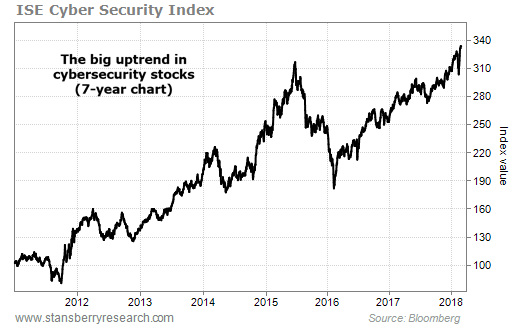
Ben recommended his favorite cybersecurity fund to DailyWealth Trader subscribers in 2016...
And the chart above shows he's clearly on the right side of this long-term trend. But Ben says this chart also offers a valuable look at what investors are thinking about these stocks today...
From January 26 to February 8, the benchmark S&P 500 Index dropped 10.2%. Most stocks haven't fully recovered. They're still trading below their January 26 highs. And it's hard to find a single group of stocks that has hit new highs... except for cybersecurity stocks.
The S&P 500 still trades more than 5% below its January 26 all-time high. And of the 11 major stock market sectors, the best performer – information technology – is still 3% below its recent all-time high.
But... cybersecurity stocks recovered extremely quickly. [This fund] hit a new all-time high last Friday. And it still trades near that record level.
In other words, after the worst sell-off in years, investors are clearly still nervous about most other sectors...
But they rushed back into cybersecurity stocks. The following short-term chart shows these moves more clearly...

As Ben explained, this is valuable information...
The new high tells us that cybersecurity stocks are one of the most attractive groups of stocks in U.S. markets today.
Hackers aren't going away. And neither is the big trend in cybersecurity... If you're not profiting already, get on board.
DailyWealth Trader subscribers who took Ben's advice are already up as much as 25% so far. But he believes there's plenty of upside ahead, and still rates this opportunity a strong "buy" today.
Interested Digest readers can get instant access to Ben's favorite cybersecurity recommendation with a 100% risk-free trial to DailyWealth Trader. Click here to learn more.
Speaking of the recent correction, regular readers know we believe it to be just that...
A correction in an ongoing bull market, rather than the start of a more serious bear market decline.
Why? Because virtually all of the important long-term indicators we follow – including the Treasury yield spread, Steve Sjuggerud's market "vital signs," and Dr. David "Doc" Eifrig's measures of economic health – continue to give the "all clear" today.
Of course, the market offers no guarantees, which is why we continue to stress the importance of proper risk management... Just in case. For now, we expect the "Melt Up" to continue.
But that doesn't mean you should expect last year's market tranquility to return...
As Steve noted last month, during the last market Melt Up in the late 1990s, the tech-heavy Nasdaq suffered five different corrections in 1999 alone. And history suggests we could see a similar trend this time around.
You see, the Treasury yield spread we mentioned earlier isn't just a reliable indicator of an impending bear market. As the following chart illustrates, it has also been a good "leading" indicator of stock market volatility over the past few decades...

The chart is a bit technical, so bear with us, and let us explain...
The dark blue line is the spread between two- and 10-year interest rates. It has been flipped upside down – so that the line moves higher as the spread moves lower toward zero – and has been pushed forward by three years. The light blue line is simply stock market volatility, as tracked by the CBOE Volatility Index ("VIX").
The relationship isn't perfect, but you can see that the large spikes in the dark blue line tend to line up with the big spikes in the light blue line over the past 30 years. What this means is a big decrease in the yield spread tends to be followed by a big increase in volatility roughly three years later.
As you can see, the "2-10" spread has been falling (moving higher on this chart) for the past several years. Last month, the VIX finally turned higher.
If the chart is correct, volatility could move significantly higher over the next couple years.
New 52-week highs (as of 3/2/18): Grubhub (GRUB).
In today's mailbag, several subscribers weigh in on Porter's controversial Friday Digest. What did you think? Let us know at feedback@stansberryresearch.com.
"Porter, I was an original Alliance subscriber. I believed in you. Thanks for your efforts! My $5k investment in you has more than paid off. It sounds like you are enjoying your success and I'm very happy for that. Your essay today about BRK was perhaps your best ever. Nice work! That took some guts. I've been thinking the same. Hope to meet someday." – Paid-up subscriber Jason Wells
"One of the most interesting articles I have ever read. It is why I am such a fan of Stansberry Research. No punches were pulled. Just the facts. Too many people will have a knee jerk reaction to this article. I for one am out of there. Thank you. If I were you I wouldn't take a vacation in Omaha in the near future." – Paid-up subscriber Jim McWilliams
"Porter, et al., Thank you for the succinct, insightful view of Berkshire Hathaway's plight. For a number of years I've anecdotally believed something was awry with BRK or Mr. Buffett. Having neither resources, nor time, nor sufficient curiosity, nor sufficient incentive to look deeper into it, I went no further. Your breakdown of the breakdown is spot on. So what now? Should BRK holders be running for the exits? Thanks for all you do, for the lumps you take from (and sometimes dish out to!) us out here in email-land, and for the info you provide." – Paid-up subscriber Andrew K.
"Porter – Thank you for another excellent Friday Digest (Buffett/Berkshire). I hope people understand the value of this kind of analysis, and that it was available – for free! Seriously – Who does this? I'm so happy to be an Alliance Member I could spit. And where I grew up that is a big compliment. Keep up the great work!" – Paid-up subscriber Paul H.
"Porter, I read your article on Buffet and Berkshire Hathaway. I think you are spot on that he has moved from his successful model to playing master of the universe. Moving from capital efficient, dividend paying companies to really big plays that are strategic (which really means you have no clue what you are doing and to justify your actions that it is 'strategic') is not going to play out very well over time.
"I do not agree with you on one topic though. Buffet is not a business man he is a financial leader. He did not make the decisions to make any business grow or be successful – he bought into [a] team that did all of that messy work. So please correct your article as we business people want him associated with the financial guys! He is in your club, not ours. I enjoy your point of view so please keep up the good work." – Paid-up subscriber Kurt Swogger
"Porter, your post on Buffett was absolutely fascinating. I assume you've sent him a copy and I very much hope he replies and that you share the reply with us if he does. Also suggest you send a copy to Bloomberg, CNBC, WSJ, etc. Bound to get you requests for interviews or TV appearances and that's always good for business. Maybe Scott Wapner will invite you and Mr. B. on to face each other, same as the Big Face Off between Ackman and Icahn. That was great tv." – Paid-up subscriber Jeff Dodge
Regards,
Justin Brill
Baltimore, Maryland
March 5, 2018