

'Every Stansberry Research Reader Should Put Some Money in This Idea'
'Every Stansberry Research reader should put some money in this idea'... The Fed throws a curveball... An unusual fact about the recent selloff... The biggest drop in oil supplies since 1999... All you really need to know about the oil market today... This 'special situation' for income investors ends soon... An invitation from The Atlas 400...
 We begin today's Digest with a reminder...
Tomorrow night at 8 p.m. Eastern time, our colleague Steve Sjuggerud will unveil his latest "fat pitch" investment opportunity.
If you're not familiar, this is Steve's name for opportunities that are obvious "home runs."
As longtime subscribers likely know, these ideas are relatively rare. In fact, Steve has only found three other "fat pitches" over the past 10 years...
The first was in U.S. stocks following the financial crisis in 2008-2009. Steve went "all in" on stocks at the time. He even took out a home-equity loan to buy more. As you can guess, he did extremely well.
The second was in 2011, when Steve declared the housing bubble was "completely over." He said houses in America were the greatest value they had been in generations, and he personally loaded up on real estate. Again, it was a fantastic call.
And the third was late last year, when Steve recommended cheap, hated gold stocks. If you've been following the markets at all this year, we don't have to tell you how well that call has gone.
Today, Steve says he has found his next "fat pitch"...
In this case, it's a once-in-a-lifetime way to invest in some of the world's fastest-growing technologies. Steve says it's like having a "second chance" to invest in revolutionary companies like Apple, Google, Amazon, and Facebook... before they became household names... and before their share prices soared.
Steve expects this idea could lead to 500% to 1,000% gains over the next several years... And he's urging every Stansberry Research reader to put just a little money in this idea as soon as possible.
In fact, to make it as easy as possible for you to do that, Steve will be releasing one of these stock recommendations – including its name and ticker symbol – LIVE on the air tomorrow night.
It's one of the fastest-growing companies with one of the most addictive products in the world (though most Americans have never even heard of it). Again, you can learn all about this company – with no obligation – simply by attending tomorrow night's FREE webinar.
Click here to reserve your spot now.
Regular readers know even "dovish" Federal Reserve officials – those in favor of "easier" monetary policy – have recently been speaking out in favor of higher interest rates. Given this trend, many believed Fed Governor Lael Brainard was likely to join the rate-hike chorus in her scheduled speech on Monday...
That was not the case.
As we mentioned yesterday, Brainard is one of the biggest "doves" at the Fed. Had she, too, endorsed higher rates, it would've been the strongest sign yet that the Fed is preparing to move again.
Instead, Brainard said the Fed should be in no hurry to raise rates again. In a speech at the Chicago Council on Global Affairs, she noted that leaving rates unchanged since December "has served us well in recent months, helping to support continued gains in employment and progress on inflation."
Now, cynics may point out that Brainard is reportedly on the short list for Treasury Secretary should Hillary Clinton become the next president. So she may have a vested interest in this position. But she was not alone in speaking out against higher rates yesterday...
Federal Reserve Bank of Atlanta President Dennis Lockhart said in a separate speech that conditions warrant a "serious discussion" of a rate hike at the Fed's meeting next week, but he emphasized that there is no urgency to do so.
And in an interview with financial-news network CNBC, Minneapolis Fed President Neel Kashkari echoed Lockhart's comments, noting, "There doesn't appear to be huge urgency to do anything, frankly."
Following yesterday's remarks, the odds of a rate hike – as measured by the CME's FedWatch Tool – dropped from about 25% to just 15%. And barring any unforeseen developments, we won't get any additional clues before next Wednesday's decision. Yesterday's appearances were the last scheduled remarks by any Fed officials before its September meeting.
According to Wall Street Journal reporter Jon Hilsenrath – long considered to the Fed's unofficial "mouthpiece" – the Fed is now leaning toward keeping rates unchanged for at least another month.
Again, regardless of any short-term hikes, we continue to believe the Fed will reverse course when the next panic begins. This is what they've always done... and to do differently now would only hasten the crisis they've been trying to delay for years.
In other news, we came across an interesting fact about the recent market selloff. It's yet another sign that central banks have warped markets in dangerous ways. In short, we haven't seen the usual flight to safety. Instead, so-called "defensive" sectors have led the selloff. For example, on Friday, utility and telecom stocks fell 3.8% and 3.4%, respectively, compared with a 2.5% decline for the S&P 500 Index.
Why? It may have to do with the "reach for yield" we've discussed many times in the Digest. As the Journal reported last night...
Low rates and bond buying by the Fed and other central banks pushed investors to take more risk, and many did that by shifting from bonds to bondlike stocks, those with steady dividends and reliable cash flow. When bond yields go up, those shares look less attractive and prices fall.
This is exactly what happened on Friday, and partially reversed on Monday... Far from protecting investors in a selloff, in this weird world the "defensives" offered no defense. A solid cash flow is of little use if investors no longer want bond proxies.
In other words, when the credit cycle turns, it may not be bonds alone that get crushed. Other expensive income investments – whose prices have soared as investors have rushed to whatever yield they can find – could be at risk, too.
Last week, U.S. oil supplies dropped by an incredible 14.5 million barrels...
That's the biggest weekly drop in crude supply since 1999, and the second-biggest decline on record in weekly data going back to 1982, according to the U.S. Energy Information Administration.
The Wall Street Journal reports that traders were expecting a 500,000-barrel increase in crude oil stockpiles.
However, analysts at investment bank Morgan Stanley note that it can account for 16 million barrels of "lost" U.S. inventory held at sea due to bad weather in the Gulf of Mexico.
We reached out to our colleague and natural-resource expert Matt Badiali, editor of Stansberry Resource Report, for his take on the number...
The U.S. supply decline is short-term noise. That's a combination of the hurricane we just had interfering with production and imports, combined with record gasoline demand this summer. It will be a short-term bump at most.
Oil has traded between $40 and $50 per barrel for more than six months now.
According to the Journal, prices above that range mean that U.S. shale producers will boost output... while prices below lead to spending cuts and a drop in supply.
Oil-services firm Baker Hughes' rig-count survey shows that rigs have increased 10 times in the past 11 weeks – climbing from a multiyear low of 404 in May to 508 rigs at the end of last week. That's a 25%-plus increase in just the last few months...
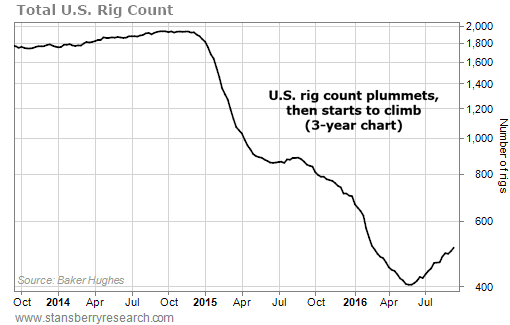
Of course, there are still about 40% fewer rigs in operation compared with this time last year. Matt has called it a "bad to less bad" rally in the oil patch, but he doesn't expect this low-volatility environment to last...
Last week, Iran declared it would increase its oil output to pre-sanctions levels within three months. As one CNBC reporter put it, "Here's all you really need to know if you're trying to figure out the oil market: Iran and Saudi Arabia are at war. Everything else is secondary."
Matt agrees. As he wrote us in a private note this morning...
The global oil story is still Iran. There is a balancing act in the works... It's a combination of Saudi Arabia, Russia, and Iran all pumping at max capacity, while "talking" about freezing increases. At the same time, you have actual production declines in the U.S., Nigeria, the North Sea, etc., that are taking oil off the market.
That's really what the strategy is... Hold prices around $50 per barrel – give or take $10 or so – to snuff out the expensive production.
The news from Iran came just days after another reported deal between Russia and Saudi Arabia to cooperate in stabilizing global oil markets. Iran says it won't cap production until it hits at least 4 million barrels per day.
This isn't the first time that Iran has ruined the "oil stabilization" party. According to Fortune magazine...
Attempts by the Organization of the Petroleum Exporting Countries ("OPEC") and non-OPEC oil exporters to reach a pact on stabilizing output levels earlier this year foundered because Iran, which is anxious to increase exports after the lifting of international sanctions, declined to participate.
Tehran's aggressive moves to recoup market share that was lost under international sanctions targeting its nuclear program has paid off in Asia, where its four biggest buyers raised their imports by 61% in July versus a year ago.
And as Matt relayed in the August 29 issue of our free Growth Stock Wire e-letter...
We've seen this story play out twice already this year... back in February, when Saudi Arabia first announced talks of a production freeze... and again in April, when the OPEC countries met in Qatar and came away with nothing.
The same thing will happen this time because of one key factor: Iran is still a member of OPEC. As we've told you before, the relationship between Saudi Arabia and Iran is terrible, and Iran isn't about to agree to restrict oil production right now after 35 years of sanctions.
Oil prices are going to move like this for the next few months. We're in for a rough ride. Until Saudi Arabia, Russia, Iran, and the rest of OPEC quit flooding the market with oil, volatility is here to stay.
Switching gears, your chance to take advantage of a "special situation" in one of the best income-producing sectors is ending soon.
As we discussed last week in the September 7 Digest, two of the biggest market index companies – S&P 500 Dow Jones Indices and MSCI – are breaking real estate investment trusts (or "REITs") out of the "financial" industry and into their own category. This means any funds that track those indexes must align their holdings with this change.
Again, according to research from JPMorgan, big funds only have about 2.3% of their holdings in real estate. But their benchmark is 4.4%. This means they'll need to nearly double their real estate holdings, beginning on September 16... And according to JPMorgan this move could grow the entire U.S. REIT market by a huge 12%.
Unlike some of the more expensive income sectors we mentioned earlier, investors haven't piled into REITs yet. Doc says the sector is trading at the low end of the range its traded in for the past several years. Better yet, last week's broad-market decline means you can get exposure today at some of the best prices in months.
Doc says this is one of the single-best "special situation" investments he has come across in his career at Stansberry Research. He recommends that you get your money there first, if you haven't already.
But remember... all REITs are NOT created equal. Doc says that four REIT opportunities in particular are especially attractive today.
He has put everything investors need to know to profit from this situation in a special report for Income Intelligence subscribers. Click here for the details... including how you can become an Income Intelligence subscriber for a fraction of the normal subscription cost.
Finally, we'll close today's Digest with a note from Gray Zurbruegg, director of The Atlas 400.
As you'll see below, he has a special announcement for subscribers who will be joining us in Las Vegas next week for the 2016 Stansberry Conference & Alliance Meeting at the Aria Resort and Casino. Here's Gray...
Interested in The Atlas 400? Want to travel the world with interesting people, doing extraordinary things? Would you like to meet and speak with 25 of our current members?
If so, your chance is just around the corner.
But before I (Gray) tell you how you can meet our current members without spending a dollar, let me tell you a little bit more about The Atlas 400.
A group of us recently returned from a trip to Kennebunkport, Maine. The period after a trip is always a great time for reflection.
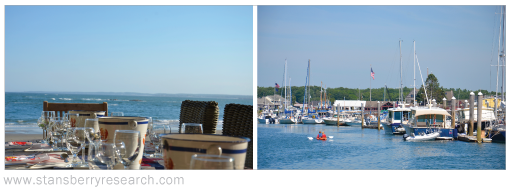
My takeaway from Kennebunkport is that this club is all about people – our members.
It never ceases to amaze me how folks come together on these adventures. New members, old members, friends, and family... everyone gets along. But it's more than that. They form real bonds.
Our latest trip confirmed for me what The Atlas 400 really is: a place that unites individuals who share common characteristics, despite coming from different backgrounds and experiences...
We want members to understand that real meaning is found in contribution and personal achievement... not in the balance of your bank account or the title on your business card.
If what I've just talked about intrigues you... Please join us for a cocktail reception at Lift Bar in the Aria Resort and Casino, following the Stansberry Conference on Tuesday, September 20.
But please, only come if you're seriously interested in membership.
There's a substantial initiation fee to join ($30,000), and our excursions aren't cheap. But if you're at a point in your life where meaning is paramount and you're in a position to enjoy the fruits of your labor, then we look forward to meeting you.
If you would like to join us for a cocktail, please e-mail me or call me directly at (410) 864-0878.
New 52-week highs (as of 9/12/16): Black Stone Minerals (BSM).
In today's mailbag, a question about junk bonds... and a subscriber tells us how he's doing on his one-year Stansberry Alliance "anniversary." Send your notes to feedback@stansberryresearch.com.
"In your 8/26/16 Digest (which was the end installment about investing in bonds) if I didn't miss something sounded like the good idea was to invest smaller amounts in several different (Junk Bonds)? In your 9/9/16 Digest, again if I didn't miss something, was leading me to believe that (Junk Bonds) was a bad idea. These two ideas sounded to me to be very contradictory. What did I miss here?" – Paid-up subscriber Dave
Brill comment: Dave, as Porter explained in his distressed-bond series, the important distinction is which bonds you buy. Most high-yield (or "junk") bonds are called junk for a reason. Folks who own most of these bonds – or worse, junk-bond funds – could lose their shirts.
The key to profiting from distressed bonds is finding "the needles in the haystack" – junk bonds that are mispriced relative to their chance of default. Remember, bonds are binary... They will either pay you in full and on time or they won't. You want to buy those relatively rare bonds that are most likely to pay you back... but are priced as though they won't. That's exactly what our Stansberry's Credit Opportunities service is designed to help you do.
"It's amazing how much difference a year can make. About this time last year I became a Stansberry Alliance member, after having initially subscribed to Retirement Trader. Earlier this year I took Porter's challenge and became a lifetime TradeStops subscriber. Before those decisions, I was a trading maniac. In and out of trades, a classic yield chaser. Fidelity loved me. Lost my tail on outsized MLP and oil positions. My portfolio was a mishmash of stocks and CEF's du jour.
"Today, I'm primarily in Stansberry recommended gold and silver stocks, Stansberry's Credit Opportunity bonds, and Stansberry recommended muni bond funds, all of these positions properly sized by TradeStops and covered with trailing stops. I'm also sitting on almost 50% cash and have some physical gold and silver as insurance that I purchased through one of your recommended sources. Two years ago there's no way I could have had the discipline to sit back and wait for the market to come to me. Thanks Stansberry, you've made my retirement much, much less stressful." – Paid-up subscriber John D.
Regards,
Justin Brill
Baltimore, Maryland
September 13, 2016
|