
Greece is kicking the can... Global markets rise... Stocks are actually cheap... Banks own $2.1 trillion of government debt... And why that's bullish... Two more central banks cut rates... The dollar is toppy... Gold should soar...
 Global markets are up today after the European currency union (or "eurozone") agreed on Friday to extend Greece's bailout for four months, assuming Greece draws up a list of reforms by Monday. Greece said it would send its list by day's end.
Japan's benchmark Nikkei 225 stock index hit a 15-year high today. The UK's FTSE 100 hit a 15-year high of 6,939.89. The S&P 500 hit a record high on Friday and is hovering around there today.
The Greek saga has been long running. But it's not in anybody's interest to let Greece fail. Despite record-high stock prices, the economy is still fragile. And we can't risk another "Lehman moment," where a major default sets off a systemic debt implosion.
Greece's new deal is a four-month Band-Aid. The country still has to address the fact it has $366 billion of debt (175% of GDP) it can never repay. Eventually, the eurozone will likely agree to a haircut. But for now, the political posturing continues.
In the latest issue of True Wealth, editor Steve Sjuggerud gave one reason U.S. stocks aren't as expensive as most people believe today. He pointed out a fallacy in the often-used cyclically adjusted price-to-earnings (or "CAPE") ratio. From the issue...
|
 There's another reason we could see stock prices head higher: Despite a record-high stock market, U.S. banks are still sitting on a record amount of cash. In particular, they're buying up loads of Treasurys and related, government debt, according to Bloomberg.
Part of the reason is that banks are required to hold more high-quality, liquid assets on their balance sheets to protect from a downturn. But it also reflects low loan demand from borrowers. Today, it seems, the U.S. consumer isn't willing to take on as much debt (for now, at least).
So instead of parking cash at the Federal Reserve, where banks earn 0.25%, they're buying Treasurys instead. The five-year Treasury yields around 1.57% today.
If you have a savings account, you know the interest you're collecting is essentially zero... So banks are making a big spread taking your deposits and buying Treasurys. Bank of America, for example, is making 1.44%. That's above the average over the last decade, according to Bloomberg.
U.S. commercial banks have added to their Treasury position for 16 straight months – the longest streak since 2003. They now hold $2.1 trillion in Treasurys and other agency debt, the most since Fed data started in 1973. As we noted above, part of the reason is loan demand simply isn't there. From Bloomberg...
|
Rest assured that eventually, the U.S. consumer will want debt again. They'll want bigger houses, new cars, TVs, and everything else. And when that money is loaned out, it will act like rocket fuel for the economy and the stock market.
We've written a lot about gold this year. The precious metal is stealing headlines as global central banks race to destroy their currencies. Record-low interest rates around the world make gold a wonderful alternative currency. As we've noted many times, gold pays no interest. So it's more attractive when government paper has zero (or negative) yields.
One interesting point we noticed is that gold was advancing in lockstep with the U.S. dollar. The markets view gold as the "anti-dollar," so seeing the two assets rise together is unusual.
Still, we noted that the dollar was one of the most popular trades in the world.
When that money leaves the dollar, where is it going to go? Remember, almost every central bank is cutting rates to weaken its currency. The dollar was the last bastion of safety. As you can see from the chart below, the dollar has skyrocketed...
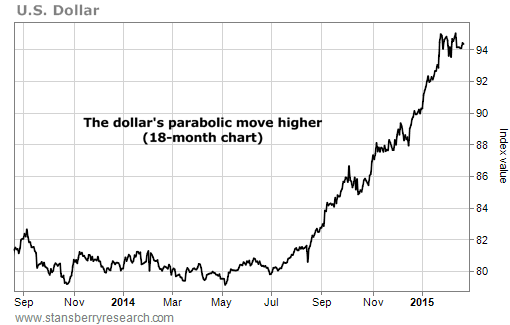 In a recent note to clients, wealth-management firm Gluskin Sheff's David Rosenberg echoed our beliefs of an overbought dollar...
|
Rosenberg also asked what happens if some of these speculators simply take profits. Steve Sjuggerud says the dollar has peaked.
And when money does start to leave the dollar, we think a lot of that capital will flow into gold. Again, gold is more attractive than parking money in negative-interest-rate German and Swiss government bonds.
Steve believes gold rising against most major currencies is a major bullish signal for the precious metal. In the latest issue of True Wealth Systems, Steve noted that gold was the best-performing currency of the past three months... It rose 8% versus just 7.5% for the U.S. dollar index. He wrote...
|
Steve also pointed out another major bullish indicator was flashing "buy" for gold. Historically, when these two indicators both say buy, it's a "super signal" that returns 47% annualized gains in Steve's favorite gold asset. Of course, gold is just one of the assets Steve tracks in True Wealth Systems.
As regular Digest readers know, True Wealth Systems is an advisory service Steve and research analyst Brett Eversole developed based on sophisticated computational models. Steve worked with Brett and a PhD in mathematics and spent years and nearly $1 million building custom analysis software, a historical back-testing program, and a chart-making software. Steve has constructed safe, successful trading systems using these incredible tools. The result is a high-end trading service based on decades of Steve's financial knowledge.
The computers follow virtually every market in the world and alert Steve and Brett when there is a tradable "setup." These signals reflect strategies that Steve has traded personally over many years as a broker, mutual-fund manager, hedge-fund manager, and newsletter editor. The computers have back-tested these strategies rigorously, and Steve recommends action when the statistics line up.
Steve also recently put together a presentation explaining the strategies he uses in True Wealth Systems... and why he focuses his trading to exchange-traded funds (ETFs). For one, you save a fortune on management fees when you buy ETFs instead of other actively managed funds.
It's a great educational piece. And should you decide to try True Wealth Systems, you'll gain immediate access to Steve's top gold trade. You can watch his presentation right here.
New 52-week highs (as of 2/20/15): Apple (AAPL), American Financial Group (AFG), ProShares Ultra Nasdaq Biotech Fund (BIB), CDK Global (CDK), Cempra (CEMP), Cisco (CSCO), Dollar General (DG), WisdomTree Europe Hedged Equity Fund (HEDJ), iShares Core S&P Small-Cap Fund (IJR), SPDR S&P International Health Care Sector Fund (IRY), iShares DJ U.S. Home Construction Fund (ITB), Medtronic (MDT), 3M (MMM), Altria (MO), PowerShares Buyback Achievers Fund (PKW), PowerShares QQQ Fund (QQQ), PowerShares Ultra Technology Fund (ROM), ProShares Ultra Health Care Fund (RXL), ProShares Ultra S&P 500 Fund (SSO), Constellation Brands (STZ), United Technologies Corporation (UTX), and Valero Energy (VLO). A quiet day in the mailbag, with one subscriber writing in to praise Steve Sjuggerud's weeklong DailyWealth series. Are you a True Wealth Systems subscriber? Write in and let us know how your portfolio is doing with Steve's recommendations at feedback@stansberryresearch.com. "[Last week's DailyWealth series] has been a great series... It makes complete sense and if I were starting out it is absolutely the way I would start because it would be very safe. When I started in 2010 I could only afford 5 shares of Altria for example. I have kept those shares to remind me where I have come from. The value that all of Stansberry Research provides to its subscribers is unmatched by any other research provider. As a Private Wealth Alliance subscriber I have profited in so many ways. Thanks to all of you. You give the average guy an opportunity that nobody else provides." – Paid-up subscriber Jeff Spranger
Regards,
Sean Goldsmith
February 23, 2015
