
How to get your hands on $400 billion... Why we like Big Tech today... Profiting from Microsoft's overreaction... Will Apple be worth more than $3 trillion?... How to profit from Apple Pay...
 Today, we'll explain how you can get your hands on nearly $400 billion in cash...
An article from Barron's stated the bull case for "the so-called mature tech sector" – companies like Apple, Cisco, Google, and Microsoft. BlackRock chief investment strategist Russ Koesterich and global investment strategist Heidi Richardson authored the piece.
They said these companies are values at today's levels because the mature tech sector trades at a price-to-earnings (P/E) multiple of around 13 (versus 19 times for the S&P 500). They also say technology stocks will benefit from trends in the market like increased data usage and advances in hardware and software.
In the article, we found one of the most compelling reasons to own these companies...
|
To reiterate, four publicly traded tech companies control almost one-quarter of the entire U.S. corporate cash hoard.
If you're looking for a conservative place for your money today, consider those names. They're cheaper than the overall market. They're the most dominant players in their sectors. And they're sitting on massive piles of cash that will insulate them from trouble. Plus, Microsoft and Cisco both yield 2.8%... better than parking your money in 10-year Treasurys, which pay 2.1%.
Dr. David "Doc" Eifrig echoed the sentiment in the most recent issue of Retirement Trader...
|
Shares of Microsoft, however, did recently get "rocked."
The company announced estimate-beating earnings in late January. But the market panicked after Microsoft lowered its revenue forecast. Shares plunged from $46.68 on January 26 to $40.90 on January 28 – a 12%-plus drop in two days for the software giant.
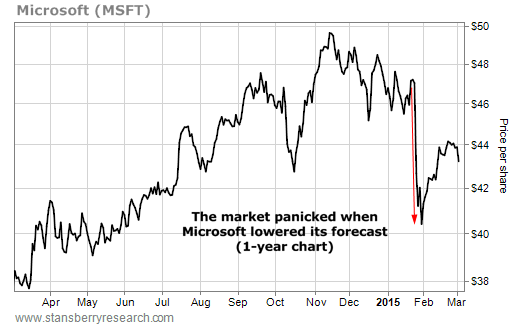
So... did the world's most dominant software company really lose $56 billion in value in two days? Or were markets just overreacting? Our bet is on the latter...
In the January 27 Extreme Value weekly update, editor Dan Ferris calmed everyone's fears...
|
Dan also noted Microsoft is growing new high-margin divisions and currently has 16 businesses producing more than $1 billion in annual sales. He also noted how much capital the business returns to shareholders...
|
As you can see in the chart above, Microsoft is up 6% to around $43.25 since the market panicked.
Speaking of Big Tech, Dan also says Apple could reach a market valuation of $1 trillion. It's already the largest publicly traded company in history with a market cap of $750 billion.
Still, our forecast may be conservative, according to Katy Huberty, managing director at investment bank Morgan Stanley. Huberty raised her price target from $133 to $160, citing the company's ability to charge a premium price for products and services, grow recurring revenue, and enter into new spaces. As she wrote...
|
Huberty also said she believes iBooks – the company's e-books platform – is gaining market share. And she believes its new streaming-music services could mean big bucks for the company.
Huberty added that she thinks Apple can increase its market four times. Adding its current market ($800 billion) to the Apple Watch, Apple TV, and Apple Car (its yet-to-be-released driverless car), she forecasts that Apple will one day be worth $3.4 trillion.
While we wouldn't take it that far, we do think buying one of the world's most dominant companies (with more than $170 billion in cash) for just nine times free cash flow is a good deal today.
Another one of Apple's major new lines of business is Apple Pay – the company's mobile-payment application on the iPhone 6 and iPhone 6 Plus. We wrote about the new service in the February 18 Digest.
Apple Pay has major tailwinds... It has signed up with almost every major payment card. More and more people are using Apple Pay (including a recent directive from the U.S. government to accept mobile payments). Plus, Apple makes $0.15 for every $100 spent using Apple Pay.
And Apple Pay isn't the only way the company plans to integrate itself into your daily life. CEO Tim Cook said he wants the iPhone to eventually replace the wallet. It would hold your driver's license, passport, and all other types of information.
If that happens, the recurring revenue Huberty mentioned above would be massive... and long-lasting.
Retirement Millionaire editor Doc Eifrig recently wrote a report discussing Apple Pay and explaining what it means for both Apple and for our society. He also identified several small-cap companies responsible for making the "guts" of this technology whose shares have the potential to soar as this long-term trend continues to develop. It's an interesting read. Get all of the details here. New 52-week highs (as of 3/2/15): AllianceBernstein (AB), Automatic Data Processing (ADP), American Financial Group (AFG), Blackstone Group (BX), CME Group (CME), Cisco (CSCO), CVS Health (CVS), Dollar General (DG), WisdomTree Europe Hedged Equity Fund (HEDJ), iShares Core S&P Small-Cap Fund (IJR), SPDR S&P International Health Care Sector Fund (IRY), 3M (MMM), Altria (MO), PowerShares QQQ Fund (QQQ), ProShares Ultra Technology Fund (ROM), ProShares Ultra Health Care Fund (RXL), ProShares Ultra S&P 500 Fund (SSO), Constellation Brands (STZ), Cambria Shareholder Yield Fund (SYLD), Varian Medical Systems (VAR), and Walgreens (WBA). One subscriber praises Steve Sjuggerud's True Wealth recommendations and another asks for someone to dethrone Dan Ferris' Constellation Brands recommendation as the top-performing open position at Stansberry Research. Send what's on your mind to feedback@stansberryresearch.com. "I have been a subscriber to True Wealth for more than 6 years and my two best successes have been the recommendations for the biotech bull market which Steve recommended about 3-4 years ago (I have more than doubled my investments in biotech – a few hundred thousand dollar gain). I did not invest in IBB or BIB (Steve's recommendations) as I chose to use my investments in my work 401k which did, not offer those funds. I invested in the Fidelity biotech fund in my 401k.
"My second best success was Steve's recommendation in Blackrock (BX) which I still have in my account and my son's account. We have more than doubled our money in that recommendation – I did not buy when Steve first recommended it because I did not have the funds at that point. However a few I months later when I managed to free up some funds I started my investment in BX.
"Steve's True Wealth letter was my first Stansberry product and given the quality of that product I have now several others. I have Dr. Eifrig's Income Intelligence letter, and his Retirement Millionaire letter, I also had for a while his Retirement Trader letter which is where I learned about options trading (safe options trading) which has been a great learning experience and a rather profitable experience as well. I have since changed to DailyWealth Trader which also focuses on mostly selling puts and selling covered calls. Although not quite as good as Dr. Eifrig's Retirement Trader, it works well for me. I look forward to the new issues of all those products every month (every day for DailyWealth Trader)." – Paid-up subscriber Denny C.
"I've been a Flex Alliance member for about 7-8 years (since it started probably). Stansberry Research is awesome; you've all taught me a lot. Porter, Jeff. Dr. Sjuggerud. Doc, Dan, etc. Thank you so much for the education! Totally P.O.'d that every time I read the Digest that STZ, up +446% – recommended by Dan – is at the top of the list. He gave a great trade/investment and a really compelling 'buy' story. I totally believed in it and it concurred with my own research. I never pulled the trigger... Shame on me. Can't stand seeing the performance of STZ ever since. Would someone please top it? Hate me every time I read it... Just saying." – Paid-up subscriber Kathryn
Regards,
Sean Goldsmith
March 3, 2015
