

How to know when the bull market is back...
How to know when the bull market is back... The most important news for stocks this month... The 'big picture' could be changing again... What to do now...
 In today's Digest, we share some important news on the U.S. stock market. But first, a quick review...
Following the steep declines in August, serious "technical" damage was done to the stock market. The selloff put the six-year bull market in question for the first time since 2011... or as Editor in Chief Brian Hunt put it...
Given the old age of the market, the rich valuations, and the major trend damage, we believe that the stock market must "prove" its strength... Until the market does this, it should be approached with extreme caution. You could look at it like a court case where the burden of proof has been flip-flopped. The stock market is guilty until proven innocent.
As we've discussed, that didn't mean we were outright bearish... or that we recommended selling all your stocks and moving fully to cash. No one can consistently predict where the market is headed next.
Instead, our advice has been to continue to own high-quality stocks, but to proceed with extreme caution – to keep a close eye on your trailing stops, hold more cash than usual, and invest new money only in the best opportunities – until the market showed signs of recovery.
But how would we judge a recovery?
Porter first explained his view in the September 11 Digest...
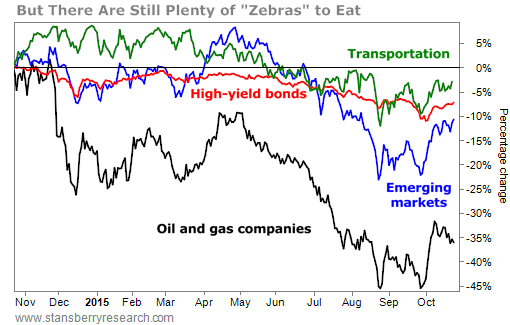
The "lions" in the current stock market correction have been the oil industry, the ongoing bear market in emerging-market stocks, and falling prices of speculative corporate debt. These downward trends are powerful. The shale-fracking fund (FRAK) is down almost 50% in the last year. High-yield bonds are down almost 10% over the last year – a massive move for bonds. Emerging-market stocks are down nearly 25% over the last year. These "lions" have, and will continue to have, a major influence on the U.S. stock market...
At the very least, before I become bullish on U.S. stocks, I want to see these "lions" – emerging-market stocks, U.S. oil companies, U.S. transports, and the high-yield corporate-bond market – stabilize. As long as these critical pieces of the global economy remain in significant downtrends, there's no way U.S. stocks can sustain a rebound.
Brian and DailyWealth Trader co-editor Ben Morris were more specific. They shared three "hurdles" the market needs to overcome with subscribers earlier this month...
Before we'll trust the uptrend, three things need to happen:
1. The S&P 500 needs to break above its 200-day moving average,
2. The 200-day moving average itself needs to turn higher, and
3. The S&P 500 needs to close above the 2,131 level.
If you're not familiar, the 200-day moving average is often used as a rough gauge of the market's long-term trend. And as Brian and Ben explained, there are two things to consider when looking at this average...
1. During bull markets, stocks tend to spend most of their time above the 200-day moving average. During bear markets, they spend most of their time below it.
2. If the 200-day moving average itself changes direction, there's a good chance a new, big trend is underway.
You can get a good feel for these two ideas in the 20-year chart below. It shows the S&P 500 and its 200-day moving average. As you can see, during each of the three bull markets, the S&P 500 traded mostly above its 200-day moving average. And during the two bear markets, the S&P 500 traded mostly below it. The arrows show the seven times the 200-day moving average changed direction for at least a month.
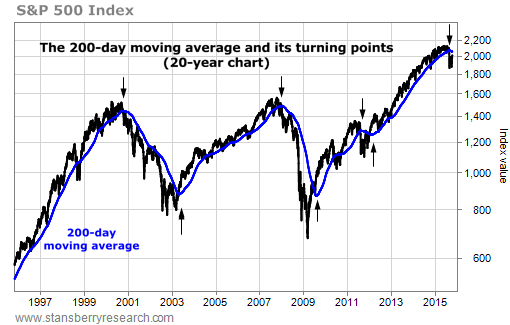
Following the selloff in August, the S&P 500 not only fell well below its 200-day moving average, but the average turned down for the first time in several years.
As you likely know, Porter shared his latest thoughts in Friday's Digest. He noted that the "lions" of the stock market he has been warning about – emerging-market stocks, U.S. oil companies, U.S. transportation stocks, and the high-yield corporate-bond market – have bounced higher since retesting their lows last month. But he isn't ready to give the "all-clear" just yet...
It's good news that these funds and indexes are not still falling. It could be the first sign of stability in these markets, something that would be bullish for U.S. stocks. But I don't think we're out of the woods yet. A longer-term look at these same areas of the market shows how much "technical" damage has been done. In my view, none of these trends has truly "broken out." Look at a one-year chart of the same indexes and you'll see what I mean...
In my opinion, the single most important "lion" to watch is the U.S. corporate debt market, represented by the iShares High Yield Corporate Bond Fund (HYG). Over the last year it's still down around 7%. A negative return is unusual for the corporate-bond market, especially when there isn't a recession...
As long as U.S. corporate debt remains in a downtrend – which you can monitor by watching HYG shares – I don't think these lions will be able to sustain their uptrends. That's why I'm skeptical that the recent moves up will last. I still think we're heading into a bear market.
Like Porter, Brian and Ben think it's still too soon to declare the bull market is back. But they say we now have the first signs that it could be on its way. In fact, as of last week, the market has quietly leapt over the first two "hurdles" they've been watching...
Last week, the S&P 500 broke above its 200-day moving average... And the 200-day moving average itself turned higher (although you can't quite see a tick higher on the chart). In other words, the downtrend just shifted back to an uptrend.
This is a great sign. But we've seen lots of false signals in the past. Our research has showed that the directional change in the 200-day moving average is much more meaningful when it holds its new direction for at least a month. Today is day six.
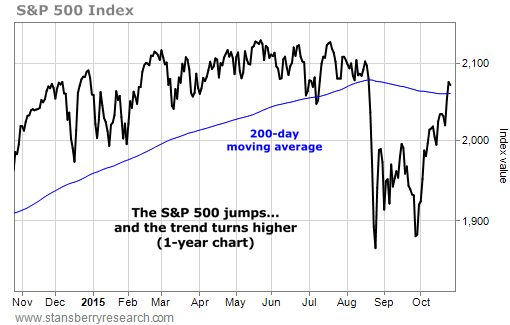
It's still early. Stocks need to hold above the 200-day moving average for a bit longer. And the S&P 500 still needs to "break out" above the previous all-time highs at 2,131 to clear the third hurdle. But this is a bullish sign...
On a scale of one to 10, we would have likely rated our confidence in the market at a three or four two weeks ago. Today, it's somewhere around a six. We're happy to see stocks advance. And we're a bit more bullish. But the market hasn't yet provided full price confirmation that leads us to say "we are bulls."
So what does this mean for you?
If you're a long-term investor who has been following our advice, you can stay put. Continue to hold high-quality stocks and plenty of cash and wait for further confirmation.
Investors who become aggressively bullish now could find themselves "whipsawed" – taking unnecessary losses and racking up brokerage fees – if this is a false signal and stocks head lower again.
On the other hand, if you didn't follow our advice – if you sold all your stocks in a panic or have been super bearish – take this news as an early warning that the trend could be changing. It might be a good time to "hedge" your bearishness with a handful of cheap stocks or high-conviction speculations.
Finally, if you're interested in learning how to profit during difficult times like these – where the long-term trend is "cloudy" and many stocks are expensive – consider a risk-free trial subscription to DailyWealth Trader.
As Brian and Ben like to say, they're "trading mercenaries"... They'll go wherever opportunity presents itself...
That means when a new uptrend is beginning in small resource stocks, you'll see us talk a lot about small resource stocks. If biotech is screaming higher, we'll look for potential triple-digit winners in biotech. The same goes for other "boom and bust" assets, like homebuilders, basic materials, steel, emerging markets, semiconductors, and more.
If a favorite stock of ours is stuck in a trading range, we'll show you how to collect 15%-25% annual income streams by selling covered calls. If the market is volatile and investors are scared, we'll take advantage by selling puts on the world's best companies. We'll show you how to use both techniques to "leverage" recommendations from the world's best analysts and legendary hedge-fund managers.
You'll hear when asset ratios are out of whack and when stocks are incredibly oversold or overbought. You'll also hear when we reach extremes of sentiment or price... We'll show you how to use that information to profit.
In short, you can consider DailyWealth Trader a "Swiss Army knife" of trading advisories. No matter what's happening in the broad markets, there are almost always short- to medium- term opportunities available, if you just know where to look. Ben and Brian are your guides... and they provide all the educational content you need to take advantage of the trades for yourself, even if you're brand-new to trading. Even better, they do it all for an extremely low price. Click here to learn more about a subscription to DailyWealth Trader.
New 52-week highs (as of 10/26/15): Chubb (CB), Expeditors International (EXPD), Microsoft (MSFT), and Travelers (TRV).
A reader congratulates Steve Sjuggerud on his weight-loss journey, and another asks a question about our actionable advice in today's mailbag. Send your queries to feedback@stansberryresearch.com.
"Keep up the good work. Personally I like to see financial researchers and advisors looking trim and healthy and in good physical condition as I feel that's a matter of discipline in one's life. If you're telling us to be disciplined in our financial investments and to buy and sell at proper times, it crosses over into our daily lives of eating properly and exercising regularly and spending wisely, etc. – generally just living a disciplined life. In my opinion your investing messages are a bit clouded if you aren't disciplined in your appearance. So great work Steve – keep it up and may you be happy with the results of your newly acquired discipline!" – Paid-up subscriber Becky N.
"As a fairly new subscriber, it is nice to see that a buy recommendation of 6 months ago has worked out well. However, that doesn't do anything for me today. The digest doesn't say whether if we were not able to act on the recommendation back in April that we should still buy now or not, or at what price on a pull-back.
"Where/when/how do I see the recommendations of what to do today as opposed to sometime in the past? As a general comment I am finding the rather large volume of emails tend to be somewhat self-congratulatory, like this one, quite general in nature (i.e. high yield bonds are at risk), or the multitude of sales pitches to buy more subscriptions. Where is, 'buy McDonald's today at a price up to $110 or $115'; or 'High-yield bonds are due for a tumble – buy the SJB Short High Yield ETF' or something actionable like that?" – Paid-up subscriber David Thomas
Brill comment: As we often remind readers, the Digest is a free daily e-letter sent to all of our paid subscribers as a supplement to your paid research. Think of it as a way to stay up-to-date with what's going on in the markets and in our other publications.
We don't send out official buy alerts in the Digest like you're used to seeing in Steve Sjuggerud's True Wealth, Porter's Stansberry's Investment Advisory, Dr. David Eifrig's Retirement Millionaire, or any of our other paid publications.
And as always, you can access all of your paid-subscription materials – issues, updates, special reports, etc. – by logging into our subscriber website here.
Regards,
Justin Brill
Baltimore, Maryland
October 27, 2015
|