

Is a 'Trade War' Back on the Table?
'Great' news on jobs... Why low unemployment could be bad news for stocks... China trade tensions are rising again... Is a 'trade war' back on the table?... In the mailbag: Are we wrong about Tesla?
 If you even glanced at the financial media today, you likely saw the news...
According to the U.S. Department of Labor, unemployment fell to a historic new low in April. As the Wall Street Journal reported this morning...
The jobless rate fell to 3.9% in April from 4.1% a month earlier, hitting the lowest level since December 2000, the Labor Department said Friday...
Employers have now added jobs every month since October 2010, a 91-month stretch that ranks as the longest period of job growth on record. The overall economic expansion, at 107 months in May, became the second longest on record, trailing only the expansion of the 1990s in length.
The fall in joblessness marked yet another milestone in the nation's long recovery from the 2007-2009 recession, which sent unemployment soaring to 10% in October 2009. Unemployment has been below 4% only a few times over the past 70 years – during the Korean War in the early 1950s, during the Vietnam War in the late 1960s and early 1970s, and during the tech boom of 2000.
This is great news, right?
Not so fast.
There are a few reasons to believe the news isn't quite as rosy as it appears.
First, this measure is one the Federal Reserve follows closely. The Fed sees getting the economy to "full employment" as part of its job description. This, along with maintaining "stable prices," is known as its "dual mandate."
But it's important to understand that "full" employment doesn't actually mean 0% unemployment, as the name implies. Instead, the Fed seeks to reach what it calls the "natural rate of unemployment."
This means the Fed isn't only concerned when unemployment rises too far above this rate (which it believes can lead to too little inflation.) It also gets worried when unemployment falls too far below this rate (which it thinks can trigger too much inflation). As of its March policy meeting, Fed officials estimated this "natural rate" to be somewhere between 4.2% and 4.8% unemployment.
In other words, unemployment has been 'too low' in Fed officials' eyes for the past several months...
And it has now fallen to a new multidecade extreme.
We already know the Jerome Powell-led Fed is worried inflation could rise faster than expected.
This month's data could strengthen that view... push the Fed to raise short-term rates even faster than currently planned... and hasten the end of this long bull market.
But there's another, even simpler, reason for concern...
In short, history suggests that a booming economy – as measured by extremely low unemployment – is typically terrible for the stock market.
It's counterintuitive, but it's true. As our
Let's look back over the past 70 years to see how stocks performed each time the unemployment rate was less than 4.5% (remember, it's 4.1% today)...
The results are, frankly, amazing...
If you bought stocks when the economy was in bad shape (when unemployment was 7% or higher), you would have made double-digit returns on average 12 months later.
On the flip side, if you'd bought stocks when the economy looked great (when unemployment was 4.5% or less), your stocks would have performed terribly, barely returning more than 1% after one year. Ouch!

Worse, Steve noted this trend has become even more extreme over the past few decades...
When you tighten the data up to more recent times – since 1985 – the results become even more extreme. Take a look...
You would have lost 3.7% one year after the economy looked as great as it does today.
And when the economy looked bad, you would have earned 13.2% in stocks over the following year.

To be clear, Steve doesn't recommend using the unemployment rate alone as a market-timing indicator...
History shows it's not until unemployment begins to rise from an extreme low that it's time to get worried. From the February 1 DailyWealth...
Interestingly, the unemployment rate itself isn't the indicator... What matters is the yearly percentage change in the unemployment rate.
You can see it in this chart. It compares the performance of the benchmark S&P 500 Index with the annual change in unemployment. Take a look...
As you can see, whenever the annual rate went up by as little as 5%, it was time to get extremely cautious. (For context, one example of a 5% change would be if the unemployment rate rose from 4% to 4.2% over 12 months.)
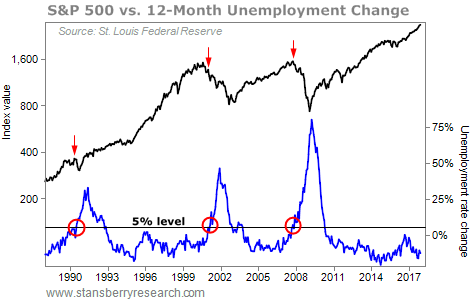

Today, unemployment fell to a new low. According to history, it's not yet time to worry. We'll let you know if that changes.
In other news, trade tensions with China appear to be rising again...
As regular readers know, tensions originally flared back in March, when the Trump Administration slapped tariffs on steel and aluminum imports. China retaliated with tariffs of its own on a number of U.S. exports, stoking fears that a "trade war" could begin.
But President Trump and China President Xi Jinping each took on a more conciliatory tone of late. And this week, Trump sent his senior economic team – led by Treasury Secretary Steven Mnuchin and U.S. Trade Representative Robert Lighthizer – to Beijing, leading many to believe a trade deal was in sight.
Unfortunately, the talks ended today with little clear progress. From a separate Wall Street Journal report...
The U.S. and China asked one another to make sweeping concessions in trade talks, failing to bridge sharp divisions and raising the chances that each government will slap tariffs on tens of billions of dollars of the other country's exports before settling the dispute.
Top economic officials on both sides sat down for two days of talks this week after exchanging lists that contained sizeable demands. The U.S. asked China to cut its trade surplus by $200 billion, for example, while the Chinese officials sought to get Washington to ease national-security reviews of Chinese investments. Instead of reaching common ground, the talks ended inconclusively Friday.
Planned meetings of U.S. officials with President Xi Jinping and Vice President Wang Qishan didn't materialize. The U.S. delegation left Beijing without comment or agreement with Chinese officials on a joint statement...
We've been critical of the Trump administration's use of tariffs...
While we would welcome freer trade with China, we believed these tactics were likely to lead to "tit for tat" retaliation from Beijing, that risks becoming an all-out trade war.
Unfortunately, that's exactly what's happened so far. And contrary to what Trump has suggested, history is clear: No one "wins" a trade war.
|
On May 10 at 8 p.m. Eastern time, Porter and Steve will reveal: The FINAL INVESTMENT
|
||
New 52-week highs (as of 5/3/18): NovaGold Resources (NG) and Okta (OKTA).
In today's mailbag: Praise for the Stansberry NewsWire... and thoughts on Tesla's (TSLA) unusual earnings call. Send your notes to feedback@stansberryresearch.com.
"Stansberry Newswire is the best... The format is perfect. Nothing better than a quick view of what is going on. Thanks Scott, Greg, and John. You guys get a 5-star rating and then some." – Paid-up subscriber Jeff S.
"[Regarding] Elon's behavior... Anyone remember Jeff Skilling's (Enron – the world's leading company) last analysts call? Hmm... and how did that turn out?" – Paid-up subscriber Randy H.
Brill comment: Funny you mention it, Randy. We were reminded of Skilling's infamous call as well: "'You're the only financial institution that can't come up with balance sheet or cash flow statement after earnings,' Grubman grumbled. 'Well, thank you very much, we appreciate that. A..hole,' Skilling responded with a laugh."
"Elon Musk is the greatest Huckster of my lifetime. The difference between him and a snake oil salesman is that with the oil salesman you actually get a bottle of oil." – Paid-up subscriber Craig R.
"I'm a reader of your guidance and weigh it alongside of others I do the same. Generally, I find your advice sound and of perspective... wait for it... with one glaring exception. Yep you guessed it... Elon musk and Tesla.
"While it's not hard to stand opposed to Tesla and Musk, as most do, it seems even in your popular stance your bias shows thru however. Such little slack has been given to Musk and Tesla by the vast majority. He has only ventured into a field that has been embattled since Nicola Tesla began doing what 'shouldn't be done.' Musk and Tesla has proven that fully electric vehicles are not only viable but smarter, more economic, and just plain more fun to own and operate. When you compare the joke offerings of "major manufactures" it's little wonder that a ground up approach might be a tad bit expensive.
"As you slam the man and the vehicle let me ask you this... have you driven a Tesla? I mean personally... you... behind the wheel and taken it for a spin? Before you armchair quarterback this breakthrough in transportation out of existence consider plopping your cheeks in one first. I know new is scary and expensive ... just grab your 'safe animal' and cuddle in your 'safe room' while the scary new thing goes whizzing by.
"One parting question for you to consider. Where would we, as a society, be of we all shared your deconstructive attitude? The edge of the 'modern world' would still be where we fall off... medicine would be 'black manic' ... and the stake would well-worn with the witches you burn.
"I dare you to drive a model S 100D for the full 325 miles per charge. Then write your article. The cash burn will be the same, the egomaniacal leader will be the same, but you my friend... will never see the future the same way. Shut up and drive." – Paid-up subscriber Doug H.
Brill comment: As we've said many times, we have no real issue with Tesla's cars. Personally, for the sticker price, we'd prefer a vehicle with fewer quality-control and reliability problems, but we wouldn't criticize you for choosing to own one.
As taxpayers, however, we resent being forced to subsidize your purchase. And as investors, we have a problem with a business that hemorrhages money... has virtually no chance of turning a profit...and, most worrisome, is run by a CEO who manipulates earnings (see here or here) and misleads shareholders for personal gain.
We have a dare of our own: We dare you to drive a brand-new $35,000 Tesla Model 3.
You know... the mass-market sedan that has "revolutionized" the electric-vehicle market? That hundreds of thousands of people paid $1,000 to reserve in March 2016? That Musk promised would be delivered to buyers nearly a year ago?
Oh, that's right... It doesn't actually exist.
Regards,
Justin Brill
Baltimore, Maryland
May 4, 2018