
Is the U.S. economy really getting better?... More from the banks... 'The most important news you're not hearing'... What to do if you're struggling today...
 It seems our comments have struck a nerve...
Last week, we shared our colleague Dr. David "Doc" Eifrig's latest thoughts on the economy. Subscriber feedback has been pouring in ever since...
If you missed it, Doc believes the economy is slowly "grinding" higher.
In particular, Doc points to improvements in data like gross domestic product ("GDP"), unemployment, and job losses... as well as the things he is seeing first-hand on his travels around the country...
Every flight I'm on is packed like a sardine can. My winemaker friend Brenda tells me that a pedicure place that used to have walk-ins now requires at least a week's notice. Fancy restaurants near our Baltimore office are bustling, and it seems like a new one opens every other week. Rental cars in Florida are double the price that they were five years ago, and often there are not enough in each car class.
While several subscribers have written in to disagree (you can find some of the latest in today's mailbag, below), we're seeing more and more evidence to support Doc's stance.
Yesterday, we highlighted the strong earnings in railroad giant CSX (CSX) and several big banks, noting customers are making their credit card, mortgage, and loan payments at the highest rates in years.
Today, several more banks joined in...
Citigroup (C) – the third-largest U.S. bank – reported its most profitable quarter since before the financial crisis. Citing cost-cutting measures and lower legal costs, the bank reported that net income rose 18% in the second quarter to $4.7 billion today (from $3.9 billion in the same quarter of 2014). Citi's revenues also rose slightly – to $19.5 billion, from $19.4 billion a year ago, slightly beating analyst estimates.
Meanwhile, BB&T (BBT) reported profits were up more than 7% in the second quarter. Net income rose from $424 million in the second quarter of 2014 to $454 million today. Revenue rose from $2.3 billion to $2.4 billion over the same time frame.
And M&T Bank (MTB) reported higher profits, revenues, and earnings per share, beating analyst estimates.
But perhaps the biggest sign of recoverycomes from DailyWealth Trader co-editors Brian Hunt and Ben Morris.
In today's issue, they called it "the most important financial news you're not hearing"...
You're not seeing it on CNBC... And you're not reading it in the Wall Street Journal. The financial media are full of headlines stoking fears about the economy. But despite what the pessimists would have you believe, the American consumer is alive and well...
A healthy American consumer buys and spends a little extra on "the basics"... things like shampoo, soft drinks, cigarettes, sneakers, and tooth paste. So as the economy improves... and as consumers spend... these companies profit. And share prices rise.
A great way to gauge the action in these stocks is with the iShares U.S. Consumer Goods Fund (IYK). Its major holdings include Procter & Gamble, Coca-Cola, PepsiCo, Philip Morris International, Nike, and Colgate-Palmolive.
While folks like to debate the "real" unemployment rate or whether the Federal Reserve's "easy money" policies are helping Wall Street banks at the expense of Main Street, these companies benefit from real spending by real, everyday consumers.
And as you can see in the chart below, everyday consumers are spending. IYK is up 50% (plus dividends) in the past three years, and just made a new all-time high today.
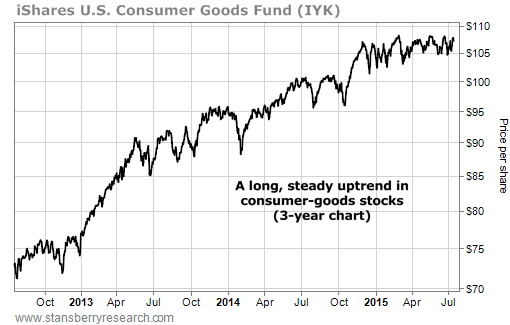
As longtime readers know, we believe our government's massive debts are likely to lead to serious problems sooner or later. But for now, signs say the economy is improving, and the trend is up.
We remain cautiously bullish... but we always recommend having your "catastrophe prevention plan" in place, just in case.
Still, we know the recovery has not reached everywhere. Not everyone has benefited, and many of those who have are still struggling to save and invest enough for retirement.
As Porter often says, our No. 1 goal at Stansberry Research is to tell you what we would want to know if our roles were reversed. And the truth is, for some folks, investing alone will not be enough.
That's why we've been quietly working for the past several months to offer something new...
Doc and Stansberry Research have teamed up with one of the best-known men in America – a personal advisor to former U.S. President Bill Clinton, billionaire trader Paul Tudor Jones, and some of the richest, most successful athletes, entrepreneurs, and investors in the world – to help ordinary folks gain financial security no matter where they are today.
You can get all the details on our new project right here.
New 52-week highs (as of 7/15/15): American Financial Group (AFG), ProShares Ultra Nasdaq Biotech Fund (BIB), Chubb (CB), CVS Health (CVS), iShares U.S. Insurance Fund (IAK), ProShares Ultra Health Care Fund (RXL), and Scorpio Tankers (STNG).
In the mailbag, subscribers continue to check in throughout the U.S. to let us know what they're seeing. Please send your e-mails to feedback@stansberryresearch.com.
"I'm writing in from Montana. It's a small state, so please don't publish my name. To Doug and Wayne from the July 15 Digest: why the heck are you (and others) staying in your town? There's a lot of the country desperate for labor, and at a living wage, especially compared to relative costs of living. Not everywhere is San Francisco, just like everywhere isn't a depressed, barely there town in western Ohio. It can't be that bad if people keep staying where they are. Just sayin." – Paid-up subscriber S.B.
"Things here in Missouri are not terrible, yet, but don't seem to be getting better. I work in healthcare, and jobs have recently been cut. It seems like crime is getting worse and there are more folks asking for help at traffic signals. I have stopped shopping at Walmart because it is depressing. There seems to be pockets of prosperity in some urban areas, but I believe half of the people live in fear for their jobs or loss of government support. If the financial sector ever declines again like the energy sector has, the country will have a depression." – Paid-up subscriber Martin M.
"Right on Wayne and Doug. You both expressed what I have been feeling when reading Doc's economy assessments. I love Doc and have written regarding this subject. No response. Empty storefronts in Tucson is not a recovering economy. I don't begrudge Doc, Steve or Porter their success. I look up to them and look forward to their honest research. But I feel Doc's take on the economy has not been fully honest or real." – Paid-up subscriber Tim
"Dear Doc, while your optimism about the economy and the future market is understandable and shared by most working in the financial services and I'm personally doing well I'd rather join the other camp of not-so-happy and rather pessimistic readers about the state of economy and the future of this country even in the next few years. I follow with great interest John Hussman's analyses and I'm wondering if you could provide similar in-depth and quality counter-arguments to support your optimism. Dr. Hussman supports his analyses with over a century of reliable data, can you defy his logic and find a similar support for your thesis? What is the state of the economy excluding the financial industry that benefits directly from the FED's policy.
"Maybe from so many close friends still working in the 'canyons of the Wall Street Casino' (to quote another of my favorite economists David Stockman whose blog I also wouldn't miss) you may know better what to expect from the market near-term and which investment is safer. But only a very naive person wouldn't see how much the market is disconnected from the economic reality. Having said that I still remain your subscriber and value very much your investment and health advisories for the million baby boomer savers that are being financially destroyed by the Fed's policy.
"P.S. Driving a still good older car is only one of the many virtues that many self-made millionaires have. Driving it because one cannot afford a new one while refusing the take the loan bait at the car dealership is virtue that unfortunately millions today are missing." – Anonymous
Regards,
Justin Brill
Baltimore, Maryland
July 16, 2015
|