
It's different this time... Nasdaq hits its highest level since the dot-com bust... Why stocks can still soar... China cuts interest rates... Why Buffett hates gold... And loves buying great businesses... A lesson from See's Candy...
 The most dangerous words in investing are "it's different this time."
Longtime Digest readers know that markets move in cycles. A market heats up and sees a huge inflow of capital. People get leveraged and buy more.
Prices detach from reality and people make a fortune. They don't think the good times will end. "It's different this time," they say. "These companies aren't valued on earnings"... "Real estate never goes down"... "The Fed won't let the market fall."
Choose your excuse. We know how it ends.
The technology-heavy Nasdaq index crossed 5,000 today, hitting its highest level since 2000...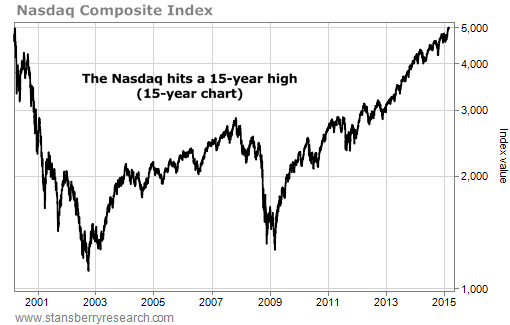 Last time the Nasdaq breached 5,000 – right before the dot-com bubble – the index fell nearly 80% over the next three years.
But this time, we think it's different. And we know that this next downturn will be bigger than the last, but given the facts you'll see in today's Digest, we think this bull market could run a little longer. We're in a world of zero-percent and negative interest rates. Never before has the world been so awash in capital. As Steve Sjuggerud said in the latest issue of True Wealth...
|
In the February 23 Digest, we shared why Steve thinks stocks are cheap today based on the well-known cyclically adjusted price-to-earnings (or "CAPE") ratio. He concluded...
|
Steve also pointed to another reason he's bullish on stocks in general today: The dividend yield on stocks is higher than interest rates on bonds.
Typically, bond investors demand a higher yield in exchange for less capital appreciation and less volatility. On the flip side, stock investors require less yield because their upside is much greater.
But that's not the case today. Last month, the dividend yield for the S&P 500 was greater than the yield on 10-year Treasurys. Since then, stocks have rallied... Today, the dividend yield for the S&P 500 is just less than 2%. Treasurys yield 2.07%. As Steve said...
|
David Rosenberg, analyst for wealth-management firm Gluskin Sheff, shared a few reasons why he also thinks it's different this time (speaking specifically of the Nasdaq).
For one, he noted that tech stocks are much cheaper today than they were back in 2000. The S&P 500 tech sector has a 15 times forward price-to-earnings multiple. In 2000, that multiple was 30 times (not to mention the future earnings forecasts were inflated).
Like Steve, Rosenberg notes the different interest-rate environment...
Today, tech stocks yield 1.5%, which is comparable to a five-year Treasury. In 2000, tech stocks yielded close to 0%, while the 10-year yielded 6.5%.
Finally, Rosenberg noted the Nasdaq is more diversified today than it was in 2000. Back then, the Nasdaq was about 60% tech stocks. Today, it's just more than 40%. The index includes more health care, financial, and consumer stocks.
Investing legend Warren Buffett published his annual letter for Berkshire Hathaway shareholders over the weekend... It was the company's 50th anniversary "under current management." Buffett and his business partner Charlie Munger both reflected on the past 50 years of Berkshire, including mistakes they made... and shared their thoughts on the future.
As always, it's a must-read. Berkshire hosts every annual letter for free on its website. Check them out here.
We'll share a few key points from Buffett's letter. But first, China is getting more aggressive in currency wars...
Over the weekend, China's central bank – the People's Bank of China – cut interest rates for the second time in three months.
The central bank cut the one-year lending rate by 25 basis points (one basis point is one-hundredth of 1%) to 5.35% and the one-year deposit rate by the same amount to 2.5%.
China cut rates for the first time in two years in late November. The global growth engine is now fighting deflation with the rest of the world.
That's bullish for gold (although Buffett, an outspoken opponent to the precious metal, would disagree). To read why we're bullish on gold today, be sure to read the February 17 Digest.
Buffett explained why he doesn't like gold in his 2011 letter to shareholders...
|
Buffett noted at the time that beyond its valuation, gold prices in 2011 made "annual production of gold command about $160 billion." Buyers (i.e. individuals, speculators, jewelers, etc.) are forced to "continually absorb this additional supply to merely maintain an equilibrium at present prices." He continued...
|
We usually think Buffett's advice is sage. But what he fails to acknowledge is that gold is real money... and a great way to diversify your cash as central banks around the world destroy fiat money.
That's what prompted Ray Dalio, the billionaire founder of Bridgewater – the world's largest hedge fund – to say that Buffett was "making a big mistake" in regard to gold.
And in his latest letter, even Buffett pointed out the folly in holding U.S. dollars...
|
As Buffett explained, over the last 50 years, investing in American businesses was a far safer strategy than investing in securities like Treasurys whose values are tied to the U.S. dollar...
|
Buffett fails to mention that gold has risen from $40 an ounce in 1971 to more than $1,200 an ounce today... a gain of nearly 3,000%. (You can't compare Buffett's returns with gold over the last 50 years due to the end of the gold standard in 1971.)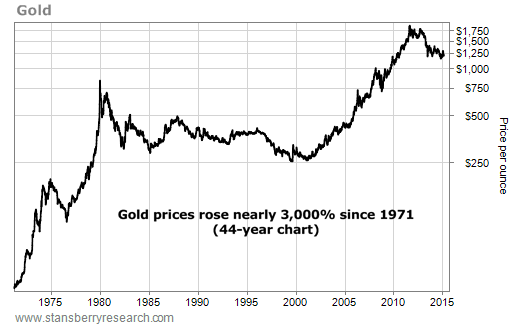 As always, Buffett also espouses the benefits of owning great businesses over the long term. In his latest letter to shareholders, he told the story of Berkshire's 1972 purchase of See's Candy. At the time, the company was earning $4 million pre-tax using only $8 million of net tangible assets. The controlling family wanted $30 million for See's. Buffett only wanted to pay $25 million. Luckily, the family accepted Buffett's offer, otherwise, he would have missed out on a great opportunity. From the letter...
|
To reiterate... Buffett bought See's more than 40 years ago for $25 million. Since then, it has earned a $1.9 billion pre-tax profit. That's the power of owning a great business over a long period of time.
Two important corrections to last Friday's Digest.
First, the quote at the opening of the Digest – "You're making it hard for me to like you," should have been attributed to T. Boone Pickens. It's one of his many wonderful and wise catchphrases. He was speaking about one of his neighbors with whom he's involved in oil production. They worked out a friendly compromise. In the editing process, he-who-shall-be-held-blameless (aka Porter) mistakenly cut out the attribution and then forgot to reinsert it later in the piece.
Second, the U.S. oil exports reached 500,000 barrels of oil per month for the first time in November. The U.S. continues to export roughly 500,000 barrels per month – a massive increase from the typical range of 20,000-40,000 barrels per month we exported in the last decade. But oil exports have not (yet) reached the 500,000 barrels per day level we mistakenly claimed on Friday. Once again, he-who-shall-be-held-blameless regrets the error.
New 52-week highs (as of 2/27/15): AllianceBernstein (AB), Cempra (CEMP), Dollar General (DG), Dalradian Resources (DNA.TO), WisdomTree Europe Hedged Equity Fund (HEDJ), Altria (MO), and Walgreens (WBA). In the mailbag... two subscribers write in from the Caribbean and Europe agreeing with Porter's advice on alternatives to living in the U.S. Have you left the country to live abroad to get away from the U.S. government's reach? Tell us about your experiences at feedback@stansberryresearch.com. "I was pleased to see your reference to St Thomas, one of the US Virgin Islands. I humbly submit you've ignored these American jewels to the detriment of your readers. I have owned a second house (the real estate folks call them villas) there for over ten years and have since added rental properties. Property taxes are low, no estate taxes whatsoever, regulations are slight (there isn't even a recycling law), the people are friendly, and the weather and water are (in my view) simply the best in the world all four seasons (it can get a little windy in September!).
"Flight time from NY is 3 hours 30 minutes and fares are reasonable. I can go on and on, but perhaps it is better for me to just say that you'd be doing your readers a real service if you were to research the place and report to your readers yourselves. You can stay at my place." – Paid-up subscriber Mike K.
"Hello Porter, I am an expat of the US and have been for almost 35 years living in Bavaria, Germany. I still own property in the US, pay property taxes and try to get back to the US at least once a year to visit family and friends. I was even considering building a house on my property for retirement, however, after Obama's reelection I shelved the idea.
"I have traveled the world extensively and one of my favorite places is Costa Rica, even though it has become more popular with US citizens in the last few years. It has a young population, no military (fantastic) and one of the best medical systems in all of central America If the flight time there from Europe would be shorter, I would have bought property there years ago.
"Just one comment on health insurance from a German standpoint. I have lived and worked here as mentioned for the last 35 years and health insurance is either mandatory (if you earn below a specific salary) or privately insured (over the sum). The nice thing about my insurance (private) is when I do not have major costs, which I have not had for the last 25 years, then I get a refund of 6 months what I have to pay in a year. I am also preparing for the worst case scenario, although I hope it doesn't come to pass – however, I am convinced something will happen and it is not going to be nice when it does." – Paid-up subscriber Bill Craig
Regards,
Sean Goldsmith
March 2, 2015
