
Editor's note: Learn to invest defensively, and you'll avoid the biggest mistake investors make. You'll win the "Loser's Game" of investing. And you'll be ready to beat the market…
You don't need to use complex strategies to beat the market. You just need to make a small change in the way you think about investing…
In today's edition of our weekend Masters Series – originally published in the September 2 issue of our free e-letter DailyWealth – True Wealth Systems analyst Brett Eversole introduces a simple way to dramatically increase long-term returns.
If you had invested in this strategy during the "lost decade" of the 2000s, you'd have doubled your money… while the broad market went nowhere.

A Simple Way to Beat the Market, Year after Year
By Brett Eversole, analyst, True Wealth Systems
There's nothing better than a simple, stupid investment idea.
Most folks think you have to reinvent the wheel to beat the market. They think the only way to produce outsized returns is with complex strategies. The kind the average person can't follow.
They're wrong.
Today, I'll show a simple way to beat the stock market. Importantly, this idea makes intuitive sense. And there's an easy way to make the trade.
This simple idea beats the market by 1.8% a year. That might not sound like much, but over time, it leads to hundreds of percent in excess returns.
Let me explain...
Today's simple market-beating strategy requires us to rethink what "the market" actually is.
In the U.S., our benchmark for stocks is the S&P 500. This index holds the largest 500 companies that trade in the U.S.
That makes sense. If you want to own U.S. stocks, own the biggest and the best. But there's a problem with this approach. As my colleague Porter Stansberry points out...
|
Porter's describing "market-cap weighting." It puts more of the index value into the largest companies and less into the smaller companies.
In the case of the S&P 500, the top 50 companies make up nearly half of the index. That's a problem... as the largest companies tend to be the most mature and tend to provide lower returns over the long term.
But history shows there's an easy way to beat this formula.
The simple change is moving from market-cap weighting to equal weighting. In the equal-weight S&P 500, each stock is 0.2% (one 500th) of the index, regardless of size.
That might seem like a minor change. But the increase to returns is enormous. Take a look...
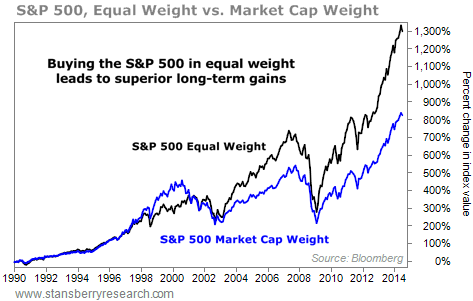
Since its inception in 1989, the equal-weight S&P 500 is up 1,297% (including dividends). The normal S&P 500 returned just 823% over the same period (also including dividends).
Over that 25-year period, the equal-weight S&P 500 returned 11.3% a year versus 9.5% in the market-cap weight S&P 500... a 1.8% annual outperformance.
Again, an extra 1.8% a year might not sound like much. But it adds up. And during the "lost decade" of the 2000s, the equal-weight S&P 500 doubled while the normal index went nowhere.
The great news for investors is that there's an easy way to make this trade. It's called the Guggenheim S&P 500 Equal Weight Fund (RSP).
You've likely never heard of RSP. But it's a seasoned fund that has been available for more than a decade. It does a fantastic job tracking the equal-weight S&P 500. And it makes following this idea easy.
Like I said, this is a simple idea. But that's a good thing. We don't need to reinvent the wheel to beat the market.
It takes an index everyone knows about, makes a small change, and increases long-term returns. Perfect.
If you're a long-term investor looking to maximize gains, forget about the S&P 500. Put money to work the smart way. Shares of RSP are the easy way to do it.
Good investing,
Brett Eversole
Editor's note: If you're looking for investments that consistently beat the market, consider True Wealth Systems. Each month, Brett and editor Steve Sjuggerud search through dozens of potential investments identified by an exclusive online system.
Created by a Ph.D. mathematician and computer programmer, this system is worth tens of thousands of dollars a year. You can't find it anywhere outside Wall Street databases. And many of the stocks Steve and Brett find this way have dramatically outperformed the market. Get more details about this system – and how you can start using it – here.