

Masters Series: The Myth About Buying at New Highs
Editor's note: Over the years, True Wealth Systems editor Dr. Steve Sjuggerud has directed readers into dozens of incredible investments. He has taught investors valuable lessons on limiting their risk by using stop losses and smart position sizing.
Another huge service he has performed for readers is his brilliant "debunking" of popular investment myths.
With hundreds of thousands of dollars in data-crunching ability at his disposal, Steve is able to test any investment theory or trading system. He's able to evaluate ideas based on hard facts and evidence... instead of going along with useless myths and un-researched claims.
In today's edition of our weekend Masters Series – previously published in the May 13 issue of our free e-letter DailyWealth – Steve debunks a common misconception about the markets that often results in even longtime investors missing out on huge gains.
Ninety-nine percent of investors don't know this. Most of them wouldn't believe it. But it is completely true…

The Myth About Buying at New Highs
By Steve Sjuggerud, editor, True Wealth Systems
I have a surprising message for you today...
It's something that will give you an edge over your fellow investors. It's something that will allow you to keep making money in stocks after they have sold.
Let me explain...
The U.S. stock market just hit a record high yesterday. That probably gets you worried.
You aren't alone... most investors get worried... because they believe that if we're at new highs, there can't be much upside potential remaining in the markets.
Although that sounds right, it's actually completely wrong...
Think about this...
Sixty-three times since 2009, the stock market has closed the week at a new 52-week high. That's not 63 days… That's 63 weeks, 63 different Fridays, since 2009.
If you had decided to sell your stocks because of any of those 63 new weekly highs, you would be unhappy now... because you would have missed out on some phenomenal gains in stocks.
What has happened since 2009 with new highs is not some kind of odd occurrence...
Buying at new highs has surprisingly been a winning strategy since the beginning of stock market history... Take a look at the average 12-month returns when buying at new highs versus new lows:
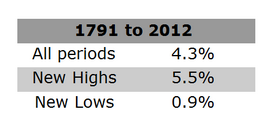
This table looks at monthly data instead of weekly, but the point is still the same... If you buy when the market is at a new 12-month high, you outperform over the next 12 months.
Also, surprisingly, if you buy when the market is at a new 12-month low, you underperform over the next 12 months.
Since we're not back in the 18th century, let's look at things in more recent times...
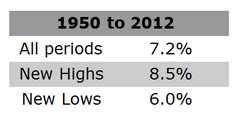
The point remains: You are better off buying the market when it's at a new 12-month high than a new 12-month low.
Ninety-nine percent of investors don't know this. Just about all of them don't believe it. But it is completely true.
The numbers get even more shocking if the market has performed REALLY well lately...
For example, over the last 100 years, the Dow Jones stock index has gone up at about 5.4% a year (not including dividends). But when stocks soared in a short period of time, they continued to soar over the next year.
For example, if stocks rose by 10% or more in a quarter, they were also up roughly 10% over the next 12 months.
The opposite was true as well... If stocks fell dramatically in a quarter (by 7.5% or more), they only managed to eke out a 3.5% gain over the next 12 months.
The moral to the story is at the very least, don't worry about new highs... History tells us they are more of a good sign than a bad one. In short, new highs in the market are NOT a reason to sell.
Of course, one of these new highs is bound to be the top, eventually... I'm not blind to that idea. My point is, it's simply not smart to bail out just because stocks have hit new highs... History shows that, chances are, bigger gains lie ahead.
Good investing,
Steve
Editor's note: In True Wealth Systems, Dr. Steve Sjuggerud uses a powerful type of computer software to analyze information about the markets that was previously off limits outside Wall Street. It took 15 computer programmers, four years, decades' worth of investing knowledge from Steve, and nearly $1 million to build this supercomputer. And the results speak for themselves… Three of Steve's True Wealth Systems recommendations are currently up triple digits.
True Wealth Systems is among our most expensive and sophisticated research letters. We don't typically "give it away." But if you sign up by tomorrow – Sunday, November 23 – you'll receive the service FREE for three months. Click here for the details.