
Editor's note: Dozens of private tech companies are set to go public... and early investors could make an absolute fortune.
Technological advancements continue to make everything smaller, faster, and more powerful. And as Exponential Tech Investor editor Jeff Brown explains in today's Masters Series essay, life as we know it is about to change... and anyone with a brokerage account can take advantage of it...

We're on the Verge of a Historic Investment Era
Yesterday, we talked about a single, amazing idea...
Exponential growth will bring amazing new developments and transform the world as we know it.
Soon, we'll have cars that drive themselves and robot assistants. We'll use advanced technology to edit our genes and eradicate diseases.
There are dozens of private tech companies working on products and services that will alter and create entire industries.
The next Uber is out there... the next Facebook (FB) is out there... the next Google is out there. They will produce life-changing returns for early investors.
When it comes to this type of firm, you need just one hit to make an enormous sum of money. Gains of 3,000%-plus are not uncommon in the area of revolutionary technology.
Remember, people who bought Google after its IPO are now up more than 1,400%.
Many innovative private companies are going to go public in the next three years.
They will go on to create huge new industries, grow into $200 billion (or more) global giants... and take investors along for the ride.
It's possibly the greatest investment opportunity of our lifetime.
But their extraordinary technology is just one part of this opportunity. The other part is due to an unusual circumstance in the stock market.
This circumstance has created a huge backlog of private companies that want to go public. It's almost the financial equivalent of water behind the Hoover Dam.
A flood of new IPOs is about to hit the market.
Here's why...
The system for financing technology companies and taking them public has completely changed in the last five years.
Back in the late 1990s or early 2000s, it used to be that if a private company had $20 million-$50 million in revenues and free cash flow, it was time to go public.
By going public, it gave these companies much-needed capital to invest and grow their companies to the next stage of development.
Today, things are different.
There are two important new dynamics in play.
First is that angel-investing dollars and venture capital dollars (early backers of new firms) go much farther than they used to. As the cost of computing power falls, so does the cost of launching a new technology company.
Due to how cheap it is to launch a technology company and bring a product to market, small amounts of capital can create billion-dollar companies. Technology companies can get to the stage where they are able to generate free cash flow and don't necessarily need to go public.
It is also worth mentioning that venture capital financing in the United States has been on an uptrend over the last 10 years.
More venture capital was put to work in 2015 than at any time in the past 10 years. At $77 billion, the total was an increase of 13% over 2014 levels and about double the level invested in 2012.
It is also important to note that this increase came with a decrease in the number of deals. 2015 had only about 86% of the number of deals compared with 2014. This indicates that there was a larger number of large deals.
The second dynamic is that large banks, hedge funds, and institutions began allocating larger percentages of their investment portfolios to private companies, primarily technology companies. Hundreds of billions of dollars have flowed into venture capital backed companies by these institutions. Fifteen years ago, these large firms were essentially not present at all.
In the chart below, we can clearly see the dramatic increase in investment in the number of venture capital backed companies by non-venture capital entities since 2009...
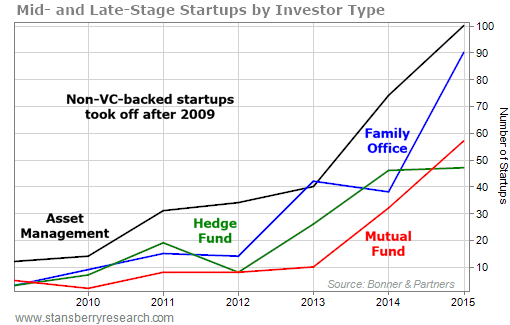
In 2009, the investments by non-venture capital entities such as mutual funds, hedge funds, family offices, and asset managers were mostly in the single digits.
By 2015, the number of investments made by these entities went through the roof.
In fact, by September 2015, 78% of the billion-plus financings were led by non-venture capital firms, up from only 60% a year before.
With so much money at play from these non-venture capital sources, it was necessary for these firms to invest in larger and larger private deals.
Each deal takes a lot of effort. For example, if a fund has $1 billion to invest in a given year, will it do 100 deals of $10 million, or 10 deals of $100 million? The answer is that it tends to gravitate toward a smaller number of larger deals.
This explains financing deals of $1.2 billion like Uber in August 2015. That fundraising valued Uber at around $50 billion at that time. It has since raised funds valuing the company at $62.5 billion.
All this is creating the most exciting investment opportunity of our lifetimes.
You see, this change in the financing of private technology companies has caused the entire technology IPO market to dry up over the last few years.
Great technology companies have been able to raise private capital in the hundreds of millions or even billions. They have been able to raise the growth capital privately without having to access the public markets.
The graphic below shows how much the IPO market for technology companies has slowed down.
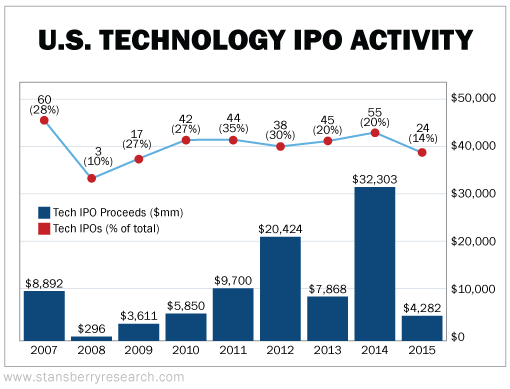
In 2015, there were only 24 technology IPOs, which represented just 14% of the year's total IPOs. These are the lowest levels seen since the financial crisis of 2008-2009. Pre-crisis in 2007, there were 60 technology IPOs responsible for 28% of total funds raised in the public markets.
And herein lies the opportunity.
This dynamic has caused a huge backlog of some of the greatest technology companies in history just waiting to go public.
Think of it like a massive bottleneck, or a dam that is ready to explode.
Venture capital investors, investment banks, hedge funds, and institutional investors invest in these private technology companies for only one reason... to make gigantic profits... to make 50... 100... even 200 times their money.
They are willing to be patient... to a point.
Eventually, the investors expect – or demand – an exit.
Exits sometimes come in the form of an acquisition by another technology company. But the really massive gains come from taking these companies public.
And normal retail investors are about to have a chance to invest in these next-generation technology companies.
I hope you're prepared. We have a chance to own the future. Let's take it.
Regards,
Jeff Brown
Editor's note: In his 25 years as a tech executive, Jeff has built startups... run billion-dollar businesses... and acted as an angel investor to several companies. In short, there's nobody more prepared to help you profit as dozens of privately held companies go public over the next year or two. He recently released a video presentation detailing this opportunity. To watch it – and to take advantage of a special, limited-time offer to sign up for Exponential Tech Investor – click here.