
More than $200,000 a share... More proof of the 'disappearing middle class'... Wal-Mart's fifth-straight quarterly sales decline... Strength in discount retailers... More evidence we'll see money printing in Europe... Why the Russian market hasn't fallen more...
 It's a bull market...
Shares of Warren Buffett's Berkshire Hathaway holding company hit a new all-time high today, crossing $200,000. (Berkshire has both "A" and "B" shares. The "B" shares are 1/1,500th of an "A" share.)
Berkshire is a conglomerate with businesses across all types of sectors: real estate, railroads, paint, carpet, insurance, clothing, food, jewelry, etc.
In other words, it's a good snapshot of the economy... And it's a sign that the economy is grinding higher.
And just for fun... If you had purchased shares of Berkshire Hathaway at inception in 1964 and held through the end of last year, you would have compounded your money (on a book value basis, Buffett's favorite metric) at 19.7% a year. That's a 693,518% cumulative return. And that number is only growing...
For comparison, the S&P 500 returned a still-impressive 9,841% over the same period.
But while the general economy is improving, some retailers are having a difficult time...
As we've written many times, the Federal Reserve's current economic policies are squeezing the middle class... Low interest rates allow the wealthy to borrow money cheaply to purchase stocks, real estate, etc. Prices subsequently rise, further enriching the upper class.
But rising prices kill the lower-income wage earners, who pay more for everything from rent to groceries, while their wages stagnate.
For an example of the "disappearing middle class," look at the latest earnings from department store Macy's...
Macy's is a bellwether for middle-class shopping habits. It's one of the largest retailers in the U.S. with 840 stores.
Yesterday, the company reported that second-quarter revenues and earnings fell short of analysts' estimates.
In the second quarter, revenue rose 3.3% to $6.27 billion versus a year ago, narrowly missing forecasts of $6.29 billion. This is after revenue fell about 2% in each of the last two quarters.
Second-quarter net income increased to $292 million (or $0.80 per share). That's up from $281 million (or $0.72 per share) in the same quarter a year earlier. But analysts forecast $0.86 per share.
As a result, Macy's lowered its outlook for the year. The company previously estimated same-store sales would be up 2.5%-3%. Macy's reduced that forecast to 1.5%-2%... which means offering discounts to attract shoppers.
"Customers still are not feeling comfortable about spending more in an uncertain economic environment," Macy's chairman and CEO Terry J. Lundgren said in the earnings announcement.
Discount retail giant Wal-Mart (WMT) reported quarterly earnings today... and its results further emphasize difficulties for low- and middle-class consumers.
Same-store sales fell 1.1%, but average ticket prices were up 1.1%, which suggests Wal-Mart is increasing prices to offset a decline in store traffic. The company also lowered its full-year earnings-per-share guidance from $5.10-$5.45 to $4.90-$5.15.
There were a couple bright spots in Wal-Mart's numbers... online sales and the "neighborhood market" – the company's small neighborhood grocery stores.
The neighborhood-market format is Wal-Mart's answer to local discount retailers like Dollar General (DG), which have been eating into Wal-Mart's margins.
The company reported that neighborhood markets saw a 5.6% increase in comparable store sales and a 4.1% increase in traffic. It opened 22 neighborhood-market stores during the quarter and remains on track to open 180-200 new units this year.
Wal-Mart also reported its global online sales increased 24%, with double-digit growth in the U.S., U.K., China, and Brazil.
And as Stansberry's Investment Advisory analyst Bryan Beach notes, Wal-Mart is still a great company. It made $3 billion after capital expenditures in the second quarter and has made $12 billion after capital expenditures in the last four quarters. It's hard to go out of business when you're generating that kind of cash.
Porter and the Stansberry's Investment Advisory research team have covered the "disappearing middle class" and the decline in traditional retail.
Consumers are turning to online retailers who often sell identical items cheaper than brick-and-mortar stores... Many consumers now use malls (or big-box retailers like Best Buy) to test products before ultimately purchasing online. We believe malls – along with many other forms of retail – will suffer.
In the February issue of Stansberry's Investment Advisory, Porter explained how to profit from America's obsolete malls, and explained their demise...
|
While malls and big-box retailers will struggle, there's one retail sector we're bullish on... As the consumer continues to struggle, he will turn to more local, discount retailers. And Dollar General is the best in the industry.
Dollar General makes the bulk of its profits selling household supplies, frozen food, and other consumer staples. It also recently introduced tobacco products to increase traffic. The company has 11,000 retail outlets around the country... And it plans to open another 700 stores this year. In other words, for most of America, it's easier to get to a Dollar General than it is to get to a Wal-Mart.
Dollar General shares rose about 1.5% today, partly because of the strength in Wal-Mart's neighborhood concept.
In a piece published in Forbes, Brian Yarbrough, a consumer-staples analyst for financial-services firm Edward Jones, discussed the strength of discount retailers...
|
More proof we're about to see massive money printing in the European monetary union... Germany's GDP shrank by 0.2% in the second quarter. Germany accounts for more than 25% of the European monetary union's output.
Inflation in the area fell to 0.4%. The European Central Bank (ECB) has a target of 2%.
Investors fled to safety on the bad economic data... German 10-year bonds now yield less than 1%... an all-time low. The market expects the ECB to keep rates low for years to come... And to date, the ECB's efforts to spark spending are clearly failing.
We explained why Steve Sjuggerud says the ECB will print more money – and why that will weaken the euro – in the August 12 Digest.
You may wonder why, despite the economic and geopolitical mess surrounding Russia, the country's stock market hasn't fallen more...
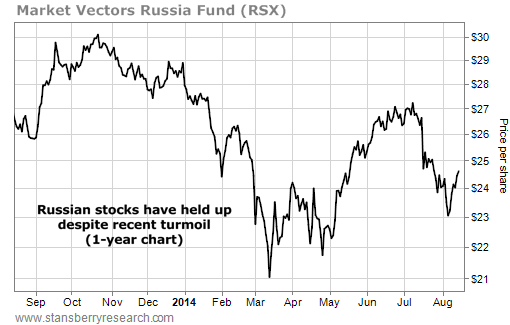 S&A Global Contrarian editor Kim Iskyan recently spoke to a Russian hedge-fund manager, who shared one important reason the market is steadying...
|
As Kim explains, you would think that Russian stocks would have fallen off a cliff, but you would be wrong. The Market Vectors Russia Fund (RSX), which holds a basket of Russian stocks, is down 6% over the last year. Meanwhile, the ruble – the country's currency – is down 9%.
|
So... who is doing the buying? In Russia during the 1990s, Kim says, it was well-connected businessmen who bought up Russian assets. But that has changed...
|
 New 52-week highs (as of 8/13/14): Brookfield Asset Management (BAM), Brookfield Property (BPY), Berkshire Hathaway (BRK), Consolidated Tomoka Land (CTO), Dolby Laboratories (DLB), Royal Gold (RGLD), Steel Dynamics (STLD), and ProShares Ultra FTSE China 25 Fund (XPP).
In today's mailbag, a few people write in telling us about their big winners following S&A's advice. Send us the stories of your big winners to feedback@stansberryresearch.com.
"I purchased Intel on 3/7/2013 following the recommendation in the March 2013 edition of The 12% Letter. The value of the stock is now up 56.59%. If dividends are included, then the gain is 62.77%. I still own the stock as this is a long term investment. Thanks for the investment recommendations, as well as the economic outlooks for the United States and the world." – Paid-up subscriber William Erickson
"In response to your asking in today's S&A Digest... my Stansberry-recommended top buys (in the past 3 years):
New 52-week highs (as of 8/13/14): Brookfield Asset Management (BAM), Brookfield Property (BPY), Berkshire Hathaway (BRK), Consolidated Tomoka Land (CTO), Dolby Laboratories (DLB), Royal Gold (RGLD), Steel Dynamics (STLD), and ProShares Ultra FTSE China 25 Fund (XPP).
In today's mailbag, a few people write in telling us about their big winners following S&A's advice. Send us the stories of your big winners to feedback@stansberryresearch.com.
"I purchased Intel on 3/7/2013 following the recommendation in the March 2013 edition of The 12% Letter. The value of the stock is now up 56.59%. If dividends are included, then the gain is 62.77%. I still own the stock as this is a long term investment. Thanks for the investment recommendations, as well as the economic outlooks for the United States and the world." – Paid-up subscriber William Erickson
"In response to your asking in today's S&A Digest... my Stansberry-recommended top buys (in the past 3 years):
| • | GOOG, bought May 2011, up 117% |
| • | ADM, bought Jan. 2013, up 78% |
| • | WFC, bought Feb. 2012, up 75% |
| • | JNJ, bought March 2011, up 74% |
| • | CSCO, bought Aug. 2011, up 67% |
| • | BDX, bought July 2012, up 63% |
"What have I bought with the profits? More winners (and an ocean-front home near Kapalua on Maui)!!" – Paid-up subscriber Dick
"[My top winner is] easily Cheniere (LNG), bought 4/7/12 for $14.99. Up 375% after commission." – Paid-up subscriber B. Rieder
Regards,
Sean Goldsmith
Baltimore, Maryland
August 14, 2014

Tech CEO: Why drone technology could explode in the near future...
Porter recently sat down and spoke with 3D Robotics founder and CEO Chris Anderson.
In today's Digest Premium – adapted from that conversation – Chris discusses the future of drones... their industrial and commercial applications... and why the technology is set to explode soon...
To subscribe to Digest Premium and receive a free hardback copy of Jim Rogers' latest book, click here.
Tech CEO: Why drone technology could explode in the near future...
Editor's note: From 2001 through 2012, Chris Anderson served as Editor in Chief for Wired magazine. He's a New York Times bestselling author and was named to the "Time 100," the magazine's list of the 100 most influential people in the world. In 2013, Time called him one of the 40 most influential minds in technology. Foreign Policy magazine named Chris one of its top 100 global thinkers. Today, he's the founder and CEO of 3D Robotics.
In today's Digest Premium – adapted from episode 174 of Stansberry Radio – Chris discusses the future of drones... their industrial and commercial applications... and why the technology is set to explode soon...
 Today, most drone users are consumers who are basically using GoPro cameras.
GoPro recently went public. The notion of recording your life in high definition is really taking off. This is, in many ways, a kind of "Golden Age" of personal videography and photography. We have these amazing tools within our reach to create cinematography about our own lives.
Putting these cameras in the air used to be hard. Now it's easy. So they have changed from a hobby into a creative tool on the consumer side.
Commercially, the big applications are going to be in data aggregation. Agriculture is a big one – using drones to scan your crops. Another example is 3D scanning. For construction and engineering, we will be able to use cameras to digitize the world around us, bringing things like buildings into the world that we can manage digitally.
We have a one-button building mapper where you touch a structure on a map on your phone and the drone takes off. It orbits around the building at several different altitudes, taking pictures the whole time, then stitches those pictures together into a 3D model. This helps you see the progress on a construction site.
Agriculture and construction are two of the biggest industries in the world. To use drones to bring Big Data to them is a huge commercial opportunity.
But there are three things standing in the way of drones going mainstream. One is that the products aren't ready. The second is that commercial use of drones is illegal in the U.S. But it's going to become legal in the U.S. soon... and it's not illegal outside of the U.S. The third barrier is the buying cycles and distribution channels. Each agricultural crop has different data standards.
Those are the three things we're all working on to get the commercial adoption. In the meantime, consumer adoption is exploding. So we're busy serving the consumers, and what works for consumers will work for enterprise. The "consumerization" of enterprise is a big theme across technology.
– Chris Anderson
Editor's note: Chris is speaking at S&A's Los Angeles Investment Conference on Saturday, August 23. He'll share his vision of the future in technology... And he will demonstrate one of the newest and most popular consumer technologies on stage.
Also presenting in LA are some of S&A's top analysts... master speculator Doug Casey... author and investment guru Mebane Faber... author and political commentator P.J. O'Rourke... and Silicon Valley entrepreneur and venture capitalist Kamal Ravikant. To learn how to secure your ticket, click here.
Tech CEO: Why drone technology could explode in the near future...
Porter recently sat down and spoke with 3D Robotics founder and CEO Chris Anderson.
In today's Digest Premium – adapted from that conversation – Chris discusses the future of drones... their industrial and commercial applications... and why the technology is set to explode soon...
To continue reading, scroll down or click here.