

Nearly Half of America Is at Risk
Nearly half of America is at risk... How to profit from the growing threat of cyberattacks... The 'Escher Economy' rolls on... Japan corners the ETF market... The eurozone's first 100-year bond is here... Introducing International Capitalist...
 It's one of the surest trends in the world today...
By now, you've likely heard the news...
Last Thursday, credit-reporting firm Equifax (EFX) warned it had been hacked, in one of the largest data breaches in history.
The company said hackers had stolen the personal information – including names, birth dates, Social Security numbers, addresses, driver's license numbers, credit-card numbers, and more – of 143 million Americans. That's virtually half the population of the entire United States.
The company quickly set up a website where consumers can see if they've been affected. And it's offering free credit monitoring for those who have. But it was little consolation for shareholders...
Equifax shares plunged on the news. They've now shed more than 30% of their value over the past five trading sessions. And allegations that several Equifax executives dumped $2 million worth of stock weeks before the company officially announced the breach suggests more trouble ahead.
But Equifax is just the latest in a long line of companies to fall victim to cyberattacks... In just the past few years, we've seen similar admissions from well-known names like JPMorgan Chase (JPM), Target (TGT), Anthem (ANTM), Wendy's (WEN), eBay (EBAY), AOL, British Airways, Zappos, Apple (AAPL), Yahoo, and many more. Even the U.S. government itself has been hacked.
These hacks can create huge headaches for consumers...
But they can cost companies billions of dollars, too. And unless we suddenly stop using the Internet for communication, entertainment, and commerce, the risks are likely to grow from here.
As our colleague Ben Morris told his DailyWealth Trader subscribers last fall, this means the demand for cybersecurity solutions is likely to soar as they do. As he wrote in the November 22, 2016 issue...
If you run a business, you're well aware of these threats. And you're likely trying to make sure your business isn't the next victim...
According to a new security spending report from the research firm International Data Corporation (IDC), governments and businesses are likely to spend $74 billion on cybersecurity this year. By 2020, that number is projected to jump to $102 billion. That's a 39% increase in annual spending over the next four years.
But Ben wasn't alone...
He also noted that several of the world's best investors are betting big on this trend. More from the issue...
Paul Singer, George Soros, and other top investors have taken big stakes in cybersecurity stocks...
Singer holds a spectacular long-term investment track record. He founded his hedge fund, Elliott Management, in 1977. And from that year through 2012, he averaged 14% annual returns with only two down years (out of 35). That was enough to turn $10,000 invested with him in in 1977 into $981,000.
Now, Singer manages $12 billion in investor funds... And at the end of last quarter, he had 7.5% of his fund's assets allocated to three cybersecurity companies. Just yesterday, one of his holdings, Symantec (SYMC), offered to buy another of his holdings, LifeLock (LOCK) for $2.3 billion...
Other top investors – like Jim Simons, David Tepper, and Paul Tudor Jones – all hold stakes in cybersecurity stocks, too.
Ben said his favorite "one click" way to invest in this massive trend was the First Trust Nasdaq Cybersecurity Fund (CIBR). More from Ben...
CIBR holds a basket of 33 companies that build and sell cybersecurity tools. To be included in the fund, businesses need to have a market value of more than $250 million. This differentiates CIBR from the PureFunds ISE Cyber Security Fund (HACK), which invests in smaller, more volatile, companies.
Most of the cybersecurity companies held by the gurus above are also part of CIBR.
As you can see in the chart below, CIBR is in a big uptrend...
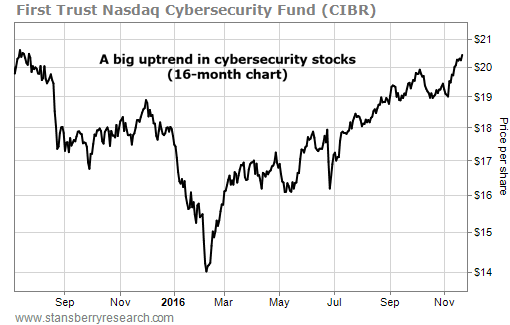
Because shares had already moved significantly higher last year, Ben recommended readers use a strategy known as "scaling in" to limit their risk. As he explained...
To limit risk further, we'll "scale in" to this position, buying in halves. For instance, if you would normally put $5,000 into cybersecurity stocks, you can buy $2,500 worth of CIBR shares today and another $2,500 in the future, if the uptrend continues. I'll let you know when to buy the other half of the position.
A few months later in March, Ben recommended buying the second half of the position. Subscribers who took his advice are up about 5% on the combined position so far. But Ben remains incredibly bullish...
While the gains to date have been modest, last week's news is a stark reminder that these threats have not gone away. Cybersecurity spending is all but guaranteed to move much higher in the years ahead... And these stocks could soar as it does.
Elsewhere in the markets, rampant central bank manipulation continues to produce mind-boggling new records...
Regular readers may recall Porter has dubbed this phenomenon the "Escher Economy." As he explained in the June 9 Digest...
In M.C. Escher's most famous paintings, the viewer can't figure out which way is up... In his painting "Relativity," a maze of stairs interconnects, each with a different gravity orientation. The paths wind and intertwine. There is no "up" or "down"...
When central banks around the world begin to spend trillions on financial assets, the same thing happens to the world's financial markets.

And he pointed to Japan's central bank – The Bank of Japan ("BoJ") – as a poster child of this disturbing trend...
Japan captured investors' attentions when it announced in 2012 that it would vastly increase the asset purchases of its central bank...
The bank wouldn't just buy Japanese government bonds... It would also buy equities. Lots of them: $30 billion or so per year. In an attempt to make sure these purchases weren't politicized, the bank explained it wouldn't buy stock directly (it wouldn't pick stocks). It would only buy via exchange-traded funds that allocate capital according to the structure of various preexisting indexes.
Last month, the BoJ's equity binge crossed a frightening milestone. According to Bloomberg data, the Japanese central bank now owns 75% of all shares in Japanese-listed funds.
In just the last five years, the BoJ has vacuumed up three out of every four ETF shares. At this rate, it won't be long before it owns the entire market.
We can't help but wonder what Japan will do then...
In the meantime, central banks continue to distort the bond markets as well...
How else could you explain yesterday's news that Austria is planning to issue the first 100-year public bond in the eurozone? As the Wall Street Journal reported...
Austria went ultralong Tuesday, when it launched new five- and 100-year government bonds – the first such deal to be sold into public markets in the eurozone...
Eurozone countries and companies have been able to raise cash for longer time periods because the European Central Bank's stimulus measures have pushed down bond yields and lowered borrowing costs across the euro area. Faced with a growing stock of low- and negative-yielding debt, investors have been forced into longer-dated bonds that offer the prospect of positive returns...
The initial price expected for the planned September 2117-dated bond is in the 60 basis points area above the yield of the domestic peer 1.50% February 2047 bond. The 2047-dated Austrian bond is trading at a yield of 1.52%, according to Tradeweb.
In other words, "investors" who buy this debt will be lucky to earn much more than 2% a year for the next century... meaning even a small increase in today's historically low interest rates could completely wipe out their returns.
Once again, we ask: what could possibly go wrong?
One last note before we sign off today...
Longtime readers may remember our friend and colleague Kim Iskyan. He used to write our high-end international advisory.
About a year ago, he moved his family more than 9,000 miles to Singapore to become the publisher for our new affiliate, Stansberry Churchouse Research. And today, he's launching a brand-new service...
As you'll see, it's not for everyone... And it's definitely not for the rent money.
It's focused on high-risk, high-reward investment opportunities in markets that are "off the radar"... in some of the most dynamic and fastest-growing economies on earth.
And Kim is the perfect analyst to head up this new venture... He has nearly three decades of experience – across more than 70 countries – finding high-upside investments in places that few people would think to look. As Kim says of this new project...
We're looking for ideas that can shoot up 500% to 1,000% or more – sometimes in a span of months – in parts of the world that are growing and changing at a super-fast pace.
I can tell you from personal experience: the growth opportunities outside the U.S. are just crazy. I've been "on the ground" to witness incredible changes in places like China... Thailand... Argentina... Sri Lanka... Macau... Zimbabwe... Iran... and dozens of other countries.
Bottom line: There are incredible gains available, all the time, outside the United States, if you just know where to look.
Best of all, unlike many international advisories, Kim says you won't have to send money to exotic brokerage houses. Most of what he recommends you'll be able to buy through your current online brokerage.
Right now, Kim is offering a special limited-time charter offer just for Stansberry Research readers. If you decide to try it, you'll also have the chance to join Kim on his investment-research trips. The first one is scheduled for early October. I can almost guarantee you've never been to this country... In fact, you may not even know where it's located.
As far as we know, there's nothing like this new service available anywhere else, at any price. You can learn more about it here.
|


New 52-week highs (as of 9/12/17): AbbVie (ABBV), AMETEK (AME), Baidu (BIDU), Biogen (BIIB), iShares MSCI BRIC Fund (BKF), Bristol-Myers Squibb (BMY), Celgene (CELG), CME Group (CME), DB Gold Double Long ETN (DGP), WisdomTree Japan Hedged Equity Fund (DXJ), Emerging Markets Internet & Ecommerce Fund (EMQQ), iShares MSCI Italy Capped Fund (EWI), iShares MSCI Japan Fund (EWJ), Barclays ETN+ FI Enhanced Europe 50 Fund (FEEU), Fidelity Select Medical Equipment and Systems Fund (FSMEX), CurrencyShares British Pound Sterling Fund (FXB), PureFunds ISE Mobile Payments Fund (IPAY), iShares U.S. Home Construction Fund (ITB), Coca-Cola (KO), KraneShares CSI China Internet Fund (KWEB), iShares MSCI China Index Fund (MCHI), Koninklijke Philips (PHG), ProShares Ultra Health Care Fund (RXL), Shopify (SHOP), iShares MSCI India Small-Cap Fund (SMIN), ProShares Ultra S&P 500 Fund (SSO), and TransCanada (TRP).
The new-highs list is surging, and the mailbag is light... Surely, that's just a coincidence. Let us know how you're doing at feedback@stansberryresearch.com.
Regards,
Justin Brill
Baltimore, Maryland
September 13, 2017