The first real day of trading in 2015 was a rough one...
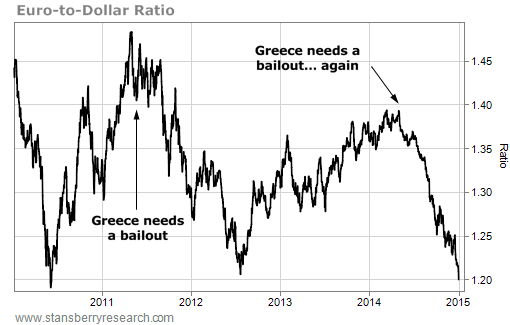
Both the S&P 500 and Dow Jones were down more than 1.8%. The euro hit a nine-year low of 1.19 versus the dollar amidst worries about Greece. Crude oil fell to less than $50 a barrel for the first time since April 2009. And to pile on to one of our favorite whipping boys,
Brazilian state-owned oil giant Petrobras is down nearly 8.5% to nearly $6 a share. Shares are down 70% since September.
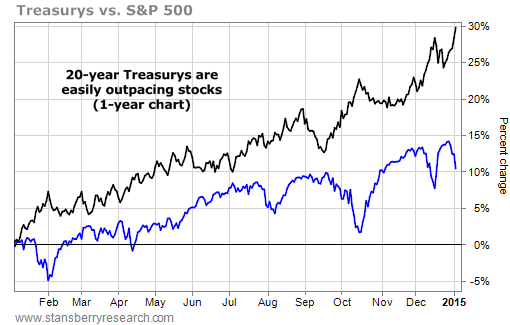
Meanwhile, yields on the 10-year Treasury are down to 2.05% (and likely heading lower)... and the U.S. dollar continued its ascent.
We'll first discuss the continued downtrend in the euro and the ongoing problems with Greece...
The European Central Bank (ECB), the European Union (EU), and the International Monetary Fund (IMF) want to impose austerity on Greece in return for the 245 billion euros in bailout loans Greece has received since 2010.
But the far-left Syriza party (whose leader, Alexis Tsipras, vows to end austerity) is gaining popularity in Greece... Opinion polls show Syriza is ahead of the incumbent conservatives led by Prime Minister Antonis Samaras. The country will hold early elections on January 25.
There are really only two outcomes in Europe today: Greece exits the euro, or the ECB prints more money. Both scenarios lead to further weakness in the euro.
If Syriza wins, Greece defaults on its debt and will likely leave the European currency union.
The Germans – who oppose further bailouts – are saying the European currency union can handle the shock of a Greek exit. (Governments haven't been the best predictors of future financial outcomes. We doubt that has changed lately.) From Yahoo Finance...
|
The German government believes that the euro zone would now be able to cope with a Greece exit if that proved to be necessary, Der Spiegel news magazine reported on Saturday, citing unnamed government sources.
Both Chancellor Angela Merkel and Finance Minister Wolfgang Schaeuble believe the euro zone has implemented enough reforms since the height of the regional crisis in 2012 to make a potential Greece exit manageable, Der Spiegel reported.
'The danger of contagion is limited because Portugal and Ireland are considered rehabilitated,' the weekly news magazine quoted one government source saying.
|
|
It's ludicrous to state with any certainty that something of this magnitude and complexity won't matter... There are too many unknowns surrounding a Greek exit. And markets hate uncertainty. Even if the European currency union were able to handle a Greek exit, there would undoubtedly be pandemonium before everything worked itself out.
On a separate note, it's even more ludicrous to consider Portugal and Ireland to be fiscally sound... Not to mention that Spain could easily be the next country to fall.
Still, Michael Fuchs – a leading member of German Chancellor Angela Merkel's party – used even stronger language toward Greece when speaking with the Rheinische Post newspaper last week...
|
The times where we had to rescue Greece are over. There is no potential for political blackmail anymore. Greece is no longer of systemic importance for the euro.
|
|
On the other end of the spectrum, German publication
Der Spiegel thinks a Greek exit
does matter a lot...
|
All of Europe would plunge into a deep recession. Governments, which would be forced to borrow additional billions to meet their needs, would face the choice between two unattractive options: either to drastically increase taxes or impose significant financial burdens on their citizens in the form of higher inflation.
|
|
The truth is that nobody knows what will happen if Greece exits the euro. We do, however, know Greece will never be able to repay its 245 billion-euro "loan." And that money only further indebts an already-struggling European economy.
Ultimately, the only answer is for Greece to leave the euro. Regardless, market participants won't wait to see what happens. They will simply dump the euro.
Of course, there was really no need to spend hours researching the latest news in Europe. After all, we've been here before... and written about this before. It's the curse of money-printing central bankers manipulating the global economy, washing over all our problems with debt. The problems don't disappear... They're just kicking the can down the road for a few years, when they will reappear, bigger and uglier than before.
As Porter wrote in the May 2011 issue of Stansberry's Investment Advisory (in the midst of the European currency union crisis)...
|
Europe has two possible courses of action... either will destroy the euro... while making us a nice profit. The first course of action is for the ECB to buckle and give Greece another bailout. (Greece is looking for 30 billion euros.) If that happens, we will see the euro slide again. The reason is simple. A bailout means money-printing. That devalues a currency. It also reminds investors the strength of the currency they are holding is only as good as the strength of the economy behind it.
The ECB isn't doing so well. Greece is back for round two. Ireland and Portugal are suffering. This time, the euro may slide even further than $1.20. If Spain goes, look out below. As we've explained before, the euro bailout fund is nothing but empty promises from bankrupt countries. The only way to bail out Europe is to pull a "Bernanke" – print, baby, print.
Regardless of how the situation is handled, it won't solve Greece's problems. Greece has a solvency problem... not a liquidity problem it can fix with a few extra euros. The country is essentially bankrupt...
This brings us to the second course of action: Greece leaves the euro. This is really the only ultimate course of action. It gives Greece one huge new advantage: It allows it to have its own currency that can be valued by the markets according to its specific economic conditions and managed by its own central bank.
|
|
This chart of the euro also tells the same story...
It's clear that today, what's bad for the euro is great for the dollar...
Foreigners piled into Treasurys last year, buying a net $284 billion over the first nine months of 2014, according to Jonathan Rick, an interest-rate derivatives strategist for French bank Crédit Agricole. That's far more than the $83.2 billion over the same period in 2013. But it's still much less than it was during the 2008 crisis and 2011 European currency union crisis.
Yields on the 10-year Treasury are approaching 2%. As we've noted in the Digest, compared with other sovereigns, U.S. Treasury yields have room to fall.
Today, 10-year British debt yields 1.67%, Spanish bonds yield 1.61%, German bunds yield 0.52%, Swiss bonds yield 0.33%, and Japanese bonds yield 0.32%.
Bond expert Jeff Gundlach thinks Treasury yields could fall to less than the low of 1.38% from 2012. He told
Barron's that lower oil prices will drag yields down. And foreign buying has filled the gap left from the Federal Reserve's exit. As he told
Barron's...
|
The answer, of course, is that foreign buying easily replaced declining government support of the market. And the strengthening dollar, which we think will continue, only makes U.S. bonds all the more attractive, for not only do foreign investors benefit from higher relative rates, but they also win on currency translation profits.
|
|
As we expect the downtrend in the euro to continue, we also expect further strength in the price of Treasury bonds (remember, prices and yields move in opposite directions)...
True Wealth editor Steve Sjuggerud thinks this year will also see big gains in China...
We discussed why Steve is bullish on China in the
December 15 Digest. In short, the Chinese government wants its market to boom... It's loosening regulations to encourage Chinese investors to buy local shares. And the government may cut interest rates and consider further stimulus to boost a slowing economy.
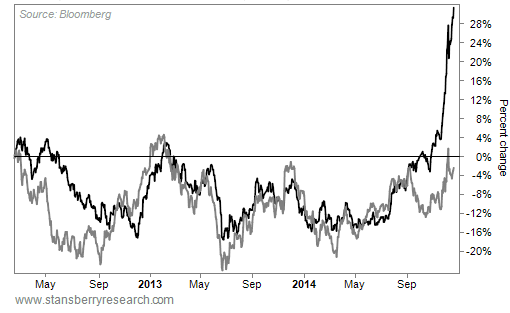
The Shanghai Composite index jumped 3.6% today. (It was up 50% last year, versus an 11% gain in the S&P 500.) And the Deutsche X-trackers Harvest China A-Shares Fund (ASHR) – which Steve holds in his True Wealth portfolio – hit a new 52-week high. True Wealth subscribers are up nearly 50% on the recommendation since September.
Steve thinks the Chinese market will soar even higher. He believes triple-digit gains are on the way.
And in the latest issue of True Wealth, he showed his subscribers another way to profit in Chinese stocks. It's a way to buy some of the biggest and best companies in China. And as you can see, these companies (the gray line in the chart below), which normally track the Shanghai Composite (the black line), are lagging today...
Steve believes this recommendation will also be a triple-digit winner. As he wrote...
|
When a great China bull market gets underway, the sky is the limit. And my friend, a great China bull market is now underway!
|
|
It's not the top of a bull market until everyone has bought in. Steve recently appeared on Bloomberg Radio to discuss Chinese stocks. The talking heads were understandably skeptical. But Steve was right. You can listen to Steve's clip for free
right here.
And to access Steve's latest recommendation, you can sign up for a risk-free $39 trial subscription to
True Wealth by
clicking here.
New 52-week highs (as of 1/2/15): Deutsche X-trackers Harvest China A-Shares Fund (ASHR), Esperion Therapeutics (ESPR), and Osisko Gold Royalties (OR.TO).
It's a new year, and some subscribers are thanking us for a great performance in 2014. How did you perform? Let us know at
feedback@stansberryresearch.com.
"Hello, I am a lifetime Stansberry subscriber since the beginning of this year and am more than satisfied with your research. The
Stansberry's Investment Advisory is factual, logical and well written allowing me to make better decisions on your recommendations. Consequently, my total SEP IRA portfolio is up +27% this year, yet I have only had at most 10-15% of it in play, with the remaining in cash! Thank you and keep up the great research.
"I would also like to thank you for the free book The Death of Money by James Rickards. I could not put it down and read in in just two days. Mr. Rickards really enlightened me on the complex subject of current world finance, which I have been eager to understand for a long time. I now have a much clearer picture of where the world central bank follies are taking us, and am way better prepared for the inevitable outcome now. I have 'anecdotally' suspected that they were creating future problems for us common citizens through artificial market/asset stimulus. Because of his writing, I feel much better prepared to further grow and protect my retirement savings, despite when this bubble also bursts." – Paid-up subscriber Art Laursen
"I did a year-end assessment of my portfolio and was pleasantly surprised at the results (more candidly, I was shocked). I just completed my first full year of subscribing to Stansberry Research, actually only the last 8 months as an Alliance member, and have spent countless hours reading everything you have published about investing. So you can imagine my delight to find that my 24% overall return on my biggest portfolio winners had been Stansberry recommendations. 76% of that gain was from
Extreme Value and
Income Intelligence/
Retirement Millionaire recommendations; the other 24% from
Stansberry's Investment Advisory and
True Wealth. Because I was a new subscriber I was not invested in their old winners dating back a few years... just the ones recommended during 2014; and of those I only selected the ones that fit my investment goals.
"This was very important to me because I felt like I was taking on a lot of risk by choosing the self-directed route for our IRA vs. handing off the 'farm' to a fund manager. And kudos to Stansberry Research for all the detailed explanations for the 'how' and the 'why' that gave me the confidence to implement their advice. I have to admit that I also checked out several other investment research companies simultaneously, but frankly, nobody else does it as comprehensively in a way that is easy to understand as Stansberry. Thank you and keep up the good work. We are out there listening." – Paid-up subscriber Elaine Dorcheus
Regards,
Sean Goldsmith
January 5, 2015