
 The grandest monetary experiment of the modern age ends today…
The Federal Reserve announced it will end the third round of quantitative easing (QE).
The central bank announced it would halt its final $15 billion of monthly bond purchases, closing out a nearly six-year program.
The Fed said there has been "a substantial improvement" in the labor market and it sees "sufficient underlying strength" in the economy.
It will continue to reinvest principal payments back into agency mortgage-backed securities.
It will also roll over the maturing Treasurys it holds to "help maintain accommodative financial conditions."
Still, the Fed's balance sheet stands at a record $4.45 trillion…

True Wealth editor Steve Sjuggerud has been updating readers on his "script" for the U.S. economy since the Fed announced it would begin QE in 2008.
He correctly predicted bond purchases and low interest rates would send asset prices – everything from stocks to real estate – soaring. He called it the "Bernanke Asset Bubble."
To date, QE has achieved its desired goals. As we noted, asset prices soared. Since QE3 began two years ago, the unemployment rate has fallen from 8.1% to 5.9% today. And the Fed hit its goal of 2% inflation… the consumer price index (CPI) is currently at 2.1%.
As we've been saying for years, the U.S. economy is slowly improving. In addition to more jobs, banks are lending more money… And people are spending more money. Construction spending is growing. U.S. oil production is at a record high.
In today's DailyWealth, Dr. David "Doc" Eifrig explained why you should ignore the fear in the market and media today… And he shared the bullish signs from some of his favorite market indicators.
Still, as we saw with the recent market volatility, things are fragile… People are scared. And the Fed can't be too aggressive in tightening monetary policy for fear of a market correction. That's why we expect the Fed will keep interest rates near zero for a while longer.
In the November issue of True Wealth, Steve described the most likely outcome…
|
Most folks believe higher interest rates mean the party is officially over, and that the five-year bull market we've enjoyed will end. But that's not the case.
As Steve wrote in the June 27 DailyWealth…
|
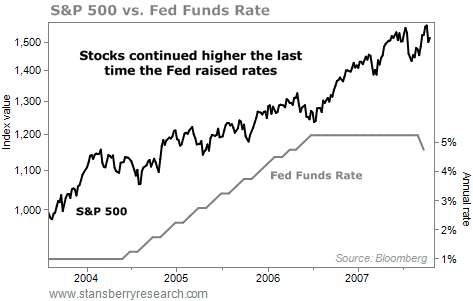
In fact, over the last 30 years, every time rates have gone up, stock prices have gone up, too. When interest rates rise, people take it as a sign that the economy is doing better… so they buy stocks.
As Steve explained in the September 30 DailyWealth, each time, the market has followed a specific pattern…
|
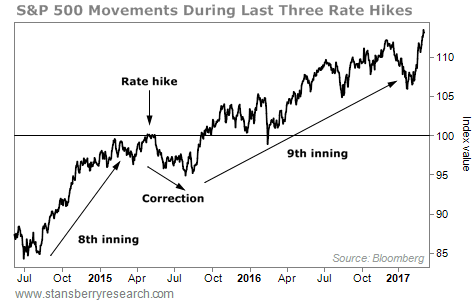
And in the latest True Wealth Systems Review of Market Extremes – out today – Steve gave another indicator that this bull market still has legs…
|

As we explained yesterday, Steve says, "If you catch one biotech bull market, you may never have to work again."
Since 2012, Steve has traded biotech stocks twice in True Wealth Systems. In January 2012, he went long and subscribers made 56% in 10 months. A month later, in December 2012, he went long again… This time, True Wealth Systems subscribers made 184% in just 16 months.
Today, Steve's True Wealth Systems indicators say biotech is once again a buy. It's cheap… The market is ignoring these stocks following a big selloff… And they're in the midst of a major uptrend.
Steve's predicting another triple-digit winner for investors who buy into the biotech rally now.
To find out exactly how Steve recommends playing biotech today, you need to sign up for True Wealth Systems. And we're giving away a free year of True Wealth Systems to anyone who signs up before midnight Eastern time tonight. Learn more right here.

New 52-week highs (as of 10/28/14): Apple (AAPL), ProShares Ultra Nasdaq Biotechnology Fund (BIB), Brookfield Property (BPY), Chubb (CB), CDK Global (CDK), CVS Health (CVS), Fidelity Select Medical Equipment & Systems Fund (FSMEX), Leggett & Platt (LEG), 3M (MMM), Nuveen Municipal Opportunity Fund (NIO), Pepsico (PEP), Procter & Gamble (PG), ProShares Ultra Health Care Fund (RXL), Travelers (TRV), UIL Holdings (UIL), Union Pacific (UNP), ProShares Ultra Utilities Fund (UPW), and SPDR Utilities Select Sector Fund (XLU).
Another quiet day in the mailbag, where one subscriber asked about our preferred methods for tracking trailing stops. Send your missives to feedback@stansberryresearch.com.
"So what is one to do? I place my trades (and trailing stops) online. So the same thing can happen? Correct? Are there any other options for this issue?" – Paid-up subscriber Coleman
Goldsmith comment: As we explained yesterday, entering your stops in the market is like playing poker with your hand showing. It makes it easy for market makers to take advantage of you. But there are plenty of ways to set alerts to track your stop losses easily.
You can write down your trailing stop on a piece of paper and simply check prices after market close to see if you're still in a trade. Or if you're good with computers, you can create a spreadsheet where you enter in prices and have the program calculate your stops.
Alternatively, you can track stops with your online broker. It's important that you don't ender a stop order… You should simply enter an alert. If you have trouble finding that page on your broker's website, call up their customer service and have them walk you through how to set it up.
Of course, our preferred way to track trailing stops is through our corporate affiliate TradeStops. This service will track your trailing stops with ease. It even imports your information directly from your broker. You can learn more about TradeStops right here.
Regards,
Sean Goldsmith
October 29, 2014
 Most people I (Brett Aitken) speak with have all their assets – including cash, stocks, real estate, etc. – in the country where they live.
It's not unique to any one country, either. People in Australia only buy Australian stocks. Greeks buy Greek stocks. Our friend Meb Faber from Cambria Investment Management said back in April that U.S. investors hold around 70% of their wealth in their home market. This is called "home-country bias."
But given the world we live in today, that doesn't make sense. The Internet has made buying international stocks much easier for the individual investor. Brokers offer stocks on most major exchanges around the world. You might have to pay a little extra in commissions, but everything else is the same as buying a stock in the U.S.
And yet, people seem to fear foreign stocks. It should make no difference to you where a company is located if it makes for an attractive investment.
Because the U.S. has thousands of stocks to pick from, some investors think they don't need to look to international stocks. Other people argue that McDonald's and Apple have global exposure. It's true that many large companies do business all over the world. But that's not exactly the same as holding a stock that generates most of its business in euros or another currency.
So if you're holding all of your assets in one country, you are completely exposed to the U.S. dollar, euro, or whatever that country's currency is. It's prudent to hold some of your cash in other nations' currencies.
The same goes for stocks. For one, they give you exposure to other countries' economies. And right now, dozens of countries' stock markets are trading for much cheaper prices than the U.S. markets. There is greater upside in some of those markets.
In Stansberry International, we track almost 50 different countries. Right now, the U.S. doesn't appear in the top 40 cheapest markets in terms of value. But other markets offer tremendous value today… and therefore, there's good reason to look for investment opportunities in global markets.
We look for countries coming out of a crisis, with an improving economy, where things are starting to get a little "less bad." That's when you want to invest… when there is still value and you can ride the trend upward as conditions return to normalcy.
– Brett Aitken
Why your portfolio should have international exposure…
If you're like most U.S. investors, your cash, stocks, bonds, real estate, and other assets are likely 100% exposed to the U.S. economy. In today's Digest Premium, Stansberry International editor Brett Aitken explains why that's dangerous…
To continue reading, scroll down or click here.