
Revisiting the most hated company in the market... We could soon see a major 'short squeeze'... Heinz and Kraft Foods are merging... Buffett and 3G strike again... This is what happens when money is free... A company to own with a soaring dollar... Doc's third video just hit the air...
 We introduced you to "the most hated company in the market" in the January 16 Digest: Stansberry's Investment Advisory recommendation Sears Holdings (SHLD).
Two months earlier, Barron's interviewed 100 brokers... 99 of them told the magazine they would never buy the stock. No other stock had more than 60 thumbs down.
For the full story on Sears, be sure to read that Digest. We'll give you a brief overview today.
While most of Wall Street saw a failing retailer destined for bankruptcy, the Investment Advisory research team saw a hidden gem. They believed Sears' chairman – billionaire investor Eddie Lampert – was selling off assets to pay large dividends to shareholders... and liquidate the business in preparation for spinning Sears' real estate assets into a real estate investment trust (a "REIT").
Porter was clear that this recommendation was a speculation...
|
But as you can see from the following chart, things are working well so far...
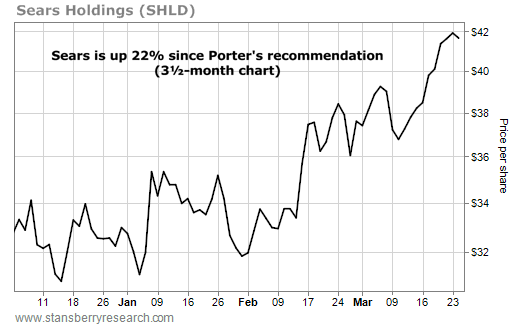
Earlier this month, Porter's team sent subscribers a special update on Sears. Everything is happening as planned, but they're tightening the stops. As Porter explained, "There's no reason to let a profit on a speculation turn into a loss."
There's still plenty of upside in Sears shares today. As they explained in the update...
|
Porter explained the new exit strategy in a recent episode of his Stansberry Radio program...
|
On the show, Porter recommended setting a hard stop at the price subscribers paid to open the position. He also told subscribers to sell if shares close at more than $50 a share... which would represent a gain of more than 50% from Investment Advisory subscribers' entry price of around $32.75.
We'll continue to update you as the Sears Holdings saga plays out.
The biggest story in mainstream media today is Heinz's acquisition of food giant Kraft Foods.
Brazilian private-equity firm 3G Capital (which owns Heinz) put the deal together. It was reportedly valued at $45 billion. Investment legend Warren Buffett, who has invested with 3G in the past (including the Heinz deal), also invested in Kraft. He told CNBC this morning that he'll own about $9.5 billion in the combined company's shares and plans to "be in this stock forever." He continued...
|
3G Capital is a master operator... It owns Anheuser-Busch InBev, Burger King, Tim Hortons, Heinz, and soon, Kraft. The company comes in, slashes costs, and improves the bottom line. We'll undoubtedly see major layoffs at Kraft as part of this.
We won't get into the details of the transaction. Instead, we'll simply note these types of deals are a function of the economic environment we're in today. When capital is free, there's nothing stopping private-equity firms from levering up and acquiring larger and larger targets.
Before the end of this cycle, we expect to see more big-name companies changing hands.
And we don't blame these investors. There's no doubt that "Buffett-esque" investing is en vogue today. For years, we've sung the praises of buying and holding stock in dominant companies with great brands – so-called "World Dominators" or "capital-efficient" businesses.
As Porter explained in the December 19 Digest, owning these types of businesses is one of the best ways to generate steady profits over a long period of time...
|
Porter noted that far more important was the fact that Berkley maintained its underwriting discipline and paid a special $1-per-share dividend...
|
In yesterday's Digest, we wrote about the effect that a strong dollar has on U.S. stocks. If a strong dollar shrinks margins for U.S. companies that sell goods abroad, what types of companies do you want to own in this environment?
As we noted yesterday, some investors are buying small-cap U.S. companies that generate the vast majority of their sales in the U.S. – like independent oil and gas firms and domestic companies like Southwest Airlines.
This currency environment is also a boon for European companies that manufacture their goods domestically (taking advantage of the low euro) and sell to economies with stronger currencies like the U.S. and China.
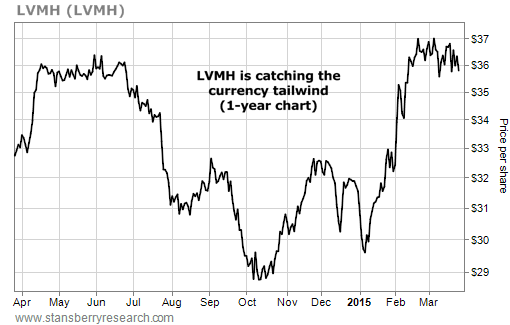
One example of this is Paris-based luxury goods conglomerate LVMH. The company owns brands like Dom Perignon (champagne), Bulgari (jewelry), and Louis Vuitton (fashion). LVMH generated 24% of its sales in the United States. Asia (ex-Japan) made up another 29% of sales.
Companies like this see their manufacturing costs plummet thanks to a weak euro. And they make even more money as they convert their U.S. dollar sales back into euros.
As you can see, the strong performance is reflected in the stock price...
One last note... Dr. David "Doc" Eifrig is releasing his third free video today explaining "The Eifrig Method" – the secret behind his 99% win rate in Retirement Trader.
We discussed the opportunity in more detail yesterday. In short, Doc is bullish on the economy today. He thinks buying stocks after a selloff will lead to big gains.
That's why right now is the perfect environment for selling put options.
Also, remember, Doc is hosting a live training session at 8 p.m. Eastern time tomorrow. He'll discuss the methods and secrets behind his trading strategy... And you'll also have the opportunity to ask him questions live.
This is always one of the most popular training sessions we host. If you haven't seen Doc before, I urge you to sign up. It's completely free. You can access the three videos we've released and sign up for Thursday's live free event by clicking here.
New 52-week highs (as of 3/24/15): WisdomTree Japan Small-Cap Dividend Fund (DFJ), Expeditors International of Washington (EXPD), iShares Core S&P 500 Small-Cap Fund (IJR), and SPDR S&P International Health Care Sector Fund (IRY).
A reader writes in with a question about holding cash. How much of your portfolio is in cash today? Let us know at feedback@stansberryresearch.com.
"In the January 27 Digest you recommended having 'enough cash to pay all your living expenses for a year' in the event there is a huge stock market crash this year. At the risk of sounding like a complete idiot, could you please define what having 'cash on hand' means? Does this mean keeping it in a checking or savings account, buying CDs, putting it under your bed, etc.? Thanks so much." – Anonymous
Goldsmith comment: It depends on your financial situation. If you have a substantial net worth with high living expenses, you would want to park that cash in Treasury bills. But if you're an average person, a combination of a bank account and some cash in your home will suffice.
Regards,
Sean Goldsmith
March 25, 2015
