
The Fed is confused... The bullish case for Europe... Negative bond yields or 3% dividends?...
 Markets soared yesterday after Federal Reserve Chair Janet Yellen's announcement...
As expected, the Fed removed the term "patient" when discussing its timeline for raising interest rates. As Yellen said...
|
The Federal Open Market Committee said it probably won't raise rates in April. But it will look to raise rates "when it has seen further improvement in the labor market and is reasonably confident that inflation will move back to its 2% objective over the medium term."
And while the Fed changed its forward guidance, the change "does not indicate that the Committee has decided on the timing of the initial increase in the target range."
The Fed also said the economy had "moderated somewhat," a step down from when the economy was "expanding at a solid pace" in January.
As we've said many times, the Fed is orchestrating the grandest monetary experiment in history... And it has no idea how it will end.
In short, the Fed is driving blind right now. Its garbled language is only meant to allow for maximum flexibility. Maybe we'll raise rates (strengthening an already-soaring dollar). Maybe we won't. We'll see what happens.
What's important is the precedent this sets. If the Fed raises rates and things go south, it has more room to cut again. The Fed – along with nearly every other central bank in the world – stands ready to ease.
Hanging onto every word of a confused group of Fed governors for clues about the future of our economy is a waste of time. They have no better guess than you or I do.
But one thing we know for certain is that printing trillions of dollars to boost stock markets works. Fighting the Fed (or any central bank hell-bent on quantitative easing) is futile.
Former Fed Chairman Ben Bernanke's efforts led the S&P 500 to triple. Now, European Central Bank head Mario Draghi is carrying the torch.
That's why it's time to get bullish on Europe.
We've been writing about the opportunities in European equities for years now. And as you can see, the trend has been up...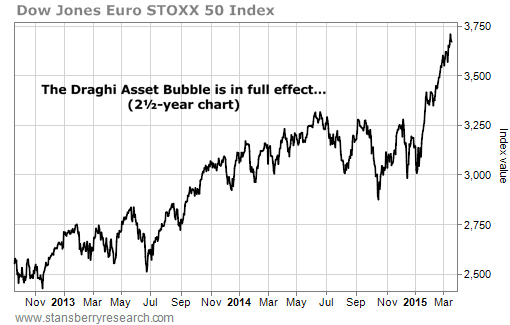
The bullish case for Europe was (and remains) simple: European stocks are cheaper than their U.S. counterparts. Dividend yields are high. Bond yields in Europe are at record lows (and in many cases, negative). And the ECB just launched a program to buy $1 trillion in government bonds.
For more on the bullish argument, be sure to read the March 16 Digest. True Wealth editor Steve Sjuggerud noted that European stocks yield 3.9%, while bonds yield next to nothing. The last time German stocks yielded more than German bonds was 2008. German stocks doubled in two years after bottoming in 2009. (Germany is Europe's economic engine.)
All you need to know is that the table is set for a massive rally in European stocks.
DailyWealth Trader co-editors Brian Hunt and Ben Morris discussed the opportunity in European stocks today.
While the Dow Jones Euro STOXX 50 Index – Europe's Dow Jones – is up 17% so far this year, there's still room to run higher. The index includes large-cap companies like brewer Anheuser-Busch InBev and British consumer-goods giant Unilever. As Brian and Ben explained...
|
The catalyst for further gains is Draghi and his printing press. More from DailyWealth Trader...
|
European equity dividend funds have seen their largest inflows since 2008 – $10.2 billion from January 1 through March 11, according to data firm EPFR Global. That compares with a total of $7.7 billion in all of 2014. In less than three months, European stocks have attracted more capital than all of last year.
I pulled the following quotes from a Wall Street Journal article about the popularity of European equities today. These quotes are eerily similar to what we heard about (and we wrote about) U.S. stocks just before takeoff...
|
German 10-year bonds ("bunds") hit a record-low yield of 0.18% today... And 25% of the bonds eligible for ECB purchase sport negative yields. As these yields go lower and lower, stocks only become more attractive.
The ECB also reported that European banks borrowed 97.8 billion euros in four-year loans from the central bank to start lending to the private sector. Analysts were only expecting banks would borrow 50 billion to 60 billion euros. This means "eurozone" banks see more opportunities for lending. They're going to turn on the credit spigot.
Our bet? Much of this capital finds its way from negative-yielding bonds into European stocks.
New 52-week highs (as of 3/18/15): AllianceBernstein (AB), American Financial Group (AFG), Deutsche X-trackers Harvest A-Shares Fund (ASHR), ProShares Ultra Nasdaq Biotech Fund (BIB), Bristol-Myers Squibb (BMY), CDK Global (CDK), WisdomTree Japan SmallCap Dividend Fund (DFJ), Esperion Therapeutics (ESPR), Expeditors International of Washington (EXPD), iShares Core S&P Small-Cap Fund (IJR), SPDR S&P International Health Care Sector Fund (IRY), Eli Lilly (LLY), ProShares Ultra Health Care Fund (RXL), Travelers (TRV), Walgreens (WBA), and Alleghany (Y).
In today's mailbag, a subscriber asks how to protect himself with low-risk investments in today's dangerous market. Send your thoughts to feedback@stansberryresearch.com.
Am I understanding you correctly from the March 17 Digest on imploding commodities as well as the January 26 Digest on imploding currencies, that if (when) the USD starts to decline that the euro, yen, CAD, AUD etc., gold, and commodities will all rise? And where should investors then, especially foreigners (I'm Canadian), be putting their money if the USD (and the value of even the most conservative/safe U.S. stocks, held by foreigners) could collapse any day, yet sitting in cash (CAD) or gold are both declining, and who knows when that may stop. To me it seems, even with proper asset allocation, that there really isn't anywhere that is low risk right now. Thanks in advance for the ongoing excellent education!" – Paid-up subscriber L. Dueck
Goldsmith comment: A long-term decline in the dollar would lead to a long-term uptrend in gold. As for foreign currencies like the Japanese yen and the euro, if the governments that manage those currencies continue printing money, they will also fall relative to gold. That's what we're seeing right now.
No matter what the environment, our general asset allocation advice is the same: Own capital-efficient businesses purchased at reasonable prices. Own some physical gold. Own some real estate. Hold some cash. If you're an experienced investor, consider allocating some capital to the short side of the market. (These are positions that profit as stocks fall.) You don't want to place huge, concentrated bets in this environment... stay diversified.
Regards,
Sean Goldsmith
March 19, 2015
