
Why this billionaire hedge-funder is wrong to doubt IBM…
Billionaire investor Stanley Druckenmiller recently told Bloomberg tech giant IBM is "one of the more higher-probability shorts I have seen in years."
In today's Digest Premium, Extreme Value editor Dan Ferris explains why Druckenmiller is wrong...
To subscribe to Digest Premium and receive a free hardback copy of Jim Rogers' latest book, click here.
The 'Final Nail' for the dollar... The yuan overtakes the euro... A Bitcoin bubble?... David Tepper is going long... Why Steve likes Asia today...
 On stage in Singapore last month, Porter updated S&A Alliance conference attendees on his End of America thesis...
Porter contrasted Singapore – a capitalist's dream with low taxes, low inflation, and high per-capita gross domestic product – with America.
You know the story, so we won't go into detail here... But the U.S. has borrowed and printed its way to the poorhouse.
Porter's last slide was titled "The Final Nail?..."
It contained a headline from a Bloomberg article published on October 10, 2013 – "ECB Agrees on Swap Line with PBOC as Trade Increases."
The article explained how the European Central Bank (ECB) and the People's Bank of China (PBOC) agreed to a direct swap – bypassing the dollar – as trade increases between the two areas. You can read the article here.
China is the European Union's second-largest trading partner behind the U.S. The EU exported 71.4 billion euros worth of goods to China in the first six months of this year and imported 133.6 billion euros, according to data from Eurostat, the European Union's statistical office.
The implications for the dollar are severe... Because the dollar is the world's reserve currency, foreign nations must change their money to dollars before transacting. This agreement between the ECB and China – which lasts for three years – pushes the dollar out of the equation and strengthens the yuan.
And it's working...
The Society for Worldwide Interbank Financial Telecommunication (SWIFT) is an organization that enables transfers between large financial institutions and corporations. (Think of the SWIFT code you use when sending and receiving wires.) According to SWIFT, the yuan today surpassed the euro in trade. It's only bested by the U.S. dollar.
We expect the trend to accelerate...
While on the topic of currencies, we'll take a moment to discuss the currency "du jour," Bitcoin...
We dedicated the November 27 Digest to the virtual currency... Bitcoin now trades for $1,000. But we would like to issue one clarification.
Proponents say the supply of Bitcoin is limited to 21 million units for now. (Of course, as we've seen with the U.S. dollar, these things can change.) Also, the financial reward for "mining" transactions will halve every four years until it reaches the smallest functional unit and the reward becomes zero. The self-regulating algorithm ensures steady supply growth. At the current rate, all 21 million Bitcoins will be created by 2140.
Our friend Mebane Faber, portfolio manager at Cambria Investment Management, created a chart showing Bitcoin (which has risen over 400% in the past month and over 7,500% in one year) versus another asset that went parabolic – stock in the South Sea Company. You can read Mebane's piece here.
A brief bit of history... The South Sea Company was a British company formed in 1711. It was a public-private partnership created to consolidate and reduce the cost of Britain's national debt. It also had the monopoly on trade with South America.
Stock in the South Sea Company also formed one of the great bubbles in history.
Meb's charts showed the rise in the value of bitcoins mirrored almost exactly the rise in South Sea stock, both in heights they reached and the speed at which they got there. Then, Meb explained what happened to South Sea shares…
|
We don't know where Bitcoin will go from here... But it is certainly exhibiting classic "toppy" behavior. The currency has gone parabolic (currently trading at $1,066). It's everywhere in the press... And the "cocktail-party indicator" is buzzing.
Whenever people learn I cover the financial markets, all they want to talk about is Bitcoin. Over the Thanksgiving holiday, I discussed it on the airplane home, at a wedding, and at Thanksgiving dinner.
A friend of mine who works in private equity in New York said all his family wanted to discuss was Bitcoin over Thanksgiving.
My father runs a chain of restaurants... A customer recently asked if he accepts Bitcoins.
And consider this (which we found on Business Insider)...
A student was holding a sign on ESPN College GameDay – the pregame show on college football Saturdays – saying "Hi Mom Send Bitcoin." The sign also had a QR Code (the barcode-looking image often associated with URLs). In this case, it was a QR for the kid's Bitcoin wallet.
The Bitcoin community sent him 22 Bitcoins – around $24,000 at today's rates.
Billionaire founder of the Appaloosa Management hedge fund David Tepper recently told Bloomberg TV that he doesn't believe we're in a stock market bubble today.
Tepper spoke after the Robin Hood Investors Conference, a charity event hosted by the hedge-fund Robin Hood Foundation, whose goal is to end poverty in New York City. He compared the market's price-to-earnings (P/E) multiples over the last five years with the five-year period leading up to 2000... Stock P/E multiples haven't increased much recently, but they saw a huge multiple expansion leading up to the 2000 bubble.
"We'll probably stay long," Tepper said. "We recently put on a Treasury short, to hedge ourselves against the equity markets. Little bit scared of tapering... higher rates... though rates won't go that high."
Along the same lines, Tepper said his biggest fear today is not being long enough:
|
Tepper also shared his views on the Federal Reserve tapering its bond purchases:
|
As we explained in the October 28 issue of our free e-letter DailyWealth... Most folks believe that as soon as the Fed's stimulus stops, the party will be over. But history tells a different story...
|
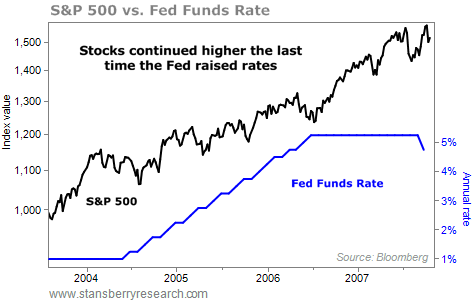
True Wealth editor Steve Sjuggerud agrees with Tepper... He thinks there are still big gains to come in U.S. stocks. In the November issue of True Wealth, Steve said he believes we're in the "middle innings" of this bull market:
|
And while Steve thinks there are still big gains available in U.S. stocks, he believes larger gains are available in Asia. In the December issue of True Wealth, he explained the situation.
After our Alliance meeting in Singapore, Steve took some time to travel around Asia and meet with business contacts. He wrote his latest issue from Indonesia.
The last time Steve visited Indonesia was in 1998 during the Asian financial crisis. As he explained in True Wealth:
|
Steve likes equities in one Asian nation.
In the last three years, U.S. stocks are up more than 40%... Over the same period, this Asian market is down almost the same amount. As such, Steve says this country's "stocks are a much better value than U.S. stocks right now." This Asian market currently has a P/E ratio of 11x (compared with nearly 19x for the S&P 500), making it the second-cheapest investable market in the world.
This country has only been this cheap twice in the past decade... And both times it's soared hundreds of percent. Here's a chart of the country's leading stock market index compared with the S&P 500 U.S. market benchmark.

Out of fairness to True Wealth readers, I can't disclose the name of this country. But you can immediately access Steve's December issue with a subscription to True Wealth.
And in addition to Steve's monthly publication, you will also receive Steve's "currency seminar"...
If you read Steve's seminar on currencies, you'll be better-informed than 90% of market participants... And it will only take you half an hour.
Inside, you'll find everything you need to know to not only protect yourself from the global currency crisis... but also several specific (and easy-to-buy) assets that will skyrocket in value in the coming years.
You'll also learn the absolute best currency to own for the next 10 years. (Master investor Jim Rogers owns a lot of it.)
Now more than ever, it's important you understand how the currency markets work. Global central banks are racing to devalue their currencies... And they're destroying the savings of billions of people. With this information, you'll be better prepared to handle what the future has in store.

New 52-week highs (as of 12/2/13): ProShares Ultra Nasdaq Biotechnology Fund (BIB), Blackstone Group (BX), iShares Nasdaq Biotechnology Fund (IBB), Kohlberg Kravis Roberts (KKR), Microsoft (MSFT), NVE Corp. (NVEC), Targa Resources (TRGP), Union Pacific (UNP), and Wal-Mart (WMT).
One subscriber understands what's happening with Social Security. You can weigh in on the "Ponzi scheme" here... feedback@stansberryresearch.com.
"Dear Mr. Foster: It's unfortunate that you had to resort to name calling in attempting to make your point. Referring to someone as a "moron" is puerile at best. After carefully reading your thoughts about the Social Security System and U.S. Treasury securities, I would heartily suggest that you consider the following.
"The U.S. government is the largest debtor nation in the history of the world. The odds are virtually zero that the U.S. will ever be able to repay its creditors. That includes U.S. citizens who have paid into the Social Security System. You see Mr. Foster, you have bought into one of the biggest lies that has ever been perpetrated on a populace. The bottom line is that the U.S. government is broke, treasury securities are indeed worthless, the Social Security System is in fact a Ponzi scheme and your government will most certainly default on its obligations.
"Porter was just trying to do you a favour and open your eyes in order for you to take the proper action now to avoid the financial devastation that will befall most of your countrymen when the default/collapse takes place. Talk about biting the hand that feeds you!" – Paid-up subscriber Steve Previs
Regards,
Sean Goldsmith
Miami Beach, Florida
December 3, 2013

Why this billionaire hedge-funder is wrong to doubt IBM…
On stage in Singapore last month, Porter updated S&A Alliance conference attendees on his End of America thesis...
Porter contrasted Singapore – a capitalist's dream with low taxes, low inflation, and high per-capita gross domestic product – with America.
You know the story, so we won't go into detail here... But the U.S. has borrowed and printed its way to the poorhouse.
Porter's last slide was titled "The Final Nail?..."
It contained a headline from a Bloomberg article published on October 10, 2013 – "ECB Agrees on Swap Line with PBOC as Trade Increases."
The article explained how the European Central Bank (ECB) and the People's Bank of China (PBOC) agreed to a direct swap – bypassing the dollar – as trade increases between the two areas. You can read the article here.
China is the European Union's second-largest trading partner behind the U.S. The EU exported 71.4 billion euros worth of goods to China in the first six months of this year and imported 133.6 billion euros, according to data from Eurostat, the European Union's statistical office.
The implications for the dollar are severe... Because the dollar is the world's reserve currency, foreign nations must change their money to dollars before transacting. This agreement between the ECB and China – which lasts for three years – pushes the dollar out of the equation and strengthens the yuan.
And it's working...
The Society for Worldwide Interbank Financial Telecommunication (SWIFT) is an organization that enables transfers between large financial institutions and corporations. (Think of the SWIFT code you use when sending and receiving wires.) According to SWIFT, the yuan today surpassed the euro in trade. It's only bested by the U.S. dollar.
We expect the trend to accelerate...
While on the topic of currencies, we'll take a moment to discuss the currency "du jour," Bitcoin...
We dedicated the November 27 Digest to the virtual currency... Bitcoin now trades for $1,000. But we would like to issue one clarification.
Proponents say the supply of Bitcoin is limited to 21 million units for now. (Of course, as we've seen with the U.S. dollar, these things can change.) Also, the financial reward for "mining" transactions will halve every four years until it reaches the smallest functional unit and the reward becomes zero. The self-regulating algorithm ensures steady supply growth. At the current rate, all 21 million Bitcoins will be created by 2140.
Our friend Mebane Faber, portfolio manager at Cambria Investment Management, created a chart showing Bitcoin (which has risen over 400% in the past month and over 7,500% in one year) versus another asset that went parabolic – stock in the South Sea Company. You can read Mebane's piece here.
A brief bit of history... The South Sea Company was a British company formed in 1711. It was a public-private partnership created to consolidate and reduce the cost of Britain's national debt. It also had the monopoly on trade with South America.
Stock in the South Sea Company also formed one of the great bubbles in history.
Meb's charts showed the rise in the value of bitcoins mirrored almost exactly the rise in South Sea stock, both in heights they reached and the speed at which they got there. Then, Meb explained what happened to South Sea shares…
|
We don't know where Bitcoin will go from here... But it is certainly exhibiting classic "toppy" behavior. The currency has gone parabolic (currently trading at $1,066). It's everywhere in the press... And the "cocktail-party indicator" is buzzing.
Whenever people learn I cover the financial markets, all they want to talk about is Bitcoin. Over the Thanksgiving holiday, I discussed it on the airplane home, at a wedding, and at Thanksgiving dinner.
A friend of mine who works in private equity in New York said all his family wanted to discuss was Bitcoin over Thanksgiving.
My father runs a chain of restaurants... A customer recently asked if he accepts Bitcoins.
And consider this (which we found on Business Insider)...
A student was holding a sign on ESPN College GameDay – the pregame show on college football Saturdays – saying "Hi Mom Send Bitcoin." The sign also had a QR Code (the barcode-looking image often associated with URLs). In this case, it was a QR for the kid's Bitcoin wallet.
The Bitcoin community sent him 22 Bitcoins – around $24,000 at today's rates.
Billionaire founder of the Appaloosa Management hedge fund David Tepper recently told Bloomberg TV that he doesn't believe we're in a stock market bubble today.
Tepper spoke after the Robin Hood Investors Conference, a charity event hosted by the hedge-fund Robin Hood Foundation, whose goal is to end poverty in New York City. He compared the market's price-to-earnings (P/E) multiples over the last five years with the five-year period leading up to 2000... Stock P/E multiples haven't increased much recently, but they saw a huge multiple expansion leading up to the 2000 bubble.
"We'll probably stay long," Tepper said. "We recently put on a Treasury short, to hedge ourselves against the equity markets. Little bit scared of tapering... higher rates... though rates won't go that high."
Along the same lines, Tepper said his biggest fear today is not being long enough:
|
Tepper also shared his views on the Federal Reserve tapering its bond purchases:
|
As we explained in the October 28 issue of our free e-letter DailyWealth... Most folks believe that as soon as the Fed's stimulus stops, the party will be over. But history tells a different story...
|
True Wealth editor Steve Sjuggerud agrees with Tepper... He thinks there are still big gains to come in U.S. stocks. In the November issue of True Wealth, Steve said he believes we're in the "middle innings" of this bull market:
|
And while Steve thinks there are still big gains available in U.S. stocks, he believes larger gains are available in Asia. In the December issue of True Wealth, he explained the situation.
After our Alliance meeting in Singapore, Steve took some time to travel around Asia and meet with business contacts. He wrote his latest issue from Indonesia.
The last time Steve visited Indonesia was in 1998 during the Asian financial crisis. As he explained in True Wealth:
|
Steve likes equities in one Asian nation.
In the last three years, U.S. stocks are up more than 40%... Over the same period, this Asian market is down almost the same amount. As such, Steve says this country's "stocks are a much better value than U.S. stocks right now." This Asian market currently has a P/E ratio of 11x (compared with nearly 19x for the S&P 500), making it the second-cheapest investable market in the world.
This country has only been this cheap twice in the past decade... And both times it's soared hundreds of percent. Here's a chart of the country's leading stock market index compared with the S&P 500 U.S. market benchmark.
Out of fairness to True Wealth readers, I can't disclose the name of this country. But you can immediately access Steve's December issue with a subscription to True Wealth.
And in addition to Steve's monthly publication, you will also receive Steve's "currency seminar"...
If you read Steve's seminar on currencies, you'll be better-informed than 90% of market participants... And it will only take you half an hour.
Inside, you'll find everything you need to know to not only protect yourself from the global currency crisis... but also several specific (and easy-to-buy) assets that will skyrocket in value in the coming years.
You'll also learn the absolute best currency to own for the next 10 years. (Master investor Jim Rogers owns a lot of it.)
Now more than ever, it's important you understand how the currency markets work. Global central banks are racing to devalue their currencies... And they're destroying the savings of billions of people. With this information, you'll be better prepared to handle what the future has in store.
New 52-week highs (as of 12/2/13): ProShares Ultra Nasdaq Biotechnology Fund (BIB), Blackstone Group (BX), iShares Nasdaq Biotechnology Fund (IBB), Kohlberg Kravis Roberts (KKR), Microsoft (MSFT), NVE Corp. (NVEC), Targa Resources (TRGP), Union Pacific (UNP), and Wal-Mart (WMT).
One subscriber understands what's happening with Social Security. You can weigh in on the "Ponzi scheme" here... feedback@stansberryresearch.com.
"Dear Mr. Foster: It's unfortunate that you had to resort to name calling in attempting to make your point. Referring to someone as a "moron" is puerile at best. After carefully reading your thoughts about the Social Security System and U.S. Treasury securities, I would heartily suggest that you consider the following.
"The U.S. government is the largest debtor nation in the history of the world. The odds are virtually zero that the U.S. will ever be able to repay its creditors. That includes U.S. citizens who have paid into the Social Security System. You see Mr. Foster, you have bought into one of the biggest lies that has ever been perpetrated on a populace. The bottom line is that the U.S. government is broke, treasury securities are indeed worthless, the Social Security System is in fact a Ponzi scheme and your government will most certainly default on its obligations.
"Porter was just trying to do you a favour and open your eyes in order for you to take the proper action now to avoid the financial devastation that will befall most of your countrymen when the default/collapse takes place. Talk about biting the hand that feeds you!" – Paid-up subscriber Steve Previs
Regards,
Sean Goldsmith
Miami Beach, Florida
December 3, 2013
Editor's note: Many market observers – including renowned hedge-fund manager Stanley Druckenmiller – are down on the future of technology giant IBM. The movement away from some of the company's core technologies has led many investors to figure IBM's days are numbered.
But in Extreme Value, editor Dan Ferris says they are off base… Dan holds IBM in his advisory's model portfolio. And in his November 26 update, he explained to subscribers what folks like Druckenmiller don't understand about IBM.

In an interview with Bloomberg last week, famed investor Stanley Druckenmiller – known in the industry as "Stan" – said IT World Dominator IBM is "one of the more higher-probability shorts I have seen in years." Bad grammar aside, Stan makes a common error.
Stan's error is easy to find... He went on to say, "IBM is old technology being replaced by cloud technology." Like most investors, Stan perceives IBM as a static collection of technologies... as a company permanently locked into whatever it was doing five years ago. I completely disagree with this viewpoint. I have to wonder if Stan and I are thinking about the same company.
IBM is not set in its ways, like fellow technology companies Dell or HP. Both of those companies are struggling because large parts of their business are dependent on a rapidly changing technology (the PC). IBM is in the business of understanding what customers want and giving it to them, whatever that might be. IBM is always looking for the high-value, high-margin product or service its customer needs. That hasn't changed over time...
The one constant since IBM's founding in 1911 has been change. IBM started out selling calculating, tabulating, and recording machines (its predecessor was named C-T-R). But over the years, it evolved as technology evolved... It invented barcodes and barcode readers in the 1970s. It introduced the first PC in 1981, which quickly became the industry standard for PC architecture. IBM sold its PC business in 2005 as part of a transition away from hardware, toward software and services. That evolution continues today...
IBM recently bought cloud-computing provider SoftLayer Technologies for $2 billion in June of this year, to form IBM's Cloud Services Division. Cloud computing is where the world is headed, so that's where IBM is headed in a big way.
Stan and other investors also claim IBM's free cash flow has fallen over the past several years. That's true. But when you value a business, you're valuing it on a per-share basis. And IBM's free cash flow per share has not fallen. It has risen every year since 2003. It will likely drop this year, but not by much... and not for long.
IBM's management has preserved the value of its equity through share repurchases. Its financial management track record is one of the best in the world. Yes, the stock is down 7% this year to about $178 per share. But IBM shares have risen roughly 17-fold since bottoming out around $10 in 1993. If Microsoft behaved like IBM, investors wouldn't be standing in line at its annual meeting every year asking management why its share price isn't going anywhere...
It's easy to get distracted by some billionaire, like Stan, trying to get attention in the news. But remember... despite his wealth and competence as an investor, Stan has been wrong before. And he can be wrong again.
For example... Stan shorted Internet and tech stocks until 1999-2000. Then he went long. Then he insisted his firm hold onto Internet and tech stocks as the market crashed in 2000. Stan was wrong three times on one bet. He's only human.
So we're not going to sell IBM just because Stan is short. And we're not going to buy it just because Warren Buffett – a billionaire investor who invested $11 billion in IBM a few years ago – owns it. Neither opinion makes any difference to us. We do our own work, and we make our own decisions.
And I see no reason to change our advice on IBM.

– Dan Ferris
Why this billionaire hedge-funder is wrong to doubt IBM…
Billionaire investor Stanley Druckenmiller recently told Bloomberg tech giant IBM is "one of the more higher-probability shorts I have seen in years."
In today's Digest Premium, Extreme Value editor Dan Ferris explains why Druckenmiller is wrong...
To continue reading, scroll down or click here.
Stansberry & Associates Top 10 Open Recommendations
(Top 10 highest-returning open positions across all S&A portfolios)
As of 12/02/2013
| Stock | Symbol | Buy Date | Return | Publication | Editor |
| Rite Aid 8.5% | 767754BU7 | 02/06/09 | 683.6% | True Income | Williams |
| Prestige Brands | PBH | 05/13/09 | 456.7% | Extreme Value | Ferris |
| Enterprise | EPD | 10/15/08 | 241.9% | The 12% Letter | Dyson |
| Constellation Brands | STZ | 06/02/11 | 233.0% | Extreme Value | Ferris |
| Ultra Health Care | RXL | 03/17/11 | 202.3% | True Wealth | Sjuggerud |
| Altria | MO | 11/19/08 | 178.1% | The 12% Letter | Dyson |
| McDonald's | MCD | 11/28/06 | 171.7% | The 12% Letter | Dyson |
| Ultra Health Care | RXL | 01/04/12 | 164.0% | True Wealth Sys | Sjuggerud |
| Hershey | HSY | 12/06/07 | 158.7% | SIA | Stansberry |
| Ultra Nasdaq Biotech | BIB | 12/05/12 | 152.7% | True Wealth Sys | Sjuggerud |
Please note: Securities appearing in the Top 10 are not necessarily recommended buys at current prices. The list reflects the best-performing positions currently in the model portfolio of any S&A publication. The buy date reflects when the editor recommended the investment in the listed publication, and the return shows its performance since that date. To learn if a security is still a recommended buy today, you must be a subscriber to that publication and refer to the most recent portfolio.
| Top 10 Totals |
| 1 | True Income | Williams |
| 2 | Extreme Value | Ferris |
| 3 | The 12% Letter | Dyson |
| 1 | True Wealth | Sjuggerud |
| 2 | True Wealth Sys | Sjuggerud |
| 1 | SIA | Stansberry |
Stansberry & Associates Hall of Fame
(Top 10 all-time, highest-returning closed positions across all S&A portfolios)
| Investment | Sym | Holding Period | Gain | Publication | Editor |
| Seabridge Gold | SA | 4 years, 73 days | 995% | Sjug Conf. | Sjuggerud |
| ATAC Resources | ATC | 313 days | 597% | Phase 1 | Badiali |
| JDS Uniphase | JDSU | 1 year, 266 days | 592% | SIA | Stansberry |
| Silver Wheaton | SLW | 1 year, 185 days | 345% | Resource Rpt | Badiali |
| Jinshan Gold Mines | JIN | 290 days | 339% | Resource Rpt | Badiali |
| Medis Tech | MDTL | 4 years, 110 days | 333% | Diligence | Ferris |
| ID Biomedical | IDBE | 5 years, 38 days | 331% | Diligence | Lashmet |
| Northern Dynasty | NAK | 1 year, 343 days | 322% | Resource Rpt | Badiali |
| Texas Instr. | TXN | 270 days | 301% | SIA | Stansberry |
| MS63 Saint-Gaudens | 5 years, 242 days | 273% | True Wealth | Sjuggerud |