
What the Fed's money printing has accomplished...
The Federal Reserve is intent upon blowing our economy into a giant bubble...
But other than inflating stock and home prices, have we really gotten any richer? Porter shares his thoughts in today's Digest Premium.
To subscribe to Digest Premium and access today's analysis risk-free, click here.
The government shuts down; life goes on... A free DailyWealth Trader... Bloomberg quotes Ferris... Gates out at Microsoft?...
 We're into Day 2 of the government shutdown...
The construction workers outside my (Sean) window are still working on the South Beach, Miami high rise across the street. UPS delivered my overnight order around 10 a.m. People are still streaming in and out of the Whole Foods I can see from my living room. And the usual $100,000-plus sports cars are still lining up outside the neighborhood Starbucks.
In other words, despite the first government shutdown in 17 years, life goes on and commerce continues.
Or as Extreme Value editor Dan Ferris reminded us in yesterday's DailyWealth Trader, "shopping trumps politics." Co-editors Amber Lee Mason and Brian Hunt quoted Dan to tell their readers to stay calm... The economy is still moving forward. The government is still buying $85 billion in bonds each month. Interest rates are still near record lows. And the long story for stocks remains intact.
We've long maintained that these government showdowns are political theater. And to further reinforce this, in today's Digest, we'll feature – in its entirety – yesterday's issue of DailyWealth Trader:
We've long maintained that these government showdowns are theater. And to further reinforce this, in today's Digest, we'll feature – in its entirety – yesterday's issue of DailyWealth Trader:
.jpg)
|
The "government shutdown" is here. Now... should you start thinking America will fall apart, sell all your stocks, and then huddle up in the basement with a crate of canned food? Today's issue answers that question. In preview, the answer is "No. Hell no." The answer to the "Should I freak out because of the government shutdown?" question is "No" for two reasons. First, remember our friend and colleague Dan Ferris' timeless piece of wisdom that "shopping trumps politics." This simple, common-sense way of looking at the market is one of the most important ideas you'll ever learn about wealth. It will help you stay sensible and ready to buy bargains when the crowd is freaking out over tiny, overhyped issues, like the "government shutdown." We can't explain this key idea any better than Dan:
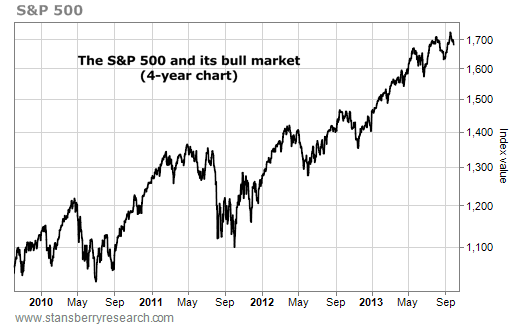
Remember... despite all the horrible things that happened in the 20th century, U.S. stocks soared in value. That's because human ingenuity and the desire to have better lives somehow allows us to overcome all of the stupid things we do. Now that we've covered that key idea, we move on to the second reason you shouldn't worry about the "government shutdown": When we take the "long view" of stocks, we see how the big trend is up. We see that we're in the midst of a bull market. And bull markets tend to run higher and last longer than most people believe is possible. To get an idea of the long view, we consult a four-year chart of the benchmark S&P 500 stock index. As you can see, the index is locked in a series of "higher highs and higher lows." Each rally takes the index a little higher than the previous rally. Each correction ends at a higher level than the previous correction. This is classic bull market price action.
As for the "government shutdown," realize it's a dog-and-pony show… just like the [2011] "debt ceiling" debate. Politicians on both sides are simply posturing for publicity. It impresses the fools. The government is NOT shutting down. Cops are still walking their beats. Social Security checks are still being mailed. The TSA is still feeling up little old ladies before they board their planes. The mail is still being delivered. And shopping still trumps politics. Sure, the market could sell off 5% or 10% from here. But we can say that about the market at any time. Given that we are in the midst of a big bull market, marked by "higher highs and higher lows," we are holding our positions with exit strategies in place, just like we always do. And should the market sharply correct from these levels, we'll look to buy bargains. Shopping trumps politics. And we're in a big bull market. Keep these two key ideas in mind when considering the "government shutdown." For the rubes and the fools, it's another thing to worry about. For knowledgeable traders, it's nothing. |
DailyWealth Trader provides some of the world's best short- and medium-term trading ideas. And it offers readers instructions on how to consistently make low-risk, high-reward trades in the market.
Amber and Brian pull trading ideas from the best analysts at Stansberry & Associates... from the market's greatest money managers... and from their extensive network of contacts and industry "insiders."
In today's issue, they recommended another trade on computer and consumer-electronics giant Apple... Already, they've closed five trades on Apple this year with annualized returns ranging from 27% to 65%... Two of their recommended put-option trades are still open and on track for 20%-plus annualized returns.
That's the strategy Amber and Brian use at DailyWealth Trader... trading options on the best and safest stocks in the market. And they've produced consistent gains. With their most recent trade, readers can make a 4.3% return in just seven weeks... that's nearly 35% annualized.
To get DailyWealth Trader and begin profiting immediately from trades like these with a risk-free trial, click here. If you want to learn more about the service, you can catch Amber's full presentation here.
The Bloomberg financial newswire quoted Dan on Microsoft this morning...
As Dan has said before, capital allocation is the software giant's biggest problem. The company has spent $21.7 billion since 2007 acquiring "three giant losers" – aQuantive, Skype, and Nokia.
And he's not the only disgruntled shareholder. (Our legal team permitted Dan to buy one share, so he can attend the annual shareholder conference.) According to Reuters, three shareholders who collectively own 5% of the company are pushing for Microsoft Chairman Bill Gates to resign.
Gates, who stepped down as CEO in 2000, still chairs the company's board of directors. According to the Reuters report… the anonymous shareholders say Gates' presence will keep Microsoft from implementing new strategies and will hamper the abilities of whomever replaces outgoing CEO Steve Ballmer. Gates personally owns 4.5% of Microsoft, making him the largest shareholder.
Dan sent me an e-mail responding to the rumor. He cited Microsoft's "loser" acquisitions. "Microsoft is a World Dominator business that's competing with itself and losing," he wrote. "I hope Gates is out, too, per the Reuters rumor last night."
Microsoft is up a little less than 1% on the day.

New 52-week highs (as of 10/1/13): American Financial Group (AFG), ProShares Ultra Biotechnology Fund (BIB), Chicago Bridge & Iron (CBI), EnerSys (ENS), iShares Biotechnology Fund (IBB), short position in J.C. Penney (JCP), National Fuel Gas (NFG), RPM International (RPM), Sequoia Fund (SEQUX), Triangle Petroleum (TPLM), Targa Resources (TRGP), and Walgreens (WAG).
Another letter of support from a reader who "gets it." Send your feedback to feedback@stansberryresearch.com.
"Since you published the angry denunciation of the letter in [Monday's] Digest, I thought I'd best weigh in with a vote of 'please, keep them coming.'
"A lot of people in this world seem to be lacking a sense of humor. It's not their fault, I suppose. You're either born with it or you aren't. Personally, I loved it. I loved the first batches of letters pre-2008, and I enjoyed the latest one.
"The idea of this level of candor coming from the chairman is funny enough in and of itself to carry the piece. And the facts speak for themselves.
"I think Porter himself pointed out that, since the union basically controls GM, there's no way they will EVER let the shareholders get all that much out of it ("Hmmm... We can afford to raise the dividend OR everyone gets a 7% raise. Let's put it to a vote!") I don't know if this has changed much, since the government HAS been selling its stake. A discussion of this dynamic would certainly be welcome too.
"Anyway, thanks, and PLEASE KEEP THESE COMING!" – Paid-up subscriber Dave
Regards,
Now that the Federal Reserve has said it won't rein in – or "taper" – its $85 billion in monthly bond purchases, some wonder if we could see increased quantitative-easing efforts?
I (Porter) don't think the Fed will do anything other than continue its current policies. But that's more than enough to inflate asset prices of all kinds. And it's foolish to think asset prices are heading anywhere but higher in the near term. Remember, some folks said the original quantitative-easing programs wouldn't jack up prices. They predicted deflation.
They don't understand. You can blow up the U.S. economy as large as you'd like if you're spending $85 billion a month.
But however good these policies feel in the short term... the ultimate consequences of all this money-printing will be severe. The consequences won't show up for five or 10 years, so people will believe it's "working."
But believe me, all the Fed is doing is devaluing the dollar to finance more and more government debt that we cannot actually afford.
Take a look, for example, at the "M2" – a conventional measure of the amount of money in the economy.

It's up almost 40% since 2008. Meanwhile our economy hasn't grown at all. Employment hasn't increased noticeably. So we've got a ton more money, but it's not buying anything extra. Are we really truly getting richer just because stock prices are up and housing prices are up? That's the question I'd like people to consider. And the answer is no.
– Porter Stansberry with Sean Goldsmith
What the Fed's money printing has accomplished...
The Federal Reserve is intent upon blowing our economy into a giant bubble...
But other than inflating stock and home prices, have we really gotten any richer? Porter shares his thoughts in today's Digest Premium.
To continue reading, scroll down or click here.
What the Fed's money printing has accomplished...
We're into Day 2 of the government shutdown...
The construction workers outside my (Sean) window are still working on the South Beach, Miami high rise across the street. UPS delivered my overnight order around 10 a.m. People are still streaming in and out of the Whole Foods I can see from my living room. And the usual $100,000-plus sports cars are still lining up outside the neighborhood Starbucks.
In other words, despite the first government shutdown in 17 years, life goes on and commerce continues.
Or as Extreme Value editor Dan Ferris reminded us in yesterday's DailyWealth Trader, "shopping trumps politics." Co-editors Amber Lee Mason and Brian Hunt quoted Dan to tell their readers to stay calm... The economy is still moving forward. The government is still buying $85 billion in bonds each month. Interest rates are still near record lows. And the long story for stocks remains intact.
We've long maintained that these government showdowns are political theater. And to further reinforce this, in today's Digest, we'll feature – in its entirety – yesterday's issue of DailyWealth Trader:
We've long maintained that these government showdowns are theater. And to further reinforce this, in today's Digest, we'll feature – in its entirety – yesterday's issue of DailyWealth Trader:
|
The "government shutdown" is here. Now... should you start thinking America will fall apart, sell all your stocks, and then huddle up in the basement with a crate of canned food? Today's issue answers that question. In preview, the answer is "No. Hell no." The answer to the "Should I freak out because of the government shutdown?" question is "No" for two reasons. First, remember our friend and colleague Dan Ferris' timeless piece of wisdom that "shopping trumps politics." This simple, common-sense way of looking at the market is one of the most important ideas you'll ever learn about wealth. It will help you stay sensible and ready to buy bargains when the crowd is freaking out over tiny, overhyped issues, like the "government shutdown." We can't explain this key idea any better than Dan:
Remember... despite all the horrible things that happened in the 20th century, U.S. stocks soared in value. That's because human ingenuity and the desire to have better lives somehow allows us to overcome all of the stupid things we do. Now that we've covered that key idea, we move on to the second reason you shouldn't worry about the "government shutdown": When we take the "long view" of stocks, we see how the big trend is up. We see that we're in the midst of a bull market. And bull markets tend to run higher and last longer than most people believe is possible. To get an idea of the long view, we consult a four-year chart of the benchmark S&P 500 stock index. As you can see, the index is locked in a series of "higher highs and higher lows." Each rally takes the index a little higher than the previous rally. Each correction ends at a higher level than the previous correction. This is classic bull market price action.
As for the "government shutdown," realize it's a dog-and-pony show… just like the [2011] "debt ceiling" debate. Politicians on both sides are simply posturing for publicity. It impresses the fools. The government is NOT shutting down. Cops are still walking their beats. Social Security checks are still being mailed. The TSA is still feeling up little old ladies before they board their planes. The mail is still being delivered. And shopping still trumps politics. Sure, the market could sell off 5% or 10% from here. But we can say that about the market at any time. Given that we are in the midst of a big bull market, marked by "higher highs and higher lows," we are holding our positions with exit strategies in place, just like we always do. And should the market sharply correct from these levels, we'll look to buy bargains. Shopping trumps politics. And we're in a big bull market. Keep these two key ideas in mind when considering the "government shutdown." For the rubes and the fools, it's another thing to worry about. For knowledgeable traders, it's nothing. |
DailyWealth Trader provides some of the world's best short- and medium-term trading ideas. And it offers readers instructions on how to consistently make low-risk, high-reward trades in the market.
Amber and Brian pull trading ideas from the best analysts at Stansberry & Associates... from the market's greatest money managers... and from their extensive network of contacts and industry "insiders."
In today's issue, they recommended another trade on computer and consumer-electronics giant Apple... Already, they've closed five trades on Apple this year with annualized returns ranging from 27% to 65%... Two of their recommended put-option trades are still open and on track for 20%-plus annualized returns.
That's the strategy Amber and Brian use at DailyWealth Trader... trading options on the best and safest stocks in the market. And they've produced consistent gains. With their most recent trade, readers can make a 4.3% return in just seven weeks... that's nearly 35% annualized.
To get DailyWealth Trader and begin profiting immediately from trades like these with a risk-free trial, click here. If you want to learn more about the service, you can catch Amber's full presentation here.
The Bloomberg financial newswire quoted Dan on Microsoft this morning...
As Dan has said before, capital allocation is the software giant's biggest problem. The company has spent $21.7 billion since 2007 acquiring "three giant losers" – aQuantive, Skype, and Nokia.
And he's not the only disgruntled shareholder. (Our legal team permitted Dan to buy one share, so he can attend the annual shareholder conference.) According to Reuters, three shareholders who collectively own 5% of the company are pushing for Microsoft Chairman Bill Gates to resign.
Gates, who stepped down as CEO in 2000, still chairs the company's board of directors. According to the Reuters report… the anonymous shareholders say Gates' presence will keep Microsoft from implementing new strategies and will hamper the abilities of whomever replaces outgoing CEO Steve Ballmer. Gates personally owns 4.5% of Microsoft, making him the largest shareholder.
Dan sent me an e-mail responding to the rumor. He cited Microsoft's "loser" acquisitions. "Microsoft is a World Dominator business that's competing with itself and losing," he wrote. "I hope Gates is out, too, per the Reuters rumor last night."
Microsoft is up a little less than 1% on the day.
New 52-week highs (as of 10/1/13): American Financial Group (AFG), ProShares Ultra Biotechnology Fund (BIB), Chicago Bridge & Iron (CBI), EnerSys (ENS), iShares Biotechnology Fund (IBB), short position in J.C. Penney (JCP), National Fuel Gas (NFG), RPM International (RPM), Sequoia Fund (SEQUX), Triangle Petroleum (TPLM), Targa Resources (TRGP), and Walgreens (WAG).
Another letter of support from a reader who "gets it." Send your feedback to feedback@stansberryresearch.com.
"Since you published the angry denunciation of the letter in [Monday's] Digest, I thought I'd best weigh in with a vote of 'please, keep them coming.'
"A lot of people in this world seem to be lacking a sense of humor. It's not their fault, I suppose. You're either born with it or you aren't. Personally, I loved it. I loved the first batches of letters pre-2008, and I enjoyed the latest one.
"The idea of this level of candor coming from the chairman is funny enough in and of itself to carry the piece. And the facts speak for themselves.
"I think Porter himself pointed out that, since the union basically controls GM, there's no way they will EVER let the shareholders get all that much out of it ("Hmmm... We can afford to raise the dividend OR everyone gets a 7% raise. Let's put it to a vote!") I don't know if this has changed much, since the government HAS been selling its stake. A discussion of this dynamic would certainly be welcome too.
"Anyway, thanks, and PLEASE KEEP THESE COMING!" – Paid-up subscriber Dave
Regards,
Sean Goldsmith
Miami Beach, Florida
October 2, 2013