
The most important story in the world today... Commodities are getting crushed... Crude oil hits a six-year low... Could oil hit $30 a barrel?... A rare moment for platinum... Chinese stocks hit a new high... Visit Rancho Santana...
 The strong dollar is crushing commodities...
The U.S. dollar is at its highest level since 2003. The world's reserve currency has appreciated 25% since July 1 – an insane move for a major currency.
.png)
Commodities are priced in dollars, so it takes more money for other countries (with their weakened currencies) to buy the goods. And we're seeing this trend play out across the board.
Before we get to our discussion of commodities, it's important to note that the strengthening U.S. dollar has larger implications than just weighing on commodity prices.
For example, in the January 26 Digest, we showed you the similar effect the strong dollar is having in the currency markets (the world's largest, most important market)... As with commodities, most global currencies are plunging against the dollar. In that Digest, we presented a handful of charts showing you what "currency implosions" look like.
We'll present similar information today. But know this: The strength of the U.S. dollar is the single biggest trend in the world today.
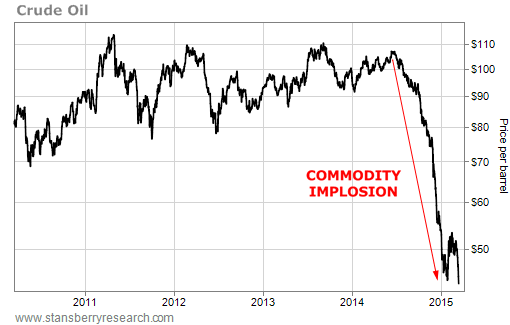
West Texas Intermediate crude oil (the domestic benchmark) is at a six-year low of $43.40 a barrel today. That's down from a peak of $145 a barrel in July 2008... though it's still above the December 2008 low of $30 a barrel...
Brent crude (the international benchmark) and West Texas Intermediate crude are the most inversely correlated commodities to the U.S. dollar over the past 10 years, according to a study by Standard & Poor's, meaning they fall as the dollar rises. (For cocktail party banter... feeder cattle, sugar, and lean hogs are the least correlated to the dollar.)
In addition to a strong dollar, oil has faced another major headwind – a global supply glut. And much of that excess production is coming from the U.S. Nobody has followed the shale revolution happening today in the U.S. closer than Porter and his research team. Porter updated readers in the March 13 Digest. He predicted oil prices would fall to less than $30 per barrel...
|
Platinum is also trading at a five-year low. The precious metal traded at a high of $1,884.80 an ounce on September 2, 2011. It trades for less than $1,100 an ounce today – a fall of more than 40%...
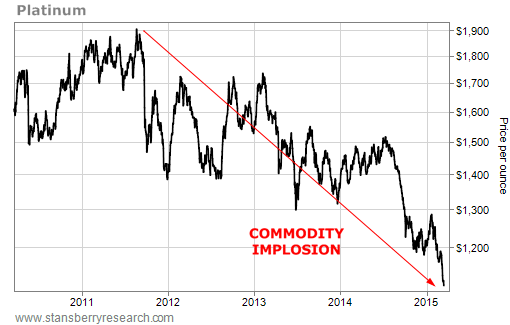
And today, we're seeing something rare in platinum... It's trading for less than the spot price of gold (which currently sits at $1,154 an ounce).
Platinum is about 20 times more rare than gold. And around 80% of the metal is used in catalytic converters in cars. Because of its industrial use, platinum prices are also falling due to weak global demand.
In addition, almost all of the world's platinum is mined in Zimbabwe, South Africa, and Russia. As we often say, going long platinum is like going long political instability in South Africa and Russia... a safe bet.
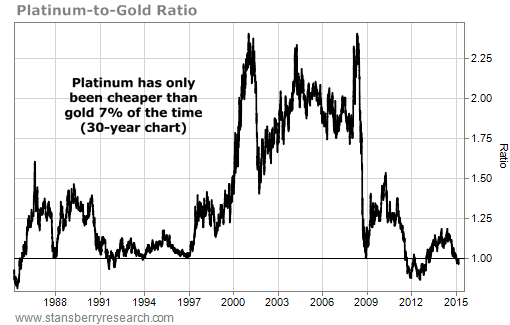
According to Stansberry Research analyst Greg Woodward, platinum has only traded for less than the price of gold 7% of the time in the last 30 years. As you can see from the following chart – which shows the platinum-to-gold ratio – when platinum becomes cheaper than gold, it's usually a good time to buy...
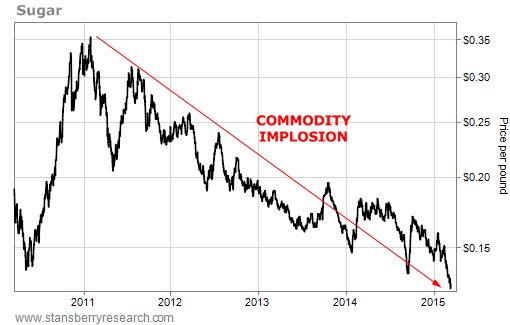
Sugar prices are also hitting a five-year low on fears in Brazil. The country is the world's largest producer of sugar, and its weakening currency (the real) could spur a flood of supply. Brazilian producers can flood the market with sugar and collect strong dollars...
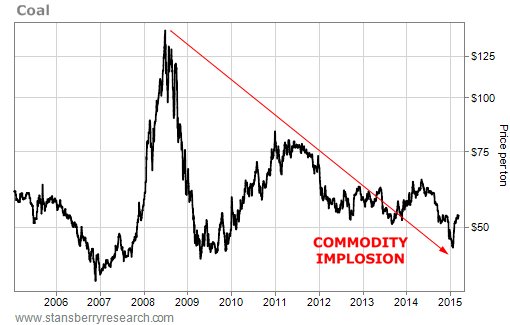
A strong dollar, coupled with slowing demand and a surplus of supply have also crushed coal prices. They're down 62% from their 2008 peak...
Of course, it's not all bad news out there... Chinese stocks hit a new high today.
True Wealth editor Steve Sjuggerud recommended Chinese stocks in October. We discussed why Steve was bullish on China in the December 15 Digest. In short, the Chinese government wanted its market to boom. It's loosening regulations to encourage Chinese investors to buy local shares. And at the time, Steve said the government could cut interest rates and consider more stimulus.
Sure enough, on February 28, China cut interest rates for the second time in three months. It cut rates for the first time in two years in late November, just two months after Steve went long China.
And the market got another bump after Chinese Premier Li Keqiang said China could ease further at a March 15 news conference...
|
Today, the Shanghai Composite Index hit a seven-year high of 3,665. Steve's True Wealth subscribers are up more than 50%.
But remember, the Shanghai Index soared 600% from 2005 to 2007. At the time, the Chinese government announced new rules that would allow foreign investors to invest in the "locals-only" Chinese stocks (so-called "A" shares).
Then, Chinese stocks fell 60% from their 2007 peak, spurring the government to make "A" shares even easier for foreign investors to buy. The Chinese government is also encouraging locals to buy more stocks and cutting interest rates. As Steve wrote...
|
In tomorrow's Digest, we're sharing the full details of one of the greatest offers we've ever made at Stansberry Research... It's called the Permanent Wealth Program. And it's a must-have for every serious investor.
But before closing out today's Digest, a quick kudos to our friends in Nicaragua...
Rancho Santana – Agora founder Bill Bonner's Nicaraguan beachfront development – just graced the pages of Forbes magazine. That's in addition to features in the Wall Street Journal, the New York Times, and several other mainstream U.S. publications.
We've been visiting and writing about "The Ranch," as we call it, for more than a decade. We're amazed at how far it has come since then. When Porter first visited The Ranch, he rode a horse to the beach, clearing his path with a machete. Now, we're getting an airport that can handle commercial planes. There's a world-class golf course just down the road. And a former U.S. president once vacationed there.
Word is getting out. And the new Inn at Rancho Santana will only accelerate the process. From Forbes...
|
You can read the full article here. And if you'd like to see Rancho Santana and the new Inn in person, we're hosting a small group of readers down there from April 15-19. A few spots just opened up... So if you'd like to attend, please contact Director of Sales Marc Brown at marcb@ranchosantana.com.
New 52-week highs (as of 3/16/15): AllianceBernstein (AB), American Financial Group (AFG), Deutsche X-trackers Harvest A-Shares Fund (ASHR), ProShares Ultra Nasdaq Biotech Fund (BIB), Bristol-Myers Squibb (BMY), Cempra (CEMP), CME Group (CME), CVS Health (CVS), Dollar General (DG), Esperion Therapeutics (ESPR), Expeditors International of Washington (EXPD), SPDR S&P International Health Care Sector Fund (IRY), Prestige Brands Holdings (PBH), ProShares Ultra Health Care Fund (RXL), Travelers (TRV), Varian Medical Systems (VAR), Walgreens (WBA), and Alleghany (Y).
In the mailbag, a subscriber asks for Steve Sjuggerud's advice on hedging... Send your thoughts to feedback@stansberryresearch.com.
"Steve Sjuggerud's thesis for soaring European stocks is the same as he plied for Japanese stocks a while back. And, yes, the NIKKEI soared, but what was the USD net gain/loss after accounting for the plummeting Yen? How does one hedge against these offsetting metrics?" – Paid-up subscriber Dennis Cline
Sjuggerud comment: Hi Dennis, thanks for writing in. My True Wealth subscribers captured all of the Nikkei's gains. We're up 72% on the WisdomTree Japan Hedged Equity Fund (DXJ). This fund "hedged" away the exposure to the Japanese yen, so we were able to capture all of the gain in the Nikkei while avoiding any losses in the yen.
As for Europe, we've had some success trading the WisdomTree Europe Hedged Equity Fund (HEDJ) as a way to gain exposure to or eliminate exposure to the euro. But I recently recommended switching out of HEDJ and into a different fund (which isn't hedged) because I think the euro's fall is nearing its end. So I don't want my True Wealth subscribers to be hedged anymore. But to answer your original question, the WisdomTree hedged exchange-traded funds are one easy way to offset any exposure to currencies.
Regards,
Sean Goldsmith
March 17, 2015
