
The new subprime bubble 'will devastate our economy'... Market tops and watching beans grow... Yo!... One of the best opportunities in the market today...
 It's the new subprime lending bubble...
In the March issue of Stansberry's Investment Advisory, Porter and his research team discussed the growth of subprime auto lending...
"The last few years have seen a surge in Wall Street's involvement in car loans. Blackstone, the premier private-equity firm, bought car lender Exeter Finance in 2011, starting a 'land rush' in the sector. Soon, others followed, like asset-management firm Perella Weinberg, which partnered with CarFinance Capital."
Historically, it was the regionally operated small, private finance companies that dominated the car-finance sector... What you can charge for a car loan varies from state to state.
But when Wall Street – thirsty for yield – learned you can charge 19% for subprime auto loans, it came running. From the March issue...
|
Lending volume grew, standards fell, and terms expanded... Today, subprime car loans make up one in every four loans. And $18 billion in auto loans were securitized and sold to investors, allowing the finance firms to shift the credit risk to investors...
The next part sounds even more familiar to me. Standard & Poor's released a report on February 26, 2014 warning that subprime auto loans were beginning to go bad at an alarming rate, before any material decrease to employment or other economic activity. "In our opinion, we're at a turning point with respect to subprime auto loan performance," the credit-ratings agency wrote, "similar to where we were in 2006."
A collapse in auto finance will devastate our economy. And several consumer finance companies are at risk.
The New York Times echoed our sentiment yesterday...
In a story titled "In a Subprime Bubble for Used Cars, Borrowers Pay Sky-High Rates," the paper exposed the rampant fraud in auto lending today: Forging lending documents, lying about borrower income, inflating loans, etc. In other words, exactly what we saw leading up to the collapse in subprime home loans. From the Times...
|
Firms are lending to the bankrupt, the unemployed, and people living on Social Security.
In many cases, the loan balances were so high because the borrower still owed money on the car he was trading in, which was rolled into the new loans. Other loans had life insurance policies rolled into them, which would pay the loan in the case of the borrower's death.
But despite the warnings we mentioned above from ratings agency Standard & Poor's, the company still slapped a "
The Times article notes a bond issue from Prestige Financial Services of Utah. The $390 million bond sale was four times oversubscribed. And many of the bonds are backed by auto loans made to people who have been in bankruptcy. The average interest rate on the loans in Prestige's latest offering was 18.6%.
And the loans are already showing some signs of stress...
According to the Times – which cited credit-data firm Experian – banks are writing off an average $8,541 of each delinquent loan, up about 15% from a year ago. And repossessions are up 78% to around 388,000 cars in the first three months of the year versus a year ago. The number of borrowers who are over 60 days late on their car payments jumped in 22 states over the same period, according to the Times.
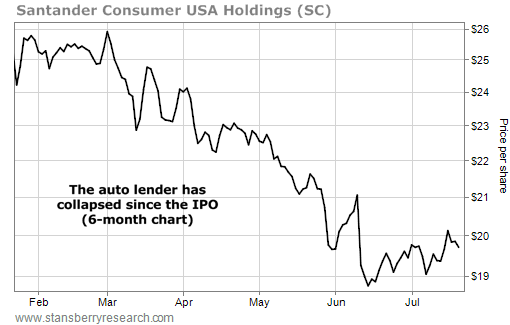
Private-equity firm and Small Stock Specialist holding Kohlberg Kravis Roberts (KKR) – along with two other private-equity shops – had invested a total of $1 billion in auto lender Santander Consumer USA. But KKR wisely sold most of its stake when Santander went public in January. As you can see in the following chart, Santander shares have collapsed...
 Another sign of the top...
Former fund manager and CNBC financial pundit Jim Cramer is going long portable-recording-device-manufacturer GoPro (GPRO ).
We questioned the validity of GoPro in the June 30 Digest... At five times sales and 46.5 times earnings before interest, taxes, depreciation, and amortization (EBITDA), the company was expensive. But we weren't sure of its staying power. Here's what we wrote...
|
But Cramer isn't worried...
On CNBC this morning, Cramer said he thinks GoPro's "sales are going to be remarkable... And the stock is going to go higher."
He said the mobile cameras are no longer just for enthusiasts, like surfers and skiers. "Now it's about the ecosystem," he added. Time-lapse videos will be easier to produce, thanks to GoPro.
But according to Cramer, the company's big opportunity is with pets... If it could come up with a camera for cats and dogs, "it explodes," he said.
In particular, Cramer likes to use the GoPro to watch the beans in his garden grow... "I have a garden and the beans are growing beyond belief overnight... I'm trying to hook up a GoPro to my fence to watch the beans."
He extrapolates his ability to watch beans into GoPro "being positioned like Apple." We're not sure we see the connection... Apple revolutionized the way we consume media by developing groundbreaking products like the iPod, iPhone, and iPad. GoPro makes small cameras.
The next sign of a top comes from our friend Whitney Tilson, manager of the Kase Capital hedge fund. In an e-mail this morning, Tilson noted the potential $10 million valuation of a new smartphone app called "Yo."
Yo allows users to send people text messages saying "Yo." That's it...
On Friday, the company announced it raised $1.5 million in a seed investment round, valuing the company between $6 million and $10 million. The app debuted in April. It has already had 2 million downloads, according to
But what's the allure of an app that can only deliver a two-letter message? As John Borthwick, the CEO of venture-capital firm Betaworks – which invested in Yo – wrote in a blog post...
|
While Borthwick and his colleagues invest in Yo, we're looking for other opportunities...
In last Wednesday's Digest, we told you about one of the best opportunities we see in the market today. Extreme Value editor Dan Ferris even called this little-known stock "by far one of the best opportunities in the natural resource sector I've seen in my entire career."
Right now, we have an opportunity to buy this resource stock before its revenues rise 10-fold... No, that's not a typo. This company just closed a major deal to buy a lot of coal and potash (a commodity used in fertilizer).
The deal would increase the firm's revenues 10-fold... which Dan believes will cause the stock to double or triple from today's levels.
What makes this company even better is that it isn't a mining company... It doesn't have to spend huge amounts of money to extract resources from the ground.
Instead, it invests a small amount of money in various mining projects in return for future royalties. Longtime Digest readers know these resource royalty companies are some of the best businesses in the world.
The business model works like this... Several smart geologists and investors buy up the "royalty rights" to some of the world's most productive and lucrative mines. But they don't handle any of the production (which is the capital-intensive part of the business). They simply receive royalty payments as resources come out of the ground.
They can spread their risk by investing in several projects... And the royalties they receive continue long after the initial investment.
Ten years ago, for example, Dan's favorite company paid a little less than $14 million for a small royalty on a nickel mine. The company has already received $30 million in royalty income from that investment... The investment paid $3 million (more than 20% of the initial investment) over the past 12 months alone.
That's why Dan says buying royalty companies is "the best way to invest in commodities."
And this company gives you exposure to a basket of commodities – gold, uranium, platinum, coal, potash, etc. You can even think of it as a cheap way to own hard assets to hedge yourself against inflation.
Here's the best part...
Dan says he's 100% certain this company will start paying a "substantial" dividend at some point in the next couple years... And by substantial, Dan means a double-digit yield based on today's share price.
This firm is going to collect so much cash from its future royalties that the money is going to flow down to shareholders in the form of a huge dividend.
When income-starved investors hear about this double-digit yield, they're sure to bid the price sky-high.
This is a rare opportunity to buy a cheap resource company run by excellent management... And you can get in before the future royalties start rolling in. As we said above, these royalties will increase the company's revenue 10-fold... And we'll see the company initiate a huge dividend. You can learn more about the opportunity – and how to access Dan's research – by clicking here.
 New 52-week highs (as of 7/18/14): AllianceBernstein (AB), American Homes 4 Rent ( In today's mailbag, one subscriber gets philosophical... and another disagrees with Porter's letter to Devon Energy. Let us know what's on your mind at feedback@stansberryresearch.com.
"Porter, it does not really matter how subscribers react to your political ideas. You offer tremendous value in all the work that is visible to me. You mentioned today how you treat your employees. It's no surprise to me, it's the same as you treat your subscribers. It is my deepest hope you will receive every wish you and all of yours may ever have.
New 52-week highs (as of 7/18/14): AllianceBernstein (AB), American Homes 4 Rent ( In today's mailbag, one subscriber gets philosophical... and another disagrees with Porter's letter to Devon Energy. Let us know what's on your mind at feedback@stansberryresearch.com.
"Porter, it does not really matter how subscribers react to your political ideas. You offer tremendous value in all the work that is visible to me. You mentioned today how you treat your employees. It's no surprise to me, it's the same as you treat your subscribers. It is my deepest hope you will receive every wish you and all of yours may ever have.
"I once heard a description of how we understand to value our place on this planet. It talked about seeing a pebble dropped into a calm pool. It was said that each of the circles emanating from the center represents our ability to influence the world we inhabit. As the size of the pebble increases, we see in the difference how our influence has expanded. Just think for every additional circle, your influence is multiplied like 360 degrees. Natural law limits inappropriate idiots from dropping oversized rocks.
"Porter, I think you are dropping some real boulders on this world, and you don't really have to light your hair on fire to get your message out. Just continue to push that boulder uphill, so you can drop another one in the pond." – Paid-up subscriber Charles Freehill
"Dear Mr. Stansberry, Regarding your recent Investment Advisory letter on Devon Energy, I have two principal points of disagreement. As the former chairman, president and managing director of over twenty companies, rule #1 is never put all your eggs in one basket unless you own that basket 100% and can afford to take a loss. Regarding Devon Energy, I don't disagree with the fact that their Canadian operations are not as profitable as their US operations. If they were to sell the Canadian operation, it would mean they would be entirely dependent upon their shale oil properties in the US. I do not think this is a good decision for a chief executive officer who could wake up one morning and find out an eco-freak could cause all shale oil drilling to stop or be cut back due to creating earthquakes or some other natural disaster.
"Reason #2 why I would not recommend this sale as CEO is because you, yourself, have been loudly recommending to get out of the US dollar ASAP. This would make Devon Energy even more dependent upon the US dollar and I think, at this stage of the economy, is the wrong decision." – Paid-up subscriber Bradford Mills
Regards,
Sean Goldsmith
July 21, 2014

Resource investor reveals how he made his fortune...
At our Natural Resources conference in Dallas, S&A Resource Report editor Matt Badiali spoke with mining financier Jeff Phillips.
In today's Digest Premium – adapted from that conversation – the two commodity experts discuss the strategies Jeff has used to make a fortune in resource stocks...
To subscribe to Digest Premium and receive a free hardback copy of Jim Rogers' latest book, click here.
Resource investor reveals how he made his fortune...
Editor's note: At our Natural Resources conference in Dallas, S&A Resource Report editor Matt Badiali spoke with mining financier Jeff Phillips. In today's Digest Premium – adapted from that conversation – the two commodity experts discuss the strategies Jeff has used to make a fortune in resource stocks...

Matt Badiali: How do you time your positions?
Jeff Phillips: As long as you're picking companies that have cash, proven management, and real assets, I think your opportunity for five- and 10-fold returns is really good over the coming years. However, as hard as it is to buy now because nobody wants to buy these stocks, it's even harder when everybody wants to buy them to say, "Gee, I really like this story and I loved it and it has worked out and I'm up 10-fold, but I probably should sell some."
I try to follow a rule that has worked for me again and again. I try to exit every year with more cash than I had the year before. I've been able to do that for 20 years. It works for me. Some people say you should sell half at a double. Well, you've been waiting a long time for a double over the last three years in the resource sector.
For the risk you're taking, you're looking for things that can give you a 500%-1,000% return. You know some of them won't work, but if you have a basket of six or seven companies over a number of commodities, and you've got a good advisor, you can do really well, and I'm excited over the next couple years.
Badiali: What's your time frame? During the bull market, some of our readers made massive gains quickly, so they grew to expect that.
Phillips: I spend three years not making any money – probably losing money – to have that one good year where I make 400%, 500%, even 1,000%. The gains in these boom-and-bust-cycle markets like resources or biotech come very quickly. It's kind of like a hockey stick. People say, "Gee, I don't want to buy XYZ company at $0.69 because it was $0.74 yesterday." The same people will be saying four years from now, "This is a great buy at $7." It will happen. I guarantee it. And you have several companies out there I think that have a very realistic chance. People will say, "Well, I should've backed up the truck," and they need to remember that you should have sold when it got to $7.
Badiali: I can remember a mutual friend of ours standing on stage at a conference and he was jumping up and down that the stock was $28 and he said, "It's going to $64," and he was wrong. That was 2006, I think. There's a lot of that. You fall in love with the story, you get to know the management, you think you're bulletproof.
What is your favorite sector? Do you have a favorite commodity? What are you buying these days?
Phillips: Well, in full disclosure, I own a little bit of every one of those companies out there, so I have exposure to heavy ores, graphite, gold, and I own more than those companies obviously.
There are great investments in gold. You've heard about the bubble in uranium, and there are two ways to make a lot of money in the resource sector. One is to get in before the bubble. Two is after a bubble bursts, finding the real companies in that space, because the underlying story that created the bubble is probably factual.
I still haven't completed my research, but lithium stocks had a bubble. They're down 75% from their highs. I don't know a lot about lithium... I've never really done a lot of research into it. But what's interesting to me is in all the commodities, if you look at the lithium price, it's actually up. If you look at demand, it has actually grown – yet those companies are still down 75%. I can't give you a company in that space, because I'm just doing research now, but it's the one commodity I've found that isn't down.
Badiali: I like that. I like the idea that they're so hated right now that stocks that had real discoveries run by real geologists have just been the baby thrown out with the bathwater, and you can go and cherry pick. In 2008, there was a little company that I got to know which I thought had great folks, named Kaminak, and I was able to buy its shares for $0.06. Those are the kinds of opportunities that we have right now.
Phillips: After 2008 and 2009, there were lots of those opportunities. But remember how excited everybody was. They were about as excited as we are now. I think what you'll see again is people will start buying now – professionals who know what they're doing. A year from now, some of the people that listen at conferences will start buying and they will have moved up, and then you'll see the hockey stick go again and everyone will say, "Gee, I don't want to sell. It's going up."
Editor's note: We're down to the last 25 "early bird" tickets for our Los Angeles event. After midnight on Wednesday, we're raising the price.
If you would like to join us in LA to hear from Porter, Steve Sjuggerud, Doug Casey, and many of our other top industry contacts, you need to move fast. Political satirist P.J. O'Rourke is also presenting. We also have one of the most influential men in technology taking the stage – but we're keeping his name a secret. And that's just one of the surprises we have in store. Reserve your discounted seat to LA before we raise prices by clicking here.
Resource investor reveals how he made his fortune...
At our Natural Resources conference in Dallas, S&A Resource Report editor Matt Badiali spoke with mining financier Jeff Phillips.
In today's Digest Premium – adapted from that conversation – the two commodity experts discuss the strategies Jeff has used to make a fortune in resource stocks...
To continue reading, scroll down or click here.