
The smartest investors in the world want to short bonds... Why the high-yield bubble could pop soon... Companies are selling record amounts of 40-year debt... How you can short the dollar and beat inflation... Steve's major China prediction is coming true...
 The world's best investor wants to short bonds.
As Warren Buffett said on
|
As you can see from the chart below, U.S. bonds have been on a tear for the past 35 years. The Federal Reserve has printed trillions of dollars and central banks around the world have slashed interest rates, which has only pushed bond prices up (and yields down) since the financial crisis in 2008...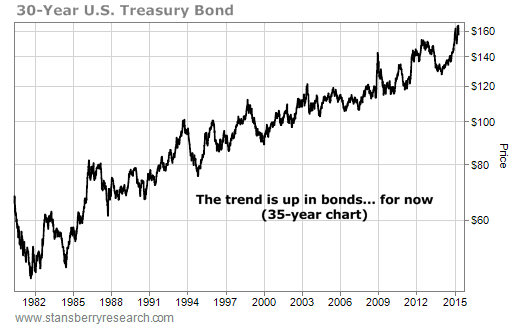 We've long warned of the froth in the global bond markets. We thought higher interest rates and inflation would take hold years ago... and we were wrong. Trillions of dollars of excess capital were desperate for both safety and yield, pushing many sovereign-bond yields into negative territory and the riskiest debt to record-high prices.
Luckily, we also maintained healthy long positions in equities, which more than made up for our macroeconomic miscalculation.
But today, more and more market veterans are warning of a looming top in the bond market.
In addition to Buffett, the so-called "Bond God" – Jeff Gundlach of DoubleLine Capital – is sounding the alarm. As he explained on the recently reincarnated Wall Street Week television show...
|
In particular, Gundlach is worried about high-yield (aka "junk") bonds – the riskiest corporate credits. He warned that many of these bonds are maturing in 2018 and 2019... And if their cash flows don't grow in line with higher interest payments, we could see default rates "out of the context of the 4% market average over the last three decades."
These problems could be compounded as emotional investors dump bond funds...
|
With higher yields available elsewhere, junk bonds are less attractive to investors.
Gundlach said this may not be an issue for two more years. But he sees the writing on the wall.
Billionaire activist investor Carl Icahn also appeared on Wall Street Week. Like Gundlach and Buffett, he's also worried about bonds...
"What's even more dangerous than the actual stock market is the high-yield market," Icahn said. Even though junk bond prices are "ridiculously high," money is pouring in. "When they start coming down, there is going to be a great run to the exits," he said.
Microsoft founder Bill Gates also expressed worry on Squawk Box this morning...
|
And billionaire "Bond King" Bill Gross wrote that the bond and stock "supercycle" of the past 35 years is coming to an end... "Credit based oxygen is running out," he wrote in his latest investment outlook.
Gross also noted that fellow renowned investors Stanley Druckenmiller, Ray Dalio, George Soros, and Jeremy Grantham share his thinking. These are some of the smartest investors the world has ever seen. Many of them, coincidentally, have made their fortunes on the back of this 35-year bull market.
For further proof that the end of this bond bull market is nigh, just look at the actions of the world's largest corporations...
If, say, Microsoft is worried that interest rates are on the rise, what would it do? It would sell as much debt at as long a maturity as possible.
And in February, Microsoft did just that, selling $2.25 billion of 40-year bonds with a 4% coupon – the first ever note with that maturity.
And the world's largest software maker isn't alone...
Companies have issued a record $39 billion of bonds this year that mature in more than 30 years... That's more than five times the amount of debt with that duration sold in the same period last year, according to Bloomberg.
The message is clear: Companies see the door closing on cheap money. They're rushing to issue as much debt as possible before the party ends.
Oracle sold $10 billion of bonds last Tuesday, which included $1.25 billion of 4.375% securities due in 2055. And Massachusetts Mutual Life Insurance Co. recently issued debt that won't come due until 2065.
In total, the average maturity for bonds issued in 2015 has been 16.4 years. That's the highest level on record for a full year, according to data from the Securities Industry & Financial Markets Association. That compares with an average of 10.7 years going back to 1996.
By issuing long-term debt at fixed interest rates, these companies are essentially shorting the U.S. dollar. Rising interest rates reduce the cost of existing, fixed-rate debt. Managed properly, these companies can use this low-cost money to buy assets that will provide a greater return.
But the individual investor doesn't have the same opportunity... No bank will loan you cash so that you can simply sit on it for 40 years.
They will, however, lend you money for 30 years at less than 4% to buy a house. And borrowing cash to buy a home is one of the best ways for the individual investor to combat rising interest rates and inflation.
While prices are up, they're still down from their peak in 2006. And near-record-low mortgage rates make housing affordable for the average American.
 We also shared Steve's forecast on home prices going forward...
Steve says the fair median value for a house today is around $261,500. And despite a rise in prices, U.S. home prices are still $53,500 below fair value. He says "it's still one of the best times in American history to buy a home."
If you don't want the hassle of taking out a mortgage from the bank and owning a piece of property – or if you can't afford it today – don't worry. There's another way for the individual investor to protect himself from the inevitable rise in interest rates: owning the world's best businesses.
We've written about this idea many times over the years. But we believe it's the single most important thing we can teach you as long-term investors. So we continue to beat the drum.
Own capital-efficient businesses. These companies, like candy maker Hershey, don't require much money to grow their businesses, so they return a large amount of profits to shareholders in the form of dividends and share buybacks.
Own companies with strong brands. This gives companies a lasting, competitive advantage. Strong brands, like fast-food icon McDonald's or soda giant Coca-Cola, have loyal customers. And these customers are willing to pay more for the joy they get from their favorite burger or soda.
Own companies that pay healthy and growing dividends. These companies often raise their dividends at inflation-beating rates. Microsoft, for example, has raised its dividend every year since 2010. (It only began paying a dividend in 2003.) Over that time, it increased its payout from $0.13 a share to $0.31 a share. That's a 138% increase in just five years.
These three traits are often found in the same companies. Simple businesses with great brands don't require much capital to fund operations, so they're able to reward their shareholders and raise prices to fight inflation. (In the May 30, 2014 Digest, we explained the many reasons owning great businesses is one of the best ways to fight inflation.)
One of our biggest predictions is starting to play out...
As regular Digest readers know, Steve Sjuggerud has made his True Wealth subscribers a fortune going long Chinese stocks.
More recently, he told readers that he believes China's currency (the yuan) will soon soar in value. As we've noted, China has been working for years to diminish the U.S. dollar's role as the world's reserve currency... and to make the yuan more prominent in global trade.
The catalyst for this is an upcoming announcement from the International Monetary Fund (IMF), an organization responsible for stability in the global monetary system. It monitors exchange rates and international trade between its 188 member countries.
And today, the Wall Street Journal said the IMF would soon declare the yuan "fairly valued for the first time in more than a decade."
The U.S. government has accused China of currency manipulation – forcing the value of the yuan down to benefit the Chinese economy. (Yes, we realize that's hypocritical, considering what we've seen from the Federal Reserve.)
This would be a major boon for China's efforts to bring the yuan to the global economic landscape. From the Journal...
|
Zhu Haiquan, a spokesperson for the Chinese embassy in Washington, D.C., said the country will continue to open up its currency. "We will comprehensively push forward reform and opening up," Haiquan told the Journal.
This is a major step toward Steve's prediction. The increasing prominence of the Chinese currency in global trades has major implications for every investor. That's why Steve put together a presentation explaining exactly what he thinks it will happen and what it will mean for you, the individual investor.
Steve believes that the people on the right side of this trend can make major profits. You can watch the full presentation for free right here.
|
New 52-week highs (as of 5/1/2015): AllianceBernstein (AB), Energy Transfer Equity (ETE), and Guggenheim China Real Estate Fund (TAO).
We've received dozens of e-mails from subscribers responding to Porter's request on Friday. We're running some of our favorites below. Please continue to send your e-mails to feedback@stansberryresearch.com.
"Your article today on the rioting in Baltimore was the most insightful and thoughtful that I have read to date. I fear that we are now witnessing the decline of the U.S. Empire. And we are past the tipping point. There are just too many people dependent on our welfare programs. And our current administration insists on importing even more. This is not the country that I grew up in." – Paid-up subscriber Sy Richards
"Nice job Porter. I've been with you guys for quite some time and am very pleased with all your services. Excellent results!! And yes, though 'experienced' I continue to learn a lot, read everything that comes in, and will be with you and your staff for many more years.
"Regarding the Baltimore situation, I don't get it! Why would a resident burn and pillage the very stores that provide services to the neighborhood? My belief is that our current government leadership has caused too much divisiveness and it makes neutral folks become less neutral. In the Marines, we had one color, green. That worked pretty well for us. Perhaps if our current leaders had more, (maybe any) real world experience, things would be different. In any case, thanks to you and your great staff for the great work and services. I'm a big follower of Dan Ferris btw." – Paid-up subscriber Jerry Coon
"Now that I have finished reading today's Digest I have decided that this is one of your best. In 2010 I listened to 'The End of America'. It made complete sense to me. So I subscribed to the Digest. We see so much the same and over the years I know that what you have said today is what is coming. It is a bitter pill to swallow. But you can just see the train wreck get closer and closer. The country that I love is being destroyed at an amazingly increased speed in the last 6 years. What is most astounding is that nobody that can do something about is doing anything. Thanks again Porter for producing 'The End of America'. My relationship with Stansberry Research has been profitable in so many ways." – Paid-up subscriber Jeff Spranger
"You asked if I would recommend your service and why. The answer is yes I will and I have. I took the leap (and yes it was a leap) to become an Alliance member. I am an engineer and know the value of a dollar, the opportunity costs and time value of money. I have learned from Doc Eifrig about options for one and the value of trailing stops (and not to ignore them). I have made a consistent 15% over the last several years of reading and following some of your company's newsletters.
"Hardest thing is to read them all. In the beginning, I really tried and it added to my education. I paid for other investment education before joining with Stansberry, often less than satisfied. I was looking for investing education, but mostly received trading education. I have found the investing education with Stansberry, that I hadn't found elsewhere.
"As far as reading, I used to read for pleasure. Now I have less time for it with family obligations and reading Stansberry newsletters. I know this has been fairly long, but you asked after all. As far as your long sales presentations. I purchase in spite of rather than because of. I listen to the first couple of minutes, to figure out what the pitch is and then turn off the sound (I have to turn it on initially) and wait for the button to appear. I then usually bookmark it and think on it a few days. If I'm still interested, I then execute.
"Due to this approach, many are just deleted (you no doubt expect that) and never viewed. In any case, I do read the entire Friday Digest and often the daily (to see what I need to read in the regular newsletters). I share podcasts with my hunting partners on the drive to and from as well as recommending your company. I plan to start my daughter on some of your newsletters to begin her financial education (she's 16). Anyway, have a fabulous Friday (probably Saturday for you) and I'm sorry you are in Baltimore." – Paid-up subscriber Alec Ross
"Dear Porter, thanks for your commentary on the violence going on in Baltimore and what is likely to be seen in to be seen across the country because our governing class don't seem to have the courage to make right the problems that they have caused and to institute meaningful reforms starting with the financial system. Keep speaking up for the truth." – Paid-up subscriber Marcus Hudgins
Regards,
Sean Goldsmith
May 4, 2015
