

These American Landmarks Are Dying
It's not too late... These American landmarks are dying... Dan Ferris: How to profit from the death of the American mall... Steve Sjuggerud agrees another bull market is here... We could see a new entrant in the Stansberry Research Hall of Fame… P.J. O'Rourke: A tax plan you will love!...
 A quick reminder to begin today's Digest...
Tonight's can't-miss online event with Porter, Agora founder Bill Bonner, and renowned analyst Chris Mayer begins less than two hours from now, at 8 p.m. ET.
If you're concerned about the spread of negative interest rates, this week's "Brexit" vote, or this fall's presidential election... or if you're simply interested in the best and safest strategies for building real, generational wealth in the stock market... you cannot afford to miss tonight's call.
It's not too late to join us, but you must sign up now. Click here to immediately reserve your spot.
We hope to see you there.
America's shopping malls are dying...
Last week, one of the country's largest commercial real estate investment trusts ("REITs") – General Growth Properties (GGP) – defaulted on its $144 million loan on suburban Detroit's Lakeside Mall.
Unfortunately, Lakeside's story isn't an unusual one...
The mall's 1.5 million square feet contain about 120 retailers. Like many low- and mid-range malls, it's anchored by a number of familiar (and struggling) department stores like JC Penney, Macy's, and Sears. And it features a number of familiar (and struggling) niche retailers like...
| • | Teen clothing store Aéropostale, which filed for bankruptcy in May. |
| • | Surf-lifestyle clothing store Pacific Sunwear, which filed for bankruptcy in April. |
| • | And jewelry and trinket seller Claire's, which saw its CEO resign in May and currently has $2.4 billion in debt trading at distressed levels. Claire's new CEO previously headed up bookseller Borders, which filed for bankruptcy in February 2011. |
Online retailers – as well as top-tier malls that cater to the wealthy – are squeezing out malls like Lakeside. Meanwhile, a big wave of additional shopping-center debt is coming due soon. As Bloomberg reported...
About $47.5 billion of loans backed by retail properties are set to mature over the next 18 months, data from Bank of America Merrill Lynch show. That's coinciding with a tighter market for commercial-mortgage backed securities, where many such properties are financed.
Remember... the carnage in retail happened even as the U.S. economy was still officially growing. What happens when the next recession inevitably arrives? Porter explained in the April 29 Digest...
The U.S. consumer has been powering the global economy (thanks to a strong dollar and strong credit growth). Those trends are going to reverse, significantly, as our economy goes into recession. That will hurt the retail sector and, indirectly, commercial real estate, which always gets hammered during recessions and will get hammered doubly hard this time.
Think about the amount of empty mall space. It's great that Amazon's earnings are soaring, but what that also means is malls are dying. Sooner or later, all of this empty commercial space will begin to hurt commercial real estate in general. Those malls are going to end up as office complexes and apartments... something nobody has figured out yet.
In other words, this default will not be the last.
In general, these indebted malls have two choices...
| 1. | They can restructure or extend their debt. This will be difficult... Lenders aren't blind to the realities facing the brick-and-mortar retail business. |
| 2. | Or... they can simply hand over the buildings to their lenders. |
This second choice is exactly what Porter's least-favorite REIT – WP Glimcher (WPG) – plans to do with five of its malls.
In a recent earnings call, the company detailed its plans to turn over several of its lower-tier malls to lenders. Commercial real estate information firm CoStar detailed analysts' reactions to the news (emphasis added)...
Four of the five malls WP Glimcher plans to transition to a servicer secure CMBS [commercial mortgage-backed securities] loans, according to Nomura Securities. WP Glimcher is also planning to enter into discussions with the special servicer for the Southern Hills Mall in Sioux City, IA, over the next several months.
"We therefore believe that all 15 of the CMBS loans secured with WPG's Tier 2 assets now face a higher risk of default," Nomura analysts wrote. "However, as many continue to report a high DSCR [debt service coverage ratio], this story will likely take some time to play out."
We doubt it will take as long to play out as these folks expect...
In the meantime, Extreme Value editor Dan Ferris recently recommended a way to profit from the death of the American mall... It's a company in a specific niche sector where "whole swaths of [its] business will disappear over the next few years."
Worse, the company has tried to hide its accounting practices... papering over failures and attempting to distract investors by launching new business segments.
Dan believes the end is near for this company. It's too dependent on mall traffic to succeed in today's era of instant shopping and two-day delivery. As he explained in the June issue of Extreme Value...
It's harder than ever to get customers to buy something in your store because they can get better prices and more variety online.
In its fifth annual online shopper survey, analytics firm comScore reported that U.S. shoppers are now making 51% of their purchases online compared with 48% in 2015 and 47% in 2014.
Dan says it all adds up to an increasingly grim picture for this company... It suffers from exorbitant spending, deceptive accounting policies, and an outdated business model that isn't adapting to a changing market.
If you're an Extreme Value subscriber, you can read Dan's full write-up here. However, if you aren't currently profiting from Dan's research, you can learn more about a subscription right here.
Yesterday, we discussed the new bull market in commodities.
We also noted that our colleague, DailyWealth Trader editor Ben Morris, believes the rally could have much further to go. He's not alone...
True Wealth editor Steve Sjuggerud agrees. Steve says commodities possess all three traits he looks for in an ideal investment...
They're cheap... They're as hated as he's ever seen in his entire career... And they've just started an uptrend. Steve says that presents a huge opportunity today. As he wrote in the June issue of True Wealth...
You'll be shocked when you hear just how far commodity prices have fallen... In June 2008, the main index of commodity prices stood at 10,600. (That index is the GSCI Commodities Total Return Index.) In January of this year, it fell below 1,900 – an 82% fall over eight years.
Think about this for a second... This isn't some speculative stock that's down 80%... This is the entire universe of commodity prices... like oil and gas... and wheat and cattle. It's the worst eight-year return – by far – in the history of this commodity-price index (going back half a century)...
What has happened in the past after big falls in commodity prices? Take a look…
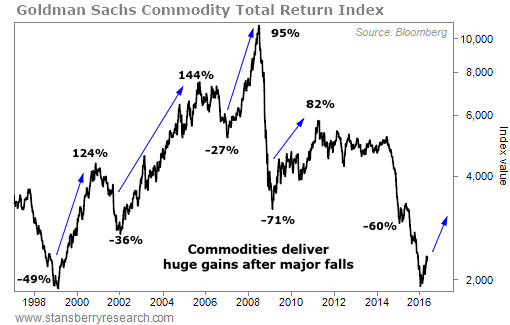
Steve explained that after each of these big busts, commodity prices have soared. The median gain after each was an impressive 110%. But Steve believes investors could do even better this time around. More from the issue...
You see, this hasn't been your garden-variety, 18-month fall in prices. This has been something greater... This is an 80% loss over eight years.
After such a sustained loss, investors have given up on commodities to a degree that I have never seen in my 20-plus years in this business. Investors have given up on inflation... and the fear of inflation is typically a massive driver of commodity prices.
The thing is, you can't do that... You can't assume inflation is dead... My friend, we live in a world of zero-percent interest. And we live in a world where governments have nothing holding them back from printing money.
I think of these two things as "latent power" for an asset-price boom. Zero-percent-interest rates are like a lit match... looking for a new fuse.
They have already lit up stock prices. And the same is true for real estate. But commodity prices? They fell to 1991 prices earlier this year. This is an ideal setup... We have an asset price that has crashed (commodities)... and we have a lit fuse in the form of zero-percent-interest rates.
Steve says investors could do well by simply owning an exchange-traded fund ("ETF") that tracks the GSCI Commodity Index. But he has found an even better way to profit today.
Steve recommends a little-known investment vehicle that soars when commodities boom, but doesn't fall nearly as much when they bust.
Over the past 25 years, the GSCI Commodity Index has returned a total of 2%. Yes, that's right... Since 1991, through all the booms and busts, the broad commodities sector has basically gone nowhere. Accounting for inflation, it has actually declined.
Steve's recommendation, on the other hand, rose 1,240% in the same period. That's an incredible difference.
This trade has all the makings of a classic Steve Sjuggerud winner... Commodities are cheap, incredibly hated, and just starting an uptrend. And Steve has found a way to stack the odds even further in his subscribers' favor.
You could eventually see this trade at the bottom of the Digest in the Stansberry Research Hall of Fame. Subscribers can find all the details in the June issue of Steve's excellent True Wealth advisory right here.
New 52-week highs (as of 6/20/16): OceanaGold (OGC.TO), Pretium Resources (PVG), Spectra Energy (SE), and AT&T (T).
In today's mailbag, two more subscribers comment on Porter's Friday Digest... and another weighs in on last week's essay from Stansberry Research contributing editor P.J. O'Rourke.
Will you be joining Porter, Bill Bonner, and Chris Mayer on tonight's free webinar? We'd love to hear what you think. Let us know at feedback@stansberryresearch.com.
"Dear Porter, you did a fantastic job of explaining the credit situation and the SEC. You can believe me because my job at work is to read commodities reports and give feedback to the writers.
"Regarding your negative critics: I read your work twice, and I check some other sources before I get in to something. I think that all newsletter subscribers should too. I plan to re-subscribe. Your work is excellent." – Paid-up subscriber John S.
"Porter, I retired after 35 years of service in the Oil Industry. I'm pretty much up to speed on the new drilling and completion technologies and have been impressed by your group's grasp and knowledge of the same. Your latest 'Why the Credit Crisis Is About to Intensify' was precise, concise and dead on point..." – Paid-up subscriber Rus M.
"P.J. is sometimes humorous, but always entertaining – even when he scares the heck out of me. Today's was brilliant, scary, and hopeful; thanks for the reminder that predictable behavior by the morons in power provides us opportunity to game their rules and profit from the bureaucrats' stupidity.
"Of course, the danger is that as they become ever more powerful, they increasingly lose their respect for the rule of law, which means even using their rules to plan one's investments may end in disaster when they decide to exercise power they do not have to capriciously change the rules according to their present whim (as the bondholders in GM found out the hard way). Thanks for the entertainment/education, PJ." – Paid-up subscriber Timothy
Regards,
Justin Brill
Baltimore, Maryland
June 21, 2016

A Tax Plan You Will Love!
The microeconomic outlook is gloomy... The macroeconomic outlook is glum... The political outlook is dismal...
So let's talk about something that's cheerful by comparison – taxes.
I have a plan to raise taxes. But this is a plan I think Stansberry Digest readers can support. I believe I have figured out a way to raise taxes that – for the first time in the history of taxation – will be fun.
Before I explain, let's take a moment to face the fact that our taxes are going to go up no matter what.
The American economy's two biggest problems are the federal deficit and the federal debt.
We should fix those problems by cutting federal spending. But neither candidate is willing to do that. So the problems will have to be fixed by raising taxes.
Hillary is a Liberal Looney. She'll create more new government programs than you can shake a stick at, then she'll tax the stick.
Trump is just as much of a Looney. He claims he'll cut taxes, but he swears he won't touch entitlements. And he's full of governmental ideas as big as his name is on his buildings. These will have to be paid for somehow.
Elect Hillary, and we'll get obvious higher taxes – on our incomes, investments, and businesses.
Elect Trump, and we'll get hidden higher taxes – in the form of worthless U.S. dollars being printed to fund the deficit and debt.
I have a better idea.
Let's tax celebrities.
I don't mean we should tax individuals for being celebrated... as long as they're celebrated for something.
Warren Buffett is celebrated for his investment savvy. He may think his taxes are too low. ("Even my secretary pays a higher tax rate than I do.") But I don't want to raise Buffett's taxes. Investment savvy benefits mankind.
And I don't want to tax celebrated athletes, artists, or entertainers even if they seem like obnoxious jerks and I'm not sure why they're celebrated. To me, rap music sounds like a bunch of angry potty-mouths fell down a flight of stairs while carrying a drum set. But my daughter assures me that Kanye West is a genius. So I don't want to raise his taxes. Kanye West benefits... um... my daughter and her friends when they're having a noisy party.
What I want to tax is "celebrities" – that modern category of useless fools and numbskulls who have never accomplished a single damn thing and are famous for it.
The net worth of Kim, Kourtney, and Khloe Kardashian plus that of their sisters Kendall and Kylie Jenner and their mother Kris totals $300 million (at least according the intrepid newshounds at Life & Style magazine). I'd say a just and fair Kardashian tax rate (call it "IRS Form 7K") would be 100%.
I'll let Used-to-Be-Bruce off the hook for having won a gold medal in the 1976 Olympic decathlon.
Taxing the Kardashians alone won't close the deficit gap. The budget deficit is $438 billion. This leaves us with $437.7 billion to go. But a 100% Celebrity Tax would apply to plenty of other people.
For tax purposes, my definition of a celebrity is "Anyone who attracts or attempts to attract public notice for doing something requiring so little talent, skill, and sense that my kids could do it."
With an extra 110% Celebrity Surtax when they attract public attention for something that would get my kids grounded without TV, iPhone, or Internet until they're 40.
I'm thinking, for example, of that idiot Johnny Knoxville and his Jackass crew of morons. I spend about half my day trying to prevent my 12-year-old son, Buster, from doing the type of things that Knoxville and his buddies did – such as taking a stolen grocery cart to the top of the local ski hill that's closed for the season and riding it down the terrain park. I don't even know where Buster gets these ideas. The MTV series Jackass was off the air before he was born.
Or the Real Housewives franchise. I've got an 18-year-old daughter. I'm sure she has the talent to spend a fortune on clothes and makeup. I know she has the skill to throw the kind of tantrums that increase TV ratings. And since she's legally an adult, she could marry a rich jerk and then act like Huma Abedin does when she peeks at Anthony Weiner's Twitter account. But my daughter is too smart for that. I hope.
Speaking of smart, my dog has more brains than the contestants who go on Naked and Afraid.
Reality TV is an excellent place to start applying the Celebrity Tax. I have one particular show in mind. My kids have a knack for being bossy. They are adept at telling each other the sibling equivalent of "You're fired!" And I've watched them spend their allowances… They possess the kind of business acumen that if you gave them a license to mint money at an Atlantic City casino, they'd go bankrupt, too.
A Celebrity Tax is perfect for our presidential candidates. If Donald Trump is as rich as he says he is, we really could make a dent in the deficit.
And talk about a useless fool and numbskull who has never accomplished a single damn thing and is famous for it, there's a certain former secretary of state.
From the "reset button" to smooth relations with Russia to the "spontaneous" attack on our consulate in Benghazi, U.S. foreign policy was one triumph after another under Hillary Clinton.
When Hillary was a senator, she introduced exactly three bills that became law. One bill created a National Historic Site in Troy, New York. One bill renamed a post office. And one bill designated a portion of U.S. Route 20A as the "Timothy J. Russert Highway."
Also, remember how we were going to get a two-for-one deal when we elected Bill in 1992? Remember "Hillarycare" in 1993?
And Hillary's attempt at being a Whitewater real estate developer made Donald Trump's handling of the Trump Taj Mahal look like a Warren Buffett investment.
Tax the hell out of Clinton and Trump. We think he's rich. We know she is. The November election is going to take one of them to the White House. Before that happens, let's take both of them to the cleaners.
Regards,
P.J. O'Rourke
|