
What lower oil prices mean for your income investments... Inflation is nowhere to be found... Municipal bonds are on fire... New highs for income... Don't miss Doc Eifrig's live presentation tonight...
 Oil is trading for less than $78 a barrel...
Yesterday, we explained why you may have more exposure to falling oil prices than you think.
Today, we'll discuss what lower oil prices mean for your income investments.
Inflation is the enemy of income investors. When interest rates tick up, the income you receive from your stocks and bonds is worth less. Of course, as we've discussed numerous times, there are a handful of dominant companies that raise their dividends like clockwork at a rate that far outpaces inflation. We've dubbed these companies "World Dominating Dividend Growers."
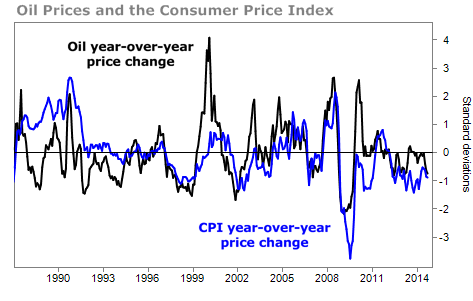
Falling oil prices – from nearly $107 a barrel in June to around $77.60 today – are one sign that inflation is not an immediate worry.
In addition to dismal growth and inflation in the European currency union, other domestic indicators are showing low inflation. Dr. David "Doc" Eifrig discussed this in the October 22 DailyWealth...
|
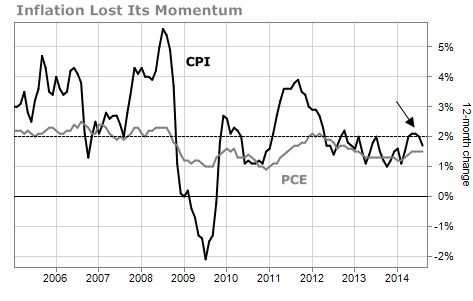 And in yesterday's DailyWealth, Doc showed how tightly oil prices and inflation are correlated...
|
 With no imminent fear of inflation, you can still collect safe and large investment income in some of Doc's favorite assets... like blue-chip stocks and municipal bonds.
As longtime Digest readers know, Doc has adamantly urged subscribers to buy municipal bonds – debt issued by state and local governments – for years.
With no imminent fear of inflation, you can still collect safe and large investment income in some of Doc's favorite assets... like blue-chip stocks and municipal bonds.
As longtime Digest readers know, Doc has adamantly urged subscribers to buy municipal bonds – debt issued by state and local governments – for years.
He took advantage of overblown fears surrounding Detroit and Puerto Rico to recommend muni-bond funds trading for less than their net asset values (NAV) and sporting double-digit tax-equivalent yields.
And recently, the Wall Street Journal featured an article on muni bonds with the headline "Returns on Muni Bonds Soar." That's about as close to hyperbole as it gets for one of the market's most "boring" sectors.
Through the end of October, muni-bond funds saw $1.3 billion of inflows and returned 8.3%... topping the Dow's 6.9% gain and a 6.7% increase in high-grade corporate debt.
"Munis" posted their longest monthly streak of gains in two decades, according to the Journal... But Doc's top two ways to buy munis returned even more – 11% and 23%, respectively, through the end of October.
That's a huge gain for one of the market's safest assets. But again... Doc took advantage of misplaced fears surrounding the asset. His subscribers were able to buy these high-quality bonds at large discounts to their NAV.
While they aren't the screaming deal they were a few years ago, you can still buy certain municipal-bond funds for discounts to their NAV... and still collect healthy yields. Given the current inflationary outlook, munis are still a good place to be.
As you can see from the new highs list below, some of our other favorite ways to generate income are also trading at new highs... including blue-chip software firm Microsoft, tobacco giant Altria, insurance stocks, and utilities.
For the past three days in the Digest, we've covered the basics of selling puts. We discussed how put-selling works. We told you why it's critical to only sell puts on blue-chip stocks. Yesterday, we showed you how to generate even more income if you end up being "put" the stock.
To cap things off, Doc is hosting a live webinar tonight at 8 p.m. Eastern time to show you exactly how to trade options. And he's leaving plenty of time for questions at the end... Plus, tonight only, Doc is making a special offer to anyone who wants to try his Retirement Trader service.
But you don't have to be a subscriber to watch Doc's live presentation... It's free for everyone. To reserve your spot, just click here.
New 52-week highs (as of 11/5/14): Berkshire Hathaway (BRK.B), Chubb (CB), CDK Global (CDK), CME Group (CME), CVS Health (CVS), Dominion Resources (D), Fidelity Select Medical Equipment & Systems Fund (FSMEX), iShares Dow Jones U.S. Insurance Fund (IAK), InterDigital (IDCC), Johnson & Johnson (JNJ), Medtronic (MDT), 3M (MMM), Altria (MO), Microsoft (MSFT), ONE Gas (OGS), Pepsico (PEP), Procter & Gamble (PG), ProShares Ultra S&P 500 Fund (SSO), Constellation Brands (STZ), Skyworks Solutions (SWKS), Travelers (TRV), UIL (UIL), ProShares Ultra Utilities Fund (UPW), W.R. Berkley (WRB), and SPDR Select Sector Utilities Fund (XLU).
In today's mailbag, a technical question on selling puts. Doc will address most of these tonight, so be sure to tune in. And send your questions and comments to feedback@stansberryresearch.com.
"Can you detail rolling forward a position?" – Paid-up subscriber Bernard Bodeux
Goldsmith comment: Option sellers typically hold options until expiration. But prior to expiration, you can "roll forward" options by buying, to close your position and simultaneously selling, to open, a new put farther out in time.
We expect Doc to cover this in more detail in tonight's free live training session. Plus, he's hosting an extended Q&A session after his presentation. You can register by clicking here.
Regards,
Sean Goldsmith
November 6, 2014
