

Where Will You Die?
Where will you die? The silent deal between you and me... Buffett's biggest goof ever... The next major corporate collapse... Where to learn the secret of 'flash bids'... Our next educational series, the 'Bear Market Trading Program'...
 You might not know it, but I consider us – you and me – in a deal together.
Let me explain...
A long time ago, I (Porter) was at a family wedding with my father. Wanting to get to the bar and the buffet as soon as possible, I said something under my breath at the end of the ceremony like, "Whew! Glad they're finally married. Let's get a drink."
My dad said, "Their marriage hasn't even begun..." Then, as we were walking out, he explained, "Porter, a marriage isn't the deal you make when you meet each other. And it's not exactly what you promise at church. A marriage is the agreement you make in the silences in between your promises and arguments. It's the real compromises. It's the things you know the other person will do every time, not the things they promise they will do."
No, you and I aren't married. But we are in a deal together. I've promised to help you become a better investor by giving you better information, better insight, and better strategies. I believe we can even help you make better decisions across the spectrum of your life by showing you how to cope with uncertainty, how to manage risk, and how to judge the quality of information you're evaluating. And you've promised, whether you realized it or not, to read our work and give us a fair shot at earning more of your business.
To make my business model work, I have to hustle. We don't get paid based on your profits. We don't get to take a point (1%) of your wealth every year. We charge insanely little (typically less than $100 per year) for the value we deliver. Our top-performing newsletters routinely deliver annualized returns in excess of 15% – returns that, were we a hedge fund instead of a publishing company, would earn us billions.
But we're not Wall Street. We're blue-collar Baltimore. So we ask you (frequently) for the opportunity to serve you in other ways. We'd like for you to join one of our lifetime packages, which gives our business its core financial support. We'd like for you to try one of our expensive trading services, which create most of our profits. And most important, we'd like for you to continue to renew your subscriptions, as this income is critical to our success as publishers.
In return for your forbearance of our constant marketing (and the occasional additional purchase)... on Fridays, I sit down and try to figure out what I would most want to know if our roles were reversed. I spend five or six hours giving you as much value as I can. I don't ask you to pay anything extra for this work. But I've been told by hundreds of subscribers it's the most valuable content we produce. (By the way, it does motivate me to hear from you. If you've come to appreciate this feature of your subscription, please let me know at feedback@stansberryresearch.com.)
We don't advertise the Friday Digest... and I have never made you any explicit promise about it. But it's like a marriage... It's the deal we've made in silence. I'll keep doing my part. But keep in mind my constant caveat: There's no such thing as teaching, there's only learning. You have to read carefully. You have to think. I can't do that for you.
What's your biggest fear as an investor? Most people think of failure as losing money. But losing time and opportunity are, in my view, just as serious. Today, I'm going to show you a surefire way to avoid losing all three when you make an equity investment.
The advice boils down to a simple checklist, so if you're in hurry, you can scroll down. But I hope you won't. Knowing why these strategies works is just as important. If you don't know why they work, you won't trust them. Plus, you'll find these same dynamics can play out in many areas of your life. I hope you'll file this Digest away for future reference. I even give you permission to share today's Digest with anyone you think these ideas might help.
Berkshire Hathaway Vice Chairman Charlie Munger famously says, "Tell me where I'm going to die so that I never go there." Most people get the joke, but they miss the point. You can't avoid dying. But you sure as heck can avoid making obvious mistakes. The crazy part is... even the smartest folks in the world make obvious mistakes all the time. Even Munger and legendary investor Warren Buffett!
Warren Buffett has now lost $2.6 billion on IBM.
Worse, since making his original $10 billion investment back in 2010, near the low in stocks, he has missed out on the third-biggest bull market in history. He missed five years of a big bull market with a big chunk of his portfolio, and as a result, for the first time in his career, he underperformed the S&P 500 for more than five years running.
And here's the kicker: Buffett told investors back in 1996 that IBM, along with General Motors and Sears, were former giants whose shares were no longer safe to own.
Buffett wrote that these businesses, "which had enjoyed long periods of seeming invincibility," were not in industries where leaders enjoyed easy supremacy. Their lines of business did not "exhibit characteristics that endow leaders with virtually insurmountable advantages." Instead, these large companies were "imposters" whose shares were "riding high but vulnerable to competitive shocks."
Over the next 15 years, Buffett was proven right. GM has already gone bankrupt since he wrote these words. Sears is a shell of its former self and, without huge amounts of financial engineering, would have also filed for bankruptcy long ago. And IBM has been suffering from the same kind of competitive shocks Buffett correctly identified all the way back in 1996.
But did he avoid the stock? Nope. He invested $10 billion in the business in 2010 and then bought $3 billion more, an amount of capital that's 10.5 times more than he invested in Coca-Cola. His IBM position is equal to 23% of all the capital he has invested in Berkshire's current "Big 15" equity positions. Talk about driving to your own funeral!
In my experience, the biggest and most dangerous mistake otherwise excellent investors make is putting way too much capital in what are called "value traps." These businesses, like IBM, look so cheap that they just prove irresistible, especially for wise and knowledgeable investors who wouldn't normally make such an obvious mistake. Buffett's investment in IBM sure looks like a classic case of this kind of error. It's a mistake you should never, ever make because it's completely avoidable. Let me show you how to block out this problem forever.
I last wrote about how to avoid value traps in the October 10, 2014 Digest. Using the approach, I'll show you again today how we found 11 stocks that were obvious value traps. (You'll see the companies listed below, with their return since we published the list.) On average, these 11 stocks declined almost 20% annually since we told you to avoid them. Almost all of these firms used to be major companies – like McClatchy, Ruby Tuesday, Career Education, Monster Worldwide, and RealNetworks. And lots of big-name investors have lost millions and millions of dollars on these names.
In fact, a little secret... I originally built this list because a famous hedge-fund manager (who lives in Dallas) was trying to get me to recommend one of these stocks in my newsletter. I couldn't believe it. To prove to him how foolish he was being, I asked my team to build this model. I thought when he saw the other companies that were like the one he was buying, he would realize the mistake he was making. But he didn't. He couldn't admit he had made a dumb mistake.
|
2014 Terminal Decline Portfolio |
|||
| Name |
Symbol |
Revenue Growth* |
Return^ |
| Republic Airways |
RJET |
-16% |
-85% |
| Navios Maritime |
NM |
-29% |
-76% |
| McClatchy |
MNI |
-23% |
-62% |
| RealNetworks |
RNWK |
-69% |
-34% |
| Monster Worldwide |
MWW |
-27% |
-30% |
| Ruby Tuesday |
RT |
-6% |
-21% |
| Career Education |
CECO |
-59% |
-14% |
| Ally Financial |
ALLY |
-41% |
-11% |
| Speedway Motorsports |
TRK |
-12% |
17% |
| Telephone & Data Systems |
TDS |
4% |
27% |
| JC Penney |
JCP |
-29% |
52% |
| * Over the last five years | |||
| ^ Since October 10, 2014 | |||
How did I know these companies were going to suffer? How did we pick 11 stocks, most of which have gone way, way down despite the bull market in stocks? (Only three of these stocks went up at all, and only JC Penney has done well... lately, at least.)
Our approach is centered on finding stocks that seem to be in a terminal decline. We look for companies whose shares are obviously out of favor (they're cheap, trading around book value or less) where revenues haven't grown for years, and where goodwill is being written off. The last part, about goodwill, is very important. It's the "secret" in the sauce.
Don't let the jargon bother you. Goodwill is simply a fancy word for corporate assets that are hard to value because they're intangible. It could be something as simple as a customer list that leads to lots of sales. Obviously, the list is worth more than the paper it's printed on... but how much more? That's where the accountants start arguing.
Don't get bogged down in the details. Just understand this: When companies start writing off goodwill, it usually means that something important in their business is broken. Maybe their brands aren't attractive to consumers anymore. Or maybe their patents are expiring. It could be any number of reasons... But in combination with a long-term decline in sales... it's almost always a tough business problem to solve.
I asked my team of analysts to do a new scan across the markets, looking for stocks that fit this model – out-of-favor shares, declining revenues, and goodwill write-offs.
They found more than 50 examples, but most of the names were small-cap stocks, whose shares can be hard to sell short, and/or were involved in the oil and gas industry. Oil and gas has obviously been through a huge boom-and-bust cycle, so I'm not as confident in those results. When I tossed out the small caps and the oil and gas names, it left us with only eight companies in our current "terminal decline" portfolio...
|
2016 Terminal Decline Portfolio |
|||
| Name |
Symbol |
Revenue Growth* |
Return# |
| Apollo Education |
APOL |
-48% |
-70% |
| Allegheny Technologies |
ATI |
-8% |
-52% |
| United States Steel |
X |
-33% |
-46% |
| News Corp. |
NWSA |
-1% |
-36% |
| Time Inc. |
TIME |
-16% |
-34% |
| Universal American |
UAM |
-74% |
-19% |
| ManTech International |
MANT |
-40% |
-8% |
| Scholastic |
SCHL |
-14% |
-2% |
| * Over the last five years | |||
| # Over the last 12 months | |||
| Note: These companies have written off $5.7 billion in goodwill over the last five years. | |||
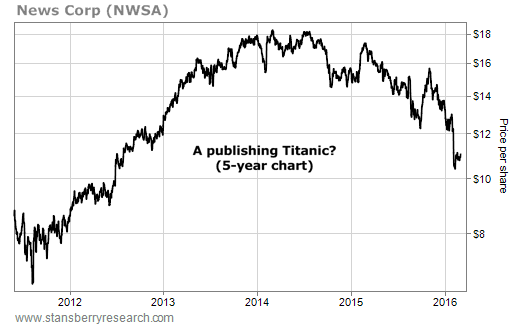
Notice that three of the eight companies are in publishing, an industry that is being completely transformed by new kinds of media. News Corp. is a huge, global leader in old-line publishing. It's highly leveraged. And it has long been a favorite of major institutional investors. Seems like a classic value trap to me...
I hope knowledge of these "terminal decline" stocks will help you in three ways.
There's the obvious: This approach will keep you 100% away from value traps if you will simply remember to use it.
There's the inverse: This approach tells you a lot about what you do want to own. You want companies that can grow revenue easily and consistently. You want companies whose goodwill increases through time, as more and more consumers come to love their brands and products. (Again, this is where the accountants will start arguing... they'll remind you that goodwill is never adjusted higher. But that's just the accounting convention, it's not reality. In reality, companies like Disney, Apple, and Coca-Cola have increased the value of their intangible assets steadily, and by huge amounts. That value shows up as premium over book value, but only because the accountants won't revalue goodwill higher.)
And finally... This approach can give you yet another tool in your fight against the bear market that I believe is developing. It's not hard to imagine that using News Corp. as a major short position could provide your portfolio with some significant benefits as a "hedge" against lower equity prices.
Speaking of protecting yourself from the bear market... As you may know, over the last seven weeks, we've been producing an educational series, published every Friday.
We called it the "Bear Market Survival Program." The series covered all of our core strategies for protecting your portfolio and even profiting from a bear market – everything from using gold as a hedge to exactly how to short stocks successfully. We even showed you which stocks you shouldn't sell during a bear market, no matter how bad it gets.
This education was dirt-cheap – just $29 for each week's module. And for the next seven days, there's a simple way for you to get all of this information for even less.
But first, let me tell you what's in today's Bear Market Survival Program module. This is our seventh and last installment of the series. In today's module, we take all of the strategies we've taught and put them together in one coherent portfolio. It's diversified. It's properly allocated. And it's a blend of our best ideas, across all of the strategies we endorse during a bear market. Whether you want to "paint by numbers" or simply see how I would use this information to build an actual portfolio, this is the module you need the most.
We got a lot of positive feedback about this educational series. We knew our readers counted on us for education, but we didn't realize how many subscribers look to us primarily as an educational resource. We've heard from hundreds of subscribers who don't even use our work for actual investing (yet), but instead simply want to learn how to invest successfully in anticipation of beginning their own investing down the road. This is an exciting new opportunity for us, and we want to expand on our educational materials.
So we're going to launch another educational series. Like the Bear Market Survival Program, it's going to teach strategies that are well-suited for difficult market periods. But this time, we're going to focus on trading. There are lots of different ways to trade the market for safe, short-term profits and income – profits that can help you continue to generate gains even while stocks in general are falling. So we're calling our next seven-part series the "Bear Market Trading Program."
What's the safest way to trade for significant short-term capital gains, regardless of what the market is doing as a whole? It's not using options. It's not currency trading (that's for sure!). It's doing "plain vanilla" merger arbitrage.
Believe it or not, you can learn to do this in about 15 minutes. It's not hard. It takes about 10 minutes a week to implement. And you can earn up to 50% a year doing it – even during a bear market. I'm not talking about insider trading. I'm talking about doing completely legal transactions that are super low-risk. We can show you exactly where to find the deals that are safe to trade, how to make the trades, and how to calculate exactly how much you're going to earn on each deal. This is my No. 1 way to trade safely for profits during a bear market.
We will also teach you how to use the "dividend kicker" for quick (usually less than 90-day), double-digit gains. I don't even want to describe how this strategy works because telling you anything about it will give away too much of this incredibly simple, lucrative strategy we developed nearly 10 years ago to generate super-safe profits. It even works during bear markets. You won't believe how easy this is...
And we'll show you another incredible trick to completely mastering bear markets with trading. It's a way to completely, 100% guarantee that the general market will not influence the value of your position. The strategy doesn't cost anything. You don't have to buy a put option or anything like that.
Again, this strategy is so simple that once we tell you exactly how to do it, you'll wonder why you never thought of it before. It's a way to immediately and permanently "insulate" every long position in your portfolio against any and all market volatility. This is the absolute best way to increase your total returns and to make sure that bear markets never, ever disrupt your long-term investment goals again.
Not all of the Bear Market Trading Program ideas will be simple, though. Some of the things we can teach you are fairly technical. For example, we'll show you a strategy called "flash bids" that can allow you to make 20% or 30% almost instantly.
Yes, these profits are rare. But they don't cost you anything to set up, and every now and then they will automatically trigger. It's like someone simply handing you money just because they're stupid. Yes, this is real. Yes, this is legal (incredibly). We'll show you exactly how to do it and how to handle your broker complaining about you ripping off their other clients.
These reports will come once a week for seven weeks. They'll teach you strategies and techniques that have been pioneered and proven by the world's best investors. These are the strategies that hedge funds charge their clients billions of dollars a year to implement. As you'll see, they aren't as hard as some may seem... But they can genuinely transform your investing and take you to a level you didn't think you would ever reach.
Wouldn't you love to be able to say with total confidence, and without a trace of arrogance, that you simply don't care anymore what the market does? That you know – come hell or high water – that your portfolio is going to make 15% to 30% this year (or maybe more, if you hit another flash bid)?
That's what we're offering. We're going to charge a bit more for this information than we did last time. It's worth a lot more. The Bear Market Trading Program will cost $49 per week. We'll bill you once a week, on Fridays. There are no refunds (after all, you can't return the education we're providing), but you can cancel at any time.
And there's one loophole... We want to make sure that the subscribers who joined us for our first educational series and who completed the program are rewarded for their loyalty to our business.
For these folks – and only these folks – if they choose to continue their education with us, they will continue to only pay the original $29-per-week rate. They're going to get the advanced Bear Market Trading Program series for the same price they've been paying. They won't pay the $49 per week we'll begin charging next Friday. Over the course of seven weeks, that's a savings of 40%. (Of course, Stansberry Alliance members receive this for free.)
Sure, the information I gave you today about News Corp. is valuable. And yes, you can put it to good use. But that's what we're willing to give away for free. There's a lot more we can teach you. Let us.
New 52-week highs (as of 3/3/16): Deutsche Bank Gold Double Long Fund (DGP), Market Vectors Junior Gold Miners Fund (GDXJ), SPDR Gold Shares Fund (GLD), Kaminak Gold (KAM.V), NovaGold Resources (NG), Sturm, Ruger (RGR), Seabridge Gold (SA), SEMAFO (SMF.TO), and AT&T (T).
A busy day in the mailbag. Send your questions and comments to feedback@stansberryresearch.com. As always, we aren't allowed to offer individual advice, but we read every e-mail.
"Just wanted to let you know that I bought FCX based on the November [Stansberry's Investment Advisory] recommendation. Shares dropped, and while I got close to hitting my stop loss, I decided to sell covered calls against my shares for additional income. The calls expired, shares have since bounced back, and I am currently up 18% on my position. There is no teaching, there is only learning. I have learned from Stansberry a whole set of different tools to use – depending on what is going on in the markets, am able to pick the best tool for the specific market condition. Thank you very much." – Paid-up subscriber Marcus K.
"Porter & Editors, In mid 2007 I was up 17% in my 401k and recall saying that bears make money, bulls make money and pigs lose their shirt! I had just recovered from the dot com bust and got very conservative and went to cash (95%). Dumb luck is better than no luck at all.
"In 2010, I was nearing retirement and a friend pointed me to SR so I stuck my toe in the water with Ferris and then Doc... A year later, I realized that markets have different cycles, some related and some not and that various newsletters have better advice depending upon the phase of the cycle, the equity and investment horizon. But I never forgot that initial wisdom – 'buying at the right price'. I graduated to the Flex membership and in 2012-13 I probably switched too many times between newsletters but only in an attempt to identify the best fit for me and the market cycle. In 2014 I became an Alliance Member and the education continued.
"Now that I am retired, I rolled my 401k into self-directed IRAs and we are now beginning the cycle (bear phase) over again. This time I am aware of the impending collapse and follow the 'bear market survival strategy'. This year I am up nearly 20% largely due to shorts and gold. Options provide another reliable revenue stream. I look forward to the teachings so I can take advantage of the next bull market. Thanks for the opportunity to learn, the logical explanations to understand, and the motivation to succeed. Keep up the excellent work!" – Paid-up subscriber Rick T.
"Did I just read that the Alliance membership is now $25,000??? If memory (and records) serves, I paid $3,900 back in 2004 and have enjoyed EVERY publication, new and old, except Venture for a measly $99 each year. If memory also serves, I am allowed to pass on my Alliance membership when I die.
"What I'm trying to say is that boy am I glad I decided to join when I did! The information and 'teaching' that allows us to 'learn' is worth far more than any college course, undergraduate or graduate, that I've paid for and my 'investment' in the Alliance has grown at 18.4% per year (assuming 11 years). Frankly, the value far exceeds that estimated 'return' on the value of my subscription.
"Porter & the rest of the group – you've lived up to everything you said you would and I thank you for being a man/business of your word. It's so rare in today's world. There was a time when I wasn't getting the emails that I paid and subscribed for because my email provider was blocking them as spam and not even letting me decide whether I wanted to see them or not (sounds like the government, but it's not). Not only did your team come up with a solution until the blocking was resolved by my preferred email provider, now that it has been resolved I get some things twice! If I miss a recommendation to buy or sell, it's my own fault.
"You guys have gone above and beyond for over a decade to make sure that I'm a happy customer. I feel sorry for subscribers that complain. They clearly don't see a good deal or service when they see it and likely complain about everything. Seriously, trying to gain access to every publication through the Flex Alliance program by switching newsletters constantly instead of understanding the value of five at a time??? I'm glad you're a young guy. If you weren't, with all the knuckleheads out there and your success I'd be very worried that you were going to retire and shut things down in the next few years. Then again, from what I know about you, this company and what it stands for is going to be around for a very long time. Thanks again." – Paid-up subscriber Todd K.
Regards,
Porter Stansberry
Baltimore, Maryland
March 4, 2016
P.S. A very special thank you to my mother, who I know reads the Digest every Friday. Last week, I got the worst stomach flu of my life. I lost 20 pounds in five days... and it wasn't worth it. Last week was also the only week of the year that my wife had planned to use our boat (www.twosunscharters.com) with her girlfriends. She was catching marlin in Chub Cay. We have two young sons, Traveler (8) and Seaton (4), who need meals... and bedtime stories... and to be taken to school each day. I spent the week in bed and in the bathroom.
On Monday morning, I made the emergency call: "Mom, I think I'm in trouble. I think I need your help." She flew up hours later from Orlando and saved the day. Hot meals for the kids, cold towels for my fever. I haven't spent a week like that with my mother since I was 12 years old. Family is an amazing thing we all take for granted. Call your mother. Tell her you love her. Mom, I love you. Thanks so much for everything.