
Why Apple hit another new high... Apple Pay could help make Apple a trillion-dollar company... The government is partnering with Apple... Why we're still bullish on IBM... Big Blue is moving to the 'cloud'... Buffett ups his stake...
 Apple continues its relentless march higher...
The consumer-products giant hit another all-time high today of $128 per share, pushing its market cap near the $750 billion milestone.
As we wrote in the February 11 Digest, Apple became the largest company in U.S. history after its market cap surpassed $700 billion. It got another boost that day after investment bank JPMorgan raised its price target, arguing that the Apple Watch would be a success. From that Digest...
|
We agree the Apple Watch is a positive development... But we're more focused on Apple Pay, the company's mobile-payment application on the new iPhone 6 and iPhone 6 Plus.
You can load your credit and debit cards, rewards cards, gift cards, and more on your phone. Then you wave your phone over the payment processor to complete the transaction.
It's more convenient than carrying around your wallet, and safer (your information is encrypted). Apple is already partnered with 90% of the country's most-used payment cards. Consumers are using the service more and more. And the trend is clearly up. More from that Digest...
|
Apple earns $0.15 for every $100 users spend through Apple Pay. The company should soon start to make huge profits from the service.
But Apple Pay also makes Apple products even stickier. In addition to hosting our photos, music, videos, and travel documents, Apple is now tied into our banking and credit cards as well...
"Apple's becoming very pervasive in consumer lives and that's what could take the stock to the next level," UBS analyst Steve Milunovich told CNBC this week.
Milunovich upped his price target for Apple to $150 a share. Hardware still plays a major role for the company, but as he noted, "services is really the glue to this story."
The Washington Post has also picked up on the significance of Apple Pay. It ran a story about a major new merchant for the application: the U.S. government.
"Starting in September, Apple Pay will be available for many transactions with the federal government, like for example when you pay for admission to your favorite national park," Apple CEO Tim Cook said at a White House organized cybersecurity meeting at Stanford University.
Apple is working with the government to make procurement cards issued to government employees compatible with Apple Pay. The company is also working to use its technology to help distribute state and federal benefit programs, like Social Security. From the Washington Post...
|
That revenue stream alone is worth $40 million a year to Apple.
But Cook has larger ambitions than just revolutionizing the way we pay for goods and services. He wants the wallet to be a thing of the past. He said he would like the iPhone to store your driver's license, passport, and all other important information.
While it's clear Apple will benefit from this huge trend, Dr. David "Doc" Eifrig recently put together a special report explaining the details of mobile-payments technology and the companies leading its development. He also identifies a number of small companies making the "guts" of this technology whose shares have the potential to soar. His presentation is free, and it's a must-watch... especially if you're an Apple shareholder. You can watch it by clicking here.
We've also been dedicating space in the Digest to another technology giant – the former 800-pound gorilla, IBM.
Today, many investors have left IBM for dead. And though the stock price has languished, we've remained bullish on the company's prospects...
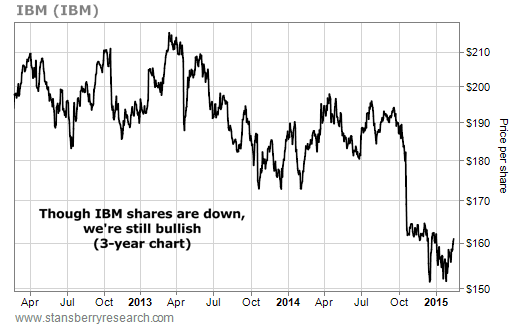
Extreme Value research analyst Mike Barrett discussed IBM's most recent earnings in the January 21 Digest. In short, the company continues to generate huge amounts of cash...
|
In that Digest, Mike noted IBM would improve its margins by shifting its focus to higher-growth IT sectors, like the cloud.
Yesterday, IBM announced it would invest more than $1 billion in its "storage software portfolio" over the next five years. That's a fancy way for saying it's developing technologies for companies to store information in the cloud for less money... Traditionally, companies spend a fortune to store data at giant data centers. Storage software shifts much of the responsibility from hardware to software, making it cheaper.
And days after IBM's earnings announcement, investment legend Warren Buffett announced he had upped his stake in the firm. Buffett's holding company, Berkshire Hathaway, increased its stake in IBM by 9%. It now owns nearly 77 million shares.
Berkshire now owns 8% of IBM, worth $12.4 billion at today's share price.
IBM is the only Extreme Value World Dominator in "buy range" today... and the world's greatest investor is taking advantage of it.
New 52-week highs (as of 2/17/15): Apple (AAPL), American Financial Group (AFG), Brookfield Asset Management (BAM), Cempra (CEMP), CVS Health (CVS), Esperion Therapeutics (ESPR), WisdomTree Europe Hedged Equity Fund (HEDJ), iShares Core S&P Small-Cap Fund (IJR), iShares U.S. Home Construction Fund (ITB), Medtronic (MDT), PowerShares Buyback Achievers Fund (PKW), PowerShares QQQ Fund (QQQ), PowerShares Ultra Technology Fund (ROM), ProShares Ultra S&P 500 Fund (SSO), Constellation Brands (STZ), United Technologies Corporation (UTX), and Valero Energy (VLO).
In today's mailbag, a subscriber asks about using silver versus gold in times of crisis. What's on your mind? Let us know at feedback@stansberryresearch.com.
"Porter has been recommending holding physical gold as a hedge against the collapse of the world paper money system. If paper money lost its value and physical gold was needed to buy goods and services, it would seem that silver would be an easier commodity use for day to day purchases due to its smaller relative value. Is there a reason Porter is recommending gold instead of silver? Is there a reason silver would be a less functional currency in the event of a crash of the U.S. Dollar? As someone looking to make a first purchase of physical metals, silver seems like an easier way to start. Thank you for your thoughts." – Paid-up subscriber T.A.T.
Goldsmith comment: Who says we don't recommend silver in a crisis? There are many good reasons to hold both. In fact, Porter and his team wrote a special report for his Investment Advisory subscribers called "Secrets of the Silver Market." In it, they talk about many of the reasons to hold silver… and the best ways to do it in anticipation of a crisis.
You're right... If it comes to the point where people are transacting in bullion, it makes sense to hold some of both. But remember, because one ounce of gold is worth the same as 73 ounces of silver today, it would take up far more space to keep a significant portion of your wealth in silver. (Holding 10% of Porter's net worth in silver would take up a lot of storage.)
In terms of value, silver and gold are similar. Both are viewed as monetary metals. We refer to silver as gold's more volatile little brother. In the case of a monetary collapse, both metals will soar. You can also purchase silver from our recommended dealers at David Hall Rare Coins and Asset Strategies International.
Regards,
Sean Goldsmith
February 18, 2015
