

Why Volatility Is Guaranteed to Rise
Why volatility is guaranteed to rise... How to put fear to work for you... Doc Eifrig shares a secret about the options market... How Doc's subscribers took advantage of the 'Brexit' panic...
Editor's note: The markets will be closed on Independence Day, so we won't publish the Digest on Monday. Our member-services department will also be closed. We'll resume our standard hours and publishing schedule on Tuesday. Enjoy the holiday.
 There aren't many guarantees in the market today.
But you can be certain of a few things over the long run...
Paper currencies will continue to decline until they reach their rightful value (zero). The price of gold and silver will move much, much higher as they do. And periods of market volatility will become more frequent... and more extreme.
Why? In short, the decades-long experiment with fiat money is reaching its inevitable conclusion. As Porter summarized in the April 29 Digest...
These bubbles are not isolated – they are all connected, enabled, and continued through the coordinated actions of central banks. And these policies have reached their final "end game." The 20-year supercycle of more debt, lower interest rates, and one financial bubble after another has finally reached its climax.
How do I know? Because the same policies that for 20-plus years have driven finance-related profits higher have now inverted. Lower interest rates, additional debt, and more manipulation have finally led to lower earnings for the world's biggest companies and banks.
As Porter explained, the volatility, leverage, and economic uncertainty these policies have created are acting as a "tax" on prosperity...
Every action in economics contains elements of diminishing returns. Economic stimulus is no exception. At some point, additional credit and lower interest rates can no longer propel an economy forward because the resulting overcapacity and overleverage cause more problems than they solve. Growth inevitably slows. Defaults inevitably rise. And... sooner or later... we'll see a panic.
By now, most Stansberry Research subscribers should be prepared for the first two of these certainties. But we'd be willing to bet most of you aren't fully prepared for the third. And that could be a terrible mistake...
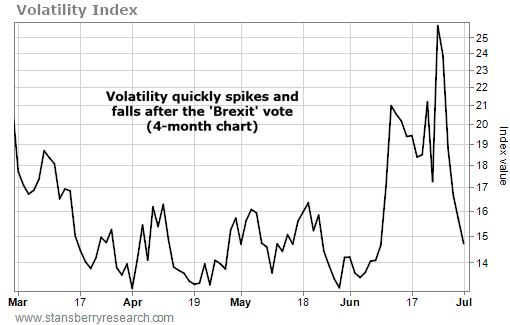
The global market is fragile, and any sign of weakness or uncertainty has investors anxious. Just look at last week's "Brexit" vote, for example. In the two trading days following the U.K.'s decision to leave the European Union, the S&P 500 fell more than 5.3%. The Volatility Index – the market's "fear gauge" – rose from 17.25 on Thursday to as high as 26.72 on Monday, a staggering 55% jump.
Since then, the market has calmed back down. The S&P 500 is down less than 0.6% from where it closed last Thursday. The VIX is below 15 again.
It's a clear sign that any bit of bad news is spooking investors.
Sure, owning precious metals, "hedging" your portfolio with some short sales, and following good risk-management strategies (like proper asset allocation, position sizing, and trailing stops) will keep you from panicking during these times.
And if you're using the powerful risk-adjusted position-sizing tools from our friend Dr. Richard Smith's TradeStops software, you'll be even better off.
But even if you've taken these precautions, you could still be missing something important.
You see, periods of increased volatility aren't just something you need to protect your portfolio from. They also offer some of the best opportunities to make incredibly rich returns while taking little risk... if you know how to take advantage.
And one of the best ways to do this is with options...
Now, before we talk about how these strategies can help you, a quick review...
If you're not familiar with options, you likely have some misconceptions about them. You've probably heard they're too risky or complicated for "average" investors. But this simply isn't true.
Yes, they can be risky the way most folks use them – buying loads of call or put options to speculate that a stock will move up or down. In most cases, this is little more than gambling, and it's a sure path to big losses.
But when used correctly – in this case, by selling options on the right stocks – they can actually be safer than investing in stocks the normal way.
And while these strategies do require a little effort, they are well within the grasp of almost any investor.
Because our colleague Dr. David "Doc" Eifrig has shown literally thousands of everyday folks how to use them in his excellent Retirement Trader service over the years. And as longtime subscribers know, the results have been extraordinary...
Retirement Trader subscribers have closed 293 out of 314 series of trades for a profit... a win percentage of 93.3%. This is one of the most impressive track records in our industry. You can't get much better than that.
We've covered the basics of these strategies many times over the years, so we won't rehash it all here. (If you'd like to learn more, you can read Doc's classic interview on the subject in the Stansberry Research Education Center, right here.)
Instead, we'd like to focus on how these options-selling strategies can make volatility work in your favor.
Doc has graciously agreed to share some exclusive, subscribers-only educational material from his Retirement Trader service to show you how it works.
As you'll see below, options allow you to harness volatility in a way no other investment strategy can. Here's Doc...
Everyone understands and enjoys that our strategies allow us to collect income upfront on quality stocks. That makes sense. But options trading is more than that. Much more...
Think of the typical stock buyer. If his stock goes up, he wins. If it goes down, he loses. He has one chance to win. Meanwhile, we have three. A novice options trader probably takes that to mean we make money if a stock rises, stays even, or falls only a little. That's true, and it is three ways to win. But when I say "we have three ways to win," I'm talking about something different.
As Doc explained, options work in "three dimensions." His subscribers win as long as one of those three dimensions goes in their favor...
The first dimension is the stock price. With our put-selling strategy, we make money when we pick the right stocks and they rise or maintain their values. We also get the benefit of collecting the income, lowering our cost, and building a cushion. This makes selling options less risky than buying stocks outright. That's the simple way to win... but what about our other two?
We don't just trade against stocks. We also sell volatility. Most folks miss this. Sometimes it's hard to think about "selling" something intangible like volatility. But it's a critical concept.
As with any investment, Doc wants to buy low and sell high. And when volatility is high, options become more expensive.
Think of buying put options as buying insurance contracts. Folks are willing to pay a lot more when they're scared of what's happening in the market. That's great for people who sell puts. Suddenly, we're able to earn more income in the exact same trade... all because volatility is higher. More from Doc...
Entire trading strategies have developed around trading volatility with no regard for stock prices whatsoever. Back in my Wall Street days, we traded volatility all the time, hedging out the actual values and moves in the stocks to focus only on the volatility number.
You don't have to go that far in your understanding. I just want you to be aware of how we're thinking behind the scenes for you... As far as we know, this is unlike what anyone else is doing. Sure, we've seen people try to mimic our tactic of selling options on stable, reliable blue chips...
But our handling of volatility can be even more important than stock selection, especially in times of panic and fear.
In times of rising volatility, Doc considers himself "stock agnostic." As you can see from the following chart of the VIX, even during long periods of market panic, volatility doesn't remain at extremes for long. It spikes and falls in cycles...
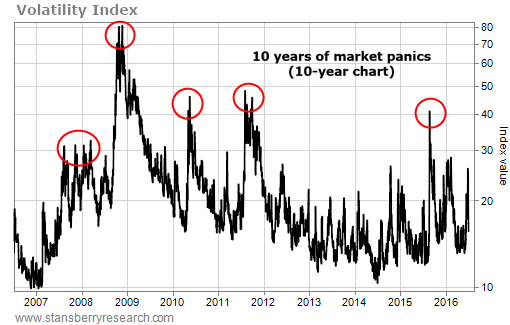
As Doc explains, these spikes may become bigger or happen more frequently, but the overall pattern doesn't change because human nature doesn't change. That's when Doc is able to take advantage...
That's where our third opportunity comes in... And we always get this one right. You see, when we sell an option, we are also selling time. As time progresses, options decline in value. Options buyers are always struggling uphill against this fact. As options sellers, we let it work for us.
Any out-of-the-money option will progress to zero as time marches on. Time will eat up the volatility premium and changes in the stock price. So while you can get stock prices, and even volatility wrong, time only moves in one direction. I haven't been wrong about time once in my entire career.
So we have three ways to profit. One of them – stock prices – tends to march upward over the long term, based on fundamentals. Another – volatility – tends to ebb and flow predictably. And the third – time – is guaranteed. That's a powerful trio.
Consider Doc's strategy versus someone who just trades stocks – or worse, an options trader who doesn't understand how these factors work. As you can see, trading options the right way allows you to tailor your risks and returns to your personal goals.
Best of all, Doc's strategy becomes far more profitable during periods of increased fear and volatility.
Today, we're going to walk you through how Doc's Retirement Trader subscribers were able to put this strategy to work for themselves following last week's "Brexit" vote.
Some folks tried to make money by betting on the outcome of the vote. Not Doc. He didn't know which way it would go. Frankly, he didn't care.
Instead, he waited until after the decision – when volatility spiked to a four-month high – to make his move.
Last Friday, Doc recommended selling options on four high-quality, blue-chip stocks that had plunged following the news.
As he noted, these stocks didn't plunge because their businesses would be seriously hurt from the Brexit decision. They plunged because the market was afraid and selling indiscriminately.
One of the companies Doc recommended was Kimberly-Clark (KMB), one of the most stable, "boring" businesses out there.
The company makes, distributes, and sells high-quality paper products all around the globe. This includes many you may personally use every day, like Cottonelle toilet paper, Huggies diapers, Kleenex tissues, and Viva paper towels, among other consumer essentials.
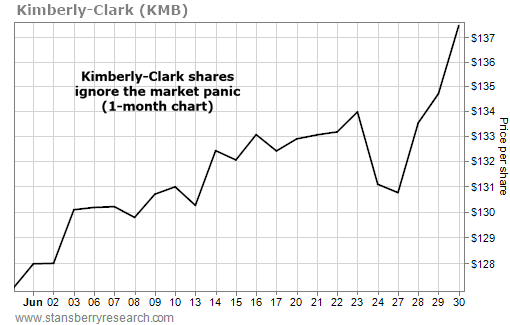
Shares plunged 3% following the news. But remember... these are products millions of people use and depend on every single day. Is there any conceivable reason folks would suddenly stop buying these products simply because the U.K. decided to leave the European Union? Of course not.
KMB shares fell to around $131 by Friday afternoon. Doc recommended selling the KMB October $130 puts, which were trading for around $4.50.
In other words, you could collect $450 in income upfront for each options contract you sold. (Remember, one options contract is equivalent to 100 shares of stock.)
Here's how the trade could go...
If KMB shares close above $130 on their October 21 expiration date – meaning they move higher, stay about the same, or even fall a bit more – the option will expire worthless. Folks who sold it will keep all $450 per contract, free and clear.
If KMB shares closed below $130 on October 21, folks who sold it will be required to buy shares for $130. That's a $1-per-share discount to where they could have bought shares at the time.
But again, you also collected $4.50 per share upfront... meaning your net cost was just $125.50 per share ($130 minus $4.50). That's nearly 5% less than you would have paid to buy shares originally. And remember... there's no conceivable reason shares plunged in the first place.
Usually, Doc's trades take several weeks to a couple months to play out. But following big spikes in volatility, that's often not the case.
Take a look at what's happened since Doc recommended the trade just one week ago. As you can see in the chart below, volatility has already fallen to "pre-Brexit" levels...
And shares of KMB have already recovered all of their panic losses and more...
The plunge in volatility means the KMB October $130 put options Doc recommended selling have already lost a lot of their value. They're now trading around $2.75. (Remember, when you sell a put, you want it to expire worthless.)
Folks who took Doc's advice are already up around 40%. It's a similar story in all three of the other trades he recommended last Friday.
If you know of a better way to make big, safe profits during periods of fear and volatility, we'd love to hear it.
We realize some of the terminology above may be a little confusing for new investors. That's OK...
As we mentioned earlier, these strategies take a bit of effort to master, but they're within the reach of anyone who's willing to take a little time to learn them.
Fortunately, this is where Doc's Retirement Trader service really shines... In fact, we believe the educational value of Doc's service is worth just as much as his excellent trading recommendations.
Retirement Trader comes with everything you need to know to take advantage of these strategies... from detailed explanations of the basics of options trading and setting up your brokerage account to Doc's step-by-step instructional videos you can watch as often as you like.
Best of all, Retirement Trader doesn't just give you Doc's best trading recommendations. It also teaches you how to find and carry out these trades for yourself.
Doc has often said his goal with Retirement Trader is to make his subscribers so proficient with these strategies that they no longer need the service.
We think you'll agree he has done just that.
Doc just put the finishing touches on a brand-new video presentation in which he walks viewers through this strategy in detail... and shows you how to start generating thousands of dollars in additional income every month.
Digest readers are among the first to see this presentation... and to have the opportunity to take advantage of a special, limited-time offer to get one FREE year of Retirement Trader. Click here to get started on this 100% risk-free offer.
New 52-week highs (as of 6/30/16): Automatic Data Processing (ADP), Aflac (AFL), Central Fund of Canada (CEF), Western Asset Emerging Markets Debt Fund (ESD), Franco-Nevada (FNV), Fidelity Select Medical Equipment and Systems Fund (FSMEX), VanEck Vectors Junior Gold Miners Fund (GDXJ), Gold Standard Ventures (GSV), Welltower (HCN), Hershey (HSY), Johnson & Johnson (JNJ), Kaminak Gold (KAM.V), Mid-America Apartment Communities (MAA), Medtronic (MDT), 3M (MMM), Altria (MO), Nuveen AMT-Free Municipal Income Fund (NEA), Newmont Mining (NEM), Nuveen Premium Income Municipal Fund 2 (NPM), Procter & Gamble (PG), Pretium Resources (PVG), Regions Financial – Series B (RF-PB), Spectra Energy (SE), Silver Standard Resources (SSRI), Constellation Brands (STZ), Sysco (SYY), AT&T (T), Travelers (TRV), Vanguard Inflation-Protected Securities Fund (VIPSX), Vanguard REIT Fund (VNQ), Wells Fargo – Series W (WFC-PW), W.R. Berkley (WRB), and ExxonMobil (XOM).
A Stansberry Gold Investor subscriber is grumpy with us in today's mailbag. Have our gold recommendations been a disappointment so far? We'd be shocked to hear that. Let us know at feedback@stansberryresearch.com.
"I signed up for the Stansberry Gold Investor the first day it was offered, like a good boy. Like someone who knows and recognizes the value of your work. But why is it fair for the foot-draggers to now get an invitation to Stansberry Gold Investor AND get a year of Matt Badiali for free? Why shouldn't I get that deal? – Why should I be punished for signing up when you first offered the Stansberry Gold Investor service?
"I would have called your customer-service line to complain, but the Digest doesn't come out to me until after you close at 5PM – and the Badiali offer is only good until midnight tonight!!! C'Mon guys – be FAIR!!!!!!" – Paid-up subscriber Dan Maddox
Goldsmith comment: Dan, I have a hard time understanding how anyone who signed up for Stansberry Gold Investor could complain about anything today. That is, unless you have an aversion to making lots and lots of money.
Also, you paid considerably less for your subscription than anyone getting in now... Even if you include the free year of the Stansberry Resource Report.
If you purchased every recommendation we gave you on day one, you're now sitting on average gains of 40% (including gains of 141%, 122%, and 106%).
Heck... with all that money you made, you could probably afford a separate subscription to the Stansberry Resource Report. If you'd like to sign up, you can right here.
Regards,
Justin Brill
Baltimore, Maryland
July 1, 2016
|