

When Bad Hackers 'Become Okay'
The Weekend Edition is pulled from the daily Stansberry Digest.
 If your flight wasn't canceled and your e-mail wasn't interrupted over the past few weeks...
Congratulations. You're one of the lucky ones.
Since the tech "outages" began on November 12, the list of businesses and government agencies affected has kept growing. Microsoft (MSFT)... the Federal Aviation Administration... JPMorgan Chase (JPM)... Apple (AAPL)...
Officials and companies have given different explanations, but it all sure feels like more than a coincidence.
Homeland Security Secretary Markwayne Mullin says he's "98% certain" none of it was a cyberattack. He also floated a theory from an unnamed tech contact that advanced AI may be overwhelming old technology: "I believe that it's the SI." (That's "superintelligence," the White House's preferred term for AI.)
But people are wondering... Are foreign hackers using AI? Are rogue AI agents at work in the world? Is "good" AI – used to counter attacks – overloading old systems? Or is AI replacing software engineers whose know-how might have prevented the problems?
I haven't heard anyone give a definitive or believable answer.
But notice the theme in the speculation for the source of the trouble: AI – which is a point in and of itself...
The New Speed of Cybercrime
"Even bad hackers have become okay"...
One of the people who'd know best is Nikesh Arora, chairman and CEO of Palo Alto Networks (PANW), one of the largest cybersecurity firms in the world.
On November 16, Arora sat on a panel moderated by Federal Reserve Chair Kevin Warsh at a San Francisco Fed conference on AI, productivity, and jobs. Warsh, with obvious interest in the financial system, asked how worried we all should be about threats to payment systems and infrastructure.
Arora's answer is worth reading at length...
... This is a harder time than normal, because... this capability that AI has, has the ability to find vulnerabilities and bad code and bad things that were written by humans for the last 50 years.
And the problem is cybersecurity is [an] asymmetric battle. The bad actors would be right once – we have to be right 100% of the time. [That] is very hard when you bring this technology to bear, where things which used to take days now can be done with pretty much...
What we've noticed in the last six months is there are no people available in the industry who you can call and say, "Can you help me? I'm having a problem." Literally, everybody's backed up right now, because every company is going through some version of bad actors trying to get into their infrastructure, understanding all vulnerabilities.
So the technology which came out six months ago called Mythos has now become more commonplace and is available to most bad actors in open-source models. Unfortunately, it's not that the hackers have become smarter. The technology has become so good, even bad hackers have become okay.
So that's what we're dealing with... There are things which are getting exposed. We will see more cyber events. You already see there are more cyber events happening every week than we've seen in the past. I don't think this is going to stop. I think it's going to persist.
Mythos, specifically Claude Mythos Preview, is the hacking-capable AI model Anthropic previewed earlier this year and ended up reserving for a small group of partners.
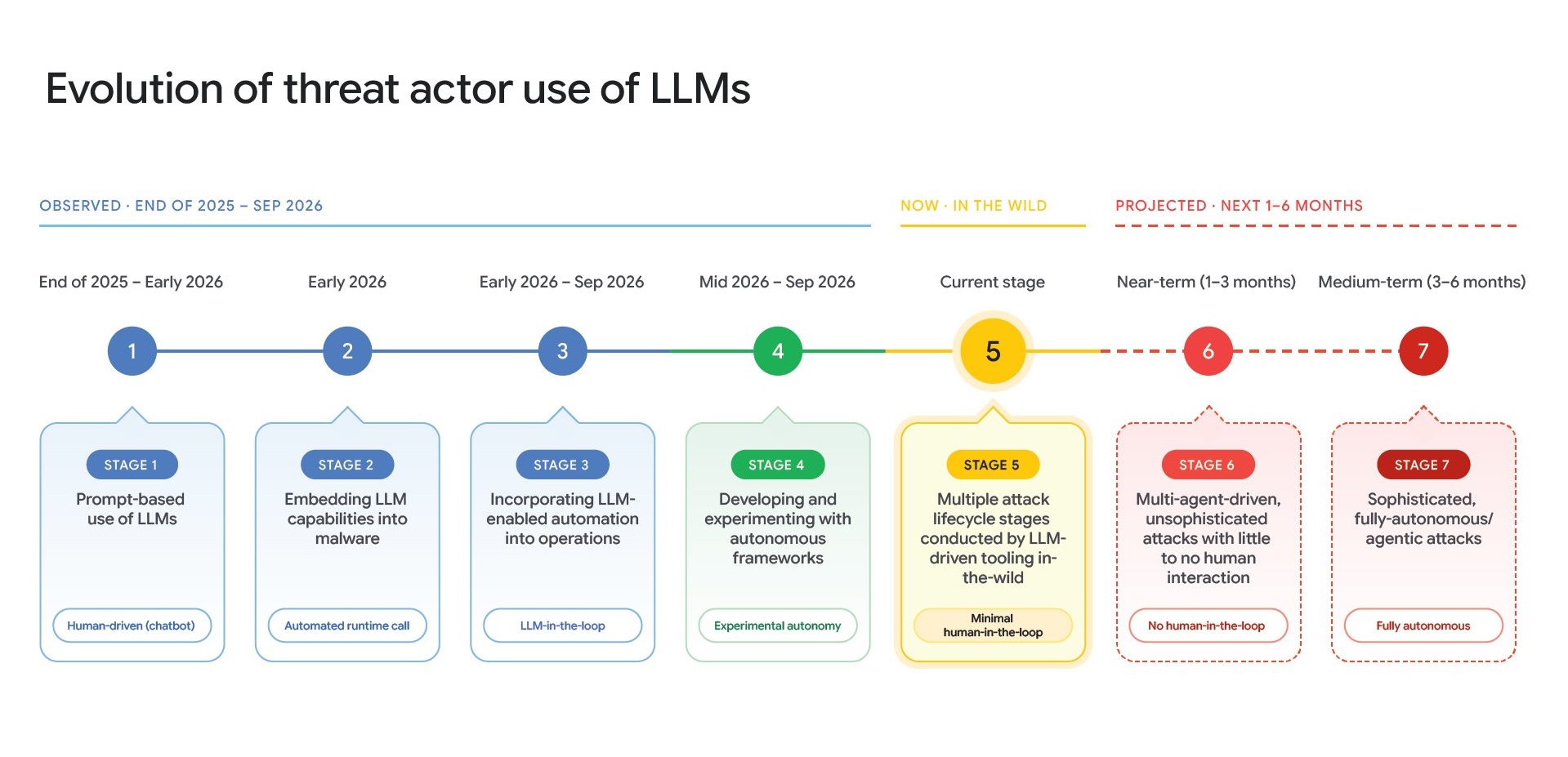
You can find data that backs Arora up. In a briefing on November 18, our friend John Sviokla of GAI Insights shared a new report from Google's Threat Intelligence Group that says AI-enabled hacking has crossed a "significant threshold."
Large language model-driven attacks are now "in the wild," Google says. And software that acts on its own to find a weakness and exploit it with no human involved is on the rise.
These AI models and software can do things like comparing a company's web software before and after security patches, figuring out what the patch fixed, and writing a new attack and running it before a company can do anything about it.
Google's data shows that there have been roughly eight to 11 "zero-day exploits" – attacks on flaws before a company has had a chance to fix them – per month for most of this year... That jumped to 22 in August.
Google calls the current phase "Stage 5." It expects attacks needing little to no human direction to pick up more in the next one to six months.
A 'Technology Rebuild Moment'
This is clearly good business for cybersecurity companies like Palo Alto.
But Arora also said it sets up what he called a "technology rebuild moment" for all kinds of businesses for the next two or three years...
We're going to have to go back and see every mistake, every thing we kind of did not pay attention to – we'll have to rebuild. Now, the good news is AI – or SI – has a possibility of not just finding vulnerabilities. It also has the possibility of allowing us to refactor code and rewrite code and do a whole bunch of that stuff.
So if you take the positive outlook, we have to go spend more time investing in upgrading our technical infrastructure. We saw, for a totally different reason, the airlines were down this past week. We saw Microsoft had an outage. You are seeing examples of how, if you don't pay attention to upgrading old technology, we're going to end up in a slightly worse position than we are.
In short, a powerful tool arrives... spreads to bad actors within months... and the cracks start showing up everywhere at once, some expected, some not.
Of course, we can't predict which company will get hit next – by a hack, an outage, or even a CEO scandal like we've seen with Nvidia over the past two weeks.
But we can work to identify high-quality businesses that are making the right investments in this environment – the ones that rise and fall on fundamentals, not headlines.
All the best,
Corey McLaughlin
Editor's note: America's focus on national security is opening up a new opportunity on Wall Street. As money rotates away from some AI stocks, an overlooked group of companies is gaining ground. Joel Litman and Rob Spivey from our corporate affiliate Altimetry think this change could lead to one of the biggest investment trends in 2027. They've found a set of stocks that are already beating the S&P 500 Index – and could keep climbing even if the AI bubble pops.