

When to Bet On a Breakout
Editor's note: Some breakouts are fueled by excitement and quickly run out of steam. Others can support years of gains. In today's issue, Joel Litman, chief investment officer of our corporate affiliate Altimetry, explains the two important clues investors can use to separate a real trend from a head fake.
Also, our offices will be closed tomorrow and Friday in observance of Thanksgiving. That means our next issue of DailyWealth will publish on Saturday, November 28. Enjoy the holiday!
The S&P 500 Index sat within about 3% of its all-time high earlier this month...
Yet 60% of its stocks were in a bear market.
That means more than half of the stocks in the index had fallen 20% or more from their highs. One Goldman Sachs trader called it a "stealth bear market" in a note to clients.
AI stocks took the worst hit. Since mid-October, the "Magnificent Seven" tech giants have shed $4 trillion in market value. Investors are worried about how much these companies are spending on AI – and how long their investments will take to pay off.
Folks tend to buy a broad index fund because it feels safe... But if most of the stocks in the index are falling, is that still the safe move?
It's an important question... because some corners of the market are breaking out.
This year, the S&P 500 is up just 7%. But healthcare stocks are up 21%. And consumer staples – the makers of groceries, toothpaste, and other everyday goods – are up 20%.
As we'll explain today, the hard part in a market like this is knowing which of these breakouts are real.
Don't Confuse a Fad With a Lasting Trend
Not all breakouts are made equal. Some fade within weeks...
For example, take utilities – the companies that deliver electricity, gas, and water to homes and businesses.
Early this year, investors bet that AI data centers would need far more electricity. Regulated utilities earn a set return on the power plants and lines they build, so more demand meant more spending... and bigger profits. And when tech stocks sold off in February, the sector also looked like a safe place to hide.
From early January to late February, utilities jumped 14%. Then the run reversed course... By late September, the sector had fallen 18% from that peak, landing 6% below where the rally started.
Anyone who chased that breakout in February didn't just miss the gains... They lost money.
Other breakouts last much longer...
For instance, take healthcare stocks. The sector hit a low in August 2025 after a rough stretch for drugmakers and insurers. Since then, healthcare has climbed 47%, versus 16% for the S&P 500.
The chart below compares the State Street Utilities Select Sector SPDR Fund (XLU) and the State Street Health Care Select Sector SPDR Fund (XLV) over the past two years. Both start at 100 in January 2025, so a reading of 140 means a fund is up 40% since then. Take a look...
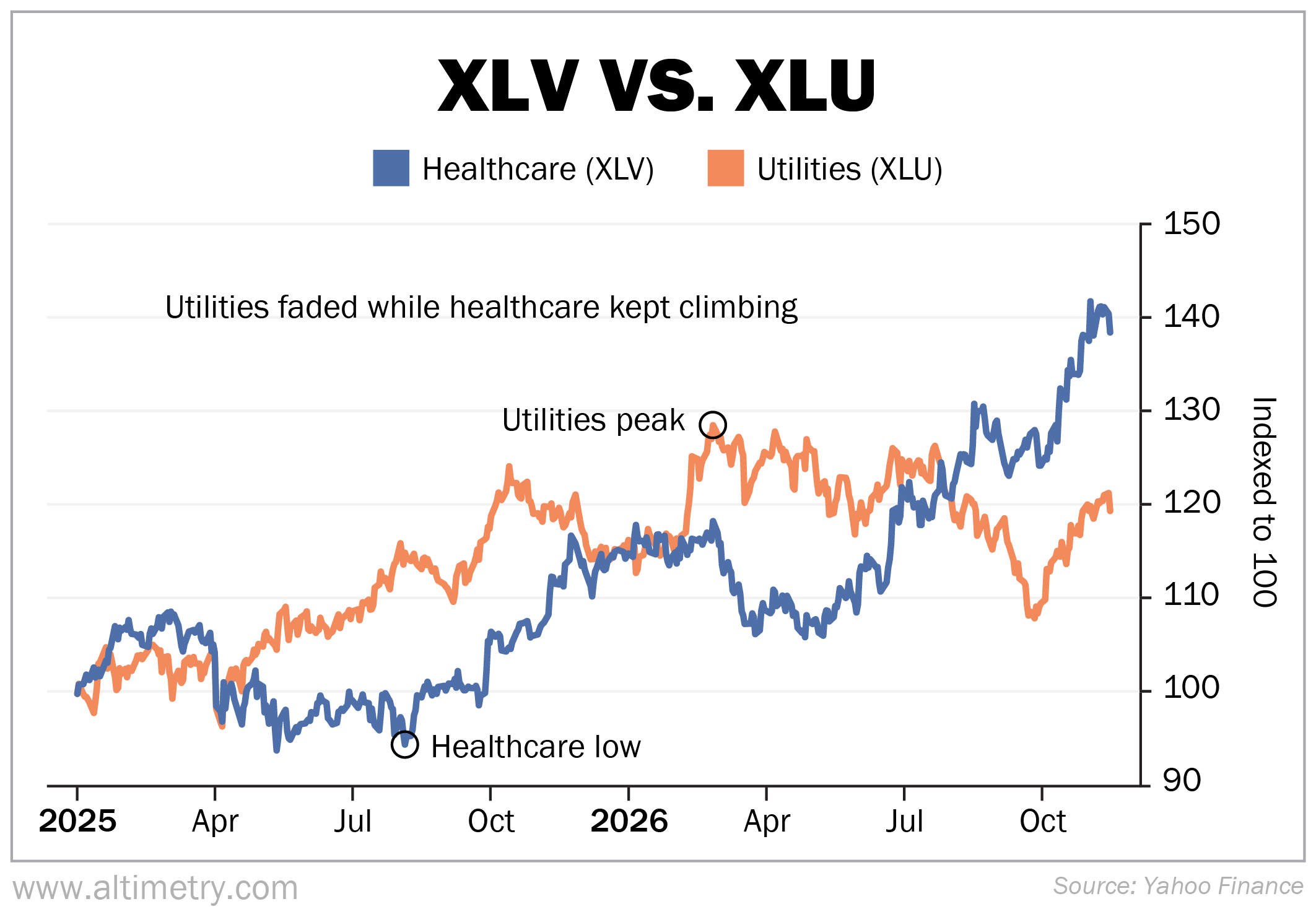
Initially, the two breakouts looked the same. One made investors money for about seven weeks... while the other has paid them for more than a year.
This is an important lesson right now. While most stocks are struggling, a few trends are taking off...
How to Spot Which Breakouts Matter
The rest of the market is starting to catch up to the Magnificent Seven as their earnings growth speeds up. The breakouts in healthcare and consumer staples are early signs of that shift.
But you can't buy every sector that pops. Telling a real trend from a short-lived rotation is key for your portfolio.
So when a sector starts to break out, look at two things before you buy...
First, look at where the run started. For example, healthcare broke out of a long slump. Drugmakers and insurers had been out of favor for months. So the bad news was already priced in... leaving plenty of room for investors to change their minds.
By contrast, utilities took off on the AI hype the whole market was already chasing. Once everyone had bought in, there was no room left for prices to head higher.
Second, check whether profits are backing up the move. The utilities rally rested on spending that hadn't happened yet. A lasting trend needs earnings and returns that are actually improving, not just a good story about the future. When profits keep pace with the price, a breakout has room to run.
If a sector checks both boxes, it's worth your attention. If it checks neither, it's likely just money rushing from one hot spot to the next.
Find the trends that last... then find the winners inside them.
Regards,
Joel Litman
Editor's note: Investors seem to be overlooking the biggest threat to today's stock market. That's why Joel and our own Brett Eversole just held a joint "Financial Survival Summit." As they explained, a major turning point is approaching on December 9. You only have a few days left to learn which familiar stocks may be the next ones to sell off... and the strategy that can help you prepare today.
Further Reading
Nike didn't need a market crash to lose roughly 80% of its value. It happened during one of the strongest bull markets in history. The reason was something investors often overlook when buying popular stocks... and highlights the importance of leaving room for error.
Individual investors haven't been this invested in stocks since the dot-com era. That's an uncomfortable comparison for anyone worried about a market bubble. But history shows we're not headed straight for a crash.