

When the Market Hands You a Gift, Take It
Editor's note: Strong earnings from Big Tech leaders haven't calmed investors' fears. AI is emerging as a major disruptor to traditional software models... triggering sharp sell-offs across the sector. In this issue, adapted from our corporate affiliate Altimetry's free Altimetry Daily Authority, Chief Investment Officer Joel Litman explains why Wall Street may be overlooking the massive AI investment cycle underway today...
On paper, Microsoft's (MSFT) most recent quarter looked like a victory lap...
In January, the company posted its first-ever $50 billion quarter in cloud-technology revenue.
Yet Wall Street hit the "sell" button.
The stock lost $357 billion in market value in a violent one-day sell-off. It was Microsoft's steepest single-day wipeout since 2020. And it's still down 16% year to date.
Other tech giants have followed suit...
Alphabet's (GOOGL) cloud-tech revenue grew 48% in the latest quarter. And Amazon's (AMZN) cloud business rose 24%, beating analyst estimates.
But all three stocks are down since reporting earnings. The problem is, software is in a rout.
AI startup Anthropic's Claude coding tool reignited fears that "software will get automated away."
Whether or not that's true, it's driving a lot of emotional investing. But it's also creating good entry points for investors who recognize the magnitude of the AI build-out...
The market isn't paying attention to the fundamentals. Instead, it's buying into the narrative that software is losing its footing.
But the hard data says otherwise...
You see, along with Big Tech's strong quarterly results, companies like Microsoft and Alphabet also announced big spending plans in 2026...
Alphabet has set aside up to $185 billion in capital expenditures ("capex") this year. That's more than it has spent in the past three years combined. And most of that capex is aimed at building the data centers that power AI projects.
The five biggest U.S. tech companies are forecast to spend about $650 billion in capex in 2026, based on company guidance and consensus estimates.
That's nearly triple the $224 billion total in 2024. And it's substantially higher than last year's $380 billion figure. Take a look...
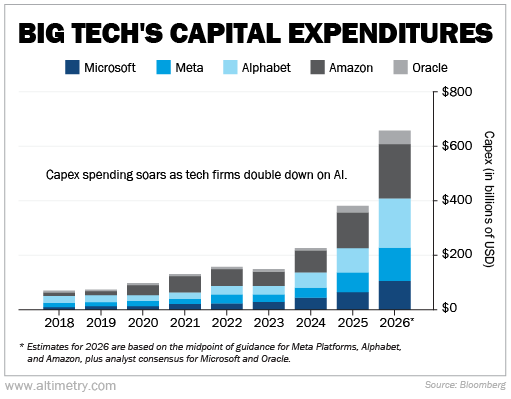
These aren't hollow statistics. And Big Tech companies are already following through on their AI promises...
Alphabet is aggressively scaling its custom microchip to power Project Genie – its generative-AI research prototype.
Microsoft is securing massive quantities of graphics processing units and central processing units to expand its AI infrastructure. That's the only way it can meet exploding enterprise demand.
In mid-February, Alphabet raised almost $32 billion through bond issuances in a single week... just one week after Oracle borrowed $25 billion. Morgan Stanley expects Big Tech companies will borrow as much as $400 billion throughout the year.
This only tends to happen in serious investment cycles. Companies don't borrow billions of dollars unless they're in a spending mood.
Now, investors are right to fear the latest software panic, considering all the volatility we saw last year.
Back in January 2025, we saw the first signs that the AI investment cycle would bring several big drawdowns. But it was clear that these would be buying opportunities.
Big Tech companies are prioritizing AI... whether they're investing in new chips or global cloud capacity.
This goes hand in hand with current capex trends. (And the bond market is still bankrolling these investments.) If that continues, any temporary sell-offs will be just that: temporary.
Make no mistake... The companies leading the AI build-out are more confident than ever. And you should be, too.
Regards,
Joel Litman
Editor's note: Following Warren Buffett's investing approach could have turned $50 into $2.5 million. And using his principles, the Altimetry team pinpointed the one stock he would buy today. After analyzing 3,000 stocks and more than 40,000 data points, this is a rare opportunity to follow a legendary investing approach to position your portfolio for maximum potential growth.
Further Reading
Everyone's talking about an "AI bubble." But the headlines are misleading. Unlike the dot-com era, major tech companies are funding their own growth. That means this boom can continue – and smart investors can capture gains while others panic.
While software stocks are facing a broad downturn, not all businesses are equally affected. Companies using AI to enhance human workflows are outperforming their peers. That reveals a critical lesson: Even in weak industries, being selective can deliver outsized opportunities.