

An update on 'the most important thing that has happened this year'…
An update on 'the most important thing that has happened this year'... 'The junk-bond crisis has officially arrived'... One of Porter's most serious predictions is already coming true...
 In the September 11 Digest, Porter called it "the most important thing that has happened this year in global finance."
He was referring to the downgrade of Brazil's credit status.
Specifically, credit-ratings agency Standard & Poor's had just downgraded Brazil's country rating from "investment-grade" to "junk," and placed the country on negative credit watch... meaning further downgrades could be coming.
The move also put all of the corporate debt in Brazil into junk status, too, including the bonds of giant, state-owned oil company Petrobras (PBR).
Porter explained why this was such a huge potential problem for the world's bond markets...
Petrobras is one of the world's largest corporate borrowers and is by far the largest hard-currency corporate borrower in emerging markets. Petrobras has $56 billion worth of outstanding bonds. That's roughly 2.5% of the entire global market for high-yield debt.
Now, following this downgrade, these Petrobras bonds are no longer "investable" for most bond-fund managers. This is an enormous amount of debt that must now be traded out of investment-grade bond funds and into much smaller, more speculative emerging-market bond funds.
He wrote that Petrobras' borrowing costs were set to rise sharply... and its bond prices were set to plummet...
Reasonable investors will now question whether Petrobras can even continue to carry this debt load at all. The company's net debt is now more than five times its cash earnings before interest, taxes, depreciation, and amortization. That's a record for the company.
Carrying a debt load of this magnitude is suicidal for commodity-based companies. Commodity prices are cyclical. Interest payments aren't. The risk of bankruptcy – once unimaginable – now becomes a possibility.
As Porter noted, you might think this has nothing to do with markets here in the U.S., but it's all interconnected...
Shoving Petrobras' toxic bonds into the high-yield bond markets will cause the cost of capital for all speculative-grade issuers to rise. Demand will go way up. Likewise, Brazil is a major market for U.S.-owned goods and services. The cost of doing business there will go up and make it much harder for Brazil's economy to break out of its current recession.
There are dozens of specific circumstances like Petrobras' current troubles throughout the emerging markets...
These aren't easy problems to solve. These debt issues are going to take time – years – to work out. And we aren't even close to the bottom yet. I believe we will see several major defaults in places like China, South Africa, Turkey, and Brazil. We could even see a default in Petrobras – one of the world's largest borrowers. The result would be a real financial panic.
As we wrote earlier this week, S&P, Moody's, and Fitch are known as the "Big Three" credit-ratings agencies. Together they control 95% of the global ratings market, with S&P and Moody's controlling about 40% each.
So if there was a "bright side" to the downgrade, it was that both Moody's and Fitch still rated Brazil as "investment-grade." Some institutions could point to that fact as an excuse to delay liquidating Brazilian debt.
But last night, we learned that could soon change...
According to a report in British newspaper the Financial Times, Moody's could now slash Brazil's country rating to junk as well. From the article...
After Congress opened impeachment proceedings against President Dilma Rousseff last week, Moody's said it was placing Brazil's Baa3 rating on review for downgrade, driven by a rapidly deteriorating economy and "worsening governability." The move raises fears of an investor exodus from Latin America's biggest economy.
"Fiscal and economic activity indicators continue to sharply deteriorate with no clear sign of when they will bottom out," Moody's said. "The initiation of impeachment proceedings against the president in early December... leaves very little chance of tackling the worsening medium-term fiscal trends."
The S&P downgrade was terrible news for Brazil's economy. A Moody's downgrade could be the nail in the coffin.
With the world's two biggest ratings agencies in agreement, virtually all fund managers would be forced to sell Brazilian debt... and even more toxic debt would flood into the high-yield market.
In short, all of the problems Porter explained above could soon be amplified... and the risk of a true financial panic could soar.
Unfortunately, this isn't the only concerning situation we have to report today.
According to Russ Kinnel, director of mutual-fund research at Morningstar, the first high-yield "mutual-fund casualty" is here. In other words, one of Porter's most serious predictions is already coming true...
Porter has explained why mutual funds that hold high-yield debt are especially dangerous. As he noted in the third installment of his five-day bond series last month...
Bond mutual funds – even the biggest and the "safest" – now own billions and billions of dollars' worth of these bonds. Mutual funds owned almost 20% of all corporate bonds by the end of 2014 (the most recent data available). That's up from just 8% of the market in 2008.
It won't just be one or two big mutual funds that blow up. There are now 10 bond mutual funds that manage more than $40 billion, up from only two in 2010. As credit tightens and riskier bonds begin to fall substantially in price, investors will panic and try to redeem their investments in these mutual funds.
The funds, which are required to provide seven-day liquidity, will be forced to sell something to generate cash. Will they sell a junk bond trading at $0.60 on the dollar and "eat" a 40% loss? Or will they sell an investment-grade bond that's still trading around par? The truth is, they won't have a choice... they will have to sell the higher-quality bonds.
Normally, an institutional investor would dispute that scenario, saying, "We won't sell. We know what we own, we're diversified. There will be some losses, but our ability to hold until maturity means that we don't worry about volatility."
But, as Porter wrote, these mutual funds have to supply daily price quotes to investors... and they have to provide weekly liquidity. As he continued (emphasis added)...
Trust me, when retired investors see their "safe" bond mutual fund is down 20%, they're going to panic. They don't know anything about holding to maturity. They just know the only way to stop the pain is to sell.
And the only way these mutual funds will be able to generate the capital to meet the redemption demands is by selling bonds that are safe and trading near par. They won't be able to sell the distressed bonds. That will cause the value of the funds to fall even faster, spawning additional redemption demands... until eventually there aren't any more liquid bonds to sell. At that point, the mutual funds will have to halt all redemption. The fear of this suspension of redemption rights will also cause many investors to sell – simply because they're afraid of being caught in a sinking ship.
On social-media website Twitter this morning, Kinnel reported that fund manager Third Avenue has halted all redemption in its Focused Credit Fund (or "FCF"). The firm said the fund entered a "plan of liquidation," effective yesterday.
The fund has plunged nearly 30% this year, as it was required to sell more than 60% of its assets.
Third Avenue's official statement on the matter will sound eerily similar to Porter's prediction above (courtesy of Zero Hedge)...
We believe that, with time, FCF would have been able to realize investment returns in the normal course. Investor requests for redemption, however, in addition to the general reduction of liquidity in the fixed income markets, have made it impracticable for FCF going forward to create sufficient cash to pay anticipated redemptions without resorting to sales at prices that would unfairly disadvantage the remaining shareholders.
Instead, the firm has decided to block all remaining shareholders from removing their money, and said it will wait for market conditions to improve to sell its remaining assets.
Regular readers know we believe they may be waiting a while.
This is clearly a problem for Third Avenue and its investors, but it could quickly become a problem for other bond funds, too.
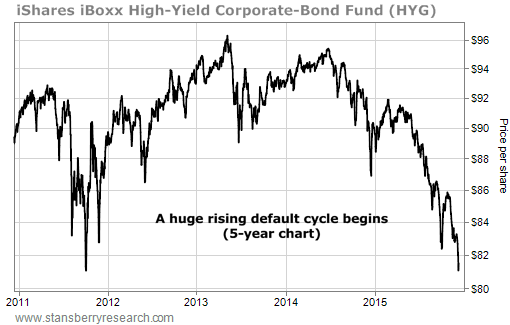
As Porter has explained, these problems are "contagious." Don't be surprised to see another big decline in junk bonds as other investors rush to sell before they too are blocked.
We expect more bond mutual funds to follow.
Again, here's the key chart to watch as these problems unfold...
New 52-week highs (as of 12/9/15): National Beverage (FIZZ), McDonald's (MCD), and short position in Santander Consumer USA (SC).
In the mailbag, a subscriber e-mails in with a suggestion about a different way to profit from the bond crisis Porter has been predicting. Send your notes to feedback@stansberryresearch.com.
"Hello Porter, Billy, here again. Assuming that all the distressed bonds you recommend are publicly traded stock, why not short that stock Instead of buying the bond. I shorted SC and GM as you suggested. SC shorted is up 22% and GM up just a little since shorting last week. So far, seems like a better, quicker deal than waiting for a bond to mature in 1 to 10 years and risking the default possibility. How about letting us know of 8-10 more stocks to short based on their rated bond distress. Thanks again." – Paid-up subscriber Billy J.
Brill comment: We recommend shorting stocks that are likely to decline as a way to "hedge" or protect your long positions from a broad market decline.
But don't let your recent success fool you... Using short-selling as a primary investment strategy – rather than a risk-management tool – is extremely difficult for even professional investors.
The long-term trend for the market is up. And even bankrupt companies can be subject to vicious "short-covering" rallies, where shares make huge jumps higher based on rumors, buyouts, extreme sentiment, or seemingly no reason at all.
You'll often get stopped out. And if you don't keep position sizes small and follow trailing stops, you could blow up your entire account. Google "KaloBios Pharmaceuticals" for a great example... The heavily shorted penny stock soared more than 4,000% in just six days last month.
As Porter explained in the October 2 Digest, in a bear market, you don't have to get "cute"...
We are entering into the largest debt-liquidation cycle in history. The Fed cut the last "cleansing" period short. The coming one would have been a doozy in any case, but the amount of credit creation over the last 10 years has been unprecedented, as I've described ad nauseam over the past few months.
As a result, there will be financial fireworks – huge, massive blow-ups. These blow-ups are going to be bigger and worse than you can imagine right now. This will all happen over the next three years. So by all means... raise some cash. Be careful to avoid low-quality debt instruments. Don't own any junk bonds. Don't own any foreign bonds. Don't own any asset-backed securities.
If you can merely avoid taking losses on these big debt implosions, you'll be way ahead of the game. And you'll be in a position to make a killing, because you will have cash at the bottom when high-quality financial assets will be "on sale" for 50% off (or more).
On the other hand, buying the right distressed bonds is a low-risk strategy. You're essentially taking the other side of the bet... You're buying the debt of companies that are unlikely to default. If you missed it, Porter explained the strategy in detail in his recent Digest series right here.
Regards,
Justin Brill
Baltimore, Maryland
December 10, 2015
|