A review of Alphabet's earnings report; The bull case for Tesla
I feel like I'm trying to drink from a firehose...
Many companies I follow are reporting earnings. And the software sector – filled with attractive, high-margin business I've always wanted to own, but not at absurd prices – is blowing up (as are my "Stinky Six").
Plus, people are pitching great stock ideas at the ValueX conference here in Klosters, Switzerland. So I'll have a lot to write about over the next few weeks.
1) Let's start by reviewing the fourth-quarter earnings report by one of my longtime favorites, Alphabet (GOOGL).
I named the Google, YouTube, and Waymo parent company as a core holding in my old firm Empire Financial Research's first newsletter on April 17, 2019.
Since then, through yesterday's close, it's up 441% versus 137% for the S&P 500 Index.
I've been pounding the table on it especially hard over the past year (archive here). This has been a great call, as GOOGL has substantially outperformed the other six Magnificent Seven tech stocks, as you can see in this chart:

Now let's dive into its earnings (full release here and slide presentation here)...
Alphabet reported $113.8 billion in revenue – up 18% year over year ("YOY") and beating estimates of $111.4 billion. Google ad revenue grew a healthy 14% YOY, up from 13% last quarter.
But the big story was Google Cloud, with $17.7 billion in revenue – up a phenomenal 48% YOY and smashing estimates of 39% growth. This was its highest growth rate since early 2021, when the business was less than a third of its current size.
And it's highly profitable: Google Cloud's operating profit was a record $5.3 billion, 45% higher than Wall Street's targets.
Alphabet's total costs and expenses grew 19%, in line with revenues. So operating margins were flat at a healthy 32%.
The company made $45.7 billion worth of share repurchases in the past 12 months. As a result, diluted shares declined 1%.
Earnings per share ("EPS") came in at $2.82, up an outstanding 31% YOY and handily beating estimates of $2.64.
With trailing-12-month revenue of $403 billion, it's astounding that a company of this size can keep growing so quickly and profitably.
So, why was the stock down this morning?
Because Alphabet is putting the pedal to the metal on cloud and AI spending, seeking to dominate this critical sector...
Last year, the company spent $91 billion on capital expenditures ("capex"). And it plans to double that figure in 2026 to between $175 billion and $185 billion.
This would be roughly all the operating cash flow the company will generate. (Operating cash flow was $165 billion last year and will surely grow this year.)
As this Wall Street Journal article rightly notes, "that new spending target, even for a company that has been firing on all cylinders lately, takes one's breath away."
Alphabet CEO Sundar Pichai commented:
Maybe the top question is definitely around compute capacity. How do you ramp up to meet this extraordinary demand for this moment, get our investments right for the long term, and do it all in a way that we are driving efficiencies?
Frankly, I have no idea what the right capex number is for Alphabet. But as I've written many times, I think the company is well positioned to win this race. So I think management is smart to spend however much it takes to do so.
(Incidentally, I believe this is the final nail in the coffin for cash-burning OpenAI, maker of ChatGPT, which is falling further and further behind Google Gemini.)
Finally, let's look at Alphabet's current valuation...
The stock was trading around $324 this morning, and its 2026 earnings estimate is $11.58 per share (the $11.40 estimate coming into earnings, plus the $0.18 beat). That gives it a forward price-to-earnings (P/E) multiple of 28 times.
That's higher than it has been in a while thanks to the huge run-up over the past year (last May, it was trading at a mere 16 times earnings). But it's still only a modest premium to the S&P 500's 22 times to 24 times forward multiple today.
My view today is still the same as it has been for more than six years: Alphabet is a great stock for conservative, long-term-oriented investors. And it's still my favorite Magnificent Seven stock along with Amazon (AMZN), which reports earnings after the close today.
2) Now let's turn to my least favorite of the Magnificent Seven, Tesla (TSLA).
The stock is down 12% since I named it one of my "Stinky Six" on October 29. But I still think it has a lot more room to fall.
That said, one of the most important skills an investor can have is being open to hearing the other side of the story. So I'm always seeking out facts and opinions that might cause me to change my mind about a stock.
Every investor makes lots of mistakes. What differentiates successful ones from the rest is the ability to identify and fix them.
In the case of Tesla, I not only listen to the bulls – I have one on my payroll! My longtime analyst, Kevin DeCamp, bought a Tesla Model S more than a decade ago and loved it.
This prompted him to buy the stock, and he still holds it. As you can imagine, he has made a fortune on his investment. Good for him!
I asked him to analyze Tesla's fourth-quarter earnings report last week, to perhaps get a different perspective. Because to me, it looked terrible...
Auto deliveries were down 16% YOY during the quarter and 9% for the full year. This led to auto revenue falling 11% and 10%, respectively. And total revenue declined 3% for both the quarter and the year.
Turning to profits for the year, operating margin fell from 7.2% to 4.6%, and adjusted earnings before interest, taxes, depreciation, and amortization ("EBITDA") were down 9%. Worst of all, EPS crashed 47% (non-GAAP-adjusted EPS fell 28%).
How is this miserable earnings report consistent with a stock trading at 245 times trailing (adjusted) earnings and 194 times this year's estimates?
To answer this, I turned to Kevin to make the bull case for Tesla. He wrote:
Another Tesla earnings report, another volatile swing in the stock and a bunch of new promises from CEO Elon Musk.
Declining auto deliveries and revenue aren't ideal for a stock with a sky-high valuation. So why did the stock hold up so well in the days after reporting earnings?
Nearly two years ago, after big price cuts and a string of quarters with decreasing margins, Musk flipped the narrative with two announcements:
- New car models fast-tracked on existing production lines
- A robotaxi unveil (delayed from August 8, 2024), cementing the shift from auto to real-world AI and robotics
Some Tesla bulls claim earnings are irrelevant now, with the focus on AI and robotics, but I disagree.
He then detailed his reasoning:
Although growth has slowed significantly, the Tesla auto business at its core is solid due to the successful release of new models over the last two years. And its energy business, helping build AI infrastructure, is crushing it with 25% growth, a huge backlog, and high margins that are lifting the company's total gross margins.
This solid foundation enabled Tesla to invest $8.5 billion into 2025 capex while still generating $6.2 billion in free cash flow and ending with $44 billion in cash – despite the revenue drop. Tesla raised its capex guide for 2026 to a massive $20 billion. The stock sold off immediately on this news, but the company can clearly fund it.
As for robotaxis, Kevin noted:
A handful of Model Y robotaxis in Austin are currently without safety monitors indicating an acceleration in the slow rollout, but Tesla hasn't yet proved the safety statistics necessary to fully scale the robotaxi service.
Related, Kevin is also bullish on full self-driving ("FSD"):
One of the more bullish developments is that Tesla released the subscription numbers for supervised FSD for the first time. Active subscriptions were 1.1 million, up 38% YOY. This shows that they are very confident in version 14 of the software released last fall.
As an FSD user, I can attest that V14 is a game changer. The pace of updates has accelerated substantially, and subscriptions are likely to continue increasing rapidly. In fact, I would bet that the trend of people buying a Tesla just for FSD will pick up steam as the word gets out and people experience how amazingly smooth, safe, and convenient it has become (and will only get better).
As for FSD's impact on the business, he continued:
Higher FSD take rates will strengthen its core business – leaning toward a Software as a Service model – while feeding the data flywheel towards the real prize: a multitrillion dollar Transportation as a Service business using millions of robotaxis.
Tesla has all the pieces to absolutely dominate this market, but the current fleet is tiny in Austin and San Francisco, nearly all with safety drivers (fewer than a dozen in Austin are fully driverless). Musk expects the fleet to double every month or so and the safety monitors will be removed, but he reiterated an "extremely cautious" rollout.
Plans are to have robotaxis in seven more cities in the first half of 2026. But will Tesla once again delay robotaxis as it has for more than five years?
He then brought up competitor Waymo, which I've written about many times:
On the surface, Tesla appears far behind Waymo, which started removing human safety drivers five years ago. However, Tesla took the harder path with a vision-only (camera-only) approach. And once it clears a safety bar, it can literally manufacture the current total Waymo "robotaxi" fleet in one afternoon at a much lower cost. This truly is an epic race...
The dedicated robotaxi "cybercab" is due to start production in April, but Musk warned the early production rate will be "agonizingly slow." Was this a hedge for another delay in autonomy?
Kevin concludes:
I believe the market is giving the benefit of the doubt to the Tesla team, and delays are expected. But Musk has the upcoming Optimus 3 humanoid robot unveil as backup to keep the party – and nosebleed valuation – going, not to mention the buzz around a potential Tesla reverse merger with the newly combined SpaceX and xAI.
2026 is once again going to be another interesting year for Tesla...
It's clear that the market is giving Tesla a lot of credit for AI and robotics with a $1.5 trillion market cap. But it's also for having a strong business to fund the massive investments to fuel its ambitions of becoming a global behemoth of clean energy, transportation, and autonomous robots with minimal, if any, dilution.
I also asked my friend Marcelo Lima, who's here at ValueX with me, if he had anything to add. (Readers may recall my debate with him about Tesla in my December 11 e-mail.) He wrote:
I think the most important document is the Tesla proxy, which details Musk's new compensation package and lays out the goals Tesla must achieve for him to receive as much as $1 trillion. That includes growing Tesla's market capitalization to $8.5 trillion, earning up to $400 billion in core profit, and producing millions of vehicles and robots.
The fact that he agreed to these after many meetings with the board tells me he thinks they're achievable. Give Musk a goal, and he will work his hardest to achieve it.
He made a spot-on forecast in February 2015, and his approval of this compensation structure is a similar forecast, in my view. I wrote about this in detail in a tweet I posted on September 12, Tesla's Moonshot Proxy.
Thank you for your insight, Kevin and Marcelo.
I'm in awe of what Musk has achieved, especially at Tesla and SpaceX, and the ambitious goals he has set for his companies. But I don't think it's likely that he can repeat what he has done over the past decade.
Yet that's what is already built into the stock price, in my opinion. I think there's a lot more downside than upside, which is why TSLA remains on my Stinky Six list.
That being said, Musk has proved all the doubters and skeptics wrong again and again. So I would never short the stock.
Best regards,
Whitney
P.S. I welcome your feedback – send me an e-mail by clicking here.
P.P.S. Over the next few weeks, I'll be traveling a lot – from here in Switzerland to Poland, then to Ukraine for the sixth time in the past three years. After that, it's back to Poland, then to Italy, back to Switzerland, back to Italy, and a day in Amsterdam. And finally, I'll be heading back to Kenya for a week to see my parents (my dad is getting better, but, unfortunately, very slowly). Phew!
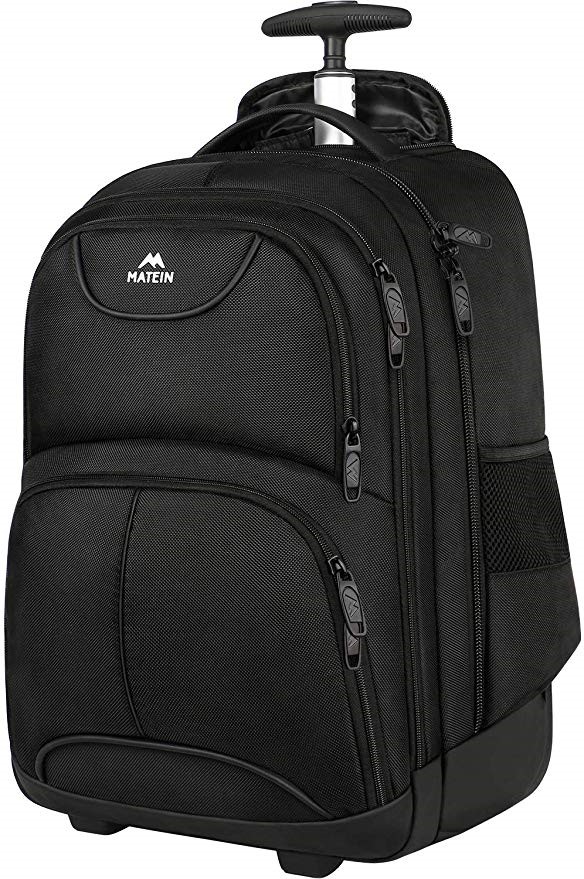
And, yes, I'm doing all this traveling carrying only this small bag (a mere $63.99 on Amazon), which I first wrote about six years ago: