

An answer to your 'bear market' question...
An answer to your 'bear market' question... Two powerful ways to use options in falling markets... How to add 'padding' to the stocks you already own... Use fear and volatility to your advantage... Who suffers the most from a slowdown in China?...
Editor's note: Be sure to read to the end of today's Digest for a special guest essay from our friend and former colleague Kim Iskyan, editor of the new Truewealth Asian Investment Daily.

 In yesterday's Digest, we discussed one of the two biggest questions we get about Dr. David "Doc" Eifrig's Retirement Trader service. Today, we'll answer the other...
As we showed yesterday, Doc's options-selling strategies can be a great way to earn income from high-quality, blue-chip stocks during "sideways" markets, where many stocks go nowhere for months on end. Even better, you can earn more income and do it with less risk than simply buying those same stocks outright.
But making money in bull markets, or even sideways markets, is one thing. Making money in a bear market is another.
So it's no surprise that many of you have been wondering the same thing: How will Doc's options strategies perform if we experience a true bear market, like the one Porter has been predicting?
Now, before we answer, it's important to remember even professional investors often struggle to make money during bear markets.
Sure, there are usually a handful of folks who make their names and their fortunes in market downturns. (The recent Michael Lewis book-turned-movie The Big Short is a great example from the last crisis.) But the reality is most professionals consider it a victory to simply lose less than the broad market.
There are a few reasons for this...
First, as we've discussed, no one can consistently predict when a bear market will begin. Because the market's long-term trend is up, turning too bearish too soon can be worse than not hedging at all. As Porter explained in the October 2 Digest...
Most of the time, stocks go up. As a rule, your portfolio should be mostly "long." You should mainly be a buyer of stocks and bonds. From time to time, of course, financial assets go down. Sometimes, they go down a lot.
Two years ago, we began to worry about the market. We knew it was due for a correction... or perhaps something worse. We took some money off the table. But we didn't stop buying stocks altogether... If we had, we would have missed out on opportunities. Worse, if we had been 100% short the stock market, we would have gotten killed.
Second, even if you manage to get the timing right, it can be difficult to make money exclusively shorting stocks.
Even the worst bear markets don't fall straight down. They're often broken up by periodic "oversold" rallies, where stocks "work off" the previous declines before moving lower again. In fact, some of history's most dramatic rallies have occurred during bear markets.
For example, during the financial crisis, the Dow Jones Industrials – the bluest of the blue-chip indexes – rallied more than 10% in a single day two different times in October 2008, right in the middle of a 30%-plus decline that fall.
Many folks – including professional investors – don't have the stomach for that kind of volatility. Just like most investors panic and sell stocks near the bottom of a decline, many will "cover" their short positions near the top of a bear market rally, just before stocks roll over again.
Finally, it can be just as hard to know when a bear market is finally ending.
While some well-known investors began turning bullish on stocks in late 2008 and early 2009 – including several analysts here at Stansberry Research – many others remained bearish long after stocks bottomed and a new rally had begun.
Our point, as you may have guessed, is that even if you're certain a bear market is beginning, it's likely a mistake to become too bearish.
Instead, as we've mentioned many times, we recommend a more balanced approach...
Hold a larger-than-normal amount of cash (and gold) to pick up the bargains that are sure to arise. Put a portion of your portfolio in well-chosen short positions to hedge your portfolio. But also keep a portion of your portfolio in high-quality, dividend-paying stocks that will pay you income and help you "weather the storm."
(Note: This is the seven-point bear-market strategy Porter explained in Friday's Digest. If you missed it, be sure to read it immediately.)
So, what do Doc's options-selling strategies have to do with this?
They can help you implement your bear-market "lifeboat" in at least two important ways...
First, they're a powerful way to make your safe dividend-paying stocks even "safer" in a bear market...
You can do this not by selling put options, like the example we showed yesterday, but by selling covered call options.
Remember, when you sell a call option, you're simply taking on the obligation to sell the underlying stock at an agreed-upon price if the buyer chooses to "exercise" the option (and buys the underlying stock).
When you sell a call option on a stock you already own, it's called selling a covered call, because your obligation to sell the underlying stock is already "covered" by the stock you own.
In his Retirement Trader service, Doc uses this strategy to help subscribers generate regular income on some of the world's safest stocks. And because you're selling options on stocks you already own, it can be used in both regular and retirement accounts.
But it's also ideally suited to help you earn even more income from your stocks and "pad" your portfolio against losses.
We'll use a recent example from Doc's Retirement Trader to show how it works. But again, it can be used with virtually any high-quality stock you already own.
Last August, Doc recommended that subscribers should sell covered calls on the Technology Select Sector SPDR Fund (XLK). This is an exchange-traded fund ("ETF") that holds the biggest and best technology companies in the world, like Apple (AAPL), Microsoft (MSFT), AT&T (T), IBM (IBM), and Visa (V), and pays a dividend of about 1.8%.
With shares of XLK trading at $40.50 per share, Doc recommended buying shares of XLK and selling one October $40 call option contract for every 100 shares purchased. In return, they collected about $150 in option premium "income."
Thanks to this income, the subscribers' adjusted cost basis was now just $39 per share ($40.50 price minus $1.50 in option premium), giving them "padding" from future losses. And as always, there were two potential outcomes of the trade...
If XLK traded for less than $40 on October 16, option-expiration day, the calls would expire worthless. Subscribers would keep the $150 in premium – representing a return of 3.7% in just two months... more than twice the stock's annual dividend yield – and would still continue to collect the stock's actual annual dividend. Even better, they could then turn around and sell calls on the stock again.
On the other hand, if XLK shares were trading for $40 or more on October 16, the stock would be called away at $40 a share. Subscribers would receive a net gain of $1 per share on the position ($40 minus the adjusted cost of $39). They would also receive the $0.18 quarterly dividend payment in September. Altogether, they would earn about 2.9% – still more than the stock's annual dividend yield – in less than two months.
In this case, XLK closed near $42 on October 16, so shares were called away. But subscribers booked a 2.9% gain in less than two months. And they were then free to reinvest that capital in another high-quality stock.
Now, let's imagine the other scenario, where XLK fell instead. Suppose it closed on October 16 at $36.45 per share, a 10% decline from its price of $40.50 at the time of the recommendation in August.
In that case, subscribers would still be showing a loss... But instead of being down 10%, they would be down just 6.5%. Remember, they collected $1.50 a share in premium upfront, so their cost basis would now be just $39, rather than $40.50. And they would then be free to sell another round of calls... collecting more income and lowering their cost basis further.
Again, this is just an example, but it shows the power of this strategy...
When used on the high-quality stocks you already own, it dramatically increases the income you earn compared with dividends alone, and in a worst-case scenario, it provides "padding" to reduce your potential losses.
In a severe bear market, you may still ultimately hit your trailing stops in some of these stocks – though as we've seen in examples like Hershey (HSY), that's not necessarily the case – but this income "padding" will help protect you.
The other way options-selling strategies can help you in a bear market involves picking up "bargains" in distressed equities and other "special situations" Porter mentioned on Friday.
Remember, as we explained yesterday, the real secret to using this strategy safely is to only sell options on stocks you'd like to own, at prices you're willing to pay.
Obviously, when you're using these strategies for this purpose, that's not a concern. You actually want to buy the stock.
Selling options is simply a way to name the price you'd like to pay for a stock... to pick up discounted stocks at even better prices than is currently available in the market.
We'll use yesterday's example of tech giant Oracle (ORCL) to see how this works.
Remember, ORCL had fallen more than 18% during last August's stock market crash. But suppose we thought ORCL had become so extremely cheap that we didn't just want to collect safe income, we wanted to establish a larger-than-normal position with the hope to hold for the long term.
To keep things simple, let's assume we sell the same December $37 put option. For each contract sold, we'd collect $188 in income upfront, and the same two potential outcomes would apply...
If shares of ORCL traded for more than $37 on the December 18 option-expiration day – meaning shares either moved higher or stayed about the same – the option would expire worthless. We wouldn't be able to buy the stock, but we'd keep the premium for a quick, 4.4% gain in three months. This is a 16.8% annualized gain – more than we would have made owning the stock. So while we would have liked to buy the stock, we've still been rewarded.
On the other hand, if shares of ORCL closed at less than $37 on December 18, we would be able to buy the stock at $37 per share. But because we collected $188 in income upfront ($1.88 per share), our true cost would be just $35.12 per share ($37 minus $1.88).
In other words, we'd either end up making a big, quick gain, or we'd get to buy a stock we hoped to buy for less than we could have bought it in the market at that time.
Like before, this is just a simple example, but we hope it shows just how valuable these strategies can be. As Porter often says, once you learn to use options this way, you'll likely never buy stocks the same way again.
If you aren't using them in your portfolio, you owe it to yourself to learn more.
Sign Doc's pledge, and sign up to attend his free educational webinar tomorrow night – Wednesday, January 20 – at 8 p.m. Eastern time. You have absolutely nothing to lose and an incredible amount to gain. Click here to reserve your spot.
New 52-week highs (as of 1/18/16): none (markets were closed for Martin Luther King, Jr. Day).
Regards,
Justin Brill
Baltimore, Maryland
January 19, 2016
Who Suffers Most From China's Woes? It's Not Who You Think
If you believe the numbers, there is no economic slowdown in China. But don't tell that to the countries suffering the most from China's economic slowdown.
Australia and New Zealand are a lot further away from China than the Association of Southeast Asian Nations (ASEAN) countries, all of which stand to suffer as growth in China slows. But economically, Australia and New Zealand are more tightly linked to China than any country that's much closer geographically. This relationship was highlighted when the Chinese government started devaluing the yuan in August 2015. Both countries' currencies fell more versus the U.S. dollar than those of most other ASEAN countries, as shown below.
| Currency | RMB Devaluation by China Following 1-Month Returns (8/10/15-9/10/15) |
YTD Stock Market Downturn in China |
| Australian Dollar | -4.6% | -5.5% |
| New Zealand Dollar | -5.0% | -5.5% |
| Malaysian Ringgit | -8.5%* | -2.4% |
| Philippine Peso | -2.2% | -1.9% |
| Singapore Dollar | -2.3% | -1.5% |
| Thai Baht | -2.7% | -0.8% |
| Vietnamese Dong | -2.9% | 0.4% |
| Indonesian Rupiah | -5.2% | -0.4% |
| * During this period, Malaysia experienced a major political scandal involving its prime minister. | ||
| Source: Bloomberg | www.truewealthpublishing.asia | |
With this year's market volatility in China, the Australian and New Zealand currencies have continued to underperform compared with other countries in the region. In 2016, the Australian and New Zealand dollars have both fallen 5.5% relative to the U.S. dollar.
Why is this happening? Australia and New Zealand depend heavily on exporting commodities – mostly to China. China is by far the largest consumer of Australian exports, and accounted for more than 39% of Australia's exports over the first 11 months of 2015. Over the same period, 17% of all New Zealand's exports were sent to China. Both figures are substantially higher than those of any ASEAN member, as shown below...
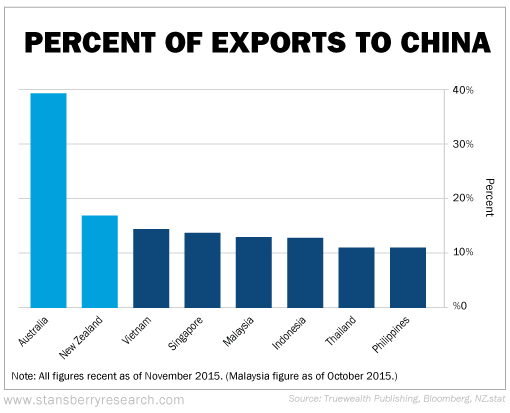
A slowing Chinese economy means fewer imports by Chinese companies, and less trade with Australia and New Zealand. This hurts their currencies – both as investor sentiment (that is, the mood of investors toward a market) darkens, and as China's demand for Australian and New Zealand dollars decreases.
China's pain will continue to strike in places that might not be the first to come to mind. Investors will do well to keep this Chinese relationship in mind when investing in Australian or New Zealand stocks, bonds, or anything else denominated in Australian or New Zealand dollars.
Regards,
Kim Iskyan
Editor's note: Kim's new venture – Truewealth Publishing – is dedicated to providing world-class, independent investment insight on Asia. Each day in his free Truewealth Asian Investment Daily, Kim shares the most important and interesting investment, economic, and business news and ideas from Asia and around the globe... and explains what it all means for markets, and for your money. Click here to sign up for free.
|