

Are you ready to 'cross the desert'?...
Are you ready to 'cross the desert'?... Porter's 'three most important concepts'... Why some homebuilders are so much better than others... A department store that's beating Amazon...
Editor's note: Today, we're concluding our special series from Paul Mampilly, editor of our new trading service, the Professional Speculator.
Each day this week, Paul has been highlighting some of the most important technology investment trends he's following, including "Big Data," the "end of aging," and "supermaterials." At the bottom of today's Digest, Paul explains how "personalized medicine" is about to revolutionize the way we treat disease... and could make early investors a fortune...

 Let's start here... in the desert...
Imagine you had to walk across the Rub' al Khali – "the Empty Quarter" – of the Arabian Peninsula. This 250,000-square-mile desert is the largest sand desert in the world. Sand dunes there reach as high as 800 feet. It rains less than two inches a year. The surface temperatures reach 125 degrees. Think about the three most important pieces of equipment you'd need, beyond the most basic stuff like shoes, clothes, food, water, etc.
This isn't hypothetical. Three guys decided to try and walk across this desert completely unassisted. In 2013, South Africans Dave Joyce, Marco Broccardo, and Alex Harris became the first humans to walk completely unassisted through the Empty Quarter. They plotted a 1,000-kilometer course from Salalah, Oman to Dubai. You can listen to them talk about their adventure here. Their story is completely nuts... but fascinating.
The most obvious piece of advanced equipment you'd need? A GPS, right? Nope. What they needed most wasn't a GPS... or even a map. What they had to have to make it across 1,000 kilometers of desert in 40 days (after which they would have quickly starved to death) was Google Earth. They needed to know their precise position in the desert relative to the giant sand dunes, which you can only see using Google Earth's satellite photos. Before the advent of publicly available satellite photos, walking across this desert would have been impossible. GPS alone wouldn't have been enough.
They also needed a strong, lightweight, easy-to-pull cart, so they could carry enough water for the journey. Obviously, they needed food, too. But the water was far more critical and heavy to carry. They spent about three years testing various designs for carrying enough water. The key to success was using mountain bike tires on their cart, rather than wide full tires, which were too difficult to pull through the sand.
And finally... to make sure they had continuous access to Google Earth, they needed to use a solar-based charger to power up a satellite phone. They lost the charger on the 10th day of the trip. So one of them had to turn around and follow their tracks for 25 kilometers to find the charger before it got dark. Without it, they probably would have died. Imagine trying to find that charger... before dark... in the desert... by yourself... knowing that if you couldn't find it, you and your friends would probably die.
So what the heck do three crazy South Africans hiking across a giant desert have to do with investing? It's obvious (to me). For most individual investors, the process of trying to manage their savings in the stock market is a lot like trying to cross the Rub' al Khali desert on foot. You have few landmarks to guide your way. And there are lots of ways to die. Most people don't make it.
If you're a new subscriber, you may not yet be familiar with the format for the Friday Digest each week. Each Friday, I sit down and write to our subscribers personally. I'm guided by a simple principle: I do my best to tell you what I'd most want to know, if our roles were reversed.
Learning the story about the guys crossing the desert, I started thinking about the three most important things most investors need to understand if they're going to be successful in the stock market. Not the obvious stuff... like the way dividends compound returns or the time-value-money formula (which explains that your returns will be driven by how much time your investments are allowed to compound and how much money you save). Nor am I talking about the more advanced, but still simple concepts, like position sizing, trailing stop losses, and avoiding taxes (where possible).
It's not that these things are unnecessary. They're critical. But they're like shoes, hats, and sunglasses when you're crossing a desert. Nobody would go without them, and they really don't require much foresight or wisdom. Instead, I wanted to answer a more difficult question. Brian Hunt, our Editor in Chief, put it best...
|
I thought about this question for a long time. Here's my list...
No. 1: The most important thing for investors to understand about investing in stocks is simply what kind of businesses make for great investments and how to properly value these kinds of businesses.
You can think of this knowledge as your personal Google Earth for crossing "the desert" of investing. Knowing how to recognize great businesses and knowing what they're worth is like knowing where the sand dunes are and how to get past them.
Here's an example of what I mean: Do you think Markel (MKL) – trading around $770 a share – is an expensive stock? Why or why not?
If you can answer this question within 30 seconds by looking at a few key statistics, then you're ready to cross the desert. If you can't... you're just not ready. You have to power up your satellite phone and spend more time studying your maps.
(By the way... I'm really curious about whether or not you can actually do that. Can you take a quick look at Markel's numbers and tell me whether or not it looks expensive, cheap, or fairly priced? Please, take a minute and send me a brief e-mail telling me what you think. If you don't know – even if you have no idea – simply send me your best guess to feedback@stansberryresearch.com. Please participate. This feedback is crucial to helping me judge what type of educational content to provide. And no, I won't reveal your name or answer to anyone unless you give us the OK.)
If you have no idea whether Markel is expensive or cheap, don't worry. You're not alone. Judging by my experiences with wealthy and business-savvy subscribers, I would estimate less than 10% of our subscribers really understand these concepts. Without this knowledge, I'm nearly certain you can't be successful as an investor. Not for long, at least.
No. 2: The second thing I know you must have to "cross the desert" successfully is a strategy that will continue to make you money even when you're wrong about the big picture.
Look at the model portfolio in my Investment Advisory, for example. I've been expecting a serious crash in stocks since 2013. We trimmed our long positions then by selling some stocks. And we hedged our exposure to the market by selling short some stocks.
But we didn't sell everything. And we didn't move to a 100% short portfolio. We've done great with our investments since 2013, even though my market outlook has been 100% dead wrong (so far).
The idea that you don't ever want to bet the farm on any particular outlook (or any particular investment recommendation) is hard for most investors to understand and implement. When events in the world spook most individual investors, they simply pull out of stocks completely. They generally do so at the worst possible time. You have to learn how to make money even when you're wrong about the market as a whole. And you have to follow your strategy... even when it's scary.
No. 3: The last thing I think most individual investors either never learn or only learn the hard way after several big beatings is to never, ever chase what's "hot."
These investment "mirages" will cost you almost every time. It takes a lot of discipline to stick with great businesses that you can personally understand. It takes discipline to buy them when you can get them at a reasonable price. It takes discipline to follow your position-size limits.
When a great new business comes along – like online auctioneer eBay (EBAY) in the early 2000s – learn to be patient. Follow it for years, and buy it when it comes into your range.
If you had bought eBay back in 2004, you'd be up a little more than $3 per share today (from $58 to $61) more than a decade later. Sure, eBay was and is a great business with a huge "moat." Nevertheless, investors who chased after it while it was "hot" saw their investments decline almost 90%. It was far better to have bought it for less than $15 a share back when it was trading for a reasonable price.
Over the next three Friday Digests, I'll be going over these three concepts in detail. I hope you'll take the time to read these essays and think about them. (Remember, there's no such thing as teaching, only learning.) If you do, please don't hesitate to send me your questions. I'll make an extra effort to respond to all of the questions we receive about these key topics.
For today, I just want to leave you with a few examples about how knowing what makes for a great business can be a huge advantage for you as an investor. The first example is homebuilder NVR (NVR)...
Longtime subscribers will remember that I first recommended NVR when it was trading for around $449 per share in 2007. This was after the housing crisis had begun. NVR's stock had sold off substantially, and it was trading for a low multiple of its cash earnings. I knew NVR was the best business in the homebuilding sector by a wide margin. I knew it would survive the mortgage crisis. And I predicted that investors who were smart enough to buy it during the crisis would make a lot of money. Today, it's trading for almost $1,400 per share. It was profitable throughout the housing crisis of 2007-2011.
How did I know? Next week, I'll show you the key attributes I look for to find a great business. But first, let me show you what this can mean to you as an investor...
Most people will say that owning stock in the homebuilding sector over the last 10 years was a bad investment. After all, between 2005 and 2015, new home starts collapsed. Lots of homebuilders went out of business. And lots of homeowners lost their homes. Prices for houses crashed, too. All of that is true... for the sector as a whole.
For example, Lennar (LEN) – one of the largest national homebuilders – has seen its stock decline by about 17% over the last decade, producing a negative average annual return (-1.4%) for the period. Investors who bought and held onto Lennar after the first big dip in housing stocks would have done poorly...
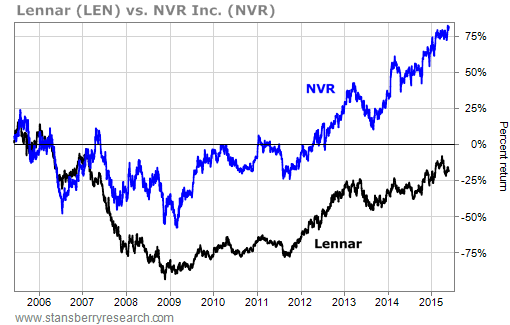
On the other hand, even if you hadn't waited until the stock fell – if you had simply bought NVR at around its peaks in 2005 – you would still have nearly doubled your money in 10 years (more than 83%), producing an average annual return of 6.2% – pretty close to what stocks in general have done on average since then. My point is, even when you buy into the absolutely worst sector at the absolutely worst time... if you buy stock in the right business, you'll end up far better off than other investors. And if you wait until these super-high-quality stocks are trading for attractive prices, you will produce extraordinary returns.
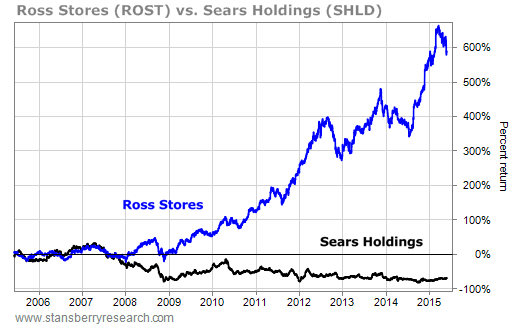
One more example... Ross Stores (ROST) is one of the best businesses we've ever studied (though we haven't recommended it yet). I'll explain why we think it's a superb business next week, but I just wanted to show you again how powerful this kind of analysis can be for you as an investor trying to "cross the desert."
Everyone knows that over the last decade, online marketplace Amazon and other Internet retailers have crushed department stores. The entire retail industry has been hammered, and nobody has gotten hit worse than department stores, right? How, then, would you explain this chart?
 Knowing how to recognize great businesses is the best advantage I can give you as an investor. Next week, I'll dive into the three secret keys that we look for in a great business. It's just three things. Anyone can find them. And as you'll see, it's all based on common sense. You don't have to be a genius to be a great investor. But you need the proper map. And you need the discipline to follow it. Until next week...
New 52-week highs (as of 5/28/2015): Bristol-Myers Squibb (BMY), KraneShares E Fund China Commercial Paper Fund (KCNY), and Sears Holdings (SHLD).
In the mailbag, I get labeled an extremist. Also, please send your answer to my Markel valuation question to feedback@stansberryresearch.com. I'm looking forward to your responses. And be sure to read on for Paul Mampilly's essay on personalized medicine...
"Your book, 'America 2020,' has been very thought provoking. I am rereading it for the third time now. While I am a stubborn, 'doubting Thomas,' I have incorporated a few of your ideas into my own investing. One thing I changed in my portfolio was to add a couple of bank warrant positions near the end of 2012 after you opened my eyes up in that area. Thank you!
Knowing how to recognize great businesses is the best advantage I can give you as an investor. Next week, I'll dive into the three secret keys that we look for in a great business. It's just three things. Anyone can find them. And as you'll see, it's all based on common sense. You don't have to be a genius to be a great investor. But you need the proper map. And you need the discipline to follow it. Until next week...
New 52-week highs (as of 5/28/2015): Bristol-Myers Squibb (BMY), KraneShares E Fund China Commercial Paper Fund (KCNY), and Sears Holdings (SHLD).
In the mailbag, I get labeled an extremist. Also, please send your answer to my Markel valuation question to feedback@stansberryresearch.com. I'm looking forward to your responses. And be sure to read on for Paul Mampilly's essay on personalized medicine...
"Your book, 'America 2020,' has been very thought provoking. I am rereading it for the third time now. While I am a stubborn, 'doubting Thomas,' I have incorporated a few of your ideas into my own investing. One thing I changed in my portfolio was to add a couple of bank warrant positions near the end of 2012 after you opened my eyes up in that area. Thank you!
"I am now going to sell a majority stake of my PNC warrants and use the profit to purchase physical silver (junk coins) with the purpose of adding more diversification to my portfolio. I am also going to purchase around 300 acres of farm land in Western Tennessee, as my wife wants to move there. Farmers often rent the land for their farming needs, so I hope to be able to collect some simple profit from that if and when food prices begin to climb. I am going to keep the acreage small scale, just to see how things play out first and to get my feet wet. The one variable I am unsure of is land tax. Right now, Tennessee tax is very reasonable. However, I do believe taxes will increase if farm land produces more profit, as someone will always have their hand in the kitty to help themselves to some of any profit. Time will tell.
"One thing I absolutely agree with you on is keeping the government in the dark as much as possible regarding my business. Being debt free, plus the government not knowing how much cash I have on hand, etc. has been very helpful. Even though I give you a poke at times (especially over gold), I think you are serious about the research you do. We basically reap what we sow; and preparing for the worst (while 'hoping' for the best) seems to be a most prudent strategy to begin taking at this juncture. Shame on any of us if we don't begin gathering acorns for a winter that we know will eventually come. But, learning what the best ways are to gather and store those acorns are just as important to me. Please keep up the good work you are doing." – Paid-up subscriber William Durst
Porter comment: It's amazing to me that many people consider the ideas in my book "radical." All I'm suggesting is a few simple, common sense things to do to prepare for a day everyone should know must happen, given the government's absurd financial profligacy.
We should all know that using debt to solve a debt problem doesn't work for long. We should all know that promising voters that they can live at the expense of their neighbors is a shortsighted way to run a country. And most of all, we should all know that printing trillions of dollars to bail out Wall Street is unlikely to increase our standard of living.
It's almost surreal that simply discussing these ideas – that any rational person would admit are simply unpleasant facts – gets you labeled an "extremist" in our country today. What's extreme is the way our country is being led. It's extremely bad... and it's going to get a lot worse.
Regards,
Porter Stansberry
Baltimore, Maryland
May 29, 2015
Personalized Medicine: Drugs Tailored Specifically for You
By Paul Mampilly, editor, Professional Speculator
In 10 years, we'll look at today's "one size fits all" way of prescribing drugs as prehistoric and primitive. Today, if you're diagnosed with lung cancer, your cancer is treated as if it's the same as many other people suffering from lung cancer.
But every person's cancer is different. And while one person may get better from one cancer drug, it might not work on the next person because each person metabolizes drugs differently based on their genetic code. One small variation in genetic code can mean the difference between a drug working or not. Drug companies understand this... and the best ones seek out people to test their drugs. When they find the right population, they design what's called a "companion diagnostic test."
A companion diagnostic is a test that tells you if a drug will help you. Some tests will even say what types of patients will actually suffer from taking these drugs.
Within five years, I expect that virtually every cancer drug approved for use will come with a companion diagnostic test to make sure the drug you're taking is the right one for you.
The companion diagnostic test works like this... A doctor will take a small tissue sample of your cancerous tumor. Next, a lab will match your tumor to see which specific cancer gene molecule is causing it. You'll get prescribed a drug designed precisely to kill the molecule causing the cancer.
Of course, this is better for the patient, who is more likely to beat the cancer. But it's also great for drug companies because they will be able to develop drugs that they know will actually work in patients. That means the U.S. Food and Drug Administration will approve many more drugs for these companies. It's a win-win scenario for patients and drug companies... especially the biotech giants like Amgen and Roche.
This trend is also good for medical diagnostic and analysis companies, which benefit from a larger variety and higher volumes of tests. Companies like LabCorp and Quest Diagnostics, and life-science-equipment companies like Agilent and PerkinElmer should do well.
Medical intelligence firm Transparency Market Research estimates that the market for companion diagnostics will grow from about $1.8 billion in 2013 to $5.6 billion by 2019. That's a 211% increase in six years... and it will translate into huge gains for some companies.
You can gain exposure to this trend by holding the big companies I mentioned above. But to capture multiple huge winners, you should buy smaller, lesser-known stocks with 100%-500% upside. These are the kinds of stocks I'm keeping my eye on for my Professional Speculator subscribers.
Editor's note: Paul is currently recommending one of the best speculations he has ever come across in 25 years of investing. This company has developed what could be the biggest medical breakthrough of the decade. He believes this stock could double over the next year... and give today's investors the chance to make up to 26 times their money over the next 10 years... turning every $5,000 invested into $135,000.
And right now, you can take advantage of an unbelievable offer... For a limited time, you can receive the Professional Speculator for LIFE... at no extra charge. Get started on your risk-free, six-month trial today. Get the details here.
