

Corruption D.C. style...
Corruption D.C. style... A crude-oil export ban, but not a gasoline export ban?... How 'pairs' trading can allow you to sidestep volatility even in down markets... The market looks better, is it time to buy?
 What's behind the first signs of stability in the oil markets? Corruption, of course. Welcome to Amerika.
Today, the U.S. House of Representatives will vote on repealing the crude-oil export ban. To get the votes needed, Republicans had to bribe Democrats...
From a recent Wall Street Journal article:
House Speaker John Boehner would authorize the Defense Department to boost payments to shipping companies... The Maritime Security Program, first implemented in 1996 under President Bill Clinton, sends $3.1 million yearly (per ship) to the owners of 60 ships staffed with U.S. workers (all of whom are unionized). A provision in the oil-export bill would increase the Maritime Security Program payment to $5 million per ship... boosting the overall payments the Pentagon could make by more than $500 million (per year).
Just so you're clear about how this works... The government (via the U.S. Department of Defense) sends ship owners (including those with foreign-owned vessels) $3 million a year. Almost all of this money goes directly into the pockets of the union workers. The defense angle is an absurd ruse. The government can (and has) commandeered ships in times of war without spending millions prior to a conflict for the right to do so.
What is this really about? These are payments from Democratic politicians to buy the support and cooperation of unions. And why do the Democratic politicians object to lifting the export ban on crude oil? Because they can.
As we've discussed in our pages many times before, the U.S. oil-export ban is mind-numbingly stupid. The ban was designed to fool Americans into believing it would produce lower gasoline prices. That might work, except for one glaring problem: It's not against the law to export gasoline.
What the crude-oil export ban really does is create huge profits for refineries and enable lucrative export markets for other refined products, like propane. Who controls refineries? The politicians who decide who gets to build them. To make sure the price of these licenses remains high (in the form of campaign contributions), nobody is allowed to build big ones. The last major new refinery built in the United States began operations in 1977. It was approved before the crude-oil export ban. Marathon Oil owns it. It's located in Garyville, Louisiana. Any idea why it's located Garyville? Have you ever heard of the Mississippi River?
The crude-oil export ban is one of those terrific political creations. It does the exact opposite of what its proponents claimed it would do. Even better, the sheeple of America, never missing a chance to lick the boots of their oppressors, love it. Corrupt politicians, meanwhile, have been living off the economic distortions of this policy for 40 years.
The irony goes even deeper when you realize why oil prices soared in the first place. Contrary to popular belief, it wasn't because of any significant disruption to supply. Just spend a little time comparing oil prices in different countries in the 1970s. Countries with hard currencies noticed almost no change. But in America, oil prices soared – despite significant amounts of domestic production. Why? Our currency was massively devalued. It started in 1971 with Nixon's decision to remove the dollar from the gold standard.
And so, our feckless leaders caused a huge decline in our standard of living. Then, they decided to "do something about it" by making it harder for our most important domestic industry (oil and gas) to earn a profit. Brilliant.
Just because the Republican politicians are the ones now pushing to lift the ban, don't think this makes them any more virtuous. It was a Republican president (Ford) who signed the ban in the first place.
And trust me, the ban created so many political goodies, our politicians never would have removed it unless there was a genuine risk of an industrywide collapse. Politicians know you can't kill the goose. You can starve him. You can nail his feet to a board. You can blind him. But you can't let him die.
In the last five days, shares of domestic energy producer (and Stansberry's Investment Advisory recommendation) EOG Resources (EOG) have soared. They're up more than 10%. I'm happy to report that subscribers who followed our advice should have a position in the shares. We recommended buying them several months ago with a proviso: We didn't believe we were anywhere near a bottom in oil prices or a bottom in oil stocks.
Why would we buy shares in a business we suspected had a lot more downside left? We knew that, sooner or later, the oil-export ban would be repealed. And we knew that the moment it was, EOG's assets in the Eagle Ford Shale play would become a lot more valuable. EOG owns the energy equivalent of a small Persian Gulf state. It is the world's leader in shale oil production. We couldn't know exactly when the government would lift the crude-oil export ban. But over the last year, U.S. crude-oil exports have increased dramatically as industry lobbyists fought to change the legal definition of "crude oil." So we knew, one way or another, EOG's energy would find its way to the world's market. And we knew that would be great for the stock.
To protect ourselves from the short-term risks of lower oil prices, we did something you might think is complicated or even risky: We recommended selling short what we believe is the worst major oil company in North America – Canada's Suncor (SU).
To us, this is logical. We want to own EOG because it is America's most advanced and efficient shale-oil producer. But we also wanted to avoid the risk and volatility of oil prices. The way to "hedge out" our exposure to oil was simply to sell short the shares of another oil company. Suncor, with its massive oil-sands assets, its long distance from export facilities, and its large refinery business, is the mirror image (financially) of EOG. Suncor stands to lose the most from the repeal of the crude-oil export ban, as it will greatly reduce Suncor's margins on refining. As you can see, the logic of our position started bearing fruit in the past 30 days. EOG has bounced higher than Suncor – 11% compared with 7%, respectively.
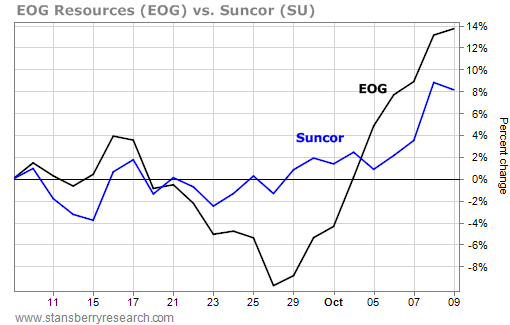
I expect to see the "spread" between these two shares greatly increase over the next few months. I expect crude oil prices to remain below $60 a barrel. That will make it hard for Suncor to earn a profit, while EOG should be very profitable at that price. If the crude-oil export ban is repealed, there's a reasonable chance for a windfall gain on shares of EOG.
If you've never tried a "pairs trade" like this, I'd encourage you to do it. You'll never really understand something until you've done it. Pairs trading allows you far greater control of investment risks, and it lets you target the particular quality or strategy of one company versus another. It's a great way to use fundamental analysis to earn safe profits and keep your portfolio invested while greatly reducing risk and volatility.
In regards to the overall markets and the risks I've been writing about (off and on) since May 2013... the clouds parted a bit this week. Domestic oil stocks have soared. For example, the Market Vectors Unconventional Oil & Gas Fund (FRAK), which holds a basket of shale-oil producers, is up 14% over the last 30 days, with most of the gains occurring this week.
Emerging markets bounced, too. The iShares MSCI Emerging Markets Fund (EEM) is up 7.5%. Even the Dow Jones Transportation Average Index showed signs of life, moving up almost 3%.
What hasn't bounced are high-yield corporate bonds. The iShares iBoxx $ High Yield Corporate Bond Fund (HYG) is still down 1.69% over the last 30 days. As long as corporate fixed income remains under pressure, I don't think the rally we've seen this week will last. If you're looking for a bottom to buy stocks, my advice is to keep watching high-yield bonds. U.S. stocks will struggle to rally in the face of higher borrowing costs.
New 52-week highs (as of 10/8/15): National Beverage (FIZZ), McDonald's (MCD), and Constellation Brands (STZ).
In today's mailbag, another new subscriber is confused. Tell us... how can we make things clearer? Send your thoughts to feedback@stansberryresearch.com.
"As a new subscriber, do you list all open recommendations somewhere – not just the ten best (which are really quite old). I find the commentary quite lengthy with no conclusions that I find specifically actionable." – Paid-up subscriber C. Cox
Brill comment: Mr. Cox, as we've explained many times, this particular publication – The Stansberry Digest – is not one of your paid subscriptions. It's a free daily letter we publish for all paid subscribers.
Think of it as a guide to help you filter out the "noise" and keep up with what's happening in the markets and here at Stansberry Research. While we do often provide actionable information, that's not our primary goal.
On the other hand, you can always access your paid-subscription materials – your monthly issues with in-depth investment analysis, special reports, open recommendations, and more – by logging into the "My Subscriptions" page at the top right-hand corner of www.stansberryresearch.com. You should also receive an e-mail notifying you whenever your new research is published.
Regards,
Porter Stansberry
Baltimore, Maryland
October 9, 2015
|