Record highs for stocks and complacency... Retirement accounts shift big into stocks... One major investor is going to cash... Alcoa is up on Brazilian news... Morgan Stanley upgrades coal... Will Gazprom cut Ukraine off?... A plea to Barbara...

The Dow Jones and the S&P 500 hit record highs today...
That explains why the Volatility Index (the "VIX") – the market's fear gauge – dropped more than 5% today.
As we've written before, the VIX measures the prices people are willing to pay for options in the form of "portfolio insurance." The higher the VIX, the more money people will pay to insure their stocks... hence, the more scared they feel.
In other words, people aren't scared today... In fact, they're more complacent than at any time since 2007.
And they're allocating more cash to stocks than at any time since 2007...
In March, stocks accounted for 67% of employees' new contributions to retirement portfolios, according to Aon Hewitt, which tracks 401(k) data. Compare that with the market peak in October 2007, when investors put 69% of new retirement contributions into stocks. The market went on to fall by more than half over the next 18 months.
"It's an emotional reaction," financial planner Dana Anspach told the Wall Street Journal. "2008 and 2009 were like being in the fetal position, [today] everyone wants to buy."
While Steve Sjuggerud believes we're in the "seventh inning" (
out of a nine-inning baseball game) of this market rally, the individual investor is incredibly adept at mistiming the market... And losing money.
And as Anspach noted, it's because of "emotion." Most market participants chase the hot stock story, like Tesla. They see their friends making money in stocks for a year or two, then pile in with utter disregard for valuation. And after the market corrects, they sell... And sit in cash.
There's lots of data to prove the follies of the individual investor...
In a study that covered a 20-year period from 1992 through 2011, asset-management giant BlackRock found that the average individual investor earned 2.1% per year before taxes. Stocks went up 7.8% annually during the same period.
Another research firm, Dalbar, has shown time and time again that individual investors underperform the market...
The results of a recent study (which you can see
here), show investors underperformed the S&P 500 over every time frame – 30 years, 20 years, 10 years, five years, and 12 months.
As Porter likes to say, "there is no teaching, only learning." And that certainly applies to the industry's efforts to educate investors. From the Dalbar report...
|
Attempts to correct irrational investor behavior through education have proved to be futile. The belief that investors will make prudent decisions after education and disclosure has been totally discredited.
|
|
We're not saying the folks buying stocks in their retirement accounts today won't enjoy some solid gains. But we doubt they'll have the discipline to get out when they need to.
Meanwhile, one major investor isn't worried about timing the top... He's selling out now.
Steve Romnick, who's responsible for $20 billion at asset manager First Pacific Advisors, has moved approximately 40% of his portfolio to cash. That's up from an average cash balance of 26.4% since 1994. Romnick thinks record corporate profits will fall as interest rates and corporate taxes rise.
During a speech last Friday, Romnick told the audience, "We're about as bearish as we've ever been." Romnick has cut his position in high-yield (or "junk") bonds to almost zero as spreads between them and investment-grade debt has fallen. (As a sidenote, Porter discussed the high-yield corporate-bond market in depth in the
April 11 Digest.)
Romnick is now investing in private businesses, farmland, container ships, and other assets that haven't appreciated as much as the stock market. He has also added to his position in aluminum company Alcoa.
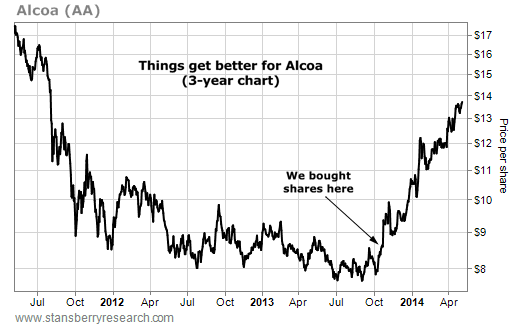
DailyWealth Trader recommended buying Alcoa last October. Editor Amber Lee Mason recapped the trade last week...
|
Like many industrial materials, aluminum is sensitive to economic cycles. When the economy slows down, aluminum tends to bust. When the economy picks up, aluminum tends to boom.
From early 2011 to mid-2012, global economic growth was sluggish, and folks didn't expect it to get any better any time soon. Alcoa suffered a major bust... Shares fell from about $18 to a low around $8. By September last year, the stock had been kicked out of the Dow Jones Industrial Average.
But as you can see from the chart below, that $8 level represented the area where things "couldn't get any worse." And that's why we recommended shares last October... just before things started getting better.
|
|
Shares of Alcoa are up nearly 4% today on news out of Brazil...
Brazilian energy prices have gotten so high that Alcoa is making more money by cutting back its production and selling that energy on the market.
In March, Alcoa – which owns thermal power plants in Brazil – said it was cutting 147,000 tons of local production due to "increased costs that have made the smelters uncompetitive."
According to people familiar with the situation, cited by the
Financial Times, it costs Alcoa approximately 40 real (Brazil's currency), or 18 U.S. dollars, to produce a megawatt hour. That same energy sells on the market for 822 real (nearly $370) per megawatt hour.
In the
April 9 DailyWealth Market Notes, Editor in Chief Brian Hunt called the bottom in another beaten-down commodity sector – coal. Like aluminum, coal had suffered a major downtrend...
|
Coal often competes with natural gas. Surging natural gas production has depressed gas prices... which have depressed coal prices. The Dow Jones U.S. Coal Index... fell from its early 2011 level of 496 to its 2013 low of 101... a fall of 80%. It's one of the biggest sector wipeouts of the last decade. After an 80% decline, it's likely the bottom is in for this extremely out of favor sector.
|
|
Today, investment bank Morgan Stanley upgraded coal miner Peabody Coal (BTU). Shares rallied nearly 3% on the news... And they're up nearly 9% since Brian called the bottom in coal.
We'll leave you today with a note from
S&A Global Contrarian editor Kim Iskyan. Kim says it's looking more and more like Russia will cut off gas to Ukraine...
|
U.S. and European Union threats to clamp down on Russia haven't had much effect so far. Economic sanctions on Russia have affected only a small number of individuals, and Russia has laughed it off. Even though Europe has the most to lose, it has been reluctant to strengthen sanctions. And we're about to see why Europe has been so wishy-washy, when Russia turns off the gas to Ukraine and consequently, to Europe.
|
|
As Kim has written previously, Ukraine gets most of its gas from Russia, which Russia uses to keep Ukraine under its geopolitical control (by giving Ukraine discounts on gas and offering generous payment terms)...
|
As Ukraine's economy has fallen deeply into a hole, the country has become increasingly dependent on Russia's largesse. Ukraine owes billions of dollars to Russia for gas... and there's no way it can pay. Ukraine's economy is probably going to shrink 5% this year. Paying Russia for gas can't be at the top of the list of overdue bills to pay.
Russia wants Ukraine to stay within its sphere of influence... and doesn't want it to get closer to the EU or NATO. Since the end of the Cold War, Russia has watched most of Eastern and Central Europe join the West. So when Ukraine's pro-Russia former president, Viktor Yanukovych, was toppled back in February, Russia withdrew its economic support for Ukraine. It ended its gas discounts, and last month Putin warned that Gazprom would require Ukraine to pre-pay for gas.
|
|
As Kim explains, if Ukraine doesn't pay, Russia will likely cut off the gas supply (like it did in 2009). But Europe gets roughly one-third of its gas from Russia, most of which flows through Ukraine. If Ukraine can't pay for its gas, the country could siphon off some of the gas intended to go to Europe. More from Kim...
|
The International Monetary Fund, which helps countries in economic distress, recently submitted $3.2 billion to Ukraine, as part of a $17 billion support program. In theory, the Ukrainian government could use some of this cash to pay its Russian gas debt. But even if it does, that will be only a drop in the bucket... and it still won't help Ukraine pay for gas in the future.
Unless ongoing talks between Russia, Ukraine, and the EU result in a deal, Russian oil giant Gazprom is probably going to cut Ukraine off in June. Europe has stored gas reserves that it can draw on, so the short-term effect wouldn't be huge. And lower summertime supplies of gas isn't as big a deal as if it was in the winter. But Ukraine's economy, starved of gas, could fall even more deeply into recession. If the dispute drags on, Europe could be affected as it draws down its gas supplies. This could just be the start of another chapter in the struggle between Russia and the West.
|
|

New 52-week highs (as of 5/9/14): Chesapeake Energy (CHK), CVS Caremark (CVS) Dorchester Minerals (DMLP), Eni (E), Energy Transfer Equity (ETE), McDonald's (MCD), 3M (MMM), Altria (MO), ProShares S&P 500 BuyWrite Fund (PBP), Pepsico (PEP), and Travelers (TRV).
"Barbara, I can definitely relate to your comments regarding the stock returns listed on the
S&A Digest. I was once like you. Eagerly looking to invest in solid recommendations to help grow my nest egg. I like you also invested in Seabridge Gold and lost a considerable amount of money based on the same Hall of Fame schedule you mention. I too thought I could breeze through a few news article and have great trades shoveled to me and make money. Seabridge Gold, 995% returns! I'm in! I was paying for stock tips from a company whose business is researching stocks. They have to be experts in order for them to make money. Right? They have to give me good stock tips or they would not be in business.
"Using this thought process I lost money. However, I did not cancel my subscription and like Goldsmith's response, I learned that the Hall of Fame Schedules are past records or examples of successful trades not hot stock tips. If you read Porter's Friday Digests he usually tries to teach us basic stock trading and he is the first to tell us that you must do additional research. In his Investment Advisory he brings not only the reasons he is recommending that we consider a certain stock but, he explains the history behind the stock. He sometimes explains how the business has evolved as some companies go back hundreds of years.
"He does this to give the background information that form the basis of the recommendation. It took me about six months to realize that not every good idea or investment strategy is golden and that the Hall of Fame was past closed performance. However, I have learned that his recommendations are not half cocked or a scam to rope in more subscribers. Does he sell subscriptions? Yes. I truly believe that Porter tells us what he would want to be told if he were in our shoes. What Porter has taught is there is no teaching, there is only learning (this is an important concept) he is also first to say you do not run out and buy his recommendations as it is a starting point. You must think it through. You may and should double check the detail and if you first, understand what you are investing in and second, why you believe it should make money, only then should you invest. Investing in stocks is not magic, it is work.
"I am responsible for what I buy no matter who I pay to advise me. Investing is work and risk. If I work to invest in assets that are less risk, look for a company that does not have a lot of debt, and a future with real, not imagined potential, I will make money! In fact, in some cases I have ignored Porters advise to exit/sell based on the 'real potential' of the business and have out gained Porters returns (anybody remember Cheniere sell at -21%, I made 107% gains or Bank of America sell at 24.6%, I made 98% gains). I also learned you must have a planned exit strategy (when to sell) and Porter's group of analysis also give you a recommended exit strategy. I can't tell you how much I've lost not by not understanding exit strategies.
"I have been able to earn on average 4% greater returns on my IRA than the best mutual funds my IRA offers. I don't set the world on fire but I will continue to subscribe as I still have a lot to learn. Barbara like me, you may have not learned enough yet... You should give it a little more time and effort, I hope you will reconsider." – Paid-up subscriber Dennis Brown
Regards,
Sean Goldsmith
New York, New York
May 12, 2014
Six investment lessons from six billionaires...
DailyWealth Trader editor Amber Lee Mason recently returned from the S&A Spring Editors Conference.
While she was there, she picked up on some excellent investing insight from industry experts...
To subscribe to
Digest Premium and access today's analysis,
click here.
Six investment lessons from six billionaires...
Editor's note: Today's Digest Premium is excerpted from the April 30 issue of DailyWealth Trader. In it, editor Amber Lee Mason shares some of the best insight she gathered from the S&A Spring Editors Conference, held recently in the Bahamas...
This was one of my favorites...
I've been giving you a "peek" at our insiders-only Spring Editors Conference, which we held recently in the Bahamas. We threw around a lot of specific opportunities for making money... But those weren't necessarily the most valuable ideas we discussed.
After highlighting a handful of his top stocks, for example, one money manager (who asked to remain anonymous) started talking about the billionaires he has worked with in his career... and what he learned from them.
If you can take these ideas to heart, his list will be more useful than a hundred winning stock recommendations. Here it is...
|
•
|
From Julian Robertson, who founded the legendary Tiger Management: Make sure you've got a great elevator pitch for your investment idea.
Julian's office was on the 48th floor. You had to be able to describe your idea before you got there. If you couldn't describe your idea that quickly, it was probably too complex and unlikely to work out well.
|
|
•
|
From John Griffin, who was Julian Robertson's right-hand man: Have the courage of your convictions.
When you find a great idea, make sure you're putting a meaningful amount of money into it.
|
|
•
|
From Stephen Schwarzman, co-founder, chairman, and CEO of private-equity giant Blackstone: Demand excellence of yourself. Don't cut corners.
When Schwarzman greeted new analysts, he said, "Folks, I've looked at all your resumes. You got A-minuses in college. But an A-minus performance does not work here."
|
|
•
|
From Peter Peterson, co-founder and former chairman of Blackstone: Make great returns by avoiding mistakes.
It's not necessarily the 3,000% winners that will give you great long-term results. It's avoiding the total losers.
|
|
•
|
From legendary trader George Soros: Understand the big picture.
George was a macro genius. When discussing private-equity investments the firm was making, he recognized that company-specific fundamentals were important, but his real value-add was making sure investors understood the structural and secular forces that could move entire industries and economies.
|
|
•
|
From Steve Cohen, founder of hedge-fund SAC Capital Advisors: Ask, "What is the most important thing?"
Steve would have dozens of ideas pitched to him daily, usually by analysts who were experts in that field or security. Steve was uniquely adept at cutting through the noise. He could identify and solve for the most important thing, allowing him to make an informed, decisive action.
|
The money manager wrapped up his talk with this advice: "Take your best practices... and all the things you've learned from the folks you respect... and create your own ideas."
If you have lessons like these at hand and practice putting them to work, you'll end up creating a lot of great ideas.
– Amber Lee Mason
Editor's note: DailyWealth Trader is published every day the market is open. Amber frequently sends subscribers actionable trades, including potential returns, updates on open trades, educational materials, and Q&A. This morning, she told readers about a way to generate 26% annualized returns on a blue-chip Big Tech firm. To gain access to this trade, you'll need a subscription to
DailyWealth Trader. You can learn more by
clicking here.
Six investment lessons from six billionaires...
DailyWealth Trader editor Amber Lee Mason recently returned from the S&A Spring Editors Conference.
While she was there, she picked up on some excellent investing insight from industry experts...