

Sjug's Top Investment Idea Is Breaking Out
The bull market in housing is playing out just as Sjug predicted... Housing inventory collapses... Sjug's top investment idea is breaking out... How to buy Tencent at a huge discount...
 Steve Sjuggerud was right (again)...
Longtime Digest readers are familiar with our colleague Steve Sjuggerud's bullish housing thesis.
It's Economics 101: Demand is skyrocketing, and supply can't keep up. That's sending home prices higher.
Steve explained the details in the July 24 edition of our free DailyWealth e-letter...
Total housing inventory has fallen year over year for 24 straight months, according to the National Association of Realtors.
Let's take a closer look at this idea and what it means for us today...
Here's a chart of the housing inventory – existing homes that are currently available for sale in the U.S.
As you can see, inventory hit a record low recently. Take a look...
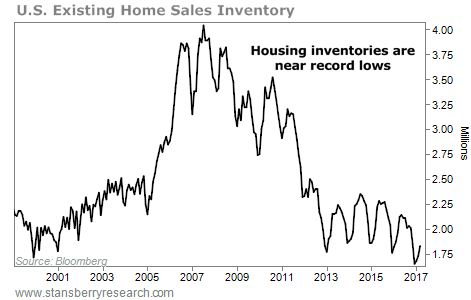
Notice that inventory peaked back in 2007... right as the housing market peaked. Inventory hasn't been this low since 2001 – a tailwind for home prices. More from Steve...
Now let's quickly look at another number: new homes being built...
You'd think homebuilders would be taking advantage of the lack of inventory. You'd think they'd be building a ton of homes. But that's not quite what's happening yet...
After the big housing bust, builders stopped building homes. It has been nearly a decade, and the rate of building is still "below trend." Take a look...
Housing starts have increased dramatically from the bottom... But they're still below average. Building hasn't caught up with demand yet. And that has kept supply low.
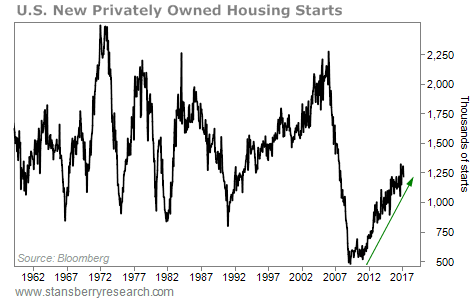
Between a dearth of new homes being built and a record-low inventory of existing homes for sale, Steve knew housing prices were set to rise. And new data confirm his thesis was spot-on...
Housing prices hit an all-time high...
New data on the housing market show that supply continues to tighten as housing prices are still on the rise.
The Case-Shiller Index – a measure of single-family homes across 20 of the country's largest cities – jumped 5.7% in June. Seattle, Portland, and Dallas reported increases of 13.4%, 8.2%, and 7.7%, respectively, for the 12 months ending in June. Nine of the index's 20 cities reported price increases from May to June.
And as David Blitzer, managing director and chairman at S&P Dow Jones Indices told housing news outlet HousingWire, rising home prices don't appear to be slowing anytime soon...
The trend of increasing home prices is continuing. Price increases are supported by a tight housing market.
Both the number of homes for sale and the number of days a house is on the market have declined for four to five years. Currently the months-supply of existing homes for sale is low, at 4.2 months. In addition, housing starts remain below their pre-financial crisis peak as new home sales have not recovered as fast as existing home sales.
Steve agrees. He believes rising home prices are just getting started.
Of course, as prices increase, homes become less affordable. But today's housing market is far healthier than during the previous bubble in 2006, which, as we know, was fueled by a glut of subprime lending.
Pending home sales fell 0.8% from June to July, according to data from the National Association of Realtors ("NAR"). But those declines weren't due to a lack of demand. As NAR Chief Economist Lawrence Yun explained in a statement (emphasis added)...
With the exception of a minimal gain in the West, pending sales were weaker in most areas in July as house hunters saw limited options for sale and highly competitive market conditions. The housing market remains stuck in a holding pattern with little signs of breaking through. The pace of new listings is not catching up with what's being sold at an astonishingly fast pace.
One big winner as this trend continues...
As home prices continue to rise and supply can't keep up with growing demand, publicly traded homebuilders are one of the biggest beneficiaries.
As you can see from the following chart, the nation's largest homebuilders – D.R. Horton (DHI), Lennar (LEN), PulteGroup (PHM), Toll Brothers (TOL), and Porter's favorite capital-efficient homebuilder, NVR (NVR) – are up big so far this year...

Steve's favorite way to play this uptrend is through the iShares U.S. Home Construction Fund (ITB), which counts those five homebuilders among its top holdings. His True Wealth Systems subscribers are up about 7% since his recommendation in May.
Elsewhere in the market, Steve's top investment idea is soaring...
Regular Digest readers know one of Steve's favorite investment ideas right now is Chinese stocks. In fact, almost a year ago to the day, we launched an entire advisory – True Wealth China Opportunities – dedicated specifically to the idea.
As we've discussed in previous Digests, Steve's early track record has been outstanding. All 22 positions in his model portfolio are in the positive, with average gains of 30%, including 19 double-digit winners.
But Tencent Holdings (TCEHY) is Steve's favorite Chinese stock. The tech giant owns the wildly popular WeChat app, whose mobile-payment platform has a dominant share of China's increasingly cashless society.
In the April issue of True Wealth, Steve explained why he believes Tencent will soon be the world's largest company, overtaking fellow tech giants Apple (AAPL) and Alphabet (GOOGL) along the way. As he wrote...
Tencent owns all the "eyeballs" in China. It owns your screen time.
For better or worse, your mobile phone is your main source of entertainment in China... This is where folks spend their time. Tencent dominates China's social networks. But its reach goes beyond that...
Tencent is also the world's leader in electronic gaming, based on sales. And gaming continues to be the company's largest growth engine.
I'm barely scratching the surface here on this exciting story.
Tencent just made a big splash...
Tencent made headlines this week as it announced it has landed exclusive mobile rights to digitally stream 100 National Football League (NFL) games this season. As the Wall Street Journal reported...
Several analysts and industry insiders are bullish on the NFL's prospects in China.
"The culture of the NFL, the fans, the tailgating and the drama that is delivered with the NFL is appealing," said Andrew Collins, chief executive of Mailman, a Shanghai-based sports- and digital-marketing agency. "It's not just sport, it's entertainment."
For Tencent, the deal is part of its overall strategy to keep its hundreds of millions of users engaged and available for advertisers. It also follows a template established in 2015, when Tencent paid at least $500 million to become the NBA's exclusive digital-streaming partner in China for five years.
Tencent plans to stream the games for free on its mobile platforms, including WeChat, which has nearly 1 billion monthly active users. Its shares are up roughly 70% this year. But Steve believes massive upside remains ahead.
How to buy Tencent at a big discount...
Folks who invest in Tencent shares today are likely to be sitting on big gains a year from now. But Steve has found an even better way to profit.
In short, it's a way to buy Tencent at a steep discount to regular shareholders. He says taking advantage of this investment "anomaly" could double your money – or more – over the next 12 months alone, and potentially make you hundreds of percent in the years to come.
But this anomaly won't last forever... It could be gone within the next few months, weeks, or even days. That's why Steve just released a brief video presentation where he discusses this rare opportunity in detail. Watch it here.
|
New 52-week highs (as of 9/7/17): AbbVie (ABBV), Baidu (BIDU), iShares MSCI BRIC Fund (BKF), Bristol-Myers Squibb (BMY), Morgan Stanley China A Share Fund (CAF), Celgene (CELG), WisdomTree Emerging Markets High Dividend Fund (DEM), Digital Realty Trust (DLR), PowerShares Chinese Yuan Dim Sum Bond Fund (DSUM), Emerging Markets Internet & Ecommerce Fund (EMQQ), iShares MSCI Italy Capped Fund (EWI), Facebook (FB), First Trust Emerging Markets Small Cap AlphaDEX Fund (FEMS), National Beverage (FIZZ), SPDR Gold Trust (GLD), KraneShares Bosera MSCI China A Fund (KBA), KraneShares E China Commercial Paper Fund (KCNY), Kinross Gold (KGC), Coca-Cola (KO), KraneShares CSI China Internet Fund (KWEB), Procter & Gamble (PG), Koninklijke Philips (PHG), iShares MSCI Global Metals & Mining Producers Fund (PICK), ProShares Ultra Health Care Fund (RXL), Shopify (SHOP), iShares MSCI India Small-Cap Fund (SMIN), Guggenheim China Real Estate Fund (TAO), and short position in Brinker International (EAT).
A light day in the mailbag. Our thoughts are with our readers who live in areas devastated by Hurricane Harvey and threatened by Irma. Let us know you're safe – and what you're seeing – at feedback@stansberryresearch.com.
Regards,
Justin Brill and Rebecca McClay
Baltimore, Maryland
September 8, 2017