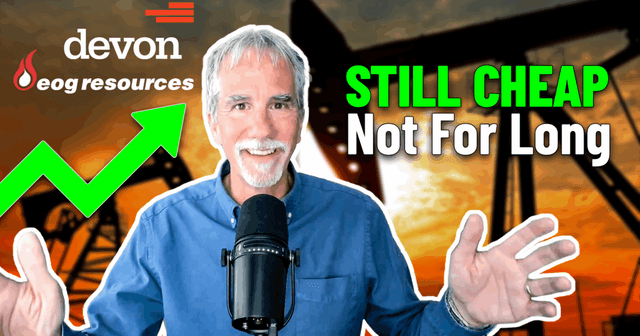

These Energy Stocks Are Still Cheap... Not for Long
In This Episode
In this week's Stansberry Investor Hour, Dan welcomes value investor Tobias Carlisle back to the show. Tobias is the founder and portfolio manager of Acquirers Funds, a deep-value investment firm. He's also the host of a podcast and the author of numerous books, including The Acquirer's Multiple.
Tobias kicks things off by discussing the performance of his energy fund and the energy sector. He likes to compare gold with oil to see how their pricing has moved in relation to each other over the past year. He thinks oil companies are still cheap and believes that we haven't seen "peak oil" prices yet. He also gives the tickers of two energy companies that he's confident are good places to put your money to take advantage of the energy crisis...
They're best-in-class shale [companies]. I think that they're a good pair together. I love the fact that [the first company] has been very careful with capital allocation... [It has] pretty good free-cash-flow generation, pretty good returning that to shareholders [via] buybacks... They're going to go from a $30 billion market cap to $58 billion together. And they're going to make out real well with $80 oil and above.
Next, Tobias shares two other energy stocks that he's fond of. While these companies aren't as stable as the previous two due to their locations, they possess quality shale sites that make them compelling considerations. Tobias then shifts his attention to two other companies focused on the fertilizer and copper industries. With the first company, he emphasizes that folks need to eat and that the company will aid in food production and remain strong, especially since "nitrogen-based fertilizer feeds half the world." And with the second company, he believes that we're currently in the middle of a cycle for copper demand...
They call [the metal] "Dr. Copper" because when copper gets "sick," the rest of the economy is going to follow suit. And when copper gets better, the economy's going to look good, too. I think [this company] has a bet on real infrastructure [spending]. So if we're going to build a whole lot of data centers, we're going to need a whole lot of copper to do that. So [the company has] done really well, but I still think we're mid-cycle here.
Finally, Tobias gives his thoughts on the housing sector. While many investors might avoid it because housing sales are lower than they were at the bottom of the great financial crisis (due to high home prices), he believes that buying now and holding on will pay off when it springs back to life. He also makes the case that in most markets you want to be a contrarian because you can buy good companies at low price-to-earnings multiples. And he cautions investors not to think about companies as blank tickers but as functioning, moving entities that have work put into them that can break them out of stagnancy...
To people who are in the stock market all the time, it's a little bit like driving and only looking through the front window, forgetting that there's a rear-vision mirror and there are side windows that you can look out of. And [they're] too much like a stock market operator, forgetting that underlying these things are real businesses. And there's some price at which these things buy themselves.
Click on the image below to watch the video interview with Tobias right now. For the audio version, click "Listen" above.

(Additional past episodes are located here.)
This Week's Guest
Tobias Carlisle is the founder of the Acquirer's Multiple and Acquirers Funds. He's also the author of several books, including The Acquirer's Multiple: How the Billionaire Contrarians of Deep Value Beat the Market.
Tobias' experience includes working as an analyst at an activist hedge fund, acting as general counsel of a company listed on the Australian Stock Exchange, and serving as a corporate advisory lawyer across various industries in multiple countries. He is a graduate of the University of Queensland in Australia with degrees in law and business (management).
Dan Ferris: If the Iran war has you thinking about energy stocks, you're on the right track, but you need to know what we're going to talk about today that nobody is telling you. We're going to talk about companies like Devon Energy – DVN is the ticker. EOG Resources – EOG is the ticker on that one. I love them both and so does our guest. We're going to talk about what they're really worth and why you should really buy them that nobody is telling you. And the one guy to make this argument is on our show today. His name is Tobias Carlisle. Let's do it. Let's talk with Tobias Carlisle right now.
Dan Ferris: Mr. Tobias Carlisle. It's good to see you again, buddy.
Tobias Carlisle: Hey, Dan. Good to see you again, too. How are you?
Dan Ferris: Good. Good. We've got to talk energy partly because, hallelujah, us sort of value guys have bought some energy, and it's treating us like we're human beings again. The topic of energy scarcity is on your mind these days, I understand.
Tobias Carlisle: I have a fund that has been up to its risk limits in energy since about this time last year because energy – [West Texas Intermediate], oil, sub-$60, was supply destruction, which means that there's no new wells being drilled. There's no investment. And oil equities followed suit. They haven't been making any money at that level. The multiples are all crushed. You can see the proportion of oil equities in the indexes is as low as it's been [since] maybe 2020 at the bottom.
I also like to look at oil versus gold because then that takes the money-printing out of the equation. I get that there's a little bit of speculation in gold last year. Gold had a pretty good run-up. But I still think that you can look at those two, you can look at, well, an ounce of gold is buying a hundred barrels of oil, which is unusual. And I was saying that last year. So, the thesis was just that low oil prices tend to be the cure for a low oil prices, and eventually you get some sort of geopolitical event, which is what I thought might happen.
So, I had – the portfolio tends to be equal weight to an individual name. We have about 30 names. Risk limit is 20%, so we had six or seven names most of last year, which was pretty unpleasant for the most part. But oil bottomed in the fourth quarter, maybe October or November last year, and started moving up pretty consistently. And the oil equities followed suit and they've continued that this year. And of course, now we've got the Iran attacks going on. There's an enormous amount of infrastructure that's been blown up. We can't get oil through the Strait of Hormuz – I don't know how you say it. How am I saying it?
Dan Ferris: Yeah. Hormuz.
Tobias Carlisle: And – Hormuz. And the oil equities have all taken off. And the thesis was never that something like that was going to happen, but –
Dan Ferris: No, not at all.
Tobias Carlisle: But just that something could happen. And here we are, something has happened. And I think that that's probably structurally impacted oil for a long period of time now. So, we'll probably see prices that are more like a floor is like $70 to $80. We're currently –
Dan Ferris: Well, that demand destruction is working.
Tobias Carlisle: Right. Supply destruction.
Dan Ferris: I mean, Harold Hamm left the fricking Bakken shale, which he discovered, for the first time in 33 years or sometime or another. He's been in the Bakken for 33 years. He is the Bakken. And he – when he met with Trump at the White House in January, a week later, he said, "Oh, by the way, I'm out of the Bakken shale."
Tobias Carlisle: That's unfortunate timing.
Dan Ferris: They're talking about drilling in Argentina and all this – oil that you need, $90 oil to make it work because it's in such horrible, horrible shape, in addition to being heavy sour. And then, he's like, "Oh, by the way, I can't make money at 58 bucks, so I'm shutting down the Bakken for the first time in 33 years." And all the independents need what? They need $70. They wake up every day saying, "Please, God, $70. High $60s, at least." Least.
Tobias Carlisle: Well, in my – when I when I was penciling it out, I thought if we could get to $80, that would just be – we'd be making out like bandits at $80.
Dan Ferris: We'd be making out like bandits, but there's a there's a nice equilibrium in there in the $70s, I think. But $70 to $80, I can easily call it that. We're not hurting too bad at the pump and yet we're making money in Bakken and printing it into Permian, etc., etc. So, yeah, I loved oil for that reason. I actually got onto the refiners in December, and then I added the producers, independent producers in January, February – early February. I forget exactly which month I did that, but –
Tobias Carlisle: It's good timing.
Dan Ferris: Yeah. Yeah, it's been a good trade. I get – what was it – the guys at SentimenTrader sending me some stuff. But it's all momentum-oriented, and market history is really what I rely on them for. And they were like, "Every component of XLE, ETF, and the XOP is over some moving average or other." It's all taken off.
Tobias Carlisle: The question, I guess, is where does it go from here? And nobody really knows, but I still think that – I still think these companies are reasonably cheap at this level. And we haven't yet seen the impact of higher oil prices because we haven't seen any earnings out of any of these guys yet, and that'll be coming in the next month or so. And then it's all going to roll on. So, I think it takes a little while.
Plus, I also think there's some supply destruct. There's a lot of infrastructure that's been destroyed. There's a lot of shipping that's having difficulty getting through there. So, I think that the U.S. is fortunately in a pretty good position because of all the shale and – so, the U.S. doesn't hurt too badly from that side but is a beneficiary on the supply side. So, I think it's –
Dan Ferris: Right. It's an interesting dynamic, though, isn't it, the way we're set up to refine a fair amount of heavy oil, which we've gotten traditionally from Venezuela, Mexico, Canada, and we crank out all this light sweet from shale, which is what we can export, I guess, but – which is great. It's an interesting situation. It really is when you put the refining piece in there, and you look at what is going on in Venezuela, which was insane to me – anybody talking about – anybody spending a lot of money there – did you watch that meeting in January with Trump in the oil executives?
Tobias Carlisle: No.
Dan Ferris: Oh, my God. Darren Woods, CEO of ExxonMobil, he just sat there and said, "Blah, blah, blah, Venezuela is uninvestable." And it's in shambles and it's heavy sour crude. It's like refrigerated peanut butter. People don't realize it's a completely different – it is. It comes out of the ground like peanut butter. It's a completely different process. Super expensive. Their infrastructure is in crap condition. All the great people they had have left the country. It's a disaster. It takes tens of billions to move the needle on that and –
Tobias Carlisle: The only processing capacity in the world is in the southern states of the U.S. So, it's all going to go through there, which would be great for the States.
Dan Ferris: Yeah. Yep. I think – the United States is in a great position. We do need to spend more on – the capital needs to flow into the oil patch for sure. But hey, if we stay in the $90 to $100 range, guess what's going to happen? They'll probably fight about it, so it'll take time. But yeah.
Tobias Carlisle: I agree 100%. And that was the point that I was just about to make. You can see today, there was that announcement yesterday that Iran said that they're prepared to accept the same terms that they were prepared to accept a month ago, which is like there's basically no news. But on the last day of the month markets are a little bit oversold, everybody's ready for a huge bounce, so everything sort of – all the equities exploited up yesterday and oil got –
Dan Ferris: Interesting day.
Tobias Carlisle: – knocked down. Yeah. And the oil equities have followed suit a little bit today, but I think that that is a – that's a very, very short-term phenomenon. That's a day phenomenon. I think as this goes on a little bit –
Dan Ferris: It's a classic reaction, isn't it?
Tobias Carlisle: Yeah.
Dan Ferris: Yeah.
Tobias Carlisle: One hundred percent.
Dan Ferris: We're not momentum guys, but come on. The market's up 3% practically in one day.
Tobias Carlisle: Yeah, it levitated yesterday. Yeah. All of the Mag Seven had something like a 5% day yesterday, something like that. That's a big move up.
Dan Ferris: Yeah. And that Mag Seven thing, too, is – I think we may have addressed that at one point, you and I, just the capex story with them just basically spending money they're never going to get a return on. And the whole world knows it now. And they turned – they've become – as a group, the top four hyperscalers have become net debtors thanks to Meta. So, yeah.
Tobias Carlisle: Crazy run. It's going to be interesting to see. I think that that – I've been an advocate of this. There's been a very long cycle towards that large growth part of the market and it's left the small value, which is my area, well and truly behind. We've seen these cycles before. The late 1990s was large growth. We remember it now as being a dot-com boom, but the names that ran were just big names like Walmart, which not a tech company, GE, not a tech company. It sort of ran along – and this is in the early – in the 1990s.
And then the 2000s was that big mean reversion where value worked really well. And then mid-2015, we sort of went into this new growth regime, which was meme stocks – it was FAANG and meme stocks. And then it was the AI trade from, like, 2023. And that all seems to have – maybe that's come to an end as of November last year. And it looks to me like – either because they're going to spend a whole lot of money building all of these data centers, and to do that you need real-world infrastructure and that – a lot of that stuff is small. They're all found in the small-value world. They're the people who are actually going to build that, so they're going to make money.
Dan Ferris: I'm glad you mentioned small. I thought of you yesterday. I was working on the latest issue of Extreme Value, which I think will be out by the time we post this video. And I was reminded of you because I came upon the story by Richard Russell of the perfect business, and it was a small business that produced some chemical for the rubber-making industry. And it was a small part of their expenses, but it had a huge advantage because I think it was the only producer of the chemical. So, the companies didn't care what they paid for it – they just had to have that reliable supply. And you find that stuff down there. Don't you? There's not just one of those. There's different ones – we found one actually in Extreme Value this month. I can't share it yet because it's fresh for subscribers, but they're out there and they're down in those small-cap stocks. This thing is like a $1 billion market cap that I'm talking about.
Tobias Carlisle: Yeah, that's a small cap these days. That's funny, isn't it?
Dan Ferris: It is.
Tobias Carlisle: That's tiny.
Dan Ferris: Yeah. I think it's $1.5 billion actually.
Tobias Carlisle: I'm sometimes shocked at how small some of the companies are when I look at them and I – they're companies that you've never heard of that are $1 billion, $2 billion, $5 billion. That used to be quite a reasonable-sized business.
Dan Ferris: Yeah, like – yeah, that used to be at least a midcap. It's crazy. And now we have trillion-dollar companies.
Tobias Carlisle: Multi-trillion. It's crazy.
Dan Ferris: Multi-trillion-dollar companies. It's like, whoa, what happened?
Tobias Carlisle: If you print enough money –
Dan Ferris: Right. You print out money and it goes into those things, doesn't it? All right. You like – in energy, I see – you and I have a couple names in common: Devon and EOG. Love both of those.
Tobias Carlisle: Yeah, they're sort of best-in-class shale. I think that they're kind of – they're a good pair together. I love the fact that Devon's been such a careful – been so good with their capital allocation. They've been great at repurchasing stock. So, while the market's been beaten up and the multiples have all been really low, they've bought back a ton of stock. Pretty good free-cash-flow generation, pretty good at returning that to shareholders either through buybacks or otherwise.
They've got that – they're tying up with Coterra in a merger of equals, so they're going to go from $30 billion market capital to $58 billion together. And they're going to make out really – they're going to do very well with $80 oil and above. That was – in my fantasy scenario, in my bull-case scenario, Dan, I was penciling in $80, so north of $80 is doing a good job. EOG –
Dan Ferris: You thought you were being optimistic. That's the pessimistic case.
Tobias Carlisle: But having said that, who knows where this will all ultimately settle. I still think that $80 is probably – that's a little bit south of where we are – last time I looked was yesterday and the oil prices were moving around a fair bit so I don't know if that's exactly right, but it was a little bit north of $100 yesterday. I don't know where – WTR was $100 yesterday. And they can print at that level and they're going to have a good – the next earnings is going to be amazing.
Dan Ferris: I like EOG in that respect too because they model – they're modeling $50 – $45 and $50 and stuff, and that's where they get – they get a 30% return down there. That's what they model.
Tobias Carlisle: I love that idea that they don't do anything that doesn't have a 30%, even assuming $40 or $50 oil. So, they're very careful.
Dan Ferris: Yep. Disciplined, man.
Tobias Carlisle: And they've similarly been good – yeah. Great. Great. I couldn't agree more. So, I think those two together – EOG is a little bit bigger, it's like a $75 billion market cap, but they're still pretty modest companies at that size.
Dan Ferris: And you like APA and CRC, too. Apache.
Tobias Carlisle: Yeah, APA has a little bit of shale but you've got some – they've got some longer-lived wells in Egypt. And I think they've got this exploration in Surinam, which who really knows how safe those regions are. I call that sort of optionality. There's – I think it's good that we started with Devon and EOG, because I think they're a little bit more certain and the returns there are pretty good. You get a little –
Dan Ferris: They're stalwarts, man. They're stalwarts, blue chips, whatever you want to call them. They're great for independents. Right?
Tobias Carlisle: A little bit racier with APA. And then, I've also got CRC, which is California – they sell into California. In California you've got to have a big carbon credit. They need higher oil prices to make money, but we've got it now, so they're likely – I think they're going to do fairly well in this environment. They've got longer-lived wells. They're not like the shale guys where they've got to keep on reinvesting. They've got their wells and they're going to keep on pumping for a long time. So, a lot of it is just pure margin –
Dan Ferris: You're a California denizen yourself, are you not?
Tobias Carlisle: Yeah. If you can make it here, you can make it anywhere. Tough on the business front.
Dan Ferris: Let's talk about infrastructure. You and I both like coppers and various chemicals, and we have another couple of names in common: CF Industries and Southern Copper. Great companies. I love Southern Copper, but tell me why you like CF and Southern.
Tobias Carlisle: Yeah. CF is a fertilizer, highly – a fertilizer maker takes cheap American gas and turns into fertilizer. As they say, the fertilizer side is demand-inelastic. You're always going to need fertilizer and more of it to feed more people. The gas side is a little bit more – gas moves around a lot. Everybody knows that gas is like the widow maker trade: If you try to trade that one way or the other, you're facing [inaudible]. You get carried out feet first. So, tough with that as an input.
The big advantage is that the U.S. is the Saudi Arabia of gas. Gas is super cheap here. It's currently $3.75 or something like that, which is about the midpoint for gas. So, CF does really well. Midpoint gas, CF will do pretty well here. If gas goes to $2, which who knows, that could easily happen, it'll do even better. I think it'll do well at $5 of $6 as well. So, I'm not too worried about CF's margins but you've got a point that it is cyclical from that perspective.
And I think that it's protected from the problems that Europe and Asia have with getting gas and processing that gas and turning it into fertilizer. Those problems don't exist for CF. So, I'm – I like CF. I think they've been quite disciplined. They're good at returning capital. They've bought back shares. They do all the sort of things that good business managers should do. So, I think CF is reasonably safe and a pretty good position here.
Dan Ferris: Yep.
Tobias Carlisle: What do you think? How do you see CF? What am I not saying on CF?
Dan Ferris: No, you got it. It's cheap gas to fertilizer. And the local supply – this is the great thing about shale. The shale story is oil, great, but the abundance of natural gas, domestic supply of natural gas, that is the story. And I totally agree. I like EQT, the gas – big gas producer. They've done really well actually. The stock has done well. too. But overall, you're right. Natural gas is – it's a bit tough. You certainly – I can't imagine trading the futures of natural gas. It's just insane.
Tobias Carlisle: It's made fortunes and the same people have lost them and given them back to –
Dan Ferris: Yeah, made and lost them in five minutes. It's just –
Tobias Carlisle: If you make it, you've got to get out. It's like having a big win in the casino. Go home.
Dan Ferris: Yeah, it is. That's exactly what it is. But yeah, the insight there, I think, is perfect. And it's perfect for this moment, too. The cheap gas to fertilizer trade, nitrogen-based fertilizer is the most incredible stuff. Vaclav Smil has a great thing, bit – the four ingredients of modern civilization – and one of them is ammonia because nitrogen-based fertilizer feeds half the world. Half the world wouldn't exist without this product. So, it's pretty cool.
Tobias Carlisle: That's a great book.
Dan Ferris: And Southern Copper? Man, I love them. I learned a big lesson about them. Why do you like it?
Tobias Carlisle: Well, pure-play copper. Mexico and Peru. Basically, market cap is $145 billion, $150 billion, so it's big. Copper is typically pretty cyclical. They call it "Dr. Copper" because when copper gets sick, the rest of the economy is going to follow suit, and when copper gets better, then the economy is going to look good, too. I think that they – it's really a little bit of a bet on some real infrastructure spend. So, if we're going to build a whole lot of data centers, we're going to need a whole lot of copper to do that. And Southern Copper Company, I think they've done pretty well, but I still think we're mid-cycle here and I think we've got a lot of room to grow.
Dan Ferris: Couldn't agree more. Couldn't agree more. And as I've emphasized on this podcast and my newsletters, commodity investing is a supply-focused thing, and then you get the little – the bump in demand that helps the stock price. But it's supply-based. And Robert Friedland says we need eight Escondido mines – the largest copper mine in the world – and we don't have eight of them. We need eight of them in the next eight years, I think he said, something like that. And we don't have them. He has one of them. We need seven more.
So, the long-term supply has – the investment has just not been there. And the guys at Altius Minerals, a little company in Newfoundland that I've covered for years since 2006 – or since 2007, actually, maybe – no, 2009, April 2009, when they were $6 and now it's $46. And they had some work where they said – at the time – it was a couple of years ago, they said, "Well, the incentivization price, technically speaking, is $5 a pound at this moment." It's probably $6, $6.50 right now.
Tobias Carlisle: It was $5.75, I think, last time I checked.
Dan Ferris: Yeah. Yeah. Yeah. So, call it $6 even. And I think I had midpointed $6, between $5.50 and $6.50. Whatever it is. They said, "But remember, historically speaking, you need double that to really get the capital to move to make a meaningful supply impact." So if you started out at $5, you're waiting for $10. And by the time we get to $10, you and I are going to be sitting on a triple with this massive big-cap stock and 10X on the smaller-cap stuff. And then the world's going to go "Oh, now we all want copper." And you and I are going to be selling to them.
Tobias Carlisle: That's it. That's the plan.
Dan Ferris: Yeah. And Southern Copper, biggest copper reserves of any company in the world, which I love. Copper in the ground. That's P+P: proven and probable. That leverage there is awesome because to get – for the for the shareholder to benefit, not one drill needs to turn. There's no – the reserves are there and we know it. It's beautiful, man. I love it. I love Southern Copper for that reason. Rick Rule taught me that.
Tobias Carlisle: I think we've had – I was around in the commodity supercycle in the early 2000s where China was the buyer of all of those things. And so, I saw all of that cycle – the start of that cycle and the end of that cycle. And the end of the cycle is pretty rough, too. So it's – this is deep-value investing. This is cyclical-resource investing. You buy and sell to do that. But we're clearly more in a buyer – it's a buyer's environment right now across probably most commodities, I think.
So, and I don't know that there's a lot of – I think the investing world has been a tech world for 10-plus years now. So, a lot of that – and a lot of the guys who are more cyclical have kind of left this business because it's been tough to survive. But I'm very optimistic. And I think that we – you can look at the consumer and – because I look at a lot of small and micro businesses. I think that we've been in an earnings recession, particularly in small and micro world, since 2022, which is a long haul, three or four years of –
Dan Ferris: Right. The interest-rate spike. Yeah.
Tobias Carlisle: I think it's interest rates. I think it was – partly, it was that COVID pandemic response and all the stimulus that came out of that pulled a whole lot of demand for, and that all went through those companies, like the pig in the python, and they all were profitable and great. Multiples shot up late 2020, early 2021. And they've come back to earth since then and they probably got back to fair value mid-2024, late 2024, early 2025, something like that. And so, we've been now trending below what I think is – and now we're at a big discount to fair value across small and micro. I think we started to see some movement last year, late last year. So, my smallest fund, DEEP, has done pretty well over the last 12 months, beaten the SPY, and particularly out of that tariff bottom. I think that ZIG, which is my mid and large cap one, that's really bottomed in November and it's been positive. It's up 6 or 7% year to date –
Dan Ferris: Let's talk about those a little. So, you mentioned DEEP – D-E-E-P is the ticker.
Tobias Carlisle: Right.
Dan Ferris: And that's small-, mid-value.
Tobias Carlisle: That's small and micro. So, that's really mostly the small – if you have a look on the Morningstar Style Box, it falls off the bottom lefthand corner of the Style Box. It doesn't fit into small value at all. It really is small and micro.
Dan Ferris: That's funny.
Tobias Carlisle: But it's funny that there's some good, quality names there that have come into that basket, just because they've all been so beaten up for so long. And then –
Dan Ferris: What's the structure? How many names you got in there? Is it equal weight?
Tobias Carlisle: It is equal weight. I hold a hundred names. And the reason that I do that is they just tend to be – they're smaller businesses. Management's not as professional and so on. You can't have too much exposure to any one of those names. But I think I like it because it gives me pretty good exposure across pretty good diversification to stuff that's cheap. I'm looking for stuff that's financially cheap. That's the idea of the funds.
And then, ZIG is mid and large. That's what its universe is at the moment. It looks more like the S&P 600, which is the small cap. There's the 500 large cap, 400 mid cap, and then 600 sits below that. So, it's maybe comparable to the biggest of the Russell 2000, but nowhere near – so, nowhere near as junky as the Russell 2000.
Dan Ferris: Oh, my God. Comparing Russell with S&P 600? It's –
Tobias Carlisle: It's funny. Yeah. But Russell 2000 has outperformed 600 over the last few years and that's just because we've been in this little junk stock rally. And you have a look at the Russell 2000, it's this – and they're villains. All of those – the top names are all –
Dan Ferris: Have you heard Jeremy Grantham talk about Russell 2000?
Tobias Carlisle: I haven't, no. What's he said?
Dan Ferris: They're like – he said, "We're basically structurally short Russell 2000 all the time." He said the earnings of the entire index frequently go negative.
Tobias Carlisle: Right. But then, S&P 600 does a pretty good job because they get the – they have a profitability filter. But because it's still market capitalization-weighted, they put all of their – the biggest names and they're trading at 40 times earnings. So, I think you really have to get outside of the indexes to start finding value. And that's sort of what I try to do with ZIG. So, ZIG looks like an S&P 600 universe. It's 30 names. It's a little bit more concentrated but it gives me the latitude to go more heavily into energy when I think energy gets very cheap. We've been – we hold lots of basic materials, which has been a tough place to be, but we're at the beginning of maybe a longer cycle here. So, I'm very hopeful for small value cyclicals. I really think the time has come and they've started outperforming since late last year.
Dan Ferris: All right. Let's hope you're right, because I might be there personally a bit myself. All right. ZIG, Z-I-G, and DEEP, D-E-E-P. I mean, is there anything you want to tell us about either one of those? Did we cover them good enough? Because I want to give you a chance to just –
Tobias Carlisle: That's it. I think that they're – I think if you've got a big exposure to Mag Seven, if you've got lots of large-cap stocks, these are a good counterweight because they do tend to trade very differently. You can have a look at what they did last year on the downside. They traded – they didn't trade as well as Mag Seven, but then when they turned around they've done quite well. And so, that's the idea of diversification across styles.
Dan Ferris: All right. So, one place where we don't overlap is housing and rebuilding, lumber and materials. And you've got LPX and MLI. Actually, we do have MLI in one of my newsletters. So, we actually do – I didn't realize we overlapped there. But yeah, what do you see here? I haven't thought about this this sector for a while.
Tobias Carlisle: I think there's been a little bit of a beat-up. Well, housing, here's the – the problem with housing is that we're basically selling fewer houses now than we were in the great financial crisis at the very bottom. And people are speculating about the causes of that one is that interest rates are too high. Interest rates are just below long run averages, but interest rates are higher than they were. So, that's one argument. The other argument is that during the pandemic there were very low mortgages, so there's lots of people with 3% mortgage, that you don't want to give up your 3% mortgage. I think that the real problem is that, yeah, housing prices –
Dan Ferris: Sub-three here.
Tobias Carlisle: Housing prices are very expensive relative to median incomes. Median house prices relative to median incomes are about as stretched as they have ever been. And probably, we need some mean reversion in house prices to unfreeze that market. So, that market's been frozen, and when that market freezes up anything that sells into that market like William Sonoma, LPX, MLI, any of those kind of businesses are going to look a little bit sick. And so, in the same way that I was trying to buy oil and gas when the oil price was low and the multiples were low, trying to buy these things while they're beaten up, because the equities tend to move a little bit ahead of the reported earnings or the uptick in their business, because most investors are smart, they get in front of these things before they start moving. And so, that's – the thesis is basically that you can buy these things at trough earnings, trough multiples. You need some patience. It might be a three-to-five-year hold to really see the benefit of it. But that's the thesis essentially on the sort of housing-related stocks.
Dan Ferris: I'm all – it sounds good to me, man. Sign me up for that. Sign me up for it. For all of our guests – I'm talking to our listeners – for all of our guests' contrarian instincts, just sign me up for all of it. Especially – and also, I want everybody to notice we're talking about all these commodities and it's no coincidence that Tobias has wound up here because you must be a contrarian to make money with these. You don't buy this stuff based on momentum or anything. You must be a contrarian. You must buy it when it's cheap and out of favor or else you're going to be –
Tobias Carlisle: I think most of the time in most markets, it's better to be a contrarian. You want to be buying out of favor, getting lower multiples. I think that what happened over the last decade is a little bit ahistoric where you get a high multiple and it continues higher on improving earnings all the time. That's sort a rare phenomenon in the market. Those cycles do happen. Probably the late 1990s was a cycle like that. Probably before then, the '60s, that electronic boom in the '60s. But it's happened before. It's not without precedent. It's just that when it does happen I think that folks forget that it's like a – it's a second order – investing is second-order thinking. It's not "what has won will continue to win." It's mean reversion and looking under the hood at the fundamentals and trying to buy cheaply thinking that there'll be a turn down the road.
Dan Ferris: I'm sorry. I started chuckling when you mentioned the '60s because there was a company called Powertron Ultrasonics and it just makes me laugh every time I say it.
Tobias Carlisle: Great name.
Dan Ferris: I think it's in John Brooks' book about that era, The Go-Go Years, which is – John Brooks –
Tobias Carlisle: That's a great book. I've got that book.
Dan Ferris: Yeah. Great stuff.
Tobias Carlisle: That was like adding the "dot-com" to your name, was adding the "-tronics." You had to have "-tronics."
Dan Ferris: Yeah, and that – yeah, that's right. Just add "-tronics" or "-sonics" or whatever it was.
Tobias Carlisle: "Dynamics."
Dan Ferris: Yep. "-onics." And your stock price took off. Crazy. Absolutely crazy. It was just like, what was it, Long Island Blockchain. Long Island Iced tea became Long Island Blockchain.
Tobias Carlisle: Oh my God.
Dan Ferris: It's incredible that people get away with that kind of stuff, isn't it? And I remember – I've heard stories as far back as the '70s gold boom where brokers would know nothing themselves about the stock that they were buying for clients but the ticker symbol and the name, and the name had gold in it, and that was it. That's not investing, by the way.
Tobias Carlisle: You don't need to do much research in a bull market. That's the – you just don't want to miss out on the bull market.
Dan Ferris: Yeah. So, how long does this go on, man? How long do we – you've probably heard of Mike Green. He does all this work on the –
Tobias Carlisle: Sure. Sure.
Dan Ferris: – passive investing phenomenon and his deep concerns about it.
Tobias Carlisle: Sure.
Dan Ferris: And the latest thing – have you seen the latest thing from them, is he and another – he was on this show and a fellow named Hari Krishnan was also on this show, and he and Hari and another fellow did some work showing that the high likelihood that the market goes to zero –
Tobias Carlisle: I’m going to be a buyer north of zero.
Dan Ferris: Yeah, at zero I'm in, man.
Tobias Carlisle: I don't think it's going to zero. Yeah, I saw that. I would have thought that when you got that outcome, you probably want to have another look at your model. The model's probably not right at that level.
Dan Ferris: Right. It's extreme. But you know something? The thing is, agreed, it sounds crazy, but what if they're 50% right? You know what I'm saying?
Tobias Carlisle: I think that the market – to people who are in the stock market all the time, it's a little bit like driving and only looking through the front window, forgetting that there's a rear-vision mirror and there are side mirrors, side windows that you can look out of. It's like – it's too much of a stock market operator forgetting that underlying these things are real businesses and there's some price at which these things can just buy themselves. You can do a leveraged buyout of these. To me, the minimum price for a business is the price that you can take it out of its leverage buyout value. Or, if you wind it up, you take it out for its liquidation value.
So, that's what I always think. What's the liquidation value? What's the leverage buyout value? And then what's this thing worth if everything goes right and it grows? And that's the least certain of the valuations. I like to live in that leverage buyout value world. And that's how I value most of the stocks are going to the businesses that I own through ZIG and DEEP, because to me that's where the smart financial buyers are going to come in. They're not going to come in at zero. They're going to come in well north of zero at the leverage buyout value, which is just – that's a reasonable value. I think that the stock's going to –
Dan Ferris: Hey, I'm sorry to interrupt. I've got to ask you while you're on this topic, do you still use that Acquirer's Multiple as your screening?
Tobias Carlisle: Yeah, for sure. Yeah, that's how I –
Dan Ferris: That's how you screen? What is that multiple, for our listeners' sake?
Tobias Carlisle: Well, if you're a financial buyer, you take on the market capitalization, but you're also taking on any liabilities that the company has. So, you take on debt, you take on minority holdings, you take on any preference shares. So, that's the true price that you pay. And that's important when you look at something like GM. When it went through all the trouble in 2008, if you would have looked at it, it might have looked like a microcap based on its market capitalization, forgetting that it had enormous amounts of debt and unfunded pensions and all that other stuff out there, which would have probably rightsized it in your mind as being still a very big company, a very expensive company, and ultimately unable to pay those liabilities.
And then you compare that to the operating income, which is something like the – cash flow is a – the cash flow statement is a reconstruction from the income statement. I just look at operating income as a proxy for cash flow. It's what's coming in unadulterated by the capital structure or taxes or interest or other things like that. And you can compare other companies – you can compare businesses on a like-for-like basis. And so, that tells you the price that you're paying. It's a little bit like a P/E multiple. The acquirer's multiple, it's what an acquirer of the business pays.
But then you also want to know what's this business worth, which is a return on assets, return on investment, return on capital kind of measure. And so, I just try to buy these things at subnormal earnings, below their sort of long-run average earnings, where they're still capable of generating pretty good returns on capital, north of what you can get sticking at the ten-year, and then try and buy at a multiple that gives you a big discount to that.
Dan Ferris: It's beautifully simple, man. I love it.
Tobias Carlisle: That's all that it is. Yeah, that's it.
Dan Ferris: It really is. Simple, but effective. And by the way, everybody, The Acquirer's Multiple is a book, The Acquirer's Multiple by our guest Tobias Carlisle that I highly recommend. And it's very short and to the point. You didn't crank out 300 pages.
Tobias Carlisle: Yeah, you can read it in two hours. It's written to a fifth-grade reading level and you can read it in two hours.
Dan Ferris: There you go. And it's worth reading. I love stuff like that. There's another book I have about – gosh, I forget the title. I must have three or four copies of it because I kept buying it and forgot that I owned it.
Tobias Carlisle: Oh, I've done it.
Dan Ferris: And it's the same thing. It reduces the whole thing to just like, in that case, 40 pages and simple equations and simple explanations of what businesses are worth because that's what real people who actually buy businesses actually pay for them. I just think this is foundational knowledge. When I run into people – look, I run into a lot of great people who know a lot of great stuff. I'm not saying people are stupid if they don't – but when I run into people who operate in the market and they're analysts and they're managing money and they don't know this, I'm just a little bit blown away by it.
Tobias Carlisle: Well, it's been a very narrative-driven market. It's really you needed to know the story. And I'm not – I'm an anti-narrative guy. I don't care about the stories. I'm interested in what – the story in the financial statements. I read financial statements for the story and kind of ignore what management says because management –
Dan Ferris: Agnostic to the narrative.
Tobias Carlisle: Yeah, agnostic. There you go. Like they say about gold mines, it's a hole in the ground with a liar on top. Well, that's a lot of businesses.
Dan Ferris: Yeah, it's not just gold mines, by the way. That's right. Very good point. We're getting to the point where we can ask our final question. You've done this before.
Tobias Carlisle: Hit me. Oh, yeah, yeah.
Dan Ferris: So, just for our listeners' – yeah, just for our listeners' sake, I'll explain again. The final question is the same for every guest, no matter what the topic. Even if it's a nonfinancial topic, which happens every so often, it's the identical question. And it's just – if you've already said the answer, by the way, you can just repeat it for our listeners. It's very simply: For our listeners' benefit, if you could just give them one takeaway, one thought today, what would you like to leave them with?
Tobias Carlisle: Last time I said you need to be optimistic because it's a force multiplier. That was Colin Powell. I think that this time I would say mean reversion is an incredibly powerful force in the markets. And mean reversion is just this idea that things do tend to go back to normal, they go back to where they were. And you can see that in business results particularly. Companies overearn and everybody thinks something's changed and they've become a much better business, and often, most of the time they haven't. They're the same old business – they're just having a good time.
And it happens on the other side, too. When they underearn, people price these things like they're going to the woodshed, when in reality they do tend to have a better day. And that's the time to buy them because you get very reduced multiples on trough earnings, and then you tend to be the beneficiary of better news as they come along. And I think the oil – well, the experience in oil equities over the last 12 months is a very good example of the way that that works. I didn't have any sort of view about where oil could get to or why it might get there. But I thought that the catalyst was probably going to come along. And I think that that's true for most commodity-type businesses and many other businesses that cycle a little bit small. And micro businesses cycle, so you've got to be prepared to buy them when they look sick and sell them when they look good.
Dan Ferris: And that really – that's not just with oil. That's with your style of investing, isn't it? The cheap price is the catalyst.
Tobias Carlisle: That's the whole thing. That's it. That's it.
Dan Ferris: Yeah. Wow. OK. That's a great insight to leave folks with. Thanks a lot, man. I'm – I love talking with you and we will always be having you on the program on a regular basis, once or twice a year, however often we can get around to you.
Tobias Carlisle: Awesome.
Dan Ferris: And I really enjoyed it. Thanks so much.
Tobias Carlisle: Yeah, I appreciate you having me on so much. Thanks, Dan. It's always a pleasure. Love chatting to you.
Dan Ferris: Most Americans have never heard his name, but today at 10:00 a.m. Eastern time, you have the chance to hear a former hedge-fund insider who turned down opportunities with both George Soros and Steve Cohen. He built a shadow trading strategy that flagged 442 winning trades since 2017. According to back tests, it could have turned $10,000 into an incredible $617,808. And now he says it could double your money or more within 90 trading days using just regular stocks. It's a way for you to profit from today's volatile market and tech disruption revealed to the public for the first time ever. He'll even give you his first trade free just for showing up. Click the link below to reserve your seat.
It's always good to check in with our friend and fellow value investor, Mr. Tobias Carlisle. I love that guy. He's a great guy. I see him at conferences. We always talk. We have a good time. And I'm also glad to talk with him because we have lots of ticker symbols in common. I've recommended Devon Energy, DVN. He's recommended it. EOG resources ticker symbol, EOG. And also in the oil patch, he covered Apache, APA, and California, CRC. We both have recommended CF Industries, the fertilizer company, ticker CF, and Southern Copper, SCCO, which I continue to believe there's a great insight there in knowing that they have enormous reserves and that when the copper price moves, the price of that stock will rip. That's – to me, that's a great insight. It was taught to me by a previous guest that we've had on several times, Rick Rule.
What else did we talk about? We didn't really talk about LPX and MLI too much, Miller Industries and Louisiana Pacific, but those are Tobias's housing and – what he calls housing and rebuilding, lumber and materials stocks. And then, we also talked about his ETFs: ZIG, Z-I-G, and DEEP, D-E-E-P. And it all is – it's all of a piece. It's all part of his philosophy of deep value, ignoring the narrative, focusing on his screen of basically what he described was more or less enterprise value over operating income. And he uses that as a multiple he calls the acquirers multiple because it's what real people who buy businesses and leverage buyouts, it's how they think about the price of the business.
So, like with all good value investors, he's got a real grounding in what a business is worth to a real buyer of whole businesses. It's a simple and brilliant way of looking at the market. It's not something a lot of people have wanted to do for the last several years, because as we mentioned, the market has just ripped with all these technological – technology-oriented names that have traded at high multiples. But the cycle always turns. And it looks like it may have started turning last November and it's continuing to do so. And all these previously and still somewhat beat-up, value, commodity-oriented, industrial type names are performing a lot better. So, yeah, man. I hope that continues because I'm onto those names, too, and I recommend them in Extreme Value and in The Ferris Report as well.
So, yeah. Wow. Great talk with Tobias. Again, we will be having him back. Don't worry. And another great interview, another great episode of the Stansberry Investor Hour. I hope you enjoyed it as much as we did. And remember to subscribe, like, and sign up for our free daily email.
Announcer: Opinions expressed on this program are solely those of the contributor and do not necessarily reflect the opinions of Stansberry Research, its parent company, or affiliates.
[End of Audio]
Don't Buy SpaceX. Buy These Space Monopolies Instead.
Value Investing Is Dead. Here's What Replaces It.
Your 401(k) Is Quietly Distorting the Stock Market
The Hidden Flaw in Wall Street's Trillion-Dollar Math