

GLP-1 weight-loss drugs are about to go generic for billions of people; The dramatic impact of these drugs on food and alcohol companies; Waymo and Uber Technologies are pulling far ahead of Tesla
1) I've written dozens of times about the GLP-1 weight-loss drugs. The best-known are Novo Nordisk's (NVO) semaglutide, sold under the brand names Wegovy and Ozempic, and Eli Lilly's (LLY) tirzepatide, sold under Mounjaro and Zepbound.
Last month alone, I wrote about them four times and shared dozens of testimonials from my readers about their experience using these drugs.
My interest – some would say obsession – with these drugs stems in part from wanting to see people's lives improve...
I've lost count of how many friends and readers have told me how they've struggled with their weight their whole lives. And these drugs have helped them lose 25, 50, even 100 pounds – transforming their lives in the process.
But there are also important investment implications for the companies involved with and affected by these drugs – even beyond Novo and Lilly.
The millions of people on these drugs lose weight because they consume fewer calories. This impacts some of the world's largest industries like agriculture, fast food, processed food, beverages, and alcohol.
And the impact is only going to grow as drugmakers introduce even better drugs.
One example is Lilly's retatrutide, which I think is going to be a blockbuster for reasons I outlined on February 27. (The stock is also up 27% since I analyzed the company on September 25, concluding that it "looks compelling here.")
So far, the main obstacle to taking these drugs has been the price point. But as this New York Times article notes, Ozempic and Wegovy are about to go generic for billions of people.
They'll be available at lower costs in India, China, Canada, Brazil, Turkey, and South Africa. That means even more people will start taking these drugs because they can afford them:
"The availability of these drugs, which have been restricted to high-income countries to very wealthy people, will now be democratized by the generics," said Leena Menghaney, an activist in New Delhi focused on treatment access.
The new markets for generics are enormous. Together, India and China are home to more than 800 million adults who are obese or overweight and more than 360 million adults with diabetes.
This has huge implications for Novo, Lilly, and the industries affected by GLP-1 drugs.
2) Believing in the impact of these drugs has kept me out of numerous stocks that turned out to be value traps...
Last week, the Financial Times reported that Kraft Heinz (KHC) and Unilever (UL) held talks of a merger of their food brands.
The two companies have seen subdued demand, no doubt in part due to the widespread GLP-1 drugs that have shifted consumer tastes:
A combination would have created a new entity worth tens of billions of dollars.
The exploration of a merger underscores the extent to which both Kraft Heinz and Unilever are struggling against subdued demand from increasingly health-conscious consumers, who are shifting their spending away from packaged food brands.
"Struggling" is indeed the right word, as you can see in Kraft's 10-year stock chart below. And it hit an all-time low yesterday:

Unilever's stock hit a 52-week low yesterday and has been flat for nearly a decade:

3) Another stock I've avoided due to concerns about the impact of weight-loss drugs is spirits maker Brown-Forman (BF-B).
It was one of the greatest growth stocks of all time for more than half a century. But as you can see in the chart below, it has lost nearly 70% of its value since its peak in late 2020 and sits near a 16-year low today:

The company has great global brands and mouth-watering economic characteristics (to this day, net profit margins exceed 20%). That's why I've written about it more than a dozen times (archive here), and I've been tempted to recommend it.
But fortunately, I didn't, in large part because I was shocked to learn that GLP-1 drugs can dramatically cut alcohol intake.
According to this article I read last May from U.S. News & World Report:
People taking semaglutide or liraglutide reduced their alcohol consumption by two-thirds within four months, according to results recently published in the journal Diabetes, Obesity and Metabolism.
And this is only one of many headwinds the company faces. As this Wall Street Journal article notes, following Brown-Forman's earnings report earlier this month:
In the U.S., weak consumer sentiment is hurting discretionary spending, while in Europe, economic conditions and excise taxes are dragging down consumer spending and trends in distilled spirits.
The company also is seeing massive sales declines in Canada, where provinces stopped placing orders for American-made spirits after President Trump started a spate of trade battles with Canada last year.
At some point, all of this bad news will be more than built into the stock price. It's now trading at a mere 13.1 times this year's consensus analyst's earnings estimates.
If my Stansberry's Investment Advisory team and I decide the stock looks compelling enough to pull the trigger, subscribers will be the first to know. (If you're not already subscribed, you can do so by clicking here.)
4) In yesterday's e-mail, I concluded that Tesla (TSLA) will likely have to suspend its robotaxi program. And this could really impact the stock, given its nosebleed valuation.
Following up on this topic today, I think the primary beneficiaries of Tesla's struggles will be Waymo parent Alphabet (GOOGL) and Uber Technologies (UBER).
In my March 2 e-mail, I shared the bull case for Uber's stock, pitched by investor David Leiter at the ValueX conference in Switzerland last month.
I also highlighted the company's strong growth and concluded:
Uber continues to grow rapidly. And the company's operating income and FCF are exploding upward.
However, the forward P/E multiple on the stock is now only about 22 times – down from 30 times about a year ago.
As regular readers know, I like buying the stocks of far-above-average companies when they're trading for market-average multiples.
Uber will not only benefit if Tesla's robotaxi business continues to fail – it also stands to benefit from expanding its partnership with Waymo. Currently, you can hail a Waymo using the Uber app in select major cities.
And Uber isn't stopping there. As this Puck article noted last week, it's striking deals with other robotaxi operators as well:
Zoox, Amazon's boxy-looking robotaxi project, announced a partnership with Uber yesterday. It's another "multiyear agreement" that will make a select fleet of Zoox robotaxis available through the Uber app in Las Vegas (later this year) and Los Angeles (next year). Zoox, which has accelerated its expansion across Vegas and San Francisco over the past year or so, is a rare competitor to Waymo in the robotaxi race. But it's also far smaller: Its vehicles have covered more than a million autonomous miles, while Waymo has done over 100 million.
This partnership marks the latest example of Uber's slow push to return to robotaxis following the death of a pedestrian in 2018 that forced the company to shelve its self-driving ambitions. In July, it unveiled a three-way partnership with Lucid, an electric vehicle maker, and Nuro, a self-driving tech company, to build and deploy some 20,000 robotaxis across its fleet.
5) If you want to track the growth, service areas, wait times, and safety records of Tesla, Waymo, and Zoox's robotaxi services on a real-time basis, check out this website I just discovered: Robotaxi Tracker.
It shows, for example, the substantial fleet growth of Tesla's robotaxis in the Bay Area and Austin, Texas since last June.
But if you look closely at the chart below, it only has eight robotaxis in Austin that are "unsupervised," meaning they don't have a human safety driver:

In other words, Tesla is having so many safety problems that only 1.5% of its robotaxis on the road today are truly autonomous.
Meanwhile, 100% of Waymo's fleet of 3,067 vehicles is truly autonomous:

Tesla bulls assume that Tesla's and Waymo's robotaxis are equivalent today... But they're not even close.
It was nearly six years ago that I rode in a Waymo autonomous vehicle with a safety driver:
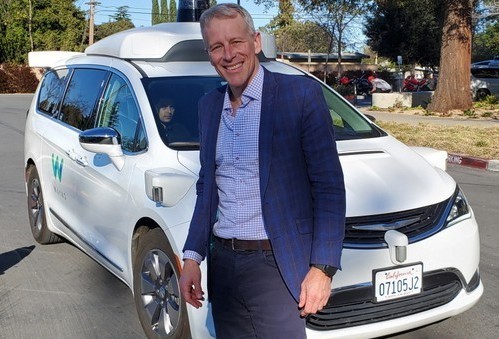
This is roughly where I think Tesla is today. Meanwhile, Waymo is now far ahead.
Best regards,
Whitney
P.S. I welcome your feedback – send me an e-mail by clicking here.