
A big, serious problem for stocks and bonds... Don't be a zebra... Why I'm sticking my neck out... A happy anniversary... Video highlights from the White Marlin Open... Meet us in Las Vegas next month...
 Something critical happened in the global markets this week...
It's the most important thing that has happened this year in global finance. One of the world's largest debtors had its credit rating lowered to "junk" status – below investment-grade. This is hugely bearish for the global economy... and in my view, it makes it almost certain that the U.S. stock market is going to go a lot lower.
As you know, I write the Friday Digest personally because, as the founder and chairman of Stansberry Research, I believe it's my No. 1 responsibility to do my best to tell you what I'd want to know if our roles were reversed. Most of the time, I get to share good news with you: Opportunities we've uncovered... strategies we've discovered... little things that can give you a better understanding of how to be a much more successful investor.
Today, though, I have to write something I don't think you're going to like. I suspect we'll receive a huge wave of cancellations because of today's essay. And of course, by giving you this bear market warning, I'm also sticking my neck out. If I'm wrong, many of you will never read our newsletters again. Nevertheless, I have to tell you about these things because I'd want you to do it for me.
By the way, I haven't seen anything about this yet from the mainstream financial press. So please... whatever you do... don't ignore today's Digest. I'll even give you all permission to share this warning with anyone you care about. Feel free to pass this around. Try to prove I'm wrong. This is that important. This information could protect your life savings.
First, though... a metaphor.
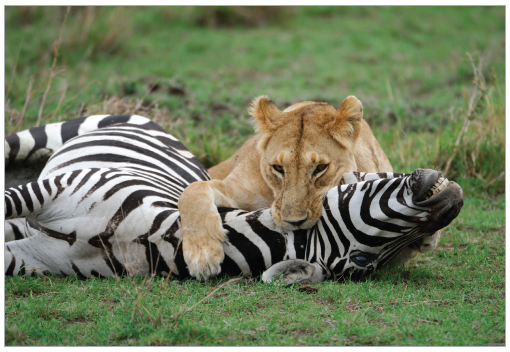
Think of investors like zebras. They all tend to run together in the same way at the same time. They stay with the herd. Like zebras, investors never change their stripes. How many times have you made the exact same investment mistakes? If you're honest, the answer is probably again and again and again.
But the way investors are most like zebras is the way investors seem to believe the lions aren't interested in eating them. After lions come out and grab a few zebras, the other zebras will stand off just a few yards away. They'll sit there and watch the lions eat their friends... or their family. There's nothing they can do about it...
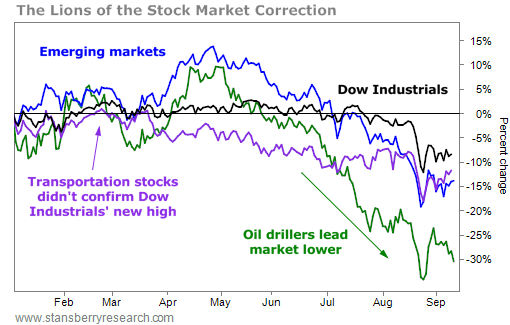
The "lions" in the current stock market correction have been the oil industry, the ongoing bear market in emerging-market stocks, and falling prices of speculative corporate debt. These downward trends are powerful. The shale-fracking fund (FRAK) is down almost 50% in the last year. High-yield bonds are down almost 10% over the last year – a massive move for bonds. Emerging-market stocks are down nearly 25% over the last year. These "lions" have, and will continue to have, a major influence on the U.S. stock market.
Consider the following chart. You can see clearly how oil (in green) and emerging markets (in blue) have led the move down this year.
The first sector to feel it in America was transportation. Your first warning of an impending bear market was when the Dow Jones Transportation Average (in purple) didn't "confirm" the new highs set by the Dow Jones Industrial Average earlier this year. Transportation stocks fell because falling oil prices led to a big reduction in demand for oil trains.
Likewise, emerging markets have a large influence on major U.S. companies because so much of the end-user demand for things like computer chips, soft drinks, and even Disney movies comes from the major emerging markets – Brazil, Russia, India, and China.
At the very least, before I become bullish on U.S. stocks, I want to see these "lions" – emerging-market stocks, U.S. oil companies, U.S. transports, and the high-yield corporate-bond market – stabilize. As long as these critical pieces of the global economy remain in significant downtrends, there's no way U.S. stocks can sustain a rebound. And there are no signs that will happen anytime soon. In fact, there was a huge sign this week that all of these trends are going to get much worse before they get better...
"All right, tough guy... what's the big deal you're talking about? What happened this week that has you all worked up?"
On Wednesday, ratings agency Standard & Poor's downgraded Brazil's country rating from "investment-grade" to "junk." The country remains on negative credit watch. This move places all of the corporate debt in Brazil into junk status, too, including the bonds of Petrobras.
This is a huge problem for the world's bond markets.
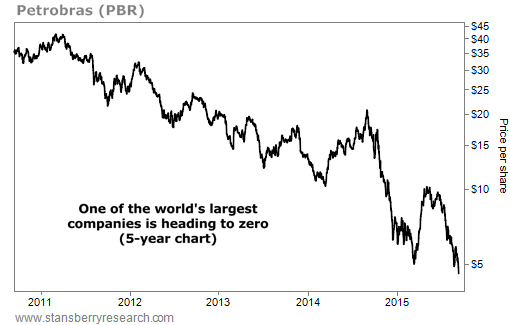
Petrobras is one of the world's largest corporate borrowers and is by far the largest hard-currency corporate borrower in emerging markets. Petrobras has $56 billion worth of outstanding bonds. That's roughly 2.5% of the entire global market for high-yield debt.
Now, following this downgrade, all of these Petrobras bonds are no longer "investable" for most bond-fund managers. This is an enormous amount of debt that must now be traded out of investment-grade bond funds and into much smaller, more speculative emerging-market bond funds.
Petrobras' borrowing costs are going to rise sharply as a result... and its bond prices are going to plummet. Reasonable investors will now question whether Petrobras can even continue to carry this debt load at all. The company's net debt is now more than five times its cash earnings before interest, taxes, depreciation, and amortization. That's a record for the company.
Carrying a debt load of this magnitude is suicidal for commodity-based companies. Commodity prices are cyclical. Interest payments aren't. The risk of bankruptcy – once unimaginable – now becomes a possibility.
It might be hard to imagine what any of this has to do with U.S. stock prices... but it's all interconnected. Shoving all of Petrobras' toxic bonds into the high-yield bond markets will cause the cost of capital for all speculative-grade issuers to rise. Demand will go way up. Likewise, Brazil is major market for U.S.-owned goods and services. The cost of doing business there will go up and make it much harder for Brazil's economy to break out of its current recession.
There are dozens of specific circumstances like Petrobras' current troubles throughout the emerging markets. China's corporate borrowers, for example, are heading for the same kind of troubles. The more China devalues its currency, the harder it will become for these borrowers to repay their foreign-currency-denominated bonds.
Think of these problems as a continuation of the debt crisis that began in 2009. The U.S. Federal Reserve's actions over the past seven years – printing huge amounts of new money and using it to buy bonds – have had far-reaching effects.
Sure, these actions might have saved U.S. banks and perhaps even the global currency system... But it also caused massive amounts of malinvestment as plenty of people around the world have been able to get credit they didn't deserve at absurdly cheap prices.
This massive bond-market manipulation led investors to seek higher yields in far, far riskier debt, which lowered the borrowing costs for firms like Petrobras and others across the emerging markets. These firms have taken on far too much debt. These aren't easy problems to solve. These debt issues are going to take time – years – to work out. And we aren't even close to the bottom yet. I believe we will see several major defaults in places like China, South Africa, Turkey, and Brazil. We could even see a default in Petrobras – one of the world's largest borrowers. The result would be a real financial panic.
In summary, the lions are still hunting. Don't be a zebra. Don't ignore these problems. Wait for some concrete signs of stability in the oil industry, emerging markets, corporate high-yield debt, and in the Dow Jones Transportation Average before you make any major investments in U.S. stocks. In my view, there's almost certainly another 20%-30% decline ahead of us... maybe more.
Before I sign off this week, there are a few personal things I'd like to mention. This drives some of you nuts. The idea that I'd take up your valuable time talking about anything "less important than money" is more than you can handle. So if you aren't interested in learning anything about me as a person, please stop reading right now.
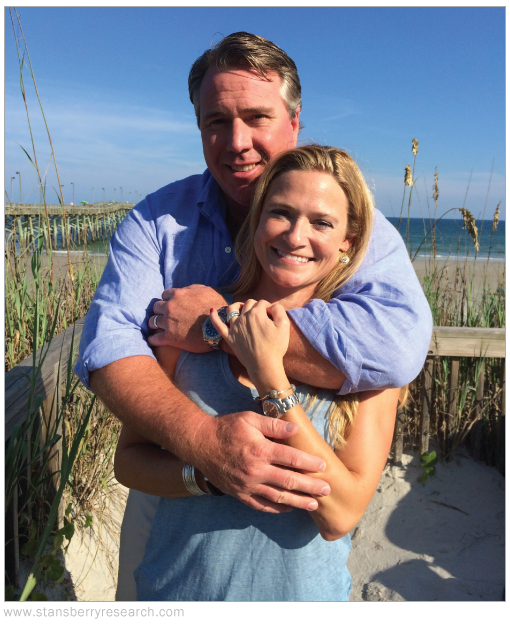
Today is, of course, September 11. For most Americans, this is a sad day. Not for me. My wife Andrea and I chose this day to get married 11 years ago. We did so intentionally. We think the best way to overcome your adversaries in life is to simply live well. So we do.
I believe we made the right decision. Exactly three years after we were married, God gave us our first son (Traveler) on our anniversary. In our house, this is the happiest day of the year.
About my wife... People often say they're "happily married." But I don't know too many people who look up to their wives the way I do. Andrea is the most beautiful person I've ever met on the inside and out. Being with her is the single greatest joy in my life.
I should confess, though... I get almost as much pleasure from my mistress as I do from my wife. As with most mistresses, mine is incredibly expensive – almost more than I can bear. I'm talking about my boat, Two Suns, of course. She's a sportfishing yacht designed to cruise the oceans in search of giant pelagic fish, like marlin, tuna, and wahoo. (We'd love to host your dream vacation. See our charter menu at www.twosunscharters.com.)
As I mentioned in the August 10 Digest, last month, we fished in the world's most lucrative fishing tournament – the White Marlin Open in Ocean City, Maryland.
The total purse in this tournament is almost $4 million. Last year, we caught the second-largest white marlin of the tournament. This year, we did even better, going to the scales twice. We caught the second-largest blue marlin of the tournament and weighed one of only nine white marlin caught. We also weighed a huge yellowfin tuna, which, for a time, held third place in that category. Keep in mind, there are more than 300 boats in this tournament. The vast majority of boats never make it to the scales. Our team has been two years in a row.
I'm incredibly proud of my crew and the team of anglers I assembled this year. I'd also like to thank our senior sponsors: Cohiba, GoPro, Royal Farms, and Stansberry Research. The fine people at GoPro helped us put together a short highlight film of the fishing and the tournament. If you've never seen 10,000 people watching a weigh-in, or if you've never seen someone yank a marlin in the boat with one hand, I think you'll get a kick out of this video. Click here to see the short film.
One last thing before we sign off for today...
As you may know, next month, we're hosting our largest conference to date. More than 500 of you have already signed up to join us over two days at the Aria Resort & Casino in Las Vegas on October 12-13. Right now, there are only a few seats left.
I'm looking forward to meeting our subscribers in person. And I can't wait to hear from some of the speakers we've arranged to present. I'm talking about people like Mick Ebeling, whose Eyewriter invention allows paralyzed people to communicate by simply moving their eyes... Josh Foer, who once won the USA Memory Championship and will share different ways to improve your memory... and comedian Penn Jillette (of the comedy duo Penn & Teller).
As you can see, we have some brilliant speakers lined up, and I'm looking forward to this fantastic event. I hope to see you in Vegas. To secure your ticket, click here.
New 52-week highs (as of 9/10/15): Inogen (INGN).
We're skipping the mailbag today... But I'd love to hear your thoughts on today's Digest. Like I said, the mainstream media isn't talking about the ideas I shared today. Do you think I've lost my mind, or do you share my views? Let me know at feedback@stansberryresearch.com.
Regards,
Porter Stansberry
Baltimore, Maryland
September 11, 2015

|