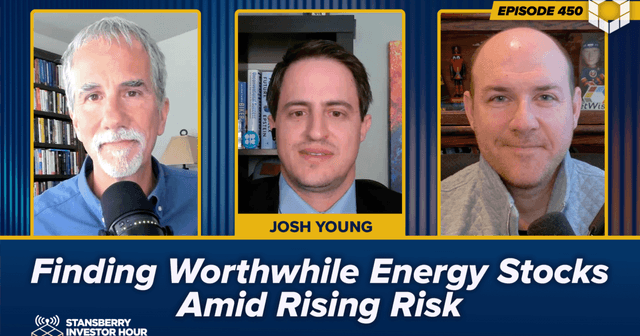

Finding Worthwhile Energy Stocks Amid Rising Risk
In This Episode
In this week's Stansberry Investor Hour, Dan and Corey welcome Josh Young to the show. Josh is the founder of Bison Interests and writer of the Bison Insights newsletter on Substack. Josh specializes in focusing on the best opportunities in the oil and gas industry.
Josh kicks things off by presenting his evaluations on the current landscape for energy stocks. He sees increasing geopolitical risk in the larger oil and gas companies. He also says that many of them have lost a lot of value as well. He then discusses the two biggest global risks in the oil and gas sector that he cautions investors to stay away from. Despite these challenges, Josh says that smaller oil and gas producers are where he sees the best opportunity in the sector...
I'm not that interested in doing bankruptcy restructurings or other sort of esoteric things like that. What I like so much about some of these smaller-cap oil and gas producers and services companies is [that] I don't need to go that extreme. I can find companies that actually aren't that bad, but they're treated as if they're gone or they're about to go bankrupt from a valuation perspective... especially in the context of some of the valuations on some of these larger companies.
Next, Josh shares why he chose oil and gas as his primary investment focus. He also reflects on the risks and mistakes that led him to the successes that he has today. Josh follows that up by addressing how technological advancements have contributed to the decrease in the oil-rig count. However, despite this appearing to be a negative scenario, Josh says that tailwinds are emerging from production going down. And he believes that oil production is going to be a critical topic during the 2028 presidential election, if not sooner...
I think [oil's] going to be a major campaign point in the 2028 presidential election, and it might be covered in the midterms, but I would bet they're sort of saving it for the 2028 election. While the rig count is falling in the U.S., despite [President Donald] Trump's sort of promising campaign of "drill, baby, drill," the rig count in California is rising... So what [Governor Gavin Newsom and his advisers] have done is they've basically suffocated the California oil and gas industry like they've suffocated many other industries. And now that Trump has said, "Drill, baby, drill," but the rig count's down in California, what they've done is they've imposed a requirement if you want a permit, where they were giving no drilling permits, just like no building permits... [And because the numbers are down now,] the place that will probably have the biggest rig-count increase in the U.S. over the next year is California.
Finally, Josh goes into depth on a company that he's fond of. He also gives his thoughts on the future of oil and where he thinks certain subsectors could grow, especially with regard to demand. But he stresses that he's not a universal commodity bull and says there's one commodity that he's less optimistic about. However, investors should still be careful overall about where they put their money...
In the same way as... the bull case for copper in terms of fewer discoveries and in terms of the likely growing demand, there's a similar story for oil. And the longer that oil prices stay low, the higher they're likely to go. And there are some great ways to express that view without getting destroyed if oil prices don't rise this year or next year.
Click on the image below to watch the video interview with Josh right now. For the audio version, click "Listen" above.

(Additional past episodes are located here.)
This Week's Guest
Josh Young is the chief investment officer and founder of Bison Interests and the writer of the Bison Insights newsletter. He has been professionally investing in publicly traded oil and gas securities for nearly two decades. Prior to founding Bison, he gained experience as chairman of Canadian exploration and production company RMP Energy (rebranded as Iron Bridge Resources). He is the author of numerous articles on oil and gas investments and is a frequent guest speaker at various energy-industry conferences. Josh holds a bachelor's in economics with honors from the University of Chicago.
You can learn more about Bison Interests here and Bison Insights here.
Dan Ferris: Hello and welcome to the Stansberry Investor Hour. I'm Dan Ferris. I'm the editor of Extreme Value and The Ferris Report, both published by Stansberry Research.
Corey McLaughlin: And I'm Corey McLaughlin, editor of the Stansberry Daily Digest. Today we talk with Josh Young of Bison Interests and Bison Insights.
Dan Ferris: This is going to be a lot of fun. Josh is a young, smart guy focused on oil and gas with a really fundamental value-based perspective. I can't wait for you to hear this. Let's do it. Let's talk with Josh Young. Let's do it right now.
Josh, welcome to the show. Glad you could be here.
Josh Young: Thanks for having me.
Dan Ferris: Yeah. We're going to talk oil and gas, which is one of my favorite subjects. Energy generally, and oil and gas, one of my favorite subjects right now. I just did a piece on my take on what Venezuela really means and what it would really take to get it running, which is substantial, as ExxonMobil pointed out at the White House. So, yeah, there's a lot to talk about. And you talk about a lot of this stuff, which is great. Maybe we should start just by quickly telling our listeners – just tell them a little bit about who you are and how you got where you are and what you're doing today.
Josh Young: Let's see. Thirty seconds or less: I'm from L.A., went to University of Chicago and studied economics, did management consulting, private equity, worked for a multi-billion dollar family office, launched a long/short hedge fund, which failed, and then co-founded Bison Interest, which invests in publicly traded oil and gas companies, and we launched it in 2015 into the back end of the oil price crash of 2014, and we invest in small cap publicly traded oil and gas companies. And we've done really well, even though the small cap oil and gas sector is down,. If you look at that ETF, it's down about 70%, 65% or so since we launched. So, we're up almost 100 and they're down. So, it's been a terrible sector and it's been lucrative to pick stocks in the sector. And that's who I am and what I do.
Dan Ferris: Well, congrats. First of all, that's amazing. There's nothing like doubling your money when the sector gets clobbered like that. I like it because I'm what I would guess would be called an old-school, bottom-up fundamentalist stock picker, value-oriented stock picker. So, when I hear that somebody did that, especially in a sector like oil and gas, I'm like, "Yeah," high-fiving you on that one.
Josh Young: Yeah, thank you.
Dan Ferris: Let's talk a little bit about your – you put up a really nice presentation on x.com recently and you talked about your macro view of energy right now. Energy has become a really interesting sector to me partially because of the underperformance recently. When you sit here today, January 2026, and look forward, what do you see just in terms of oil, gas, liquids, whatever else, whatever else you have an opinion on?
Josh Young: Sure. So, we had one really good year for Bison. We were up almost 400%. And after that, people started asking me what my predictions were. We were down 50% the year before, so it's not like this was some miracle or whatever. And people started asking me for my predictions about everything. And so, I bought – I have it sort of over in a different part of the office, a little crystal ball. And so, what I would do is I would just wave over the crystal ball and say, "Ah, it's broken. It's not working." So, just, I think that the fear/caution into any sort of macro conversation is just there's this massive cone of uncertainty around the future. And –
Dan Ferris: Yeah. A man after my own heart. You know something? I would have answered that – I would have started my answer to that question in the exact same way. I would have. And people who read my stuff every week know that.
Corey McLaughlin: I can vouch for that, for sure. It sounded like something Dan would write. I've always been looking for someone with a crystal ball. I finally found somebody.
Dan Ferris: That's right. And it doesn't work.
Josh Young: Yeah, sorry, it's broken.
Dan Ferris: All right. So, given that – so, really, you make a good point. The real question is you're assessing the state of things right now and the valuations of things you like and don't like, etc. That's a good point.
Josh Young: OK. Yeah, no, of course. And again, I just wanted to throw that out there. So, I am wearing a tanker tie. And I've started wearing ties recently. I feel like it sort of adds a little bit of seriousness to these topics which are quite interesting and serious. And so, I do think that there's elevated oil geopolitical risk here. And so, we're starting to see it priced in on the larger oil and gas stocks. And the technical analysts I talk to, they're talking about there being sort of breakouts in the sector and the prices of some of the largest producers and integrators are at very high levels. And so – at least relative to where they've been anytime oil has been anywhere close to where it's at right now.
And so, that makes me very uninterested in those particular companies because in commodities, the easiest way to lose money is to get excited about the technicals and to buy companies at premiums to their intrinsic value because people like them or because the stock chart says go up. And then, it's amazing how people come up with these narratives around these companies when their stocks are up about how they're fantastic or good management or good at whatever, when the reality is that a lot of them have destroyed a lot of value over time and at best are sort of managed in sort of a mixed positive attributes and negative attributes way. So, I'd say there's a lot of risk in the sector.
Dan Ferris: OK. Let me ask you this. What do you make of the idea that if – and this is an enormous if – if the Trump administration really does move the needle on those legal and commercial frameworks that Darren Woods, Exxon CEO, cited at the White House that are – make the country uninvestable, if the Trump administration really did move the needle on those, on the legal and commercial framework for producing hydrocarbons in Venezuela, given what's needed, don't the majors have a significant advantage simply because they can put $10 billion or $20 billion to work in a place like that over a couple of years or something? No?
Josh Young: Oh, yeah. Any one of these factors is big and multifaceted. And so, there's this big potential – the real prize there for the producers would be resource capture. It's that there's billions of barrels that could be secured where they could potentially get a portion of the economics from those billions of barrels by saying the right things and doing the right things with the Trump administration and whomever ends up in power down in Venezuela. I think the comments by the Exxon CEO were correct even if they were misplaced. The right answer to our current glorious leader is "Yes, sir. And by the way, you're brilliant and look the most handsome." So, they were the wrong answer but technically correct.
But the bigger problem is if you're Exxon and you just spent $40 billion buying Pioneer in West Texas, or you're Chevron and you just spent $40 billion or whatever buying Hess and Guyana in the North Dakota Bakken, well, if you go grow your production in Venezuela, you destroy the value of these tens of billions of dollars of assets that you just purchased, as well as the value of the rest of your production globally. And so, some of these companies that are expected to put billions of dollars in actually have real incentives to not deploy that capital beyond misallocation, where there's a good chance that the third time won't be different in Venezuela, and that eventually there will be nationalizations again and violence and whatever. And so, I would bet on that, sadly. And so –
Dan Ferris: Right. Isn't that the big issue. Darren Woods said it: The time frames are decades. They need security for decades. That's what really stops me because I'm pretty sure that Trump isn't going to be in office for decades. OK, just spitballing there. So, who's to say what the Venezuelan legal and commercial frameworks are going to look like in even three or five years. Even if they make lots of headway in the next two, go out three or four or five, I don't know, It's tough. It's a tough one.
Josh Young: I don't know that you even need to speculate on that in the sense that in that conversation, Conoco's CEO asked, "Hey, what happens to our $12 billion that they stole?" And Trump said, "Hey, you write it off." And that's the wrong answer.
Dan Ferris: Oh, yeah.
Josh Young: It's – it just gets back to like the economic miracle of Western civilization. We were agrarian farmers. We were in a very low-tech situation with very low trust. And then, essentially the – I forget what they call it, the enclosure laws or whatever in England, and then sort of similar rules where private property was imbued upon people and property rights were protected, that's the start. It wasn't the Industrial Revolution. It was private property that drove our prosperity and our technology miracles that we – we're enjoying as we talk virtually through electrons and plugs and all kinds of magical stuff. So, if you don't have property rights –
Dan Ferris: Do you know an economist –
Josh Young: Sorry. Go ahead.
Dan Ferris: – called de Soto? Do you know an economist called Hernando de Soto? He's got two books on that very subject. You sound just like him. Anyway, go ahead. Sorry.
Josh Young: Yeah, no, it's OK. So, without private property rights, there's no starting point. So, why would you as the CEO of Exxon or Shell or whatever put new money to start a new operation? And if you're Chevron, you've played the political game to the point where you were getting to produce and sell oil even in the context of sanctions. And so, yeah, you put more money in but you're just reinvesting money you've been getting out. The other companies, I see real risks and uncertainties. So, I'm not too worried about more oil production growth from Venezuela anytime soon. It's not really in the context that – I'm not – for now I see that as very low probability and almost not relevant for my investing time frame.
Dan Ferris: Good. I kind of – I derailed you a little bit but – so, basically the super majors, they're pretty fully valued to you. Right? That was the original point. OK.
Josh Young: Yeah. They're fully valued.
Corey McLaughlin: Where – that's great thoughts on Venezuela. And you talked right off the bat about geopolitical risks. I think we're all aware of that by now. And I think people off the top of their head can think of a few places. But where to you are the biggest risks globally right now with oil and gas?
Josh Young: So, Russia and Iran. And I guess that's probably not surprising. People have talked to the end to nth degree about Russia. And then Iran, I think the president – Trump really put himself in a tough position. He took a stand on these protests that were domestic issue in Iran. And morally, I'm very sympathetic, but there's a reality of state craft and of politics and whatever where foreign domestic. issues are foreign domestic issues. And he took a stand and then drew a red line and then drew it again and then it was violated. And so, there's this increasing risk of the Trump administration pushing for regime change.
And the history is people think that regime change would lead to more oil production and more sort of securing oil rights, like people accused the Bush – the [George] W. Bush administration of and [Dick Cheney] of and so on. But you look at the oil production in Iraq after regime change in it fell precipitously and stayed low for years. And so, there's a similar – I think that's the right framework for regime change or that sort of risk. And that's like the low end of the risk. The high end is what happens if there's an issue even temporarily with shipments from the Strait of Hormuz? And before people say, "Hey, that's impossible," there were tankers and there were ships getting shot down and sunk very recently in the Red Sea by a terror proxy of Iran. So, again, I'm not saying it's definitely going happen but I think it makes sense to keep in mind.
Dan Ferris: Yeah, it's a risk. That's good. Yeah. So, if you don't like majors and you do see geopolitical risk, what's the next item in that train of thought? "I like cheap domestic producers" or something like that? Or – what comes next after that? What's logically next?
Josh Young: Yeah. So, in the value chain for oil and gas there's producers, there's services companies, there's pipelines, and there's refiners and gas stations, essentially. And so, in the current environment, the oil majors, which control some of a lot of that, are very expensive. The refiners are actually pretty expensive too on a replacement value calculus where the – some of them like a Valero or whatever on the large side are trading at really high levels versus their recent and even sort of long-term history. And then, the pipelines are also at pretty elevated levels.
So, where that leaves me within this sort of value chain is the smaller producers and the smaller oil field services companies. And people don't like them in the same way as they didn't like the intermediate or small gold miners and platinum miners and silver miners. And they have similar narratives around it where they say, "Hey, that's uninvestable" or "Those management teams are bad" or whatever. That's part of why I wanted to pick on the Exxons of the world a little upfront. Again, they're great, but they're not perfect. And I think some of these management teams on the smaller side in oil and gas and in mining are also great and not perfect. And maybe they're less great than an Exxon, but if I can buy them for three times instead of 12 times, then I can squint and see a path to making a lot more money on the low valuations than the high valuations.
Dan Ferris: Yeah, just looking at some of the stuff that you've tweeted and written about, you don't mind a little hair on the pick at all. I almost feel like you require it. Almost. The valuations you like, almost every time that's how you're going to get there, is there's a problem.
Josh Young: Yeah, I think so. I think – one of my friends likes to say that he likes things that are hopeless, and then when they go from hopeless to just in really bad shape that the valuation move there is astronomical. And then, when they go from really bad shape to looking pretty decent, that's the point where he gets out. And you can get your 10X or whatever on some of these things just from that move from looking real bad to looking less bad. And again, I'm not that interested in doing bankruptcy, restructurings, or other sort of esoteric things like that. What I like so much about some of these smaller cap oil and gas producers and services companies is I don't need to go that extreme. I can find companies that actually aren't that bad but they're treated as if they're gone or they're about to go bankrupt from a valuation perspective. And so, especially in the context of some of the valuations on some of these larger companies.
Dan Ferris: Right. You are a value-oriented – you're a classic value-oriented commodity guy. There's not many of you left, to be quite frank. You're kind of – "dying breed" is not unfair.
Josh Young: That was actually the intent. We named the firm Bison because the bison are the only animal – basically, the only four-legged animal that faces into the storm and gets through it safer and faster. The others run away. And when we launched it, there were something like 200 or –
Dan Ferris: And was nearly hunted to extinction.
Josh Young: Yes, that's right. That's right. And they're back. And they're back. There's a lot.
Dan Ferris: Yeah, baby. That's right.
Corey McLaughlin: Yeah. That was – before we get too much more into it, what made – what stood out to you? Why be a bison? What stood out – why oil and gas after your early career? Just – how did you settle in this area?
Josh Young: So, I like the people a lot. I think that there's a lot of really interesting, hard-working, innovative people in oil and gas. And I think that there's people like that in every sector pretty much, but I think that the people that are like that in oil and gas are materially undervalued and arguably even disrespected. And so, I love this idea of finding brilliant, innovative managers or technologists or whatever in oil and gas and getting to bet on them and getting to pay a tiny fraction of the valuation I'd have to pay to bet on similar people in other sectors. So, that was, I think, the big thing.
And then, also, after 2014, after – everyone got destroyed. It was wild. You look at – the big stocks fell, the small ones collapsed, many bankruptcies, many funds out of business, private-equity funds out of business, public equity funds closing. It was crazy. And so, you had this mess. And you had this sector that was still – even in the boom times in the early 2010s it was still not very respected. People still felt like it was going away. And so, you could see valuations that were really distressed versus where they had been even a couple of years earlier. And then, also, clear paths to valuation recoveries through either valuation or just value realization. And there were many, many special situations that were available.
The thing I'd been doing prior to launching Bison, other than blowing up a long/short fun – I am not good at shorting stocks. I should not do that. And so, I did that and –
Dan Ferris: Dude, nobody is.
Corey McLaughlin: Timing's hard there. Yeah.
Dan Ferris: Yeah.
Josh Young: So, other than that, I was doing these one-off sort of co-investment type special situations where I'd find a company that was getting sued but they were going to win the lawsuit and the stock was down 60% and it was going to go 10X on the backside. And that one worked really well. Convertible-debt-type deals. Various other sort of off-the-run special situations. And the idea was to take a portfolio approach rather than doing this on a one-off basis and buy a whole set of these with different risk factors and different return drivers, all with the risk ultimately of commodity prices of oil and gas and natural gas liquids and day rates for rigs and volumes for pipelines and just sort of build a portfolio like that. And it's worked really well in terms of the relative performance I've been able to achieve versus the versus the oil and gas indexes, especially versus the small-cap index that we're very exposed to. So, it's worked really well so far. And that's sort of the thought process on sort of finding these off-the-run things. And the nice part is, you want to always get everything right, but if you're going to make mistakes, you might as well be making mistakes on things that can 10X versus making mistakes on things that you're betting on a 20% or 30% sort of return.
Dan Ferris: Absolutely. As asymmetric as possible. That seems like such a basic thing. I'm surprised more people don't embrace it. I'm surprised there aren't more people scouring through this stuff that you look at, looking for the undervalued stuff that nobody else knows about.
I feel like to a certain extent the value investors did sort of arbitrage out a lot of the net nets and the Graham- and Dodd-type metrics. But there's still a lot of stuff down there, as people like you will attest. And we've had other guests who aren't focused on a single sector who are the same way. And the stuff divides – liquid trades by appointment practically, or whatever. And there are these bank deals that are in small banks that people can find when it's a mutual and it's going public or whatever. There's stuff down there. I'm shocked that in the year 2026 you can just be a bottom-up guy and just rifle through the securities listings, almost like Buffett turning the pages of the Moody's Manual, and find this excellent stuff with huge upside. It's like where is – everybody's asleep? It's great. It's great.
Josh Young: Well, it's a little more complicated than that.
Dan Ferris: Sure. Sure. That's not – yeah.
Josh Young: I have to have made mistakes for 20 years to get to this.
Dan Ferris: Yeah. Well, nobody's – yeah.
Josh Young: And you're the compounded result of all the risks and mistakes and successes that you have in your life. And so – and then the big part that immediately came to mind was that a lot of the ideas that we've had that have worked really well have been through getting to know new technologies, getting to know people, getting to understand sort of development patterns and sort of where to look, because a number of the things that I'll buy are hated. And sometimes if I talk about them publicly, they get more hated. And so, you've got to, I think, be able to really be confident and then also be open to being wrong and being able to change a position or whatever if you're wrong.
Dan Ferris: Josh, you mentioned – every time you talk, I feel like I have five new questions. So, I'm just going to pick one. You mentioned technology. I'm glad you brought that up. How much – and if the answer to this is "I don't know," that's totally cool. But how much of the decline in rig count do you think is attributable to technological advancements? I just read the other day somebody – they're drilling laterals that are, like, six miles long somebody drilled. And I know some people, I think it was, it might have been Exxon Pioneer, somebody said – yeah. Yeah. They did that acquisition because the land pieces fit together like this and you can drill across longer lateral. So – and there's potential for other acquisitions to do the same thing. Do you have a sense of how much of the decline in rig count is attributable to this?
Josh Young: Yeah, so the – it's a little complicated because U.S. oil shale was growing by about a million barrels a day every year for the last 15 years. And so, the U.S. represented the incremental – especially when you include natural gas liquids, the US represented more than 100% of the non-OPEC oil and liquids production growth globally. So, other places were shrinking and we were growing by enough to offset that and grow to be able to grow global oil production to adequately supply the market for the last 15 years.
Dan Ferris: Amazing.
Josh Young: Well, at the current pace that has now changed and we are in decline. And last year we did not grow a million barrels a day. And so, the right question I think is what's the right number of rigs to be able to actually keep production flat in the U.S.? And then how much production – how much does production actually need to grow in the U.S., not necessarily this year or next year, but over the next 10 years? Do we need a million barrels a day of growth in the U.S. again or do we need half a million or do we need none?
And so, I know it sounds like a funny way to answer a question about a four-mile versus six-mile lateral, but you sort of – you start with where you need to go, and then you say, "OK, well, where are we?" And we're not there, in my view. I think we need to grow by about half a million barrels a day, including natural gas liquids, every year in the next decade. And we're just not anywhere close. And there's this problem, which is that the best wells have already been drilled in shale in North America. The best wells by far, already gone. The next best wells are almost all gone and you're seeing a lot of evidence of it. So, the best wells were getting drilled by EOG and by Concho and by Occidental Petroleum. And so, Concho got bought and Conoco is sort of running out of those best locations. They might have already run out a while ago. Devon has been buying a bunch of other fields indicative of a rapid diminishment of these. When you can drill a 10,000- or 5,000-barrel-a-day oil well in West Texas or southeast New Mexico you literally do nothing else other than that, because why would you? EOG, too. They've drilled so many wells, and then they just went and bought this giant field in Eastern Ohio, which again is indicative of depletion.
So, there's a lot of data supporting that story. The well productivity on a per-foot basis has collapsed over the last five years. No one talks about this, both on oil and natural gas. We studied it. We looked at every well and if you look in aggregate at the total number of wells drilled and then the total change in natural gas production from those wells, you can see on a per-well basis – so, on a per-well per-foot basis productivity is down a lot. So, they're offsetting that by drilling longer laterals and by completing more efficiently. But there's this game – they call it the red queen effect, essentially, and it is kicking in. And that's where I think it is really exciting, not just the stock-picking aspect of the sector, but I think – and there's some tailwinds here that people, they get excited about one or two aspects of it and sort of miss the bigger picture, I think, of what's really going on.
Dan Ferris: Yeah, OK. So, I think the answer to my question is it's complicated. As you – you started out saying it's complicated and you weren't kidding. So –
Corey McLaughlin: So, I'm curious, you just mentioned there at the end the tailwinds, given that. I think some people would hear it we're not producing – we're not growing production anymore and take that as a bad thing. What tailwinds are you talking about here?
Josh Young: So, the easy way to frame this, because as we're talking, it's just on the tail end of a big winter storm that sent natural gas prices skyrocketing. And natural gas prices went up a lot in the short term. The cash price – I think I saw some folks sold some of their gas for a day for $50 [per thousand cubic feet ("MCF")], and the normal price is maybe $3 to $5 an MCF. The spot price right now sort of going into February is about $380 an MCF. And they were able to sell – or the next forward month, sorry, was about $380 and they were able to sell for $50.
So, why that happened? Well, demand was up because of the storm, but also supply was down because about 10% of U.S. production was knocked off line, maybe closer to 20% was knocked off line. So, as a commodity producer, if everyone can knock their production off by 10%, you can get 100 times or 10 times the price, at least for a short amount of time. This is why OPEC, they'll say why they exist, and I have their little OPEC plastic thing. I got to go visit and meet the secretary general and all these other folks there and it was pretty cool about a year ago. But they exist because it turns out if you produce just a little less as a set of producers, you can get a much, much higher price.
So, I think that's the right context. But then, demand is growing. This is the part that's so strange. Oil demand has grown over the last 40 years by about 1% a year every year other than COVID or 2008 financial crisis. And so, even in some of the bad recessions in the late '70s, early '80s, demand still grew globally. And so, if you have that growth of about a million to a million and a half barrels a day, depending – low end in a recession, global issues, high end in sort of a global growth period – you need to solve for global oil production growth of over a million barrels a day. And then when you're in decline in countries like Mexico, you're in decline in Venezuela, you're in decline in many other countries, you need to offset those declines.
And everyone points to Guyana, where you have production growing a lot. But Guyana, despite all the headlines and all the excitement, they're just now getting close to a million barrels a day. I don't remember exactly if they're at 950 or 1.5 million or whatever, but they're just getting there now despite, what is it, multi-billion – multi-tens of billions deal that Chevron and Exxon fought over and who knows how many headlines and front pages in the Wall Street Journal and so on. And that's one year of production growth, and that barely offsets declines in various other countries, even just in their immediate vicinity.
Dan Ferris: Yeah, and the prospect for further declines with people like Harold Hamm. For the first time in 33 years, no drills turning in the Bakken. The guy invented the Bakken, you could say. You know what I'm saying? For the first time in 33 years, not a drill turning. I'm like, "Wow." And the breakeven – I think in the Bloomberg they were saying the breakeven there is, like, $58. And he said, "Yeah, when the margins are gone, there's no sense in drilling it."
Josh Young: Let me try to address that in a –
Dan Ferris: OK. I have another question but go ahead, yeah.
Josh Young: Sure. Just – I feel like I talked a lot on the last one, but let me just try to explain. So, what's happened is as there's been core depletion, core depletion has occurred faster than drilling and completion efficiency gains. And so, what you're seeing is that breakeven number – that reminded me of sort of – I could have just explained it much more simply. I just wanted to share some of the description and narrative around what's happened. But economically, the breakevens are rising. And they may rise asymmetrically. They may rise much, much more than people are thinking because the best wells were drilled and the best wells were three times as good as the next best wells. And if you drill twice as long into bad rock or less good rock versus half as long into great rock, you might get the same production rate maybe in the first month, but your decline rate might be two or three times faster. And you might only recover less production from a four-mile lateral on tier three rock, let's say, in North Dakota as you would have got from even a one-mile lateral in core rock that was drilled when I visited in 2010 or something like that.
So, that's the – there's this – the rate of change in depletion is higher than the rate of change in efficiency and that's where you see where the Bakken, he stopped drilling. He didn't stop drilling five years ago even in a low price environment. He slowed it. And then, also, he has a political reason to not stop. He's a big donor and supporter of the Trump administration. So, it's very meaningful that he stopped.
Dan Ferris: Yeah. It's – yeah, he sat there in Washington and said, "Yay, Mr. President" or whatever and just kind of paid some lip service to what Trump wanted and kind of mentioned difficulties like vaguely in Venezuela. And then a week later, he says "By the way, I am not turning another drill in the Bakken," which pioneered the discovery of this massive 200,000-square mile region. That was when – that juxtaposition a week apart, I was like – I couldn't believe it. That plus the Darren Woods comments. I was like "OK. Well, things are a lot different than –" Trump's talking about "We want oil prices lower." Meanwhile, everybody's going "Yeah, we want them higher." And not only that, but if you look around, all the independents who don't care what anybody thinks of them and will talk to the press hate this. They hate it. They feel like the tariffs – part of the reason for those of us higher breakevens are everything costs more due to tariffs. Several of them have cited this. So, they're like "Tariffs. Drill, baby, drill at $60 or whatever. This sucks. We hate this." The oil and gas industry, it seems like they're not behind – they're not on board with Trump at all at this moment. It's just...
Josh Young: Let me tell you another story that you might not be familiar with. It's been covered a tiny bit in the news, but people keep relegating it. I think it's going to be a major campaign point in the 2028 presidential election and it might be covered in the midterms, but I would bet it's – they're sort of saving it for the 2028 election. So, while the rig count is falling in the U.S. despite Trump's sort of promise and campaign of "Drill, baby, drill," the rig count in California is rising. And just to be clear, I voted for Trump, but I am not a Gavin Newsom fan, I've been very public about not – but his advisers and his approach on this is truly brilliant.
So, what he's done is he imposed – they basically suffocated the California oil and gas industry, like they've suffocated many other industries. And now that Trump has said, "Drill, baby, drill" but the rig count's down in California, what they've done is they've imposed a requirement. If you want a permit where they were giving no drilling permits, just like no building permits – the Palisades is still burnt down, terrible – if you plug two old wells, plug and abandon two old wells, you can drill one new well. And California has it might be hundreds of thousands of old wells, plenty to remediate.
And so, there's two drilling rig companies left. I don't know if we should talk about specific names or whatever, but there's one that's publicly traded. And so, this publicly traded company, Ensign, is backed by two Canadian billionaires. It's technically – it's headquartered in Canada. It's backed by Murray Edwards, who's famous for starting and running Canadian Natural Resources, and it's backed by Fairfax Holdings, which is this giant, very successful insurance company.
Dan Ferris: Yeah, Graham Watson, the Warren Buffett of Canada. Yeah.
Josh Young: Absolutely. Can't say enough good things about him. Really fantastic. So, they're the two biggest holders. They own, I think, in aggregate over 50%. It's right around 50%. They put in money sort of recently. And so, you have this drilling rig company. Drilling rigs are hated. And people are more gravitating to offshore rigs. There's a better story there. There's more of sort of a bright future there. But you have Ensign, which is the only public company with exposure to drilling rigs in California. And they're benefiting from Newsom very sort of cynically taking this industry, which he had almost choked into oblivion and saying, "Hey, you all are able to go drill some wells. But you have to shut in the nonproducing one so I can pretend it's like pro-environment."
And it's so – the industry was so killed there that they need to drill a lot of wells, even though the economics are not so great for drilling new wells for oil, because they need to refill some of the pipelines so they don't have some flow issues and processing issues and so on. So, the economics are spectacular when you include the infrastructure impact on drilling these wells. So, the, the rig count should be, let's say, 30 and it was, like, seven or eight not too long ago. And almost all of those rigs I expect will be provided by Ensign. No one wants to go to California. I talked to some of the other big drilling rig companies that are like, "Hard pass. We'd just rather not work than – at least at the current day rates than go to California. It's just not worth resetting up operations." You have to hire all these people and fill out all the whatever and comply with all the stuff and have all the liability. Ensign's there already.
So, anyway, I thought you guys would appreciate that. So, there's these weird political machinations that the place that will probably have the biggest rig count increase in the U.S. over the next year is California. And so, what a world we live in, right?
Dan Ferris: Yeah.
Corey McLaughlin: Yeah, I was not expecting to hear that today. That's for sure.
Dan Ferris: That's right. It's like one of the most – on the planet Earth, one of the most hostile hydrocarbon producing environments, and they're going to grow the rig count. Love it. That's a sign of the times.
Josh Young: So, I think what's going on – sorry, just to close the loop. So, what I think is going on is for 2028 what Newsom's going to say is – they're going to have this advertisement showing Trump saying "Drill, baby drill," and then they're going to show how many rigs fell and they're going to show really sad people who worked on rigs who were laid off and there's a huge human cost to the Trump administration not following through on their campaign promises. And then, they're going to show the many middle class, working class folks that have jobs that are busy working. Maybe they won't show the actual drilling rigs, but they'll show various minorities at – hard at work in California, and they'll say, "We put Californians to work. And we did it when Trump couldn't."
And I think that's what they're constructing. And again, it's so cynical. It's wonderful for the people that benefit. It's terrible for the people that are getting hurt. And I think that's – so I look at that and say, "OK, well, I can own this thing at –" and I own it. This is not a recommendation or whatever. People should do their own work. But it's at a third or so of tangible book value. It's at – it's also a very levered company. So, they have a $550 million-or-so Canadian market cap and a billion of debt. And they have Fairfax and Murray Edwards owning more than 50% of it. So, it's like their public [leveraged buyout] of a drilling rig company. And again, it's relatively small. It's relatively liquid. I wrote about this for my newsletter a few different times and, whatever, it's fine. I guess, to talk about it here. But again, illiquid, risky, has debt, but also they're the winner in all of this sort of mess because – and they also have rigs in Venezuela. But again, I'm still maintaining my negative view on – I'm positive on California drilling, weirdly, and negative on Venezuela.
Dan Ferris: OK. So, Josh, just for our listeners' benefit, this company that Josh is talking about is not the Ensign Group, ticker ENSG. It's not that. It is Ensign Energy Services, Inc. And the U.S. over-the-counter ticker is ESVIF. That's the one you're talking about. Market cap of about $440 million USD.
Josh Young: Yes.
Dan Ferris: And actually, you know something? Not horrendous volume. I mean, $240 a share, like 47,000 shares a day. It's viable. It's doable for – certainly for us individuals. Our listeners.
Josh Young: So, the primary listing for it is in Toronto on the Toronto Stock Exchange. And there the volume is much, much larger and it's – it's sort of funny with these foreign listed companies where they'll show up as this five-ticker – or, sorry, five-letter ticker and it looks like, "Oh, what is this thing?" And then it's sure 30% owned by Murray Edwards and it's the only one of his companies that's not up 300% in the last five years or whatever. And it's a – it's sort of a – it's this funny sort of – I think actually for – a lot of the Canadian energy companies have done well, but I think there's still this residual sort of – it's a secondary market, so it sort of flips in both directions sort of more extremely than U.S. stocks tend to.
Dan Ferris: And God bless it for doing so because, man, that's where the great opportunities come from, man. A friend of ours, Rick Rule, likes to say in natural resources you're either a contrarian or you're a victim. So, I say, bring on those swings. Let the swings begin.
All right. So, you've shared – all right. So, you've shared a – we love tickers. We love individual names. Our listeners, I promise you, they're all scribbling this down and they're taking a look. And if you had another one, we're all ears. We wouldn't mind at all. If you don't, that's cool.
Josh Young: Sure. So, I'll tell you about a company that I've owned for a long time that I got in a little dustup with their board and management over some of their governance practices and where they – they've made some changes to their credit. They've not made the change – all the changes I wanted, but they've made – they've shown some progress. So, I'll acknowledge that. And they're in this drilling joint venture. This one – actually, the – Ensign services is Canadian-listed but has operations here in the U.S., all around the world, whatever. This one's just Canadian. It's called Journey Energy.
And I have talked about this before, but the thing that's changed here is that they're in this drilling joint venture that's drilling some of the biggest wells in North America at the time where a lot of these shale wells here in the U.S. and in Canada are degrading. And so, it's this sort of newish – it's not a new discovery, but the folks that are operating their joint venture are brilliant and they're in their fifth go-around in a public company and their past four were really successful. And so, the results are so spectacular that when I started seeing them last year, I bought a lot more stock, wrote about it also for my newsletter. And I think it's worth looking at because the stock has done well in the last year. It's done poorly over the last few years. And I think it's just getting dragged – if the wells continue to do how they look like they're doing where they just keep getting better every year and that's the – their partners' expertise, it could get dragged way higher. And then, also, because it's a non-op participant in this joint venture with these guys who are spectacular, I think those guys are trying to buy them and there's at least one other company where it'd be very obvious for them to buy this company, or at least this asset. And it really is just this – it's so rare to have assets like this that are really undeveloped that have lots of upside and that are actually getting better in North American shale. Again, almost all of them – I'm bullish because almost all of them are degrading and here's this one that's getting 20% better a year over the last few years.
Dan Ferris: That's cool. So, Journey Energy, JOY, in Toronto. I want to back up to a macro point. We have declining rig counts obviously. Oil prices are down. How fast – you characterize on your x.com, your Twitter feed, you characterize this as a setup, a nice setup. So, obviously we're looking for the price to bottom somewhere. But you don't even have to tell me that. I know you can't predict that. Nobody can predict these things. But do you have a sense of the amount of time it would take for this setup to sort of – for the opportunity – has the opportunity truly arrived? Is the opportunity here now because oil is whatever it was, $60-ish recently? Or is this like buy today and by 2028 or 2029 you should see a good result? It seems to me – I feel like this thing, it could turn around fast. But I want to hear what you have to say about that.
Josh Young: So, I might be a little optimistic in the sense that if you asked me this question every year since 2015, I might have said, "Hey, we're in this downturn." And every year it gets more compelling because if you underinvest in something, there's a cumulative negative supply effect. And demand keeps rising, despite everyone's forecast a few years ago, "Oh, it's going away, peak oil, whatever, demand," and the demand is not falling. It's actually rising, and it's rising in surprising places and surprising countries.
And really, the joke I like to point to is in The Graduate where the older man pulls young Dustin Hoffman aside and says the future is plastics. And it turned out he was right. And the future for oil might be that where there's huge demand growth in plastics and chemicals and so on. We need them for the modern world, and as more people sort of come out of poverty, they end up using more plastics. And then, countries and groups like in the EU that are trying to use less plastics end up with more disease issues and other things where they end up reverting back towards more consistent plastics use.
So, I'll just say I've been an optimist. And I guess I've been wrong in the sense that I thought prices would have been a lot higher here than I expected. And I would just point to, hey, the longer it takes, the higher it's going to go. And the longer it should stay higher, the more backfill on exploration, delineation, and development that you're going to need. And when people don't believe that, now it's easy because I can just say, "Hey, look at silver." Everyone hated it, and now they might still hate it, but it's up 5X, and the miners are all –
Dan Ferris: Or even copper. Yeah. That's right. Yeah. That's exactly right. The more that the supply situation deteriorates, kind of the worse it gets and then the more ballistic the price response can be. Yeah –
Josh Young: Actually –
Dan Ferris: Go ahead.
Josh Young: You threw in one thing there that I just want to comment on. This might make all your listeners hate this and that's fine. I'll just – I'll take the hate. I'm not a universal commodity bull. And I try to look for indicators of where I could be wrong. I was pretty bullish on copper because the Grasberg mine went down and there's all kinds of other issues and there's this great narrative. But China's been a large seller of copper as they've been a large buyer of oil. And the narrative has been that China's this big incremental consumer of copper for various electronics, as well as for electric vehicles and the grid and so on. And I don't know for sure that this means that the copper thesis is wrong and won't work. But when I look at it and I think about where I want to bet, the history has been for this commodities boom and the last one that you basically bet on the things that China is buying and you sell the things that China is not buying. And China is not – they're selling their physical supplies. There was in a Bloomberg article recently, they're selling their physical supplies of copper and they just keep building more and more oil storage and they just keep buying more and more oil. So, between the two and just to contrast it, especially in this context of some of these other commodities going crazy, I'm much less optimistic on copper.
Dan Ferris: OK, noted. Yeah. I get that. I think there's been a lot of – I would say personally I think there was a lot of supply damage because basically new discoveries in a way – if you look at data for new discoveries in copper year after year after year, up to – in the decades up to the peak of the housing bubble, 2006, there's discoveries every single year. Since then, fewer discoveries on average and some years with none at all.
And then, you have, of course Friedland is talking his book, Robert Friedland, but he keeps reminding us just normal global growth is going to take eight of the largest copper mines in the world and we don't have eight of them. So, I like copper longer term but I hear what you're saying. It's – and that that's why we have people like you on. You're much more focused on what looks attractive this year and maybe even this quarter, I don't know, but – than I am.
So, gosh, you've given us two tickers. Yay. And lots of good stuff. Lots of good macro stuff. I think it's time for our final question. This is the perfect moment. After all that you've told us – it's the same final question for every guest, by the way. It's the identical question. Even when we have a nonfinancial guest, which we used to do every now and then, same identical question. And it's just for our listeners benefit. If you could tell them just one takeaway or one thing, if you could just leave them with one thought today, what would you like that to be? And if you've already said it, feel free to repeat it. That's fine.
Josh Young: I think the thing that people should take away is that in the same way as, Dan, you just walked through really eloquently the bull case for copper in terms of fewer discoveries and in terms of the likely growing demand, there's a similar story for oil. And the longer that oil prices stay low, the higher they're likely to go. And there are some great ways to express that view without getting destroyed if oil prices don't rise this year or next year and if it does end up being, let's say, a 2028 or 2029 bet. So, that'd be my takeaway from this, that if someone's listening and the one thing they hear is just, hey, there's this promising future for oil demand and questionable future for oil supply, which makes it very interesting and promising, I think, for years ahead.
Dan Ferris: Excellent. I love that answer. Love it. And thanks for being here, Josh. I had a ball talking with you, I have to say.
Corey McLaughlin: Yeah, me too.
Josh Young: Thank you very much. I really appreciate it.
Corey McLaughlin: If people want to find more of your work, where can they find it?
Josh Young: Yeah, sure. So, bisoninterests.com for my investment firm. And then with my other hat, my fun hobby. I've been writing this newsletter, bisoninsights.info.
Dan Ferris: All right. Thanks.
Folks, the White House is on a stock-buying spree that is comparable to a hedge fund that has raised billions. And the stocks in question are surging as a direct result: 200% within 24 hours in one case, 90% in another. And that's just the tip of the iceberg, which is why we're hosting an urgent financial summit, "The Stocks That Save America" on Tuesday, November 18. That's tomorrow.
This event will feature a man you may know well, 50-year investing titan Rick Rule along with my guest today, Nick Hodge. Together, they'll reveal why the success of some stocks could now be a matter of national security, how a select group of U.S. companies could soon play a historic role in rebuilding the nation's industrial backbone and the wealth of regular people. And the name and ticker of a free stock recommendation they believe could soar as this story accelerates – a stock I personally love, by the way. If you enjoyed today's episode, this briefing will be a must-see follow up. Now head over to www.whitehousestocks.com to learn more and reserve your spot. Again, that's www.whitehousestocks.com. Don't delay.
Well, Josh was a really good guest. I really enjoyed talking with him. He's got a lot on his mind. He knows a lot. Got a lot of good insight. He's focused on one sector, which I love. That was really awesome. I like that.
Corey McLaughlin: Yeah, I feel like you had a good connection there: value oil and gas. And he's a younger guy too, which is a rarer breed. Right?
Dan Ferris: Yeah.
Corey McLaughlin: So, yeah, that was good. He's obviously got a lot of industry knowledge and, I don't know, to me, he's one of the guys – just hearing him, this is the first time I really listened to him, but I don't know, he seems like a guy you'd want to follow.
Dan Ferris: Right. If all you knew were his words and you didn't see his face or hear the sound of his voice, you'd be like "This guy's got to be 80 years old." He's beating up small-cap oil and gas. What? So, it's really cool. I'm – it's funny because I don't even know if I'm contradicting myself, but I said I wonder why more people don't do this. But the opportunity for a guy like him exists because nobody does it. So, yeah. So, if everybody was doing it, I'd be saying, "Ooh, I don't want to do that." Right? With good reason.
Corey McLaughlin: Yeah. How about California being the leader in rig growth? Rig growth.
Dan Ferris: Yeah, I had no idea.
Corey McLaughlin: Yeah, me neither. But I'm going to look at that company a little bit more in California.
Dan Ferris: Yeah, Ensign.
Corey McLaughlin: Ensign.
Dan Ferris: Ensign Energy Services. Yeah, that one – that was very interesting to me too. And the other – it's funny because the reasons why he said other rig companies don't want to get involved there are the reasons when I was researching the big refiners, that's the reason why they shut down all of their recent shutdowns in California refining capacity. That's what they all said. They cited it almost exactly what he said in their press releases. They were very forthcoming. "We can't do business here. It's not worth it. There's too many regulations. We're out of here." And yet, Ensign sees that as that's part of the opportunity. And that happens. It gets bad enough eventually that everybody's gone and one person gets to seize the opportunity. So, that makes – it makes sense in that sort of bizarre contrarian commodity way, doesn't it? It's cool.
Corey McLaughlin: It does. Very bizarre. They're the last man standing there. And so – or only man standing, it sounds like. So, yeah.
Dan Ferris: So, that was a fun conversation and a fun episode of the Stansberry Investor Hour. I hope you enjoyed it as much as we really, truly did.
Announcer: Opinions expressed on this program are solely those of the contributor and do not necessarily reflect the opinions of Stansberry Research, its parent company, or affiliates.
[End of Audio]
Your 401(k) Is Quietly Distorting the Stock Market
The Hidden Flaw in Wall Street's Trillion-Dollar Math
George Noble: Why the Tesla and AI Bubble Will 'End Badly'
Everyone Trades Too Much... And It's Costing Them Everything