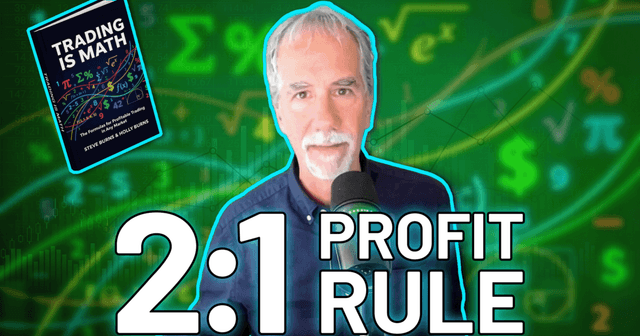

The 2-to-1 Rule That Makes You Profitable
In This Episode
In this week's Stansberry Investor Hour, Dan welcomes Steve Burns to the show. Steve is the founder of New Trader U, a blog with thousands of articles plus online courses.
Steve kicks things off by explaining how trading is math, detailing how its different components are formulaic. He says that understanding the "math" of expectancy for your returns can help you with managing your discipline, and knowing the risk-to-reward ratio for any trade is the first important step that every investor needs to take before they enter a trade. Steve notes that despite what many folks might believe, being right 50% of the time is pretty good. But even performing that well requires understanding the risks that your trades have...
It's good to taper your gains and losses to what you can mentally endure. It's going to be less than you think you can, especially with how big your capital is. Going into a 20% drawdown with multiple six figures is a lot different than going into a 20% drawdown with five figures. So you need to understand that. And math can help you understand the math of the drawdowns and the recovery time.
Next, Steve reflects on his early trading days, comparing his methodology and results then with his current strategies. Then he details one metric that determines profitability. It's the most important thing you need to be mindful of that will impact the profits your trades bring in, regardless of factors like win rates. And Steve analyzes the cons with modern trading that ease of entry has provided. Most individual investors don't realize these risks exist and stand poised to lose big...
The low barrier to entry provides the danger [of treating trading like gambling]... [The traders] bring in the gambling mentality... It's like the casino paradigm. The casino is a business model. They know the bet sizes they'll allow. They know what the edge is in all their games. They know they're going to win in the long term... And the traders come in with the gambler's paradigm, where they have the odds against them. They're randomly making gambles based on predictions and opinions, so they don't have an edge right out of the gate. And professionals will act like casinos and take their money.
Finally, Steve discusses how to create an edge in trading as an individual investor despite the overwhelming odds. He then explains "positive expectancy," a mathematical formula that shows your average losses versus your average wins. Knowing this can help you more properly filter out volatility, which traders should keep in mind when establishing their position sizes and stop losses. And Steve shares the green lights he looks for when entering a trade...
I'm looking for positive momentum. Whether that's a five-day, 20-day [exponential moving average] crossover, I found that to back test very well... But the key is that I have to have things in demand, if you want to be trading stuff like Nvidia or the semiconductor [exchange-traded funds] or Apple, you want to have things with built-in demand... You don't want to be buying junk off the bottom and things that have bad financials, because you want to find stocks that have good fundamentals. And then you could trade them using technicals. But you want solid fundamentals for what you trade.
Click on the image below to watch the video interview with Steve right now. For the audio version, click "Listen" above.

(Additional past episodes are located here.)
This Week's Guest
Steve Burns is the founder of New Trader U. He started investing in 1993 and trading with his own accounts in 1995. After accumulating nearly 20 years of experience, he founded New Trader U in 2011 to help traders improve their psychology and profitability.
Steve is the author of numerous books, including Trading Is Math, Moving Averages 101: Incredible Signals That Will Make You Money in the Stock Market, and Buy Signals Sell Signals: Strategic Stock Market Entries and Exits. He has also contributed to Trader's Planet, Trader's Magazine, and See It Market.
Dan Ferris: Math is fun. Math is awesome, and you need math to trade. Trading is math. Those are our lessons today, and it's going to be a lot of fun learning about them. The man who can teach us all those things is here. His name is Steve Burns. Let's talk with him. Let's do it right now.
Steve, it's great to have you here. And I have to know... I have to know. Most people think math is not sexy. But when I read your stuff and listen to you, I think, "OK, he's got my attention." And your thing is "Trading is like math." So, can you just lay it on me? How – where do we start? I don't even know where to start from here. How is trading like math?
Steve Burns: It's interesting. How that all started, I tweeted out one time, I said, "Trading is not predictions and opinions. Trading is math." And I tweeted that. And I had people start messaging me on Instagram and Twitter going up and saying, "What do you mean trading is math?"
Dan Ferris: Exactly.
Steve Burns: So, I thought "OK." In my mind, it's always natural. Risk-reward ratios, moving averages, positive expectancy. I always thought of it as how much your – how big your wins are, how many losses you have in a row, compounding interest, all the stuff. I thought that's very simple in my mind. It all makes sense. But people are saying what the heck do you mean? So, I had a private message. I explained all the different mathematical dynamics. And then I thought, "This is a really good reply. I'm going to share this on social media." And I shared it across all my social media platforms and it was one of the most viral things this year. It just went nuts with replies.
Dan Ferris: Who knew? People love math. I wouldn't have –
Steve Burns: Yeah, I could never – the title "Trading is math," when I – that was my title of my post and it went nuts and I've been trying to explain this for 15 years and, like you said, nobody ever cared.
Dan Ferris: If you said, "Hey, have you seen my viral math trading post?" I would be like, "No, does such a thing exist?" And apparently it does. So, all right, you tell me where we begin. Obviously, when you're trading securities there are prices, there are numbers and ratios in math everywhere. But when you just say, "Trading is math," that's – there's something that upsets the visceral balance of things because people think trading is about discipline. People who know, they'll say it's about the discipline. And, of course, you have to know the math of risk controls and position sizing and so forth, but that discipline is the sort of inhuman, weird thing that you must consistently do. You're not singing that song. I would guess you agree, but that's not the song you're singing. The song you're singing is "Trading is math." What are you trying to tell us?
Steve Burns: Yeah, I believe you're correct, but the discipline of actually following any kind of a trading or investing system could come from the math itself. If you understand the math of the expectancy of your system strategy or investment portfolio long term, it will help with the discipline.
Dan Ferris: I see. Got it. Right. That's what the discipline is about. OK. So, with other folks – and we've talked to a lot of people on here, man. We – I've been doing this since 2018, so it's like once a week since 2018, just dozens and dozens and dozens of market wizards and other really great traders. We all arrive at the same place, which I just said: the risk controls. They'll eventually – one of them, I forget who it was recently, he said, "Dan. I could almost pick trades randomly. I could randomly take the trade and just use my risk control and position sizing and then do that 10 times and probably still get a decent result." That's how important that is. I'm assuming this math you're talking about has a lot to do with that. Is that a good guess?
Steve Burns: Very good guess. It sounds like you're talking about Tom Basso and the late Van Tharp wrote a paper about the random entry strategy where they simply use risk-reward ratios, stop losses, and trailing stops to make money randomly by using the math of the positive expectancy.
Dan Ferris: Yeah, we knew Van well actually around here. He was a friend of the firm for years. But I wasn't specifically talking about them. I'm talking about somebody we interviewed recently. I'll remember it. I'm 64 now. The memory doesn't work the way it used to. But we need to inform our listeners on this. We need to tell them what is what. What is Steve talking about? And let's break it up. What is the first thing as a trader that if you're telling me, "Look, trading is math because –" and this is the first thing, what's the first thing that I should know?
Steve Burns: The first thing that applies to everybody from day traders to Warren Buffett value investors is the risk-to-reward ratio. I think that's first step. And that's the variance of your stop loss placement versus your profit target to start with. I think if you can get a 2-to-1 reward-to-risk ratio as your first step in whatever trading or investing style you do, I think that's the very first step that you can have a positive expectancy over a series of trades or investments.
Dan Ferris: Right. So, you want something that you think – your expectation is that it'll go up two or more times more than the stop loss you're willing to put in. So, if you're buying something at $10, and you think it's going to go to $12 your stop is at $9.
Steve Burns: Yeah. That's – yeah, that's the very first step. Of course, trend followers will want to have a 10-to-1 or 5-to-1. It's all different, but that's the first step.
Dan Ferris: I was going to ask because that is what I normally hear: 3-to-1, 10-to-1, 5-to-1. Nobody's ever bottomed it out at two.
Steve Burns: Yeah, but someday traders would do that because of the smaller intraday time frame, but if you get a 50% win rate with a 2-for-1 reward-to-risk ratio, that's profitable regardless. That's the first – very first basic step of math.
Dan Ferris: I'm glad you said that, Steve. I want the listeners to understand what Steve just said. If you're losing half the time but you're managing the risk to reward right, you can still make money. And this – I'm glad this came up because I think a lot of the times – we have a lot of individual subscribers in our newsletter business and individual investor readers. They're not institutions – they're just individuals managing their own accounts. And I remember as an individual, when I started out, I had this naïve viewpoint that there has to be something these people are doing that just wins every time. It's just wins every time. I just want to – all I want to do is double my money every time. I remember specifically a couple I met during the dot-com boom who said, "No, we didn't do this or this or this because we didn't want to make 50%. We wanted to make 100%." I thought "Well, OK." But the reality is, if you can be right half the time, you're pretty damn good, right?
Steve Burns: Oh yeah. And that's proven across – you know that from your years of the professional traders. Most great traders are right about 50% – 40%, 50% of the time. It's just the size of their wins that offsets their losses. And no new traders or new investors want to accept that. They want, like you said, 100% win rates. How can I double my money quickly? It's crazy how they start their mindset.
Dan Ferris: Right. So, I guess the first lesson here is what you said about the 2-to-1 risk to reward at least, and understanding that this is – you can immediately see why discipline is important because you have to reiterate. You have to reiterate and reiterate and reiterate and trade and trade and trade to generate the returns. There's no "I'm going to double my money every time." There is – "I'm going to do risk and reward right every time with great discipline." And then over time, if you do it right, you win. And even that, maybe you have a losing year every now and then, right?
Steve Burns: Yeah, that's the other thing. People can't stand to know professional traders have losing weeks, losing months, or even losing years. That's what baffles their mind. How can you be a professional trader and have a losing year? They think it's impossible.
Dan Ferris: Right. It's crazy. It sounds crazy. "I thought you know what you were doing." So, well, let's lean into that. If you know what you're doing and you have losing months – or a losing month or two or three or a losing year, is there a specific reaction to that? Is there an action to take? Or do you simply accept that as a part of your system?
Steve Burns: I think it's the expectancy. If you have back tested your strategy, if you're – let's say you're a buy-and-hold S&P 500 investor. Well, the safest if you're a buy-and-hold S&P 500, you can expect a 50% drawdown about every seven to 10 years. You can expect that. That's not going to be different. And you can expect about 12 to 15% annual returns on average on the S&P 500 buy and hold. And I think every trading and investing system is like that, where you have to have the expectancy of whatever your system is, your drawdown, which comes to the position sizing and how much you're going to lose per trade. If you're risking about 1% of your capital if you lose on a trade, and you have about a 50% win rate, you're going to have 10 – you could have 10 losing trades in a row and be down 10%. And that's math. And you – when you do what you like, you don't freak out. "Well, I can expect to have once or twice a year 10 losing trades in a row when the market environment changes." So, I think understanding the expectancy helps deal with the losses and drawdowns and losing streaks.
Dan Ferris: You know what my experience has been in this business, is that – and even personally. I haven't been perfect. I've blown myself up a few times in the last 30 years. I mean, not for many years now, but it happened. And the thing is you come to a place, don't you, Steve, where you really better know yourself extremely well because what you're doing is you're projecting forward in time your whole emotional and mental state when you're looking at a 20% drawdown or something. And you're saying, "Oh, no, it's in the system. I'll be OK." And then you get there and you do everything wrong because you just don't know yourself and you really don't have the discipline. If somebody's really determined and you know that they maybe don't have the experience, what in the world do you tell them? You know what I'm saying? I mean...
Steve Burns: Yeah, that's the thing. You have to go into it understanding the risk. And part of the math on that too is if you get a 10 – I try to keep my drawdown – same thing with you. I've had 50% drawdowns multiple times and been through those journeys. It taught me – I learned risk management through those. But I prefer now five or 10% drawdowns. So, if you get a 10% drawdown, the math says you need about 11% to get back to even. But if you get a 20% drawdown, you need 25% to get back to even. And then you get the 50% drawdown and you have to double your capital to get back to even. That math needs to inspire you to not have those drawdowns because whatever you're going for in returns, you're going to face the same reverse polarity in losses.
So, it's good to really, like you said, taper your gains and your losses to what you can mentally endure. Like you said, it's going to be a lot less than you think you can, especially with how big your capital is. Going into a 20% drawdown with multiple six figures is a lot different than going into a 20% drawdown with maybe five figures. So, you need to understand that and math can help you understand the math of the drawdowns and the recovery time.
Dan Ferris: Right. Yeah. No, what you just said is something I was told years and years and years ago. You cut your money in half, you've got to double it just to break even. And of course, I didn't appreciate it and then it happened to me and I thought, "Oh my God, I never, ever, ever want to do this again." And I was lucky that it happened when I was younger. And making those losses when you're younger, man, that's – I highly recommend it because you're going to make them. And you'd better make it when you have a lot less money and a lot more runway ahead of you to recover and learn and grow your capital. A lot of folks, though – we, like I said, we have all individual and – primarily overwhelmingly individual investors as listeners and readers and stuff. And we as a firm have been sort of obsessed with sticking to your stops, don't oversize the position, etc., etc. Those are the really two big ones, aren't they? Is there anything bigger? I always come back to that. Is there anything bigger than the honoring the stop and sizing the position right?
Steve Burns: Yeah, I like to measure total capital loss portrayed to understand your potential risk and – risk of ruin and drawdown. So, what percentage of your capital – if your stop losses hit based on your position sizing, how much of your capital do you think you're going to lose? And I really advise people to stay within 1% or 2% of capital loss if your stop losses hit. So, if you have, like I said, you have 10 losing trades in a row losing 1% per trade, you're going to be down 10%. If you're risking 2% of your capital and lose 10 trades, you're going to be down 20%. So, I like to think in terms of capital of risk per trade.
Dan Ferris: Right. And for you personally, what do most – is there a strict single position size or do you size it for the trade? Or how do you establish size? And what's your preferred size?
Steve Burns: Yeah, in general for my trading account, my more aggressive taxable trading account, I do about 10% position sizes. So, even if the stock goes down 10%, then it's a 1% loss. But I can go – but in my bigger, more aggressive capital that's tax- deferred in my retirement accounts, I'll go 20% in indexes. I like trading indexes or even leverage indexes sometimes with 20% position sizes, so even if it goes against me 5% I'm still only down 1% of capital.
Dan Ferris: Yeah, Steve, I have got to butt in here and say, "Folks, that is aggressive." You'd better know what the hell you're doing. You'd better have Steve's sense of discipline and his knowledge of math to go 10%, 20% on a position, just so you know. I've got to tell him that. Got to. When did you have – that – like I said, to me that's aggressive. To our average listener, that's going to be really aggressive. How did you come by this? Were you always this aggressive? Put it that way.
Steve Burns: This is tame. Everybody thinks I've got to stop. I'm tame now. I used to – there were years I'd hold half of my retirement in a single stock and did real well during the – 2003 to – yeah, I'm – this is so tame to me. But I learned a lot of lessons. Like you said, early on, I had a – the dot-com bubble popping taught me a lot of risk management lessons because I thought I had it all figured out in the '90s and everything changed. So, that taught me a lot. But I still came – but a lot of time my aggression, though, is usually in low volatility indexes or slower-moving stocks when I'm in my aggressiveness. But I usually cut – my biggest thing is I kept my stops really short. I usually won't be down a couple percent in a stock and I usually won't be down a percent or two to an index. I cut my stops really short. But if I'm right, I'll make multiple times more. So, that's really how I – tight stops is how I really manage. I mean, getting really good entries with good risk-to-reward ratios with tight stops.
Dan Ferris: Tight stops strictly observed. With – I don't know about the tight stops strictly observed, but with the big positions and the half the retirement account, You sound like Stanley Druckenmiller or somebody. You sound like one of these really big macro guys who place these massive levered bets. Do you still – and you still use leverage to this day?
Steve Burns: I'll use levered index ETFs, is about all I use. But like you said, younger – 10, 15 years ago, oh my goodness, I loved going big. And I was – I got so much luck in the '90s. It was just – it was so easy. And even another great – 2003 to 2007 was another great run. But I think after the financial crisis really, I did great avoiding the financial crisis losses because of my lessons from the dot-com pop. But after the financial crisis, I really cooled my jets. I mean...
Dan Ferris: Yeah, you and a lot of other folks, I'm sure. And the fact that we went through from just call it 2000 to 2008, that's eight years, two big drawdowns. Right?
Steve Burns: Yes.
Dan Ferris: That was – I think that that tamed a lot of folks. I bet you're not alone in that.
Steve Burns: Yes.
Dan Ferris: And then people went nuts on the resources and got whacked by 2012 or oil in 2014. It was like holy hell. It was just like one crushing blow after another. So, I understand that. When did you start trading? Did you start in the '90s?
Steve Burns: I started studying compounding gain charts in the – and I was 17 years old and I was so hungry to get going on compounding capital when I was 18. And yeah, I started – 1991 is when I started. I was about 18. I started just to get a little bit of capital, a little grubstake, and just started investing and growing and compounding at 18. And right into the '90s, which worked out great.
Dan Ferris: Yeah, that was a nice ride from '91 to 2000, basically. Wow. Yeah. We get a – man, I've talked to so many people. A lot of them that I talk to are maybe half a decade younger and they'll say, "Yeah, I started in '95 and it was great for five years. And then I lost 80% and I learned all the stuff that we're talking about today." That's the core conversation that I have with traders who – of that age. But it's good, isn't it?
Steve Burns: Yeah, it is.
Dan Ferris: It's good to have those experiences. Are you – can you share what happened to you in the bust, in the dot-com bust?
Steve Burns: Yeah, the dot-com – I was compounding – unaudited gains, not claiming my returns, I'm not audited, but I compounded about 20% returns every year through the '90s. I think I hit 40% in '99, about 45%. And I was just doing mutual funds back then. You didn't even – you didn't really have index ETFs so I was using mutual funds to – and highly – high-growth tech mutual funds. I remember one of my accounts had quadrupled in a few years. It was all tech mutual funds. But I ended up – I was more of an investor, really hardcore investor, sort of like the bitcoin people, like, "Tech is it." I thought tech was the future for the '90s. I thought it makes sense. I'm investing in tech and I'm doing the right thing at the right time just through almost blind chance. And I did not really – just – and then I ended up having about a 50% drawdown from my peak.
But the cool thing is even at a young age I had about enough to pay my house off when I was about 27 years old. I didn't do it.
Dan Ferris: Oh, that's cool.
Steve Burns: But I had enough. About 27. So, I thought "Man, this is the life." But then I had – then, inflation-adjusted it was a good amount of capital. I ended up getting about a 50% drawdown from my peak. I peaked – I think it was the double top of the Nasdaq 5000 where I didn't quite get there. That was my peak capital. And then I started aggressively moving in and out of it. I would buy dumps and sell and buy deep dips. I started trading more actively in 2001. Ended up losing – being down 50% from my peak. And I bottomed out around early 2003. And then I got back on my streak again. I started doing good double digit returns, like 20-some-percent a year through 2007. But I was a chicken. And that's when I also put half of my retirement into a single stock for – and it quadrupled. And so once again, I think I'm a genius. And then 2008. I started getting nervous thinking "Something's not right here. I'm not giving this money back again." And I slowly moved –
Dan Ferris: Steve, what was the stock? What was the quadruple?
Steve Burns: It was a company called Delhaize Group that was originally Food Lion. It was one of the fastest growing grocery chains pre-Walmart. And I was a bagger for them in the early '90s and I worked my way up to store manager in the mid '90s. So, I had an inside scoop of the – I worked there – I had an inside scoop of the business. So, I thought this doesn't make any sense. So, I invested heavily. And I exited.
Dan Ferris: That's cool. I would have thought you were going to say some bank or other or a home builder or something in that era. That's cool. I didn't expect that. Anyway, also, I wanted to say wasn't Nasdaq like a 70%, almost 80% drawdown in the dot-com?
Steve Burns: Yes. Yes.
Dan Ferris: And minus 50 for a tech heavy guy? Come on. That's –
Steve Burns: Yeah, I remember my – I remember in 2008, because I was managing my wife at the time's retirement account and she also got the double-digit return, 20% returns for the 2000s. And 2008, she was only at 5% in 2008 and I couldn't go short in that account. And my wife was upset. I mean, "You just only got 5% this year, in 2008?" I'm like, "Everybody else is tailing!"
Dan Ferris: I know. You made a positive return in 2008? You're a genius. Right?
Steve Burns: Yeah. She was – and that's when I thought I would never want to manage anybody's money. That's for sure.
Dan Ferris: Boy, I'll tell you, I thought – and I got a little pat on the back from our founder, Porter Stansberry, that year. He says, "Dan recommended Walmart –" and I think it was up 20% that year, and – oh, what was the insurance company? Berkley.
Steve Burns: Berkley. Oh, yeah. I remember them.
Dan Ferris: Berkley was up about 6% that year – a financial stock, essentially. And I was like –
Steve Burns: I remember that. I remember the IBD 50 was – turned into Berkshire Hathaway and Dollar General stores. They were public at the time. I was like, "What?" I remember the IBD flipped from tech to consumer staples and insurance and stuff in 2008. It was – those were funny times.
Dan Ferris: Yeah, you like IBD? You like Investor's Business Daily? You still read it?
Steve Burns: Oh, I read – I've read How to Make Money in Stocks by William J. O'Neill. I've read every edition of that book ever written. I think it's like five or six editions. I've read it and studied all those charts over and over again. One of my things I got started with. It really helped me find Priceline and Apple and back in – was it – yeah, 2007 and 2012. That was a good period for me for IBD.
Dan Ferris: So, you've – would you say that was your number one influence, the O'Neill books?
Steve Burns: I think I really ended up being more Paul Tudor Jones, more macro index trading. I think I evolved into that because the volatility of those individual stocks is where I made my big – my money and really established myself with money. But boy, the bigger you get, the harder it is for that volatility. It's no big deal when you're starting out.
Dan Ferris: Yeah, Chris Hohn takes huge positions in individual stocks. And I'm like – I'd be soiling myself. I just wouldn't be able to do it, frankly. So, I hear you. And I personally – any personal trading I do is small option positions on index funds. It's not anything big. And I'm mostly kind of a buy-and-hold guy. But the trading is all in – for the reasons that you're talking about, the trading is all the big sort of SPY, TLT, like that just because of that reason. TLT was a little volatile recently in the past few years even, too. But I agree. That's an interesting way to go. OK, so PTJ. That's a pretty good name. One of the original market wizards. I think he was in the first or second market wizard book. I don't remember.
Steve Burns: Yeah. I think my favorite thing about him is his lack of drawdowns because that was my thing. I bid so big for so long, it just – it wears you out. After 15, 20 years of that, it just gets to be – and you have enough money to be financially independent, you're like "Let's just keep it this way. And let's just –" you'll trade the same – just trade differently. Maintaining the wealth is different than getting the wealth in a lot of cases.
Dan Ferris: I have to say there is there's nothing like a loss here and there on a giant position size to really chase an individual. I think too many individuals kind of do what they call YOLO-ing now. There's a lot of people who I think are virtually gambling in the market right now in a variety of ways. But those moments, they're key, man. Aren't they? You've got to look yourself in the eye and say, "Uncle. I don't know what I'm doing." Or, "What I'm doing is really wrong and needs to be rethought." It's – that's – I guess what I'm trying to say, Steve, is you must agree that – let me put it this way. Is there a more important moment in a trader's career than when they figure out that those big losses are just intolerable? I wonder if there's a more important moment.
Steve Burns: The No. 1 thing that determines profitability is the size of your losses. If you have huge losses, you will be unprofitable. All other factors don't matter. It doesn't matter [your] win rate. It doesn't matter how big your wins are. It doesn't matter – because it's the – it's how your equity curve flows. It's going to eventually blow up on you. So, I think if you want to be profitable, keep your losses small. That's step No. 1.
Dan Ferris: It's totally counterintuitive, too. I'm glad you put it that way. Your profitability determines on the size of, what, your profits? No, your losses. This is great. I'm – I hope that our listeners are taking a lot of good notes here because these – Steve is tossing you off – this is pure trading gold. This is like market wizards-level gold. And we had Jack Schwager and two or three of the –
Steve Burns: Oh, man.
Dan Ferris: Yeah. Two or three of the wizards. You know Jack?
Steve Burns: Yeah, me and him have corresponded a lot over the last 15 years.
Dan Ferris: Oh. Did he ever ask you for an audited track record?
Steve Burns: He did not, but John Boik, he was going to write "Unknown Market" – well, not "Unknown Market," "Unknown Traders" back in the 2000s. And he did ask an audited track record, and John Boik was supposed to get together my track record in the 2000s – or was it the – the '90s back then. And I was supposed to be – but then the publisher wouldn't publish the – his "Unknown Trading Legends" book back in the '90s. So, that was a pretty cool – but I don't know if my size at the time would have – wouldn't have qualified for Market Wizards. I don't even know if – plus the problem was I've changed brokers so many times now. I would have kept all those statements had I had known that would have mattered one day. But I have not kept all those statements. I only have whatever my previous broker is for the last eight, nine years. So, that's fun.
Dan Ferris: Right. And for a lot of that time it's probably just hard copy statements through the mail. Right?
Steve Burns: Yes. Exactly. There was no online in the '90s. I remember doing all my – a lot of my trades on the phone where you had to push in buttons on the phone for your percentage of your portfolio allocation.
Dan Ferris: Wow. Yeah. I think actually this is an important topic, the fact that trading has become so frictionless and easy. Absolutely anyone can throw money into an account, fill out the online form, and you're in business just like that. And I don't know how I feel about this, honestly. I'm like, well, it is a good thing. Overall, I do believe it is a good thing. But I also know it's like making gambling easier. Just human nature. It's like making gambling easier. And that's going to create a lot of gambling addicts. I mean...
Steve Burns: It's like the low barrier to entry creates the danger. They provide liquidity, which is good for professionals, but it's no barrier to entry. Could you imagine if people could go practice law or practice medicine and make money on the weekend? And everybody's like, "Oh, yeah, I'll go do this court case and make $5,000." That's how – that's why it's so dangerous, is because there's no barrier to entry for trading now.
Dan Ferris: So, listen, folks, write down the words "low barrier to entry." Steve, why is a low barrier to entry bad? Why is that troublesome for a trader?
Steve Burns: Yeah, like you said, it's – they bring in the gambling mentality and they don't have a – it's like – just like at a casino, the casino paradigm where the casino is a business model. They know what their bet size is they will allow. They know what the edge is in all their games. And they know they're going to win long term. Those big giant casinos in Las Vegas aren't – they don't just do that for charity. They got all that from people losing money to them. And the traders come in with the gambler's paradigm where they have the odds against them. They're randomly making gambles based on predictions and opinions, so they don't have an edge right out of the gate. And the professionals are going to act like casinos and take their money through a positive expectancy they have on their own systems. And that's the – and nobody even thinks of it. It's math. The casino paradigm – the casino business model is math. It applies the same way for traders.
Dan Ferris: The math works in the casino's favor, not yours. Also, I would say – I'm 100% confident you'll agree with me on this. Also, that low barrier to entry means the competition is everywhere and it is ferocious, and it has more computers than you, and it has physics PhDs working at Renaissance, and it has every tool imaginable. AI. They have their data centers or whatever they're trading on nearer to the exchange, and they actually pay money to route the signal through the wire in the shortest possible way so they can trade at the highest possible frequency, which you absolutely cannot do without tens of millions of dollars. It's just – the competition is absolutely insane.
Steve Burns: And even on top of that, Robinhood is selling your order flow. You are liquidity for someone else to make money out of.
Dan Ferris: Yep. You're the exit. Your buy is some more informed trader's exit, just so you know. OK. So, now that we've beaten them down with the fact that there's no way they can compete, what do you do? Have we already really told them what you can do to get an edge back? Or is there something else?
Steve Burns: Well, the most – like we talked, about the best thing you can do to start with is do not have any big losses. That is controllable. You cannot control the size of your wins, but you can control the size of your losses with stop losses and position sizing. So, start with small losses, but you have to build a systematic process. And the best way to beat a high-frequency trader is be a low-frequency trader where you have your own system. Whatever it is, it has an edge, whether it's a day trader buying a range breakout the first 30 minutes, or if it's following swings or trends and having a quantified process where you've back tested it, you've seen how it operates in the – historically. You understand the risk-reward ratio. You understand the back-tested data. You find patterns in the market that repeat, and then you trade them, and then you create a positive expectancy model out of it where you know what your expect is. You know you're going to lose so much, you're going to win so much over a series of trades, and you know what environments it does best in.
But it's like a business. You're creating a business out of your trading, where you're buying merchandise at a price and selling it for a higher price, whether that's buying at the cheap, deep dip buys, or you're buying breakouts – high and sell, either buy low, sell high, or you're buy high, sell higher. But it has to be a quantified process with an edge that has a positive expectancy. And you know your numbers. You know your numbers. You know what to expect from your system.
Dan Ferris: So, I wonder if you can give us a good definition for sort of a layman who's not a mathematician. What do you mean by the term "positive expectancy?" That's a mathematical term, is it not?
Steve Burns: Yeah, it's a formula where you see what your trades, how many trades you have and what your average loss is versus your average win. So, you see what all your average losses are and what all your average wins are going to be, and does that equal a positive amount? So, you see the biggest factor in that formula will be the size of your losses. And the best way to be profitable is to have big wins; the best way to be unprofitable is to have big losses. So, you want to have an expectancy. And if you are controlling your stop losses and you know the market over time tends to trend or swing, so you know you're just trying to find a directional bias at any given time – it could be a signal. The Turtle Traders made fortunes – what was that, in the '80s, the late '80s? The Turtle Traders made a fortune with simple breakout systems with commodities because commodities tend to have big trends and they have much bigger trends than they do with the chop. So, if you can catch – if you have a system for capturing those big trends, huge wins, you're going to make money over time. So, their systems was simple. It wasn't breaking – a 55-day breakout and then sell if it breaks out down below – what was it? – 20, whatever, a 30-day low or something. A 55-day breakout and then half of that low you get out. And they made a fortune off of that. That was their system base. But also position sizing and volatility filters.
Dan Ferris: Yeah, 55-day breakouts. The Turtle Traders. I don't know if we need to get into who the Turtle Traders were. They were some of the market wizards, really, is all you need to know. And you can Google – what's his name? – Richard Dennis and William...
Steve Burns: Eckhardt.
Dan Ferris: Eckhardt. Thank you. Were the originals. OK. Yeah. So, when you – in other words, however you have traded for the past year, two, three, five, 10, you've generated a certain amount of gain or loss. And if you've generated a gain over a long enough period of time, let's just say, your system has demonstrated a positive expectancy. And if you've generated a loss over a long period of time, it's demonstrated a negative one and you'd better get a new system or you're going to have a problem. Simply put. But also, traders use this to look forward, too, don't they? You can sort of model a system for yourself and see if it works just by plugging in what? Different expectations for the average gain, different expectations for the stop loss you're willing to institute? And what – and are there any – there must be other key inputs. That sounds too simple to me.
Steve Burns: Yeah, well, volatility filters. You also need to consider the volatility of whatever you're trading and how your position-sized based on the stop loss. And the stop loss has to be based on the – on a technical level. If you've seen a chart bounce off the 200-day moving average six times in a row and you're going to buy right at the 200-day moving average, then your stop loss is at the 200-day moving average. You can have a bigger position size if your stop loss is tight. But if you're trading in the middle of a wildly volatile environment, you have to lower your position size. You have to filter an average true range. The average true range ("ATR") will show you how much your stock or your chart typically moves. So, you – if your ATR doubles, then you want to cut your position sizing in half because your risk has doubled. So, that is another – and I think the Turtles also used that in their commodity trading: filter volatility risk.
Dan Ferris: We could get into this a little more, but Steve, I know my listener and I know that – well, they're like me. They're human and they know something about finance and they are grateful for all this talk about position sizing and other risk controls, all the emphasis we've put on controlling the risk and keeping losses small, but eventually we all want to know how does this guy take a trade? How does the – what does the entry look like? What are you looking for to enter the trade?
Steve Burns: Yeah, I'm looking for positive momentum, whether that's a five-day, 20-day EMA crossover. I've found that back tested very well. And things that are under demand, especially indexes.
Dan Ferris: Exponential moving average, everybody. Sorry. EMA. Sorry.
Steve Burns: Yeah. It moves faster, it adjusts faster with the prices. So, if you back test a five-day, 20-day EMA crossover on the daily chart on most indexes or leading stocks, they have a positive expectancy over time. During bear markets they'll beat buy-and-hold. I mean, sometimes they don't quite beat buy and hold, but you can drop your drawdown in half when you actually have an exit strategy if you're trading the indexes or leading stocks. But the key is that I have to have things in demand. You want to be trading stuff like Nvidia or the semiconductors ETF or Apple. You want to have things with built-in demand or index – even sector index ETFs. You want to have things in demand. You don't want to be buying junk, junk off the bottom and things that have bad financials because you want to find stocks to have good fundamentals and then you can trade them using technicals. But you want solid fundamentals for what you trade.
Dan Ferris: Yeah, another thing that we often hear. And as a firm, Stansberry, we – I wouldn't say we pioneered it, but certainly in the newsletter business starting in the early 2000s, we were focused on quality back then. We were focused on good financials and good businesses back then. And that, of course, has become – many, many, many of our guests will say, "Yes, I trade momentum and enter trades this way and size them and all the rest of the things that you're talking about." But also, like you, we wind up here saying, "Don't buy garbage." And it's not just "Don't catch the falling knives that have negative momentum," is it? Because a great business can have negative momentum. And you want to keep an eye on it if you want to – maybe you want to short it, maybe you want to keep an eye on it for a bottom, whatever. But you want to keep an eye on it. The company with negative or positive minimum that is a piece of garbage, that's a red flag. And so, you won't trade them at all – honest Injun, Steve, you won't buy – I don't know, let me pick a decent one that had a run. Like the ARK Fund, ARKK or – which was loaded with garbage. And that thing had a heck of a run up to 2021. A heck of a run.
Steve Burns: Yeah. I added it to my watch list in 2021. I avoided it, I finally added it to my watch list, and then it just kept stopping me out. It's like "What, now it's garbage after that run?" But it had some good – those stocks, even though they were not fundamentally sound, they – like you said, they performed amazing during 2020, 2021. But this fundamentals still were not there. So, it was removed pretty quickly afterwards. But they did have some good stuff in there too. I do like ETFs with – diversified ETFs, I love them because they lower the volatility and risk through the diversification. But yeah, no, I don't go chasing – looking in dumpsters for stocks. The things that have always made – done well for me are things I knew. I had an Apple iPhone. Apple did great. I use Google every day. Google did great. They're not hidden.
Dan Ferris: Do you only trade stocks? Are you just buying and selling stocks? Or are you – do you use options as well?
Steve Burns: I did options heavily for 2007 to about 2013. I did play options during the good bull market years. But the volatility, wow. I tell you what, there was one year that I ended up being down 50% in the year with options. I was up – first I was up 70%. Then I was down 50%. And then I was back – finished the year up 52%. Not audited. I'm just sharing my experiences. But it's like I just – that's exhausting. It's just – and they're just so – they're priced so perfectly. The time decay and the prices are perfectly – 90% of the time, 90% of the time, it's so hard to even overcome the theta cost of the option, or the vega cost gets priced out when the volatility collapses. There's just a whole other dynamic that makes trading much more complicated. So, I had a great run. As usual, I got lucky out of the gate and got lucky and did well. And then reality set in. Then I went back to equities.
Dan Ferris: Yeah, if anybody doesn't know about options and you think you want to trade them, type the words "option Greeks" into a search engine and read all those five or six or seven things or whatever they are, those Greek words, and consider how multidimensional and complex the movement of the price of an – of a call or put option is. Just consider that please. Do that little exercise. I'm not saying you're going to swear off options, but you're going to understand that there's an aspect to them that is – it's a derivative. It's a derivative of another instrument, so it's got a layer of complexity to it. And boy, that's a fat layer, is all I want to tell you.
Steve Burns: And how good the option sellers are at pricing them accurately. You can actually do earnings with it. It's like bookmakers. Through earnings you could almost know what's going to move just based on the – even if you're right, on the right side of it, you can still lose money because of the vega crush after earnings. It's – that it's a professional level game. I think in the money options is what I used to – liked to trade the most with the highest delta because you could be right and make money a lot easier. You risk more, but the money options is what I preferred if you're going to go the option route.
Dan Ferris: All right, there you go. This is not advice.
Steve Burns: This is just not financial advice.
Dan Ferris: We're just talking. That's cool. So, let me ask you this, Steve. I know not – traders often don't like to tell you what's in the book at any given moment. And if you don't want to, that's cool. But is – can you tell us what is it right now that has you excited as a trader? What trades are the most exciting-looking to you right now?
Steve Burns: Well, this – man, today was a shocking turnaround, but right now I like the total – the Vanguard Total Stock Market. That is a strong – things that aren't exposed to AI and Nvidia and semiconductors right now have been doing – Apple. Apple is sort of like a consumer stock now. It just had a five-day, 20-day EMA crossover. Silver looks promising again. It also had a five-day, 20 EMA crossover. So, not investment advice, but right now I'm long the Vanguard Total Stock Market. I'm long the Dow, the DIA ETF, and the – and silver. Not investment advice, just my current position, which could be stopped out of today or tomorrow. much
Dan Ferris: That's the other thing. You're talking to a trader. It doesn't mean he's going to be in it for the rest of his life or even for the rest of the next 10 minutes. That – Vanguard, that's not VOO, is it? Which one is it?
Steve Burns: I think it's VTI.
Steve Burns: VTI. OK. All right. Just for folks to have a look to see what they think. We're not telling you to buy or sell anything. All right. Steve, this is – I could do this for a couple hours. I'm having fun. You're a good talker. I love good talkers. But we really should ask our final question right now. And the final question is the same for every guest. It's absolutely identical. Even when I don't talk to people in finance – every now and then I'll talk to somebody who's a health expert or something, and it's the identical final question. If you've already said the answer to it in our conversation, just repeat it. It's – no worries. The question is simple. It's for our listeners' benefit. Can you just give them one thought, one takeaway that you'd like them to go away from this with today?
Steve Burns: If you're an employee and you're listening to me, I think it's crucial that you turn your earned income into investment income by buying into investments. For me, what I've always done is the equity in companies. If you work for a company, you need to be owning the stock in the company if you believe it and know what it is. You need to move from being an employee selling your time for money to an investor or business owner, where you are buying and investing in assets. That's the only way to hedge against inflation. Inflation will just kill your earned wages, especially over the last six years. So, that's what I would say, is money is not just something you spend to have fun with and optimize your lifestyle. Your earned capital, your earned income should be converted to investment capital in any way you can do it. And that's where the – that's how you grow wealth. And your real wealth is your net worth, not your earned income. So, financial independence is always something I've been very passionate about. That's really what started me on my own journey and everything I've done in my life. My job – my passion wasn't to have a 40-year career. My passion was to retire as quickly as I could. That's what I pursued. And I tell you, it's a journey well worth going through if you can sacrifice for a few years.
Dan Ferris: Excellent answer. I love that answer. That speaks straight to our mission in life. So, I don't know. You don't want to be an employee, so we can't hire you but we'll have you back on the podcast to repeat it in six or 12 months. But thanks for being here, Steve. I really enjoyed talking with you.
Steve Burns: That was a great conversation. That was just outstanding. Thank you so much for having me.
Dan Ferris: All right. You bet. Thank you.
Well, that was a heck of a lot of fun. And if somebody told you that, hey, there's this episode of this podcast and they're talking about the fact that trading is math and it's a lot of fun, I know you would be highly skeptical. But you just heard it, so you know that it's true. And that Steve Burns' book, by the way, as we mentioned. It's called Trading is Math by Steve Burns and Holly Burns. And it basically tells you all, chapter and verse much more detail of all the things we talked about today, which is – Steve's been on this journey for 15 years and he's finally getting people to listen to the fact that trading is math and that that's a very exciting, wonderful thing. He's got a million social media followers. I'm thrilled to have this guy on the show and to communicate this message because it is true. If you can't face up to the fact that trading is math, maybe trading is not your thing. If you can embrace it, and he makes it a lot easier to do that, then maybe you can do it and make some money at it.
So, really super exciting. I really enjoyed that interview with Steve. Another great interview. Another great episode of the Stansberry Investor Hour. I really truly hope you enjoyed it as much as we did.
Announcer: Opinions expressed on this program are solely those of the contributor and do not necessarily reflect the opinions of Stansberry Research, its parent company, or affiliates.
Stansberry Research does not guarantee any specific
[End of Audio]
George Noble: Why the Tesla and AI Bubble Will 'End Badly'
Everyone Trades Too Much... And It's Costing Them Everything
What Big Money Is Doing While Everyone Else Is Guessing
The Diesel Crisis That Could Send Gas to $10 Overnight