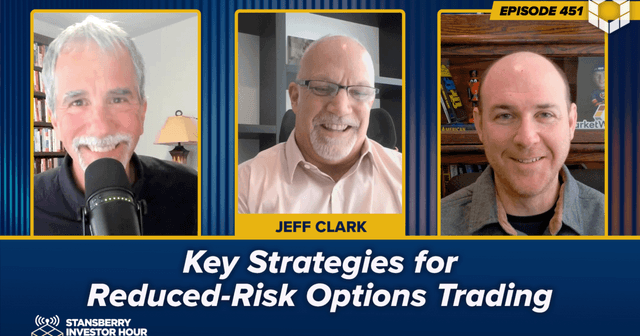

Key Strategies for Reduced-Risk Options Trading
In This Episode
In this week's Stansberry Investor Hour, Dan and Corey welcome Jeff Clark to the show. Jeff is the editor of Jeff Clark Trader, a newsletter focused on options trading. Using his decades' worth of experience, Jeff helps his subscribers profit from options regardless of the market environment.
Jeff kicks things off by stating how options trading can be a great way to invest. He says if you're responsible, you can reduce your risk and improve your upside in a trade. He then dissects a core rule of trading: maintaining discipline. Knowing how much capital you're willing to risk in a trade is the first step. Jeff says a common mistake folks make is putting all their money in without proper risk assessment. On the other hand, he warns that handling winners is equally important. Knowing when to take money out of winning trades can help you preserve your gains...
As you're making money – and sometimes it's life-changing gains that you can make in the market... you have to pull some back to secure your new step up in the monetary world, if you will. It's kind of like Who Wants to Be a Millionaire. You get to a certain level, and if you keep going on, they guarantee you can't fall back below this. So you get some money off of it and take some of the pressure off. That's what taking money out of the market allows you to do.
Next, Jeff shares some of his personal rules and strategies. He provides two consistent rules that he uses in his trades. However, he also acknowledges that the market is constantly fluctuating and explains his strategies in a few different market scenarios. Jeff follows up by detailing how much money he's willing to risk in certain trades based on his portfolio. When the topic of AI is brought up, Jeff says that while it's great in analyzing data in the long term, he believes it can't predict how investors can react in the short term...
The great thing about the AI stuff and the technology and putting all this stuff into it, [is that] it does leverage your time a little bit better. But the one thing that can't ever be replaced – and I don't think AI will ever catch on to this – is [that it] can't gauge human emotions. The stock market on a short-term basis is a function of emotions... All of these things tend to happen [during a panic] and people freeze up. And I do that, too. The difference is I've been doing this long enough that I recognize that I'm freezing up. And so the mind kicks in and says, "OK, this is the time you have to override the emotions." And that's what allows me to take on a larger position.
Finally, Jeff emphasizes how investors won't know when a stock has peaked and when it has bottomed until long after the moment has passed. As a result, he warns against bottom fishing and thinking you're getting a good deal on a stock, because it just might keep sliding down. Additionally, he thinks that investors should be responsible with their money, especially the older they get. Making risky plays with retirement money is never a wise decision. Jeff then wraps things up by showing how to earn income by selling uncovered puts...
All you're doing [by selling uncovered puts] is you're basically agreeing to buy a stock that you want to own anyway at the price you're willing to pay, and you're getting paid to make that commitment. That's like going into a store at Christmastime and you notice that a sweater is on sale for maybe 100 bucks. And you go to the cashier and you say, "Look, if this thing ever goes on sale for 90 bucks, I'm willing to buy it." And the cashier goes into the cash register and takes out five bucks and hands it to you, and you walk away. And then if it does go on sale for $90, you go back to [the store], you buy it for 90. And if it doesn't go on sale for $90, you got your five bucks, and you can maybe make that same deal again.
Click on the image below to watch the video interview with Jeff right now. For the audio version, click "Listen" above.

(Additional past episodes are located here.)
This Week's Guest
Jeff Clark is the editor at Jeff Clark Trader, an options-focused newsletter. Using the same strategy he used for his clients – about 100 of California's wealthiest individuals – Jeff shares the techniques he learned exclusively with his loyal subscribers. Jeff began writing newsletters after retiring from his independent, San Francisco-based brokerage house and private money-management firm at the age of 42. Before that, he developed the curricula for an international Master of Business Administration program and founded an investor-education firm.
Jeff has previously edited two successful trading letters for Stansberry Research, The Short Report and Pro Trader, for more than 15 years. Since 2005, his subscribers have had the opportunity to make triple-digit gains more than 50 times and double-digit gains more than 160 times.
Dan Ferris: Hello, and welcome to the Stansberry Investor Hour. I'm Dan Ferris. I'm the editor of Extreme Value and The Ferris Report, both published by Stansberry Research.
Corey McLaughlin: And I'm Corey McLaughlin, editor of the Stansberry Daily Digest. Today we talk with Jeff Clark of Jeff Clark Trader.
Dan Ferris: Jeff is an old friend. I've probably known him 20 years. I haven't talked to him in 10. Just saw him a couple weeks ago, but before that, I haven't talked to him in a long, long time. This guy has been around for decades. He is a veteran, experienced trader. He focuses solely on options. If you're interested in options, you've got to get your pens and pencils out and take notes. So, let's do it. Let's talk with Jeff Clark. Let's do it right now.
Jeff Clark, my old friend. Good to see you again. Thanks for being on the show today.
Jeff Clark: It's my pleasure, Dan. Nice to see you as well.
Dan Ferris: Yeah, so as we – just before we hit the record button we saw each other recently at a meeting in Philadelphia and now we're doing the podcast. So, maybe we'll make an agreement to see each other more than twice every 10 years, just starting right now.
Jeff Clark: Yeah, I think it was kind of fun. We hadn't seen each other for 10 or 12 years and then all of a sudden it's twice in a couple of weeks. So, I missed you, man. It's good to see you.
Dan Ferris: Let's get you familiar with – let's get our listeners familiar with you. You've had quite a career. You've done some really interesting things. So, we don't want to spend 10 minutes on it or anything, but maybe give them the 30-second Jeff Clark resume, because it's really cool.
Jeff Clark: Well, I've been trading in the market since I was – well, before I was an adult. I got my broker's license literally three days after I turned 18, ran a brokerage firm, started my own brokerage firm. I specialized in trading options. So, we had a little boutique shop that we were basically one of the very few sole option trading firms in the country, I believe. Retired from that business on September 30, 2007, is when I turned in the keys to the office – which if you're going to retire from a brokerage business, September 30, 2007 was a pretty good time to do that.
Dan Ferris: Yeah, you're about 10 days from the top there, I think. That's awesome.
Jeff Clark: Yeah, that worked out pretty well. And ever since then, I wanted to stay sharp. I wanted to maintain my business practice and my investment practice as well. And so, I decided that maybe the best way to do that would be to share my research through newsletter writing. And I was picked up by Porter Stansberry, who got me my first start in the business here. And I've been writing newsletters ever since.
My particular specialty, as I mentioned before, it's option trading. And a lot of folks, they wig out a little bit when you talk about trading options because people oftentimes a lot of times associate option trading with risk, when it really should be the opposite. Options were designed to reduce risk. And so, my entire career, that's what I've focused on, is I use options. Rather than going out and buying a stock, what I try to do is I take an idea like you might have a favorite stock out there, I'll take that stock idea, I'll go over to the options market and create a strategy using options that allows me to increase the potential reward on that stock while at the same time reducing the risk of that. And that's basically my philosophy. That's how I ran my brokerage firm. That's how I've run my own personal investments. And that's how I deal with things in the newsletter business.
Dan Ferris: Great. I love that. I love the asymmetry of that, increasing the upside, decreasing the downside. And you're right, I think a lot of people hear "options trading" and they do wig out, as you say because they think it's super risky. And the way a lot of people do it, let's be honest, is super risky.
Jeff Clark: Well, yes. If you use options to gamble, you don't – gamblers are going to lose money. And so, the trick is not to gamble with it. And there are all sorts of different strategies you can utilize in the options market that allows you to do exactly what I just defined: reduce your risk, increase your potential reward, and not gamble. And as long as you have some sort of a discipline that allows you to – or prevents you from blowing up your account, then there's really no reason to trade anything other than options.
Corey McLaughlin: I just have a quick follow-up on your background, real quick before we get into more of the strategy and whatnot.
Jeff Clark: Sure.
Corey McLaughlin: Why did you get into options right off the bat? That seems like a –
Jeff Clark: Oh, gosh. That's a great question.
Corey McLaughlin: It seems like a brave, big jump.
Jeff Clark: When I was a little kid, I think I started following the stock market – this was – I was such a messed-up child. I was eight years old. I started following the stock market. So, when I first got into the brokerage business, like I said, it was just a few days after I had turned 18 and I was a pure fundamental investor. I was Dan Ferris, just a mini little Dan Ferris. And that's all I did. I looked at stocks and I looked at fundamental investing. I did the whole [Benjamin] Graham and [David] Dodd thing and all that sort of stuff.
Then I was hanging out in the office one afternoon, maybe a month after I got my license. There was a handful of guys in the back of the office high-fiving each other and doing stuff. And I said, "Hey, what's going on?" And they showed me this option play that they had just tripled their money on. And I said, "Well, that's an interesting situation." All I had known at the time about options was just enough to get me through the Series 7 exam and get my broker's license. So, I thought "OK, I'll spend a little time on this."
So, my very first option trade, I took $450 and I bought three – at the time they were called OEX index options. That was the S&P 100. And I bought three of them at a buck and a half, $450. And then I was still in college at the time, so I went off to school, came back in the afternoon, and they were trading for four and a half. And I said, "Oh, that's a nice little windfall for an afternoon." So, I sold and made a little bit of money off of it. I thought "OK, maybe I ought to spend a little bit of time and figure out exactly how this stuff works." And I'm telling you, I – the first 17 trades that I made, I more than doubled my money on every single trade. I would never bet more than $500 or $1,000. And I went 17 for 17. And I have to tell you, when you're an 18-year-old kid still going to college, when you go 17 for 17 there's a change in the personality. You think you can do no wrong and you become supernatural.
[Crosstalk]
And so, I finally – I figured out, I said, "Why am I playing around with $500 or $1,000? Why don't I just take the whole wad and throw it all into a handful of option trades?" And so, I took my account, threw it all into option trades. And you can guess what happened next. The next five option trades just absolutely spectacularly blew up on me and I lost everything in that. I thought "OK, there's – there must be some way to use options, the power that had managed to work out well, 17 for 17, and then avoid those five." Obviously, getting the ego under control and everything else helps to do that.
So, that's how I crafted the option strategy that I use and basically decided that it's not for gambling. It's really – there's two things that I know for sure after spending 40 years in this business. One is I can take any stock ideas, I can go over to the option market, and I can create a better trade using options, one that will give you more reward and less risk. And the second thing is any strategy used with options, as long as you develop a discipline that prevents you from blowing up your account, will be profitable over time. Those are the two fundamental things that I will absolutely die on those hills.
Dan Ferris: Right. And I was going to say before, we talked about discipline minutes into this interview. We got to discipline and not blowing up your account. It's not sexy but you can't make money doing this kind of thing without it. Right? That's just impossible.
Jeff Clark: Well, no, if you want to get rich overnight you go into the casinos and you put all of your money on black or on red and you take one spin and then you leave. If you want to do that on options, it's the same thing. You make one trade and you leave. But nobody ever does that. You make money at the casino, then you stick around until you've lost everything. And in the options market, if you want to stick around – and I will be playing this game forever, as long as I've got breath in me because I enjoy it. I love it. It's a passion of mine. In order to exist in the options market for any length of time you have to have a discipline and you have to be able to prevent yourself from doing stupid things.
Dan Ferris: Prevent yourself from doing stupid things. Another not sexy thing that is absolutely essential. And we always get here. My point is, to my listeners, we always get here. We got here sooner with you, Jeff, than we normally do with most of the traders we talk with, but we always arrive at this place. Risk control, risk control, risk control. You either do it or you're wiped out. It's just really that simple.
Jeff Clark: Absolutely.
Dan Ferris: OK. So, your risk control sounds like – there's two parts here that I'm sort of hearing and you can clarify this for me. One part would – based on that 17 for 17 and then losing it all, would probably be I'm going to guess position sizing. And then another part of it sounds like trade structure.
Jeff Clark: Oh, absolutely.
Dan Ferris: Those sound like two important ones.
Jeff Clark: The simplest way to do it is if you think of it like this. Let's say you've got a stock that you like. I don't know, what's a popular stock these days? Nvidia. So, you like your Nvidia. It's trading around, what, $170 a share. And you think "OK, I'll buy 100 shares." Well, that's $17,000. What do you risk on $17,000? At what point would you stop out of the trade and admit you're wrong? Is it 10%? Is it 20%? Whatever it is, I take that number. Let's say it's 10%. So, 10% of $17,000 is $1,700. I'll take that $1,700 and that's the most amount of capital I'm willing to put at risk. In fact, I'll cut it in half. I'll take $850 and say that's the most amount of capital. So, now I'm not risking even what I would be willing to risk on the stock.
Leave the other – the rest of the money sitting in the bank accounts, earning Treasury interest, whatever. And I'll take that $850 and go to the option market and I'll structure a trade that allows me with $850 to do better if Nvidia goes up than I would have if I owned the stock and to lose less if Nvidia goes down because I've only risked $850. So, that's a very simplistic way to do it. But what a lot of folks do when they enter the option market is instead of putting $17,000 into Nvidia and instead of doing $850 like I would do, they take the entire $17,000 and they throw it into the options. And of course, you know what happens when that – when you do that. Either you get lucky and you're right, and you learn the absolute worst possible lesson you can learn – meaning that you've made all of this money and this is a wonderful treasure trove in the options markets so "I'll do that again," and you do that until you eventually blow up your account – or you blow up your account first off and then you swear off options forever. Neither one of those is a good outcome.
Dan Ferris: Yeah. Well –
Corey McLaughlin: Yep. Those are the two outcomes. That's for sure.
Dan Ferris: Right. Right. And there's nothing like – it's funny, some folks we've had – it must have been at this point a couple hundred traders on the show, short-term kind of traders, including options traders on the show, and futures traders like market wizard types, and they always – put it this way. You sound just like them. You sound exactly like all of them.
[Crosstalk]
Jeff Clark: [Inaudible]
Dan Ferris: Well, no, that's what's interesting, is that you have a lot that's unique. You're – some of them trade futures. They're not doing what you're doing. The options traders, some of them, they only do certain kinds of spreads or whatever. But what's the real point there is when I say you sound like all of them, you're not – this isn't boring. This is a way to get – to make money in the market without losing a lot of it, and that's not boring. The point is that 200 different people can approach the market in their own unique way and wind up with the same principles. It's a beautiful thing. I buy stocks mostly. I do options trading but it's like there's one trade that I just do all the time if it – provided that the setup is right, which it is, like, 95% of the time. So, that's different than what you do. You're not buying any stocks at all. You're only – you're creating these options trades based on what you see in the stock market. Something completely different. And yet the core principles are the same. To me, that is profound and unappreciated.
Jeff Clark: I agree with you. I think most folks don't recognize that. If you're going to be successful in the financial markets, you have to have a focus on risk. The rewards will take care of themselves, but it's the risk that poses the danger to your longevity in this business. And we're all sitting here. We're not teenagers anymore, so we're not playing Kalshi in the prediction markets, with any serious money anyway. But where the serious money is is in being able to control the risk side of the equation.
Dan Ferris: OK. I want to talk about specific option strategies that you use. But first, I have a particular question in mind. It's something that I'm actually writing the – as we speak here, I'm going to be writing the Stansberry Daily Digest that will be published the day after this recording is being done. And the basic topic is we talk a lot about how to handle loss. Keep your position sizes small, cut your losses quickly, etc. But we never talk about the worry, and it is a worry for those in – the worry of how to handle a big win, especially a big speculative win, like a lot of people are holding right this split second in silver. Silver has gone on a ballistic run. And you and I both know, Jeff, we've been around the block, we know that a lot of people – this could easily wind up like a meme stock. Lots of people are rich for 10 minutes and then they're wiped out. And lots of people pour in at the top and then they stay – overstay because they don't control the risk. So, handling a winner – handling a loser is really important. You've got to cut those losses. Handling winners is really important because a lot of folks are winning right now in silver and gold.
Jeff Clark: Oh, absolutely. If you think back to the Internet-bubble days – and I've got a great story with this – I had a buddy of mine who used to work out at the same gym with me. And he somehow got to invest in Commerce One. CMRC was the symbol. Business-to-business enterprise, whatever you call it anymore. Anyway, he invested $10,000 pre-IPO. They IPO'd and his $10,000 was all of a sudden worth about $7 million. And he held on to the stock. He was in a lockout period, so he couldn't do anything with it. And as the stock continued up and the Internet bubble inflated, it became worth about $25 million.
Now, at the time he was able to sell some of it. And so, I was encouraging him, I said, "Look, you ought to take some money off the table. You went from $10,000 to $25 million. Maybe pull a little in." And he said no because he had read an article in the Contra Costa Times that said that this stock which was currently trading at $300 was worth $1,000. And I said – I won't use his name, but I said, "Look, you have life-changing gains. You went from $10,000 to $25 million. That changes your standard of living. If you triple that and you go from $25 million to $75 million, you really haven't changed your life that much. So, at least take out enough of it to where you can sustain yourself in this new stratosphere in your life and go do something with it. Go buy the ranch that you are talking about. Go do whatever."
So, after some arm twisting, he did that. He took enough money out so that he could establish himself as a rancher down in Southern California. And fortunately, he did that because Commerce One eventually went to zero. So, it was a $300 stock. I think it peaked somewhere around $350 and then all of a sudden it's at zero. So, I guess the longwinded point of that is as you're making money, and sometimes it's life-changing gains that you can make in the market, as that's happening, you've got to pull some back to secure your new step up in the monetary world, if you will. It's kind of like Who Wants to be a Millionaire? You get to a certain level, and if you keep going on, they guarantee you can't fall back below this so you get some money off of it and it takes some of the pressure off. That's what taking money out of the market allows you to do, is it takes some of that pressure off. Because this is a this is a longevity game. We're going to be doing this for forever. And the only way that you can persist in doing that is if you are constantly taking money off the table.
The rewards of this will take care of themselves but the focus 100 – I shouldn't say 100% but a large portion of the focus ought to be on managing risks, allowing the rewards to take care of themselves. But then you've also got to pull something back. So, you can't look at any one individual trade and say, "Hey, this is the one where I have to maximize my possible gains." No, because as soon as you start thinking that, I promise you, you'll turn around and you'll be in the bathroom one day and your silver went from $115 an ounce to $50 an ounce and you'll be kicking yourself for making that trip.
Dan Ferris: You know what fascinates me about this is that – that's a great story. And thank God for Jeff Clark. And I bet that guy is so grateful to you.
Jeff Clark: Well, he didn't like me when it went from $300 to $350.
Dan Ferris: Well, yeah, he didn't like you then. But $350 to zero was a lesson for him.
Jeff Clark: Yeah, he certainly appreciated it a couple years after the blowup of the dot-com bubble and the rest of the –
[Crosstalk]
Corey McLaughlin: It never got to $1,000, it sounds like.
Jeff Clark: What's that, Corey? Sorry.
Corey McLaughlin: I was saying, so, it never got to $1,000, it sounds like.
Jeff Clark: Oh, no, no. It peaked out well short of $400 and then it was over.
Dan Ferris: All right.
Jeff Clark: I think actually that article I was talking about was published in February, and then of course the Internet bubble popped, I think, in March. So, yeah.
Dan Ferris: Yeah, how about that? Sign of the top. Anecdotally, of course. But what I was saying was what fascinates me here is that whether you're cutting losses or preserving gains, you're doing the same job either way. You're controlling risk. You're preserving wealth so that you can build on it in the future. You're –
Jeff Clark: And that's all the smart stuff to do. The people who have a big win and then they just let it ride and ride and ride – and once in a while it's going to work out. But that is very similar to taking that big wad of cash and putting everything on black or red at the casino in that you learn a really poor lesson doing that, because maybe you've maximized your gains on this particular trade, but it's very unique that that happens. And if you make a strategy to consistently try to do that, eventually you will wind up with nothing because you will blow up your account and you'll lose everything because that's the wrong thing to do. The market is unforgiving to folks where the ego gets out of control. And I say that having blown up my account early on in my business career.
Corey McLaughlin: Do you have hard and fast rules that you use every single time to take profits? Or after doing this for 40-plus years do you have – leave room for adjustment there?
Jeff Clark: Well, there's always a little bit of wiggle room, but there are two rules that I stand by. I never put more into a trade that I'm willing to lose. So, when I say I take a small portion of what I would put into the stock and go over to the option market, for example, that Nvidia example, that $850, I'm willing to lose that because I was willing to risk $1,700 on the stock. So, instead of $17,000 I'm willing to risk 10%. I'll take half of that and I'll risk that in the option market. So, if I lose 100% of that, that's still better than losing 10% of the stock. So, I never play with more than I'm willing to lose 100% of, because you can't control it. Maybe Nvidia has some poor earnings announcement and it gaps down and where you thought you might be willing to cut your loss at half of that you don't have a chance to because it's become worthless overnight.
The other thing is on an option trade, if I'm buying options, if I'm speculating, whether I'm buying calls or puts, if I make 100%, I sell half the position. There's no ifs, ands, or buts about it. It's automatic because that takes my original capital off the table. I can still stay in the trade. So, if I'm really right on it and eventually it makes it to my target prices, I'll do well on that remaining half, but I've taken all of my risk off the table. I don't want to say I'm playing with house money, but that's technically what I'm doing once I've taken my capital back.
Dan Ferris: All right, let's talk – are there any – I assume that you operate multiple options strategies and you're not just doing one strategy?
Jeff Clark: Oh, no, they go all over the place. It just depends on what the market is allowing me to do. There are different strategies you do when the volatility is high versus when the volatility is low. I do three things with options. I generate income, and I do that by – usually by selling uncovered put options, and that works best when the volatility index is high. I take long-term big picture ideas. Like, if I thought the AI boom was going to continue for all year, I would figure out a way to take my favorite AI stocks, structure an option trade around that and then leave that and go take a nap for a year. And then I do short-term speculating.
Dan Ferris: OK. Let's talk about the last one first: short-term speculating. I know lots of folks are interested in this. So, let's hear from somebody who knows how to do it without blowing themselves up and making actual money at it and stuff how it's done. Is this just like you think something's going to go up so you buy a call option or you think it's going to fall and you buy a put option?
Jeff Clark: Well, that's the basic. That's the – if you boil it all down, that's what it is. But my particular – my favorite type of strategy is what we call reversion to the mean, which basically means I look for stocks that are either way extended to the upside or way extended to the downside relative to historic norms and I bet on those proverbial rubber bands snapping back. So, if I see a stock that is remarkably oversold and it falls in line with a lot of the technical analysis I do that shows that possibly it's on the verge of a reversal, then I'll look at that as an opportunity to maybe buy a call option on it. If I see something that's way overbought and it also based on technical analysis looks like that rally is waning and it's ready to start to fall, I'll attempt to buy a put option on it and I'll speculate with that under the provisions like I explained with Nvidia. I would figure out if I'm willing to buy the stock, how much I'm willing to buy, what portion of it I would say I'm wrong and I get out of the trade. Then I take that as my maximum amount of money that I would be willing to lose, and I'll take that over the options market and I'll craft a strategy using calls, oftentimes buying calls, that allows me to profit if the stock goes up and not lose any more than I'd be willing to risk on the stock if it was to fall.
Dan Ferris: You reverse it for the other – for puts.
Jeff Clark: Exactly. Yeah.
Dan Ferris: So, is there – I love the way you frame this. If you bought the stock, you'd be willing to lose X, and you'd take even less than X in your one example, your Nvidia example, and that's the maximum you're willing to lose.
Jeff Clark: Exactly.
Dan Ferris: Is that a set percentage for you? Is it a percentage of the portfolio? Where does that come from? Where does the amount come from?
Jeff Clark: For myself personally, I'll take a higher concentrated position depending on my confidence in the trade. So, if I see a stock that's trading, that normally trades at 15 times earnings and now it's trading at half that, it's trading at 7 times earnings. And I look at it on a technical basis and it looks oversold, it looks washed out, everybody in the world hates it, nobody's in love with it, and there are catalysts on the horizon that might spark a rally, like there might be a CEO change, there might be a new product that comes down the line, there might be an earnings announcement due out, anything that can justify a catalyst for that, I will take a larger than – I don't want to say larger than normal, because what's normal for me might be not normal for somebody else. But I know a lot of folks limit their stock exposure to 2% to 5% of the portfolio. I don't mind taking 10% to 15% of my portfolio and putting it into a particular trade. But again, it's on the parameters I just discussed, that if I put 10% into the stock, how much am I willing to risk? I might tighten that risk parameter a little bit and then move that smaller amount over to the options market. Does that make sense?
Dan Ferris: It does. So, let's say you've got a hundred thousand bucks. You're willing to put – you're willing to buy $10,000 of Nvidia. You're not going to put $10,000 into that. You're going to say "I'm willing to lose $1,000" and then maybe you're betting $500.
Jeff Clark: Exactly. Exactly.
Dan Ferris: Is that – OK.
Jeff Clark: So, when it comes down to the portfolio, it's a much smaller position, but it could still be a concentrated position because that $500, if it moves like Nvidia, it can – you can make $3,000 or $4,000 or $5,000 off of that $500.
Dan Ferris: Jeff, I want to underline this with a big fat Sharpie for our listeners. Listen to the way Jeff thought about how much to put into the option trade. How much would you buy? How much of the stock would you buy? How much of that would you be willing to lose? And then he's saying even less of that goes into the options trade. Generally speaking.
Jeff Clark: Yeah, that's exactly it. And again, it's a matter of longevity in this business. I know I'm not going to – if I hit it big on a trade, I know I'm still coming back tomorrow. It doesn't matter how much money I make on any individual trade. I'm coming back tomorrow. So, I have to have the habits enforced that allow me to stay in this business a long time.
Dan Ferris: All right, so let's talk about finding these things. You must – and you're doing technical analysis. You must be looking at a hundred charts a day or something.
Jeff Clark: It used to be that. Yes, I would look every Saturday morning, I'd get up early, I'd make a huge pot of coffee before anybody else in the house got up, and I would go through probably about 1,600 to 2,000 charts every Saturday. It was a – I enjoyed it but it's a lot of work. It's several hours of work. And I would look at patterns that looked interesting to me in terms of bottoming patterns or topping patterns and there's – if you've been doing this long enough, you can recognize things that look like they're ready to reverse. And then I'd see the ones that played out from the previous week. And I'd note that because if they played out recently, then the odds are pretty good that if I find another pattern that's very similar to it, it'll play out similarly. Not always, but oftentimes that tends to be the case.
Fortunately, now I'm over at TradeSmith and there are systems guys over there. They do a lot of quant stuff. They do a lot of computer stuff and they do everything else. One of the guys said to me, he says, "Look, I know you spend a lot of time hours doing this. Why don't you tell me exactly what you're looking for, which indicators you're using, the slope of the lines, all that sort of stuff, exactly what you're looking for and I'll see if I can't produce a program." And it took them a few months, but they did. They generated a program that now, instead of me looking at 2,000 different charts every Saturday morning, I get a spreadsheet that's got maybe 50 bottoming type patterns and 50 topping type patterns. And so, that's – every day I get that and my life is so much better now because of –
Dan Ferris: I'm going to look at the coffee futures because I'm looking to short coffee futures based on that because you're not making that pot every Saturday.
Corey McLaughlin: Well, hopefully you still get to enjoy coffee.
Jeff Clark: No, I'm still drinking as much coffee. It's just –
Corey McLaughlin: OK. All right. But yeah, that's –
Jeff Clark: I'm having a little bit more fun.
Corey McLaughlin: That's what we talk about – we've been talking about a lot recently, too, with AI and whatnot, applying technology to old ways of doing things. That's the perfect example right there, in your –
Jeff Clark: Yeah, and the great thing about the AI stuff and the technology and putting all this stuff into it, it does leverage your time a little bit better. But the one thing that can't ever be replaced, and I don't think AI will ever catch on to this, is you can't gauge human emotions. The stock market on a short-term basis is a function of emotions. Longer term we can talk about earnings and cash flow and dividend policy and all that sort of stuff. Short term, the reason IBM goes up for down 2% today isn't because the business changed 2% – it's because people's emotions towards IBM changed.
So, a chart in technical analysis at its basic nature is basically the emotion behind that stock at that particular moment in time. It's a snapshot of the emotion surrounding it. So, if you can spot emotional reversals or emotional peaks and troughs, then you can use technical analysis in a very nice way that allows you to profit off of those reversals as they come in. And all you have to do is look at every single time the market has bottomed in the past year, when there's been enough of a dip that things have sold off and people have panicked, there are things that happen at panic bottoms. That's usually when the VIX spikes above 30. You get incredibly oversold ratings on a number of different oscillators. All of these things tend to happen and people freeze up. And I do it too. The difference is I've been doing this long enough that I recognize that I'm freezing up. And so, the mind kicks in and says, "OK, this is the time you have to override the emotions."
And that's what allows me to take on a larger position. As stocks are falling, I can jump in and start buying them. And it's true when stocks are running up. You look at the gold and silver market right now and you can almost feel a crescendo in the emotion jumping into those trades. I don't think it's hit the peak yet, but man, it is – it feels like it's getting close to that. And I'll watch the charts and I'll watch the different oscillators and the different momentum indicators that I use to try to figure out where there's an opportunity to maybe bet on a reverse into the downside.
Dan Ferris: You are reminding me very much of John Netto right now. He's a trader we had on the show, and he is known amongst his peers as being – most of the traders we talk to say, "Everything I do is to get emotion out of the process entirely." They just want to follow the rules and keep their discipline and follow the position sizing and all the rules, the whole system they've created for themselves. But Netto is – sounds like you. He sounds like he's aware of that emotion. He's aware of the buildup of that bullishness on the way up and the pessimism near the bottom and has developed the ability instead of letting it work against him to use it in a trade.
Jeff Clark: Yeah. Being self-aware is a very helpful thing as a trader. If you sit there and you stare at a screen and you go, "Oh my God, the market's rallying. I don't have nearly enough long exposure," I know that's when I ought to be selling stuff. And if the market's falling and I say, "Oh my God, I need to get out," that's when I ought to be buying. And it's so – when I was younger, it was nearly impossible for me to do. Now I don't give a darn. Now I know how the game is and I've seen it happen so many times. And the thing is the world has a habit of not coming to an end. So, when it feels like the world is ending, that's when you have to be able to step up and step up in size.
Dan Ferris: So, I wonder – I want to ask you about silver right now. I mentioned it before, but it's – the chart has gone ballistic and I've said to my readers and our listeners a few times a ballistic chart doesn't usually resolve by going sideways.
Jeff Clark: This is true. This is true. And if it does, it will go sideways for a long time.
Dan Ferris: Right. Right. Yeah, you'll get a – and I feel like the more ballistic, the more – the longer the consolidation. But how do you – how would you counsel someone to handle this? Lots of people listening probably have 200%, 300%, 400% or more gains in this. What do you do, man? Is there anything to do here? Or just let it ride, observe your trailing stops? How do you handle this?
Jeff Clark: I would say how I handle it – because I have handled it recently. Understanding that parabolic moves always end badly. There's no forgiveness on that. You never know when it's going to end, but you know it's going to end badly. You can go back to any parabola and it erases almost the entire move. So, we know that that's a high probability in this particular situation. When I look at a chart of silver, yeah, clearly it looks like a parabolic move.
The other thing about silver is it's become part of the popular conversation. I think I told the story of a conference we were at. I said my wife came home one day and she said, "Honey, do we own any silver?" And of course I did. I had quite a bit of silver and had experienced a very nice run. And I said, "Why? Why would you ask?" She goes, "Oh, I just heard it was doing well and we could be all good." And so, I sold everything I owned the next day. And I think it was around $96 an ounce. Which I look like an idiot now because it's gone up to $115. But my point behind that is if my wife is familiar with what's going on in the silver market, that tells me it's become a very popular – unless they're talking about it on The Housewives of Beverly Hills or something like that, she picked it up from her friends who – they're not all into finance. It's different than us. We live the world of finance. My wife doesn't. She's in manufacturing. So, when she's talking about silver going up in price, I know it's hit the main conversation, so maybe it's time – it's flashing a little bit of a warning. Now, I wouldn't be interested in shorting silver yet, but it's almost at the point where that becomes a trade.
Now, if somebody came to me and said, "I have zero silver. Should I buy some now?" I would probably try to dissuade that person from jumping in because you just don't know. Yes, it could go higher, but I have a pretty good feeling weeks or months from now it will be lower than where it is. And I'd be – I'd much rather buy things when they're on sale than as the prices are taking off. If you're sitting on a bunch of silver – what did I say earlier about Commerce One? Take a little bit off. Be willing to cash in a little bit so you maintain that new step up in your elevated financial level and then set a stop on the rest so that if it comes down to a certain level, you say, "OK, I've had a wonderful run. It's time to get out." And then once you're out, give it some breathing room. Don't watch it every second of every day and wait for "Oh my God, I've got to get back in. Oh my God, I've got to do this." No, it's – sit out a little bit. Let the emotion get out of the market.
Dan Ferris: Sound – very prudent advice. Personally, I'm – I've got way more paper silver than physical silver. And I think I'm probably – at some point my paper silver will go to zero and I'll probably just hang on to the physical because it's not that much.
Jeff Clark: Yeah, I should clarify. Yeah, when I said I sold all my silver, I sold all my paper silver. I still have – I have my gold coins and my silver coins and all that sort of stuff, mostly because it's very difficult to sell that. I have to get my car and drive all the way to a coin dealer and I don't feel like doing that. So, I'm stuck with money in silver and gold.
Corey McLaughlin: No worries.
Dan Ferris: Somebody's got to do it. That's right.
Corey McLaughlin: Yeah, you're not the first person I've heard recently say – obviously it's gone parabolic, silver has, but it's still – you still don't think that it has – it could go higher.
[Crosstalk]
Jeff Clark: Yeah. Most of the stuff that I follow on it, the oscillators and momentum indicators that I use, they're sky-high but they're not showing any divergence, which tells me that even if we do pull back a little bit, we probably have one more run up. So, even though that pullback might be violent, it might be 10%, 15%, 20%, maybe even more than that, but there's probably still one more run up. Again, I sold mine, so I'm saying this from – I'm hoping for a pullback because I'd love to have that happen and then I'm able to get back in. But if I was counseling somebody who has a whole bunch of paper silver, I would probably say, "Take a little bit off and then just make sure you've got a stop on the rest. And if it stops you out, what do you care? You've made 3, 4, 5, 10 times your money in the last, what year?" What are we up, 300% in a year?
Dan Ferris: Yeah. Oh, yeah. It's crazy. Yeah, I think the one year – I just wrote it down, it was 200 and some percent, maybe 270% in the past year, but almost 60% since January 1st.
Jeff Clark: Oh, it's amazing.
Dan Ferris: A huge part of that gain has arrived recently. Yeah. You said earlier something that really is sticking in my mind. Basically, it's – correct me if I'm wrong. What I heard was you can't maximize the gain. You can only have a strategy for entry and exit and you work that and you get the gain that you get. The idea that you're going to maximize it, probably not going to happen. You'll catch plenty of profit. You're doing your system – you will catch plenty of profit.
Jeff Clark: Exactly.
Dan Ferris: But try to maximize it, call the top, stay in extra long? No. Not going to happen.
Jeff Clark: No, you're never going – I shouldn't say never, but you're rarely going to buy the absolute bottom and you're rarely going to sell at the absolute top. And if you get lucky and it happens, wonderful. But if you try to make a habit of that, you're either going to be too late to sell or you're going to wind up holding it through thinking that "Oh, no, I could get the top out of this. It'll come on back." And it doesn't work that way. And having been through a number of market cycles, I can tell you you'll get lucky once in a while, but it's not – you can't consistently maximize your gains.
Dan Ferris: There is no such skill as that, in other words. There's no such skill as picking tops and bottoms.
Jeff Clark: Well, you can get close, but you're never going to get the exact.
Dan Ferris: Right. You know when they're passed.
Jeff Clark: No, actually, you know what? You know when they're past but you only know far after that.
Dan Ferris: Exactly.
Jeff Clark: You think about the folks who traded the Internet bubble, they bought in late and they stayed and they rode it up, and then as it came back down – and this is what's happened in this particular market, is everybody's been conditioned to buy the dip. So, we get a dip and everybody jumps in and buys it and it goes back up. And then we get a dip again. "Oh, I'm supposed to buy the dip." They jump in. And there's going to be a time where that doesn't work, where the market corrects a little bit and they buy the dip and then it falls a little bit more. And then they buy that dip because "Geez, it was down 10%. I've got to love it down 20." And then that doesn't work. And then it's down 40%. They go, "Well, this is an absolute bargain." And they jump in and they buy Pets.com at 40% off of its high.
And then what happens is ultimately it doesn't bottom until that person who did this averaging down stuff all the way to the bottom finally says, "Forget it. I'm out." And then they get crushed and that's the absolute bottom of it and we run back up. So, my fear is people have been conditioned to buy the dip, and there's going to be a point where buying the dip doesn't work anymore. And you're not going to know that until it's much lower and much – far too late to do anything about it.
Dan Ferris: Right. So, just with silver, I want to sum up for our listeners, all the indicators are just – they're dimed. They're maxed out. And yet, they're not diverging yet. They're not falling off. But still you're in cautious mode. You've seen this movie before.
Jeff Clark: Yeah, that's a great way to illustrate it. It's not something – if it was diverging, then I might be looking at possibly taking a short trade because that rubber band is so far stretched to the upside it's about to snap back the other way. But without that divergence, I don't feel confident in taking a short trade. But you can look at a chart of silver and you can see this parabolic move and you go, "Well, it would be foolish not to take advantage of your good fortune at this point and trim a little bit off," especially if you have – if 50% of your net worth is now in silver. I'm not saying anybody has 50% of their net worth in silver, but you know what I mean?
Dan Ferris: Well, it's –
Jeff Clark: Somebody might. Somebody does.
Dan Ferris: Yeah, somebody out there, I'm sure, does. But that – and that idea, the YOLO trade, throw it all in and if you lose, so what that has – it got a lot of life during the meme stock thing. And –
Jeff Clark: Yeah, but you had a lot of life among people who have a lot of life left. When you're 20 years old, you've got a shot at it. It's only – if it's the government $600 check that you're using, I can – yeah I see somebody playing a lottery ticket off of that. But when you're 50-plus and you're staring at retirement or you're 70-plus and you're looking at "Hey, how do I make this last the next 30, 40, 50 years," however long you might be alive – God willing, 50 years – you have to be a little bit more responsible with your funds.
Dan Ferris: All right.
Jeff Clark: God, did I say that? Now I sound like, "Tell us another story, Grandpa Jeff."
Dan Ferris: Yeah. Well, like I said earlier, it's all the boring stuff that makes you. It really is. And this actively managing your own options portfolio isn't for everybody. We're not saying it's for everybody. But we're just saying there's a way to do it that – would you agree? Most folks could understand this. You're not doing rocket surgery.
Jeff Clark: Yeah, but Dan, I would say it is for everybody.
Dan Ferris: Oh, it is?
Jeff Clark: I'm going to argue that it is for everybody. I think managing your own options portfolio is something that folks ought to learn how to do because rather than making the standard 7% to 10% or 12% return on the S&P 500, you can do a lot better than that while taking on a lot less risk, but you have to know what you're doing. You have to be – you have to have a system that allows you to speculate a little bit reasonably and also generate income off of it at the same time. And that's really the idea behind most of my option strategies.
Corey McLaughlin: Yeah, the income piece is when – I feel like so many people could be using that today, too, who aren't, just because income is hard to come by and to keep up with inflation and whatever else. It's – when you're talking about people in or near retirement, I would – every person I've heard of who's gotten into – pretty much every person that I've talked to or heard from who's gotten into some of these strategies that you're talking about has been – if they learn it the right way has been very happy with it. I'm assuming you've –
Jeff Clark: Honestly, with the increase in the number of weekly options or the stocks that trade weekly options, the ability to generate income by selling uncovered puts or selling covered calls, if you want to go that route, is phenomenal. And the returns are just ridiculous. You can take a stock that is 10 times earnings, a stock that – first of all, if you're going to sell uncovered puts, the number one rule to selling uncovered puts is you only sell uncovered puts on stocks that you want to own at the strike prices where you want to own them. So, if you like the idea of owning AT&T and AT&T is, what, $23 a share? You like the idea of buying AT&T if it goes on sale at $20. So, you would sell an uncovered put at the strike price of $20. I'm just using it as an example here. If you don't like the idea of owning AT&T at any price, you don't sell an uncovered put on AT&T. So, all you're doing is you're basically agreeing to buy a stock that you want to own anyway at the price you're willing to pay and you're getting paid to make that commitment.
That is – that's like going into a store at Christmas time and you notice that a sweater is on sale for maybe $100. And you go to the cashier and you say, "Look, if this thing ever goes on sale for $90." And the cashier goes into the cash register and takes out $20 and hands it to you – not $20, $5 and hands it to you. And you walk away. And then if it does go on sale for $90 you go back and you buy it for $90. And if it doesn't go on sale for $90, you've got your $5 and you can maybe make that same deal again.
It is a phenomenal way to be willing to buy stocks. And oftentimes, when you are obligated to buy it – for example, last year during that whole meltdown in April, the tariff tantrum, I had a handful of uncovered puts. I had uncovered puts on Google, Advanced Micro Devices, a couple of others. And sure enough, they sliced right through my strike prices and I was forced to buy the stocks. Google is up over 100% since then. Advanced Micro Devices is up 300% since then. I haven't held them all the way through, but when I was up 30%, 40% on those stocks, I cashed out. So, where I was only making a little bit of money off of the income, I was forced to make capital gains on those trades. So, if you're willing to buy the stock, the other thing about selling uncovered puts is when that opportunity comes to buy the stock, you don't sit there and let your emotion get ahead of you. You've already contracted to buy it at those prices you were willing to pay in the place. So, you're forced to make capital gains. I love that about this strategy.
Dan Ferris: You're forced to buy a stock you love at a price that's lower than the one where you spotted it.
Jeff Clark: Well, based on a decision that you made when you were thinking rationally, when emotion wasn't overcoming you.
Dan Ferris: Right. Very good. All right, Jeff, it's time for our final question. Same question for every guest, no matter what the topic, even if it's a nonfinancial topic. Same identical question. And the question is simple. It's for our listeners. If you could provide them with one takeaway, with just one thought today, what would you like that to be?
Jeff Clark: Don't blind yourself to the fallacy that options are risky. Options are not risky. Options are best used as a way to reduce risk. And if you do it appropriately, options can be the most fabulous financial instrument you've ever seen.
Dan Ferris: Awesome. Where can listeners find out more about you?
Jeff Clark: You can go to jeffclarktrader.com. That's got a list of all of the products that that I write for, all of the subscription services I write for, and a brief background on who I am and what I do.
Dan Ferris: Awesome. Always a pleasure to see you, Jeff, and we're going to have you back sooner than 10 years, I promise.
Jeff Clark: I appreciate that. Dan, it was great to see you. Corey, nice to see you as well.
Dan Ferris: Folks, the White House is on a stock buying spree that is comparable to a hedge fund that has raised billions. And the stocks in question are surging as a direct result: 200% within 24 hours in one case, 90% in another. And that's just the tip of the iceberg, which is why we're hosting an urgent financial summit "The Stocks That Save America" on Tuesday, November 18. That's tomorrow. This event will feature a man you may know well, 50-year investing titan Rick Rule along with my guests today, Nick Hodge. Together they'll reveal why the success of some stocks could now be a matter of national security, how a select group of U.S. companies could soon play a historic role in rebuilding the nation's industrial backbone and the wealth of regular people, and the name and ticker of a free stock recommendation they believe could soar as this story accelerates. A stock I personally love, by the way. If you enjoyed today's episode, this briefing will be a must-see follow-up. Now, head over to www.whitehousestocks.com to learn more and reserve your spot. Again, that's www.whitehousestocks.com. Don't delay.
Well, I really didn't expect that. I've known Jeff for a very long time, probably 20 years at this point, but I had sort of lost touch with him and with his thinking and his investing style and strategies. And I didn't anticipate him saying, "No, I really do think everybody should and could learn to trade options with less risk." That was really interesting and it makes me really curious. Doesn't it make you want to read all his stuff now? It's like "OK, show me."
Corey McLaughlin: Yes, exactly. It does make me want to read all of his stuff. And it's – especially since – the strategies are one thing and we've talked about similar strategies with other people before, but to be doing it for over 40 years, He is proof that you can do it. You don't do – you don't sustain this for 40 years on accident. Like he said, when he first started, he kind of blew up, like a lot of other people doing options. I did the same thing. My first options trade, I remember, I think I made money on it. It was like a call option on something and I was like "Oh, wow, this is easy." And then the next one I lost everything. So, it's very – it's a very common story. But once you get through it into these other strategies that are like – this is what options were designed for, not to wildly speculate on on some bullish idea that you have. It's completely opposite. It's to reduce risk the right way. And so, yes, he's one of these guys that if you're interested in options at all, you should – you can follow.
Dan Ferris: Yep. And he's got all the experience and all of the tools that you wind up if you're a smart guy, like he is, that you develop over years and years to learn how to preserve what you've got and build it – on it in the future, to cut your losses short and let your winners run and all that good stuff. Just a great trader, in other words, with decades of experience behind him. And there we go.
Corey McLaughlin: Yeah, you know what's interesting about – what's maybe different about him, too? He's one of the first guys who's – I've heard say specifically one part of the strategy is short-term speculation, which a lot of people in some strategies stay away from, or do it and don't admit it. That's something – frankly, that's what people like to do the most. That's the easiest thing. A lot of people say, "Hey, I want to short-term speculate on this thing for two weeks or a month and that's what I want." It satisfies some need that we have. At least me.
Dan Ferris: It does.
Corey McLaughlin: And so, to have that as an actual strategy, though, and reasons and indicators behind that is a wise move, I would say.
Dan Ferris: Yeah, and I would go farther. I would say a really good gambler and a really great trader share some common elements in that. They're – they see their results generally pretty quickly and they're obsessed with controlling risk through position size and other means. So – and they're always assessing the odds of every trade or every hand or every – whatever kind of game you're playing. So, yeah. Yeah. And speculating, most people, I think, though, people I speak with, they talk about taking flyers and speculating as something where they limit the amount of loss because they know they really don't know shit about what they're buying. So, they have no idea what's going to happen in the next two weeks or months and they know that and they're – like you say, they're scratching an itch. They're satisfying that human need. Whereas, a guy like Jeff is doing it intelligently and with a real strategy and with risk controls and all that good stuff. So, I think he's got a – he puts a lot more into it than what most folks do. And most folks who speculate could learn an awful lot from a guy like him. Wow, yeah. Glad to talk to him. And I promise, if you like Jeff Clark, it won't be 10 years till the next time we speak with him.
Corey McLaughlin: Ten years. Yeah.
Dan Ferris: All right. Well, that was a lot of fun. That was a fun interview and a fun episode of the Stansberry Investor Hour. I hope you enjoyed it every bit as much as we really, truly did.
Announcer: Opinions expressed on this program are solely those of the contributor and do not necessarily reflect the opinions of Stansberry Research, its parent company, or affiliates.
[End of Audio]
Value Investing Is Dead. Here's What Replaces It.
Your 401(k) Is Quietly Distorting the Stock Market
The Hidden Flaw in Wall Street's Trillion-Dollar Math
George Noble: Why the Tesla and AI Bubble Will 'End Badly'