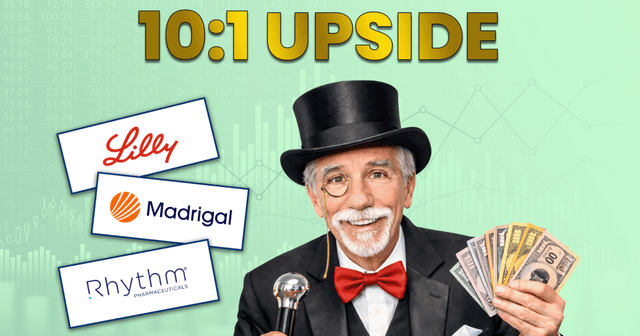

10:1 Risk/Reward: 3 Drug Monopolies Built for Massive Upside
In This Episode
In this week's Stansberry Investor Hour, Dan and John Engel welcome Dave Lashmet to the show. Dave is the editor of Stansberry Venture Technology, an advisory that takes a "venture capitalist" look at the market. Dave scours the market looking for little-known small-cap companies that are potentially producing the next wonder drug or technology.
Dave kicks things off by discussing the first of three biopharmaceutical companies he's sharing that have monopolies in weight-loss drugs. He starts by showing how drugs gain their monopolies via patents, giving them "economic exclusivity." While companies might be targeting the same patients, the patents influence how they're being treated. The first company gains an edge by not only targeting folks suffering from obesity, but also by treating those with Type 2 diabetes. Dave also explains the contrast in mentality between the U.S. and other countries regarding obesity being preventable. And he provides info showing how obesity is a "slippery slope" and shares that a study found that participants who got off the drug gained back the weight they lost before...
We pretend that obesity is entirely a matter of will and not a slippery slope. As you gain weight, you exercise less. As you exercise less, you gain weight. As you gain weight, you exercise less... These drugs can short-circuit that, but only if you stay on them. If you get off them, you're in trouble... Without these drugs, the control study basically gained back 25 pounds in six months.
Next, Dave sums up how the first company has cleared all of the risks and expenses from clinical trials, while a close competitor still has to get past its trials due to unknown side effects. When asked about why folks would stay on a weight-loss pill for life, Dave points to how our culture has drastically changed over the years, from actively working on farms to passively working in cubicles. These drugs help balance out the resulting shift. Dave then transitions into the next company that has a drug that focuses on fatty liver disease. He explains how this distinction helps the company gain its monopoly due to how irreplaceable livers are. And similar to the first company, this drug will have lifelong consumers. And the good news for investors is that its only competitor causes weight gain...
By the end of 2026, it'll be a $2 billion drug because it's safe and it works. And it's a once-a-day pill for fatty liver disease. And the alternative is that your liver fails and you die. So it's a highly promising compound. There's one pill in development that can try and compete with it. The other pill, which is still in development, triggers weight gain. Do you know what people with fatty liver disease do not need?
Finally, Dave presents the final company that tackles weight loss by focusing on genetics. Unlike the first two companies, this one treats patients with an injectable drug rather than a pill. However, it zeroes in on our natural "hunger switch," suppressing the users' appetites. Right now, the company is only waiting to get past trials, which puts it at a disadvantage compared with the other two. But Dave still believes that because of how it works, it's still set to stand beside the two pills...
So what kind of maintenance therapy can you give people so that they actually improve? A once-a-day pill that saves their liver, which had been damaged because of obesity, and then recovers, and maybe a different approach to hunger – that's it. These three. Everything we've seen from GLP-1s. That's the opening act. This is the real deal.
Click on the image below to watch the video interview with Dave right now. For the audio version, click "Listen" above.

(Additional past episodes are located here.)
This Week's Guest
Dave Lashmet is the editor of Stansberry Venture Technology, a monthly advisory that takes a "venture capitalist" approach to investing. He was one of the first employees at Stansberry Research back in the early days of the business. His unique insight into new technologies has led to some of the biggest gains in the company's history. Dave has spent 10-plus years teaching and writing about medicine and technology at major research universities. He has also conducted research at some of the most important facilities in North America, including Harvard Medical School, Johns Hopkins University, the Massachusetts Institute of Technology, and the Canadian Centers for Disease Control, just to name a few.
Dave returned to Stansberry Research in 2014 after a stint at a consumer-electronics company where he managed a team of experts. His work there took him around the world, delivering presentations in Germany, Taiwan, China, Canada, New York, and Los Angeles. He has even delivered a briefing before a congressional delegation. Dave is also an analyst for Stansberry's Investment Advisory.
Dan Ferris: Would you like to invest in a monopoly? Yeah, me too. How about three of them? That's what we have for you today: three pharma and biotech monopolies. And I've got two of the most brilliant guys on the planet to talk about them, my co-host John Engel, and our guest, my old friend Dave Lashmet. So, let's not delay. Get out your pens and pencils. You're going to write some ticker symbols down. We've got 10-to-1 upside potential here for you. OK? So, let's do it. Let's talk with Dave Lashmet. Let's do it right now.
Dave, welcome to the show. Good to see you.
Dave Lashmet: Same here, Dan.
Dan Ferris: And John, welcome as well. John and I are going to do our best to get all the good info out of you that we can today. I noticed – before we get going though, I noticed something here. We're going to talk about GLP-1 drugs and weight loss. You've been covering this longer than anyone I personally know. You've been doing it what, six years? And the first time I really started taking it seriously was three years ago. I had an analyst that I interviewed at the Stansberry Conference in Las Vegas and he was like, "This thing is going to be so huge." But you were already on to it three years prior to that. And I'm curious what happened in, what was it, 2019 maybe that you said, "Hold the phone, this is important."
I'm curious.
Dave Lashmet: So, I live on an island and my mother-in-law's neighbors live on the island with me. And my mother-in-law's neighbor was in Paris with me at the same conference and said, "Do you want to meet me for lunch?" And I'm like, "Sure, whatever. It's someone from my island." Paris is huge, my island is tiny. And while walking to go meet this guy, I passed about 700 doctors in line to go to a lunch session sponsored by Novo Nordisk for their Ozempic drug. And I'm like, "I don't know what that is, but 700 doctors are voting with their feet to find out about this one thing. And they're not all going to get in the room and they're not all going to get free lunch." There's literally a river of humans trying to go into the session.
So, it turned out that Ozempic, if you use it at double strength, triggers massive weight loss. And this was a cardiology conference – years before at a cardiology conference in the U.S. called the American Heart Association meetings. A doctor told a joke, which was, "Look, this drug is the best we can do unless we can get people to lose weight." And everybody laughed. There's literally no way to get heart patients to lose weight. And this was the breakthrough. So, we saw it in August 2019. We started covering it in November 2019. As soon as the trial data had had come out, we were already tracking it. So, we were at ground zero. We knew that the existing drug at double strength would trigger massive weight loss.
Dan Ferris: And here we are six years later and it's practically the only – they're practically the only drugs anybody wants to talk about. It's like there are no other drugs now. All right, so I want to get into this. You've got three drugs to talk about today, starting with a weight loss drug. And you maintain that you have actually not just three drugs but three monopolies, three honest-to-goodness monopolies, which is really rare in the world. Let's dive in. Let's start with the first one, which is a weight loss drug, Eli Lilly's weight loss pill. What's the big deal? How is this a monopoly?
Dave Lashmet: What's confusing to investors – and it's because their marketing departments want you to think so – every drug is a monopoly because every drug has a patent, which gives it economic exclusivity. But if I build a statin drug and you build a statin drug and John builds a statin drug, we're all going to go after the same patients. So, even though we have a legal monopoly, we don't have an economic monopoly because we will set prices against each other. It's not what the market will bear. It's how low can you go? You will cut price to gain market share. John will cut price against you to gain market share. Then I will cut price against John to gain market share – or maintain it. We end up with some sort of equilibrium where none of us make money. Or we make trace amounts of money, nowhere near what you make in monopolies.
And the easiest proof of that – easiest proof of that is that if a drug has a direct competitor, its price goes up 3% a year. If a drug does not have a direct competitor, its price goes up 9% a year. Why? Because it can. So, essentially you get pricing control. And not only the initial price but as you ramp year after year after year. No one who takes a drug is going to not take the drug for basically an 8% or 9% increase. They're still going to take the drug. They're just going to eat it and call it inflation. But drug inflation runs about 5%, but it's more than double that for drugs that have a monopoly. What makes weight loss different is that it's just so huge.
Dan Ferris: So, to speak.
Dave Lashmet: I know, right? So, there's easily a hundred million American adults who are obese.
Dan Ferris: Wow.
Dave Lashmet: I know. Dan, you're the exception. You're thin as a rail.
Dan Ferris: Yeah, I want to say – I was going to say that's massive. Again, the puns are just – are going to come hot and heavy here. Again. Hot and heavy.
[Laughter]
OK, I just – I can't stop myself. You can't avoid the puns. But a hundred million blows me away. I did not know that.
Dave Lashmet: Yeah, there's some effort to sort of redefine the U.S., so numbers can be higher, but the 2023 to 2024 numbers of 100 million seem fair and conservative compared to where else we can go. See, if you have a [body mass index ("BMI")] of 29.5, then you don't have a BMI of 30 but it could already screw up your blood work. You'll get metabolic syndrome. So, your body is acting as if you're obese. Even though technically by skin surface area to height you might not have hit a threshold, your blood already hit that threshold. So, conservatively, it's 100 million Americans for the market. There's probably 150 million Europeans who are also obese. So, it's a quarter of a billion people who face critical health challenges from excess weight.
Dan Ferris: Right, a quarter billion people in all countries.
Dave Lashmet: A quarter of a billion people.
Dan Ferris: Yeah. With huge amounts of money spent.
John Engel: And I don't think that market is fully tapped yet, right, Dave? We've still got a lot of growth to come, mostly because for some of these drugs, they're not covered under Medicare, correct, unless they're taking it for a different reason, not specifically for weight loss?
Dave Lashmet: Yeah, it's a push-me-pull-you. There's a – there was a change in Medicare two weeks ago. In general everybody's resistant to paying that price.
John Engel: Yeah.
Dave Lashmet: So, when it was in shortage Medicare wasn't picking it up. I think that Medicare will pick it up for certain conditions. But if you're morbidly obese, above a BMI of 40, you're going to have so many health conditions you're going to qualify.
John Engel: Right.
Dave Lashmet: So, that's like someone who's five feet tall and 290. That's heavy. When you should be 150 and you're at 290, you may be overweight.
Dan Ferris: You might just be. So, but I could imagine – correct me if I'm wrong here, but if you're – like you say, if it's – 40 is the cutoff, let's just say, and you're at 38 or 37 –
Dave Lashmet: The cutoff's more like 30.
Dan Ferris: Oh, the cutoff's really 30.
Dave Lashmet: And maybe 35.
Dan Ferris: OK.
Dave Lashmet: Yeah. Thirty would be overweight and 35 would be obese and 40 would be morbidly obese.
Dan Ferris: All right, so – but I'm thinking about the cutoff for Medicare coverage, like when you have some conditions that are obviously caused by your weight which are severe and can be treated by losing weight. So, therefore...
Dave Lashmet: The answer that's right in front of us that we're not talking about is Type 2 diabetes. So, Type 2 diabetes grows hand in hand with the American and European obesity epidemics. When you have such a massive amount of excess fat tissue, you feed it. And as you feed it, you only have one pancreas and you have just way too much circulating sugar for the amount of insulin that you can create in your pancreas. And so, you get into sugar abnormalities in your blood. And that triggers a disease called Type 2 diabetes mellitus. And these drugs started as Type 2 diabetes drugs, but it turned out that they also triggered massive weight loss. So, as a Type 2 diabetic, you can get on these drugs and get them covered.
John Engel: In addition to now, what, sleep apnea and – there's another one that was approved recently. Right? Cardiovascular disease?
Dave Lashmet: We know that weighing 290 when you should weigh 150 is kind of hard on your knees, so there's been some pretty good studies on knee osteoarthritis. So, fat tissue is inherently inflammatory, and so it can reduce the inflammation by reducing the fat beds. Plus guess what? Every step does not mean 290 pounds into your knee. So, it will soon win approval for osteoarthritis if it hasn't yet.
Dan Ferris: All right.
John Engel: I think that's important.
Dave Lashmet: But we know that overall the health benefits to your heart are also significant, so I think it's won approval for cardiovascular benefit. It's about 20%. Twenty percent reduction in heart attacks for strokes in a year if you're on these drugs.
John Engel: I think that's important because that expands the market potential for that drug. Whereas most people think of it as just an obesity drug, it's not. It has benefits in other areas as well. All these diseases are commingled. They're related, right?
Dave Lashmet: Yeah. And in Europe and in Japan and every other developed country, including Canada, except the United States, they own a patient from cradle to grave because there's only one health care provider. So, they already recognize obesity as a condition that deserves treatment. In the U.S. it's more like an auto repair shop. "If you're not broke, we're not going to fix you." So, you have to think of some way that someone's broken in order to go intervene to fix them. It's not preventative medicine – it's therapeutic medicine. So, everywhere else they already recognize obesity as a treatable condition that has long-term health consequences, and they just treat it because it's better to treat it early. In the U.S. people tend to stay even on their work health care plans for about four years. So, each medical-insurance company can kick it down the road and make some other medical insurance company cover these patients for when they're really sick.
Dan Ferris: All right, so I'm sold. I'm sold on weight-loss drugs. But what you're telling me is that Lilly has an effective monopoly, a real economic monopoly on the weight-loss pill. And of course, right away my first thought as an investor is are you telling me nobody else is working on a pill form of this?
Dave Lashmet: The current drugs all our proteins and they all fit a pocket in your GLP-1 receptor to look like natural GLP-1. And that's how they work. They regulate your blood sugar. It turns out that there are also GLP-1 receptors in your brain. I call it the winter switch. So, in winter, you have to burn fat to stay warm in the northern hemisphere, or in the southern hemisphere in the winter. You have to burn fat to stay warm. And that switch, we used to think it was a side effect, but when you're on these GLP drugs your resting heart rate goes up by five beats per minute. And it means you're literally running hotter. And it also is an appetite suppressant in your brain. So, between appetite suppression and running hotter, that's why you lose weight.
The problem comes because all these injectable drugs, all these GLP-1 proteins, people only stay on them for about a year. And when you get off them you do not have a higher metabolism, and your appetite, which was always there, is there again. So, one big breakthrough that Lilly has done with its new pill is pick up patients after they stop the injectable drugs as a maintenance regimen so that it's a once-a-day pill you can take whether or not you've had anything to eat. And you will essentially continue to lose weight or at least maintain.
So, the six-month study that they just did was gain back two pounds after you lost 32 pounds. But it's stable. It's basically a stabilizing force. And you get out of injections. And we know medical insurance companies don't like to pay for the injectables in the U.S. We pretend that obesity is entirely a matter of will and not a slippery slope. As you gain weight, you exercise less. As you exercise less, you gain weight. As you gain weight, you exercise less. Right?
Dan Ferris: Yeah.
Dave Lashmet: So, these drugs can short-circuit that, but only if you stay on them. If you get off them, you're in trouble. So, bounce back is fast and furious without these drugs. The control study basically gained back 25 pounds in six months. In six months. They gained back 25 pounds on average. And if you're on the drug, you gain back about two pounds, which is really a rounding error, because it's not 10,000 patients – it's a couple hundred patients. So...
Dan Ferris: OK, so this is a –
Dave Lashmet: So, this idea of a once-daily pill is very promising. Here's what investors miss that I'm going to tell you so that you know. The average dose that people take of Ozempic is about two milligrams a week. That's what they inject of Ozempic or Wegovy. It's the same drug. Two milligrams a week. Novo can turn that into a pill. Novo Nordisk can turn that into a pill by adding it to vitamin A so it's absorbed into your gut instead of being an injectable. But they need 25 milligrams a day. OK?
Dan Ferris: Whoa.
Dave Lashmet: So, that's 175 milligrams instead of two milligrams.
Dan Ferris: Whoa. And just because it's taking a different route. Is that the whole –?
Dave Lashmet: Because your digestive system digests things, including proteins so you can use them as building blocks. So, if you eat a protein drug, it's ridiculously inefficient. The cheat code is add it to vitamin A but it's not a great cheat code. It destroys your manufacturability by a factor of 100. And economically, the opportunity cost is Novo Nordisk could either sell 100 prescriptions of Ozempic or one prescription of their new Wegovy pill. They're giving up 99 patients worth of revenue. And we think the entire enterprise is at a loss. They can say that their marginal costs are less if they just transfer over a completed drug, but you can only play accounting tricks for so long. They've already – Novo Nordisk has already made profit warnings for next quarter, even though they're launching their own weight-loss pill. It's because they lose 100 patients worth of revenue for every prescription that they fulfill. It's an insane strategy. And the only reason that Novo is doing it at all is because they're so afraid of what Lilly has. So, what Lilly has is a chemical pill that you can make for a dollar and sell for $20.
John Engel: I think it's important to sort of explain to people, Dave, what the difference is between a small molecule drug and a protein drug, because this is a big point. I think people need to hear this so they understand it. So, Novo Nordisk has a pill. It's gone through clinical trials. It's approved, correct? The pill was approved recently.
Dave Lashmet: Yeah, it started sales two weeks ago.
John Engel: Novo Nordisk. Lilly is on its way to approval but it hasn't gotten approval yet. But there's a difference between these two pills. And I think you need – I think you should concentrate on that and explain that just one more time so people hear it. It's – the key is the difference between a small-molecule drug and a protein drug and how you make these drugs, really, is the key to understanding that, that value that Lilly brings.
Dave Lashmet: Yeah, we can simplify it almost easier. Every pill is a chemical and every injectable is a protein, except Novo Nordisk's new Wegovy pill, where they're trying to attach the protein to vitamin A but it gets digested. In a world without Eli Lilly's pill it might make medical sense if you could charge a hundred times more for it. But you can't charge a hundred times more for it. So, it doesn't make economic sense.
John Engel: Again, I think that's the key. Yeah, so I looked it up before we spoke today because I thought this was such an important point. I was hoping you were going to touch on it. But I think on average to make a small-molecule drug is 10 times to 12 times cheaper than it is to manufacture and make a protein drug. So, that's some serious cost savings. That means they could sell their pill for cheaper than Novo and just cut them out of the picture basically.
Dan Ferris: There we go. That makes the sort of science-plus-economic connection for me as an investor. Now I have a clearer –
Dave Lashmet: Right. But that's straight up. But when you take the protein drug and you need a hundred times more than it, it's a 1,000-to-1 ratio. Every time Novo sells any of its pills, it's losing money. And anytime Lilly sells one of its pills, it's making money. Lilly's not putting out profit warnings. They're building five factories to make this pill. They're building one factory to optimize it the process and then they're going to step and repeat it with four factories. Until 2020, the largest factories ever made for – in biotech was a $500 million factory. That's as big as they could possibly ever get. Lilly is spending $50 billion on factories.
Dan Ferris: OK. Yeah.
Dave Lashmet: So, they're going to make – the reason they're putting $50 billion in factories is they'll make $100 billion a year on these pills.
Dan Ferris: Right. Yeah. Massive return on investment. OK. This is making sense to me now. And the – you're going to tell me that whatever this process is that Lilly has to make this – I'll just call it a chemical pill – nobody else is doing this. That's the monopoly. Nobody else is doing this.
Dave Lashmet: Yeah. Roche is closest. They're five years behind. And that means that they have all the risks and all the expense of running large-scale clinical trials. See, unlike genetically perfect, genetically identical laboratory mice, every person is different. So, when you test a drug in 100 people, you can find a 1-in-100 side effect. When you test it in 10,000 people you find a much less common side effects, but a 10,000-person cohort prepares you to sell to 10 million or 100 million people. You kind of know what side effects might be out there. But it's really risky. If there's enough people that have a side effect, you can't sell the drug. So, Roche has all its risks in front of it and it's five years behind. Lilly's finished all its trials. I saw data in Vienna, I saw data in Chicago. And my scientists went off to New Orleans and saw some more data. That's it. That's the entire pivotal data for Lilly's pill.
We went in person to see if there were side effects and there's nothing that you see in the pill that you don't see in the injections. And it's no more severe than what you see in the injections. So, once you've started weight loss pills, you can stay on the same GLP path and your body's already adapted to the changes. And then, there's basically no more side effects. So, this is a once-a-day pill that in established users of injectables, after you have a higher dose to lose weight, when you move this to the maintenance therapy, this will be as big as statins except they're not generics. Lilly hasn't priced it yet because it isn't fully FDA-approved. But all the approval trials met their – they hit their efficacy and they hit their safety, so they're going to get approved.
Dan Ferris: OK. So, this is worth massive amounts of money. And we talked before we hit the record button and I think we said Lilly has a $620-odd billion market cap?
Dave Lashmet: They're at $926 billion.
Dan Ferris: $926 billion.
Dave Lashmet: Which is – so, it's essentially a trillion dollar company.
Dan Ferris: Yeah.
Dave Lashmet: Right? But –
Dan Ferris: So, how do you – can this move the needle in a trillion-dollar company is the question, right? For an investor.
Dave Lashmet: I can even get you to bend on this one. So, imagine that they sell a hundred billion dollars' worth of the pills. The technical name for it is orforglipron. It doesn't have a brand name yet because it's not FDA-approved. Lilly knows what the brand name is but they're not telling anyone. They're printing off "buy orfor now," whatever it is. I don't know what the brand name is. But orforglipron, if they sell $100 billion of it at 90% margin, that drops to bottom line. So, if they start making $50 billion in free cash a year, how much would you pay for $50 billion in free cash a year?
Dan Ferris: Yeah. All right.
Dave Lashmet: It's more than price to earnings.
Dan Ferris: You're saying $50 billion more. Right?
Dave Lashmet: Yeah.
Dan Ferris: So, if the market prices it at 20 times, that's – you're doubling. You're doubling the market cap.
Dave Lashmet: Yeah.
Dan Ferris: That's the answer. There's a potential double here. That's the answer.
Dave Lashmet: Right. And that kind of matches what I said. I was on Porter's stage last year and I called this a safe triple when it was at $600 billion, which also predicts that this drug will take Lily to be a $2 trillion firm. I mean, I don't think it'll get there until the drug launches and they can make enough of it but there will be massive demand for this drug. And until the four factories are up and running, that'll be supply-constrained, but not demand-constrained.
Dan Ferris: It's funny. I remember you –
Dave Lashmet: So, you've got time. You've got time to buy Eli Lilly. I can't buy it because I cover it. You can buy it.
Dan Ferris: Right, OK. I remember you – it's funny because I remember when Ozempic, when the injectables were at a similar stage and you were telling me about the demand and they've got to build factories and they've got to make more, and here we are again with a whole brand new extremely wide moat product, it sounds like.
Dave Lashmet: Yeah, there's a fun aside. Novo Nordisk wanted to compete with Eli Lilly in [the] pill world. So, they know that if you get high on marijuana, you get the munchies. And there's a particular brain receptor that – where cannabis lands and it's the cannabinoid receptor. Well, Novo Nordisk spent a billion dollars to buy a drug that would hit the cannabinoid receptor but turn it off instead of on. The idea was that it gave you the un-munchies and then you would lose weight, which kind of worked in mice, but in people it gets you high. Of course it gets you high. It's cannabis. So, they spent a billion dollars to prove that they could develop a pill that would get you high.
Dan Ferris: Right. Get you high and still not have the munchies. That's got some value, doesn't it?
Dave Lashmet: No, because it's narcosis. It's hallucinogenic. And even in early trials, people couldn't find their car in the parking lot, which is bad.
Dan Ferris: That is bad. But let me –
Dave Lashmet: That's considered a side effect.
Dan Ferris: So, we're getting into another area that I don't want to spend too much time on. I want to move on because you've got two more of these. But I've always had a slight philosophical issue with this, just the idea that people are going to be on these drugs forever now – maybe. And rather than – certainly some substantial portion of the population of obese people could get rid of the weight and improve through exercise and diet. There's some willpower involved to some degree, isn't there? And I just wonder. A lifetime of being on a drug like that, it's an odd – "Take drugs and be healthy," it's just – it's a bit of an odd message. I don't know. Maybe I'm too –
Dave Lashmet: Yeah. See, you are a special person in that your commute is from where you are sitting now to the books that are behind you.
Dan Ferris: Yes.
Dave Lashmet: One of us on this call has to drive to work. And when that person drives to work, they're trapped in a car in traffic twice a day, so their exercise opportunities are limited. The way that we've built our culture where you commute to work, which is true for at least 90% of us who are in the workforce still, you commute to go sit in a cubicle and then commute home. So, the opportunities in normal everyday life are actually quite limited. A hundred and twenty years ago, 125 years ago, 1900, the year 1900, 90% of the U.S. population lived on frickin' farms. They didn't have to invent exercise. They had to go milk Bessie. And going to milk Bessie meant rounding Bessie up, pulling on her teats, filling up a wooden bucket, and then carrying the full wooden bucket back to the ice box. Like –
Dan Ferris: No, I hear you.
John Engel: I think there's a better way to describe the benefits, too, because I've thought about that a lot, too, Dan. I think – if you think about how we – how the health care system is structured in the U.S., we all share health expenses as a group. So, the healthier we can be as a group, the less expenses we potentially have. I'm sure there's studies out there that will indicate there's an economic benefit to having healthier people over time. And I think this is a pill that on its face it might be used as a glamour drug or something, but for people that actually need it that can become healthier people in the long term, I think that saves society. It gives society a benefit as well.
Dan Ferris: All right. Well, we wanted to spend plenty of time on that one because it's like the world's obsessed with it. But let's move on. You've got two more of these monopoly drugs that you want to talk about, Dave. So, tell me about something I never think about and rarely even hear about, which is Madrigal Pharmaceutical's fatty liver treatment.
Dave Lashmet: So, thanks, Dan. Fatty liver disease is a consequence of obesity, but it's not a traditional fat bed in – layered under your skin. It's actually fat being absorbed by your liver and having nowhere to go. So, your liver adds more and more fat. It adds so much fat that liver cells don't touch other liver cells, so it's not working as a filter. And the cells are slipping away from each other because there's a fat cell in between. So, then they add connective tissue so your liver doesn't turn into a dropped Jello pudding. So, you not only lose liver filtration ability, but you change the nature of your liver.
Dan Ferris: OK, so you change – wow. OK.
Dave Lashmet: And you can get kidney dialysis. There's no liver dialysis. If your liver fails, you die. If you get a liver transplant, you live. That's rare. You got it from someone else, so you have to be on anti-rejection drugs for life. It's a pretty traumatic surgery. It's wicked expensive. It's also dangerous. And because you're on anti-rejection drugs, which turned down your immune system, any cold can kill you. It's not a good play. So, liver transplants are very rare and dangerous.
Dan Ferris: The liver's not a small organ either, is it? It's like – it occupies quite a cavity, doesn't it?
Dave Lashmet: It does. So, the idea to cut fat and connective tissue that's come into your liver is – has been promising. So, in 2016, we saw a feeding frenzy among biotechs to buy up drugs that treat fatty liver disease. Six in a row failed. The seventh one didn't really work and the company kept pressing the FDA. It's like, "Look, nothing treats this" and the FDA is like, "And your drug doesn't either."
Dan Ferris: Neither do you, yeah.
Dave Lashmet: And along came drug No. 8 which is Madrigal's drug. And Madrigal's drug is actually a once-a-day pill for fatty liver disease. You can use it alongside the weight-loss drugs. You can even use it alongside the new weight-loss pill from Lilly. So, Madrigal's pill is called Rezdiffra. Madrigal is a tiny company. We followed it from Phase II trials because their drug worked and we could see it. We stayed with this company through its Phase III trials. Our copywriters enjoy marketing schemes. This drug, while we owned it, went up 250% in one day.
Dan Ferris: Whoa.
Dave Lashmet: Two hundred and fifty percent in one day because its Phase IIIs worked out. Since that time, Rezdiffra has become a billion-dollar drug from Madrigal. It's not backed by Pfizer or Bristol-Myers Squibb, just Madrigal selling this once-a-day pill. It's worth $330 million last quarter. It's already at $1.2 billion. By the end of 2026, it'll be a $2 billion drug because it's safe and it works and it's a once-a-day pill for fatty liver disease. And the alternative is that your liver fails and you die. So, it's a highly promising compound. There's one pill in development that can try and compete with it. The other pill, which is still in development, triggers weight gain. Do you know what people with fatty liver disease do not need?
Dan Ferris: Yeah. Yeah. I guess, the disease is so bad maybe you'd go ahead with something like that, but that strikes me as a nonstarter. As soon as you know that, you just don't want to spend another penny on it. I just want to sort of scope out the idea of competition. And that sounds like – you're telling me that's it, basically.
Dave Lashmet: Yeah, John knows this as well: There's a protein drug that might treat the worst-off patients when you're at the moment where you need a liver transplant and you're waiting. There's a protein that'll treat Stage 4 patients. That protein is still about two years from the market. So, even for Stage 4 patients, there's literally nothing. It's a complete open field. Madrigal's the only player. Because these patients are accruing more fat in their liver, you can put them on weight-loss drugs as well. But the once-a-day pill is an easy add-on. And it's worth a billion bucks standing still. As it ramps, it'll just keep ramping.
Dan Ferris: OK.
John Engel: Yeah, another note to your –
Dave Lashmet: So, Madrigal's an $11 billion firm, but it's already selling more than $1.1 billion worth of a pill that costs pennies to make and sells for something like $35,000 a year.
Dan Ferris: Wow. John, you were –
Dave Lashmet: Yeah, so it's a –
Dan Ferris: Yeah?
Dave Lashmet: It's a 1000X markup
John Engel: I was just going to mention I think it's worth mentioning the competitive threat in this case, too – it's also a potential drug with a black box warning, correct? You might want to explain that to people as well.
Dave Lashmet: Yeah, the other drug that triggers weight gain had – its trials had to stop for liver damage. So, it restarted when it – when and if it succeeds through its Phase III trials, if it gets approved, it'll get approved with a black box warning.
Dan Ferris: OK, so for listeners and me, a black box warning is something that comes from the FDA that says "Halt?" Or what exactly is it?
Dave Lashmet: It sort of decimates sales because it warns doctors who would prescribe it that there's a side effect that's bloody nasty. So, right now patients in the trial for the rival drug, the rival pill, have to go in every six weeks for liver screening. That's just not practical. Right?
Dan Ferris: No. Yeah. OK.
Dave Lashmet: OK. So, Madrigal is going to have a lock. And we think that Madrigal and Lilly's pill will be paired in the future.
Dan Ferris: Whoa. Yeah.
Dave Lashmet: Yeah. So, if Lilly's pill could be worth $100 billion, Madrigal's pill could be worth $10 billion. It's currently worth $1 billion at an $11 billion firm. If it starts selling $10 billion worth of product, Madrigal has massive legs.
Dan Ferris: All right, so huge upside there. That might be – of the three – and let's get into the next one even just to make sure we cover it while we have time. Of the three, 10X is like – is that the biggest upside?
Dave Lashmet: It's a lot of upside. I've done this current newsletter for 10 years and we've had three 10-baggers.
Dan Ferris: All right.
Dave Lashmet: We've had three times that. We've had – of the 100 stocks we picked, three of them went up 10X, because we like to have less risk going in. If I wanted to pick 10,000 penny stocks, I might get seven that go up. But I had to buy 10,000 penny stocks and get slaughtered all the time. We only go into a position if we think there's a 10-to-one reward-to-risk ratio.
Dan Ferris: OK. That sounds good to me. That's definitely speaking my language. But let's talk about this and then maybe we can do a little summing up at the end here. The next one that you want to talk about is from Rhythm Pharmaceuticals. I have to admit I don't follow biotech and pharma because I don't have the science gene or whatever. And I've never heard of Rhythm. So, what's the hunger-switch pill?
Dave Lashmet: Once upon a time when we tried to figure out the genetics of weight loss, there appeared a fat yellow rat. In all these mice that seemed to be identical, one was yellow and really, really big. So, what was wrong was that it wasn't getting melanin, which makes us tan or gives dark skin dark skin. So, the fat yellow mouse had a melanin disorder. It turns out that in humans there are four melanin receptors. The ones that matter for our current purposes are [melanocortin 1 receptor ("MC1R")], which is the skin-darkening one, and [melanocortin 4 receptor ("MC4R")], which controls hunger. So, if you can selectively hit [MC4R], you can control hunger.
Dan Ferris: That's interesting. That's a cool tidbit. I like knowing that. That's going to make me sound smart at parties.
Dave Lashmet: Exactly. So, Rhythm developed – based on studies from the University of Berkeley – a protein drug to treat genetic obesity. These are kids that are, like, [8 years old] that weigh 200 pounds. At 8.
Dan Ferris: Whoa. That's sad.
Dave Lashmet: Right. So, you know the pain 1-to-10 scale. How do you feel, 1-to-10? Your pain?
Dan Ferris: Oh, yeah. Answered it many times.
Dave Lashmet: Yeah. There's a there's a equivalent 1-to-10 self-reported hunger scale. These kids run at about a nine. So, after they eat, they're hungry. They literally – their parents literally have to padlock their refrigerators. Standard treatment is to padlock your refrigerator.
Dan Ferris: OK, there may be an opportunity there.
Dave Lashmet: Right. So, Rhythm developed a drug to hit MC4R to control the hunger switch. It's FDA-approved, but it's a once-daily injectable. So, as a once-daily injectable it can't compete with once-weekly injectables. And it's more precise. It's actually a different switch. It's hunger itself. It's not [raising] your base heart rate. And it's not the same kind of winter switch where you're ready for winter, like GLP-1. It's a completely different path. OK?
Dan Ferris: OK.
Dave Lashmet: But in their IPO and their prospectus when Rhythm went out, they've tested this in general obesity, which is me and whoever's next to me in the donut shop. Not these genetically nailed kids. And it works. It works in general obesity because it triggers your hunger switch. And it turns it off and you're not hungry.
Dan Ferris: A question I was about to ask – doesn't it compete with GLP-1 right away? As soon as you tell me that?
Dave Lashmet: Yes, but...
Dan Ferris: Yes, but...
Dave Lashmet: Yes, but it's a different way. So, technically it could be additive. Right?
Dan Ferris: OK. I see.
Dave Lashmet: But it's also – it's a monopoly breaker. If Lilly has a monopoly on this pill and nobody else has another pill that seems to work, then we get to Rhythm's story. So, LG Chemistry, which is LG, the ginormous Korean conglomerate, something like 15% of the Korean economy – Samsung is, like, 25% of the Korean economy, South Korea, and then another 15% of the South Korean economy is LG. It's a massive firm. Well, their chemistry department developed a MC4 drug but they didn't know what to do with it. They've never run human clinical trials. They don't know what sort of side effects can be triggered. They don't know anything about it. So, they partnered with Rhythm to make a once-a-day pill that does the same thing as the once-a-day injection. So, they moved to a chemical pill. It's already in Phase III trials. And this is the most potent challenge to the GLP-1 $100 billion industry. And if the pill works through Phase III it's a $50 billion product. A $50 billion product. Right now Rhythm is a $7 billion company.
Dan Ferris: Nice. Huge upside.
Dave Lashmet: So, currently, there's something like 60 GLP-1 drugs in development from everyone and there are two drugs in the world for MC4R, and Rhythm owns the first one and Rhythm owns the second one.
Dan Ferris: Wow. OK. Yeah. So, I want to own all of these. I want to own – Lilly sounds great and a doubling of the market cap, but I really just want to own Madrigal and Rhythm, like, yesterday.
Dave Lashmet: Madrigal doesn't have risk because it already has a billion-dollar product that's FDA-approved. Rhythm, although it treats these genetic diseases, it kind of rose because investors don't study biotech. Rhythm's market cap rose because investors said, "Wait, that's a weight-loss company?" It's like it's completely different. It's completely different because it's a once-a-day injectable for genetic obesity, right? But this pill is completely a game changer. If this pill works, I think that Roche or Bristol-Myers or Novartis will figure it out eventually and probably buy Rhythm up. So, I don't – I can't say it'll go up 100X because Rhythm has no marketing department. They have no direct-to-television advertising budget. They're going to get a big pharma partner or they'll get taken out one way or another because it's too lucrative if it works. It's just too big a prize. If your neighbor is growing gold and silver and building a sidewalk with gold and silver coins and they go on vacation, yeah, you're going to go next door. It's literally too valuable. So, it's an intriguing technology and it has one competitor. And the competitor is so ridiculous, Dan, I have to tell you about it.
Dan Ferris: All right.
Dave Lashmet: It's a company called Palatin Technologies. OK. Remember how I said the melanin 1 receptor is bad and the melanin 4 receptor is good?
Dan Ferris: Mm.
Dave Lashmet: They have a melanin 1 receptor drug. It's approved for female – suppressed female sexual desire. It's FDA-approved. You can only take it up to eight days a month or you get permanent skin darkening. Permanent skin darkening.
Dan Ferris: OK. That's so weird. That's so weird.
Dave Lashmet: It has a black box label that says, "Don't take more than eight times a month." So, Palatin said, "Although we have an MC1R drug, we kind of along the way hit MC4 as well, so let's develop it as a weight-loss drug." They ran one short trial. They triggered – they used it once daily. Is once daily more than eight times a month? It is.
Dan Ferris: Sounds like 30 times a month to me.
Dave Lashmet: So, they're triggering permanent, irreversible skin darkening in patients. And it's like it's not going to work. The FDA is not going to let you do this.
Dan Ferris: No.
Dave Lashmet: So, they're – this small company is claiming to have a weight-loss drug. And it doesn't take much objective reasoning to go like, "That is never going to work." So, right now, 60 drugs are being developed to hit GLP-1. There's one injectable that Rhythm owns for MC4 and one pill that Rhythm owns for MC4. And the pill data looks pretty good so far. The Phase II data looks pretty good. But they still have to run Phase III trials. They're still a few years out.
Dan Ferris: Right. I was going to say when you say "If it works," where are we? So, you're saying in three years we'll know if it works.
Dave Lashmet: In three years they'll be able to sell it. As we see the current data come out, we'll know whether or not it works. But until you run larger-scale safety trials and repeat the positive trial, you can't win approval to put a drug in people.
Dan Ferris: OK, so you know if it works some substantial time before you can sell it. When do you – is there a "when it works" date for you, or you're just kind of – is it a wait and see how long it takes?
John Engel: They're in Phase II, Dave? Where are they right now?
Dave Lashmet: They're in Phase II. So, their first target is essentially people who've been in car accidents or had brain surgery for some reason or another and are missing the part that would control their hunger. So, that's about an 80,000-person cohort globally. It's not very common, but you can sell the drug for a lot of money. So, they're chasing that first. But if it works in them, it will work in everybody else. They're still humans, right?
Dan Ferris: Yeah.
Dave Lashmet: So, we'll get good data in 2026 to confirm whether or not it works, but it won't become an obesity pill to rival Lilly probably till 2029.
John Engel: Yeah, they'd have to run a Phase III trial, right? They wouldn't go for –
Dave Lashmet: Yeah.
John Engel: Yeah. That's a big hurdle.
Dan Ferris: OK. And so, then the next question becomes, all right, we get through, we get through Phase II, we're in 2026 and it goes out to this group of folks who had accidents. And as you've told me, they're human, if it works in them it works in everybody else. But then they have to do a third trial. The market has to get wind – the market has to know what you just told me. The market has to know that. So, from there it becomes what's the risk in the trial? What's the risk in that final trial?
Dave Lashmet: This drug hits MC4 a hundred times more than it hits MC1. So, the known side effect is that white folk get tan if they're taking it. But as you get into more and more people, we don't really know what unusual and rare side effects could occur. That's the risk.
The other risk is we have a very good handle on how much Lilly's pill helps you. And if this pill doesn't help as much, then it will have a competitive disadvantage, right?
Dan Ferris: I see. OK.
Dave Lashmet: But at some point, Lilly's pills are going to go generic because its patent will expire. And this company's patent has five more years of life where it would be the only branded product that works for weight loss. So...
Dan Ferris: I see. And patents are what, 20 years?
Dave Lashmet: Twenty years from when you start your Phase I trial.
Dan Ferris: Oh, wow.
Dave Lashmet: Before you put it in people you have to own rights to it because the FDA establishes that you have to have the ability to manufacture this drug, or why are you bothering and why are we bothering letting you put it in people?
Dan Ferris: I see.
Dave Lashmet: So, 10 years of trial development and then 10 years of sale and then you're pretty much done.
Dan Ferris: Got it. OK. So, it sounds like there's more – there's clearly more risk here and – but the rewards are pretty big. Rewards are massive when you take all three of these stocks together, aren't they? It's just like hundreds and hundreds of billions, trillions of dollars, really. These are – this is a massive trend.
John Engel: Yeah, and you know what? Dave gave a great way to diversify within that trend, too. He's given you a big name. He's given you a mid cap name and he's given you sort of – your classic biotech binary outcome type of pick. I like that.
Dan Ferris: Right. I see that. I see that now. And you're right. It's a –
Dave Lashmet: Yeah, it's a – I don't pick my own stocks. I like that my readers get to take advantage of what I find because they're the ones who pay me to go around the world to go to Vienna to watch Eli Lilly present its data in front of thousands of scientists – and me. It's a really cool – John's gone on these trips with me as well. It's really cool to see science sort of happening, or at least medicine, emerging medicine. It's fun to track this. And I like doing it for my readers. So, I can't really take advantage of this. And my – this is my December issue. And what we covered is the safest, biggest company in the world is safer and bigger than anyone knows, because Novo Nordisk is making a lot of noise about a drug that's going to put Novo Nordisk out of business. I don't know why they're doing it. They're doing it because they're afraid of Eli Lilly. But Eli Lilly is the smart play. And then Madrigal is a billion dollar drug from a company you've never heard of. It's ridiculous. An average investor who finds Madrigal will be very happy with the results. Right?
Dan Ferris: Yeah.
Dave Lashmet: And for people who have high risk tolerance to find out that there's another way for – if you can get your hat around this idea. Dan, a contrarian, I know this might be a foreign word to you.
Dan Ferris: Yeah, maybe not.
Dave Lashmet: Rhythm's a really cool contrary play. It's the place that nobody's looking, right?
Dan Ferris: Yeah. Yeah.
Dave Lashmet: So...
Dan Ferris: Very, very cool. It makes – but as John said, it makes me want to own – and what you just said too, it makes me want to own all three. It makes – it's like a little mini biotech pharma portfolio complete with like a massive cap major. And like John said, a massive cap, mid cap, and then a binary outcome, smaller cap. It's kind of perfect. And it just – before when I was saying that the potential here is massive, it's already massive but I guess what I mean is this has changing the several aspects of the global economy kind of potential. One of the guys who I talked to a few years ago, they were already talking about how United Airlines was saying, "Huh, we're going to save X amount of dollars on jet fuel in a few years. We need to pencil that in." And whatever else happens when people lose a lot of weight and you don't have to transport that weight. Automobiles, whatever, all kinds of transportation modes. It's just like one effect. What people eat and how they go – when they go out to eat and what the food trends in the restaurant industry look like from here on out is another thing. I mean, it just – this seems like one of the biggest biotech or pharma or whatever trends of my lifetime. What was bigger? What's as big as this before this? I honestly don't know.
Dave Lashmet: So, here's why these are – here's why these three pills are different. Everyone is stopping taking the injectables because they're injectables. They're stopping taking them. So, all these, "Oh, fuel will change, airports will change, cars will change, you can put less air in your tires," none of that s**t's true because people roll into these drugs, they roll off them, they gain the weight back, and they're back where they started. So, what kind of maintenance therapy can you give people so that they actually improve? A once-a-day pill – a once-a-day pill that saves their liver, which had been damaged because of obesity and then recovers – and maybe a different approach to hunger. That's it. These three – everything we've seen from GLP-1s, that's the opening act. This is the real deal. These pills are the real deal. No one sees them coming.
Dan Ferris: Wow. No one sees them coming in terms of the effect on market cap and market value, which is amazing. I mean to find – I have to say your focus on 10-to-one risk-reward potential is – it's enviable. We don't – what I do in my newsletter is we don't always find that kind of stuff. We're often good with 3 to 1 or so. And I know a lot of folks, a lot of traders and investors, they're like "Hey, three-to-one risk reward and I'm excited," but 10-to-1 is huge. So, thank you for bringing it to our attention.
Dave Lashmet: That's our goal. I'm not saying we're going to get there.
Dan Ferris: Well, sure. But – it's your goal, but it's your orientation. And it's credible, though, because you've found some already and you've proven your ability to find them. And we don't expect you to find them every 10 minutes. But the point is the potential is there and you're capable of finding it. It's exciting. That alone is extremely exciting. If somebody tells me, "I want to find 100-baggers" I'm like, "Yeah, you and everybody else. As long as you can wait 40 years for them, you're in business." But a credible path to these 10-to-1 risk-reward setups is very exciting to me, is what I'm saying.
Dave Lashmet: Yeah, you said that Mr. Market already knows this, but the truth is, like our colleague who's still alive but is no longer working with us named Steve, he used to buy the biotech index because everything's in there and it's all perfectly priced. It's like that's not remotely true. In the biotech index, there's some biotechs that we know will fail, like Novo's new pill or Inventiva's pill requires liver screening and makes you gain weight or Palantin's pill that makes you permanently get skin darkening. They're all in the biotech index. We're sorting out the good from the bad. That's what we're doing. Right?
Dan Ferris: Yeah. You counseled me away – I was talking about the biotech index two or three podcasts ago when you were talking to me and you counseled me against that. I'm very grateful for it. Anytime somebody can just give me a nice razor so that I don't have to worry about something and think about it again, I'm grateful. So – and you did that for me with the biotech index. So, I'm – we're at our – this is the time for our final question. We've covered these three amazing stocks here, Lilly, Madrigal, and Rhythm, and summed them up nicely and given people a reason to own all three of them. So, it's time for our final question, which is the same for every guest no matter what the topic. Even if it's a nonfinancial topic. So – and it's just for our listener's benefit. If you could give them one takeaway, one thought that you'd like to deliver to them today, what would that one takeaway be that you'd like them to have from this? And you can take your time. We can edit silence if you need to think.
Dave Lashmet: Lilly's pill is a hidden monopoly. Novo Nordisk is buying ads to say that their Wegovy pill is available, but Novo Nordisk cannot afford to make its own drug. Lilly's pill is the promise that we've all been waiting for.
Dan Ferris: Wow. OK, that's powerful. Lilly's pill is the promise of this – of these weight-loss drugs that we've all been waiting for is what you're telling me.
Dave Lashmet: Yeah. Pfizer keeps trying to buy weight-loss drugs and Pfizer's CEO constantly goes "We're going to split a hundred-billion-dollar market with Lilly." And then their drug fails. Then they go, "We bought a new drug and we're going to use this drug and split a hundred billion dollar market with Lilly." And then that drug failed. And now they've bought a third drug and said, "We're going to split a hundred-billion-dollar drug with Lilly." It's like no, you're not, Pfizer, because your drugs keep failing. The drug that's going to come out that's going to do everything is Lilly's. You know it. We know it. Everyone knows it.
Dan Ferris: All right. Well, thanks for being here, Dave. And thanks for helping me out, John. I'm not a scientist.
John Engel: Absolutely.
Dan Ferris: I need a guy like John around if I'm going to talk to a guy like Dave.
John Engel: Yeah. Hopefully I was helpful.
Dan Ferris: All right, man. Thank you. Thank you both for being here. I have learned and I know our listeners have learned a great deal and we will hopefully talk to both of you again real soon.
Dave Lashmet: Cool. Thanks.
John Engel: Absolutely.
Dave Lashmet: Thanks, John. Thanks, Dan.
John Engel: See you guys.
Dan Ferris: That was a lot of fun. I always have fun talking with Dave Lashmet, and thank goodness I was smart enough to bring John Engel along to help explain it all for me. That was a great education, a mini education on weight loss drugs. And we got not one, not two, but three ticker symbols. We got Eli Lilly, LLY, massive opportunity there and a nice big cap, safer company. Then we got Madrigal Pharmaceuticals with 10-to-1 potential, Dave told us. Amazing. And then the riskier pick was Rhythm Pharmaceuticals, which is RYTM. That's the ticker symbol for that. So, we got three great ways to play weight loss drugs. It's a massive trend. Over time it's going to be worth trillions and trillions of dollars. I really do think it's going to change the global economy.
And these three drugs – you heard Dave. Dave said especially with what Lilly's doing, this is finally the real promise of weight loss drugs delivered in a once-daily pill. And it's a technology that no one else has. Everyone – the competition is behind or they have a product that is just not going to get it done. So, that's super exciting. Plus these other two opportunities to do slightly different things in weight loss with huge potential returns there. Really exciting.
And it's exciting to me and I hope to you because, honestly, how much do you know about biotech? How much do you know about pharma? You heard Dave talk, "Don't buy the biotech index." Get a guy like Dave on your team. Read Stansberry Venture Technology and use those picks. They're much more intelligently chosen than just throwing money at the biotech index. And I recommend index funds in my Ferris Report newsletters. I'm not saying they're bad. I'm just saying in this particular case you can definitely absolutely do a lot better. So, we got Lilly, Madrigal, and Rhythm. Really exciting stuff.
OK, so one more time, Lilly, ticker symbol LLY, Madrigal, ticker symbol MDGL, and Rhythm, ticker symbol RYTM. I hope you enjoyed that as much as we really, really, truly did. And don't forget to like, subscribe, and sign up for our free e-letter.
Announcer: Opinions expressed on this program are solely those of the contributor and do not necessarily reflect the opinions of Stansberry Research, its parent company, or affiliates.
[End of Audio]
Dan Ferris: Copper Could Double – and He Says You Have to Own It
Rob Spivey: He Found Six Defense Stocks Positioned for the Coming Spending Boom
Joel Litman: We Are NOT in an AI Bubble
Bryan Beach: He Never Would Have Bought These Stocks – Until Now