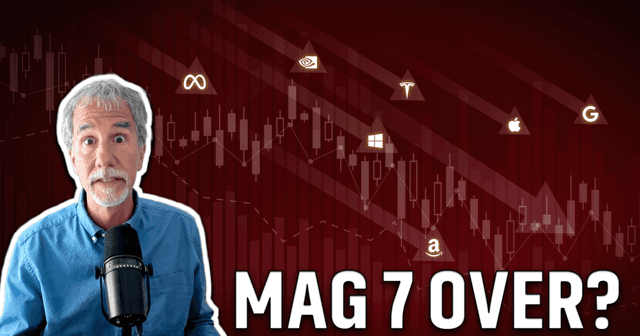

The Mag Seven Trade Is Breaking... Here's What Comes Next
In This Episode
In this week's Stansberry Investor Hour, Dan welcomes David Cervantes back to the show. David is the founder of Pinebrook Capital Management – a boutique asset manager focused on asset allocation and managing various systematic trading strategies.
David kicks things off by reflecting on the progress that glucagon-like peptide-1 (GLP-1) drugs have made since his last discussion at a Stansberry Research Conference several years ago. The drug has branched out of medical use into professional use and for standard weight loss, resulting in the companies he previously discussed to have performed well since then. He then discusses the current market shift from the Magnificent Seven to industrials and the S&P 493. The equal-weighted S&P 500, in particular, is beginning to outperform the Mag Seven. And David shares his thoughts on Blue Owl Capital selling its assets and what that means for the private-equity industry...
It really depends on where we are [in] the cycle. In other words, a lot of this stuff happens in the weeds of the industry, and no one bats an eye when things are fine. It's when things start getting a little messy and they're like, "Wait, you did what?"... So when you get a Blue Owl-type situation – and the situation is a little suspicious to begin with, but then it comes with a bunch of assumptions or explainers that don't pass the sniff test. Then you start thinking, "OK, there's definitely more to this."
Next, David explains where the money flowing from the Blue Owl sale is coming from and how it's connected to the banking system. If the sell-off negatively impacts banks (and by extension, the labor market comprised of voters), politicians will step in to "fix" things using whatever means necessary. David then gives his thoughts on the U.S. dollar and why he thinks that, despite skepticism and bearish outlooks, it still has what it needs to maintain its current position. And he lists how small-cap stocks have changed in how they operate and their relationship with private equity...
There are some structural factors that have changed the small-cap market. The first one is regulatory... to avoid all these bad things [following the dot-com bust]. That made the cost of capital more expensive. Public capital became very expensive. This is why we've had this boom in private equity, because private capital is cheaper... All these brand-name enterprises that are now at scale... needed access to public capital to fund their expansions. Now you don't need that. Now you can go to KKR, Blackstone, whoever, and they can drop $2 billion into an emerging startup – no one will even bat an eye with that.
Finally, David expresses why the labor market is important for the economy and for policy. Discussions he has had with experts indicate that tightening or hardening the labor market will likely result in layoffs and inflation. Following this, David details the areas that he thinks will do well, given the current market rotation and uncertainty in Iran...
[There] are a lot of big things that are happening. You can latch onto [the] trends. I don't do a lot of single-name stuff. I don't have the time to do that. But sector stuff... that's the basic way of viewing the world and allocating capital.
Click on the image below to watch the video interview with David right now. For the audio version, click "Listen" above.

(Additional past episodes are located here.)
This Week's Guest
David Cervantes is the founder of Pinebrook Capital Management. Prior to starting Pinebrook, David was in fixed-income sales at Morgan Stanley, covering middle-market financial institutions in Latin America. Before going to Morgan Stanley, David was in cross-asset sales at UBS and JPMorgan Chase.
David has an MBA from the University of Wisconsin, Madison and completed some of his graduate studies at the National University of Singapore. He is also a graduate of the University of California, Santa Barbara, where he double majored in economics and international relations.
Dan Ferris: Do you want to find out where we are in GLP-1 drugs in the stock market today? This guy is going to tell you. And do you want to find out where we are with industrial stocks, small cap stocks, the S&P 500, and a lot more? Well, get out your pens and pencils because our guest today, David Cervantes, is a brilliant macro analyst. He's going to talk about all that and more.
David, welcome back to the show. It's good to see you again.
David Cervantes: Dan, good to see you. It's been a long time.
Dan Ferris: Yeah, it's been a couple of years. And I want to pick up right where we left off on stage in Las Vegas a couple of years ago, because I'll tell you something, David, you were the first guy – we have a really smart couple of science guys and they were covering weight-loss drugs before you sort of told me, but you were the first guy who told me "You know something? This is going to be enormous. It's going to change economies. United Airlines is going to save money on fuel" and all kinds of things like that. You were the first and you told me a couple of years ago. And the topic came up recently and I'm like "Wait a minute. I've got to check back in with the first guy." So, things have changed. These drugs have become huge. Where are we now? Where have we been? Get me up to speed. Where are you on GLP-1 drugs these days?
David Cervantes: So, the answer is they are going through a classic kind of growth cycle evolution. So, what does that mean? First, there's the introduction, then there's some adoption, and then there's kind of like, well, what does this really mean? And eventually, it's a little cyclical, but healthcare is somewhat different in that regard because it's – we all – these are in lifetime things. Once you go on a GLP-1 you're on it forever because you have to manage – the real underlying condition is diabetes. That doesn't go away. So, you need to manage that. So, you'll be on that forever.
But I think from the macro sense or just the social sense, they've gone from adoption to there's mass awareness now. Celebrities are using them. I don't know how familiar you are with Ariana Grande. I only know this because of my kids, but Ariana Grande, she is, I think, in a Broadway show and the character requires her to be really skinny. So, Ariana Grande is using these GLP-1s, and she's a small person to begin with, and she's using the GLP-1 drugs to really fit the bill, literally the playbill, as they call it on Broadway. And so, this is not just medical use. Now there's professional applications for your character.
Dan Ferris: Right. Pure weight loss. Just pure weight loss. No diabetes.
David Cervantes: Pure weight loss. No diabetes, but it works. It gets the job done. Side effects are somewhat minimal for the most part. And people – I actually personally know people who are non-diabetics in my demographic, middle-aged males, otherwise healthy, who are using them as a way to manage the dad bod, so to speak, to be thin and healthy. I'm not there yet, but you know what? I might get there. And if I get there, then I'll get the jab, too. So, that's kind of where we're going now, where this is becoming more widespread, more adopted, and we're seeing different applications than the original first use. The original first use was diabetes. Now it's beyond that. And we're getting new evolutions of the drugs, more powerful, more sophisticated time releases, blah, blah, blah. Microdosing. Just a lot of different iterations of these drugs.
Dan Ferris: Yeah, so am I ever going to pay less for a damn airline ticket once they start saving money on fuel?
David Cervantes: Yeah, it'd be nice if you could. The problem is fuel is – with what's happening right now in the Middle East, fuel is obviously up a lot. So, I think for now you won't get any respite from the large-waist – or, the smaller-waist people.
Dan Ferris: Right. And we must point out that when we talked about this on stage in Vegas two years ago, you mentioned at least Eli Lilly, if not another stock, but Lilly has performed substantially better than the markets since then. So –
David Cervantes: Yeah, yeah, that's – thank you. Yeah, it's up, I believe, 70% since we – that was on October 23, 2023 and that's up around 70% since then. The S&P 500 is up, I think, 23% and change since then. So, it's substantial outperformance for sure. It worked out. The other one was Novo Nordisk. I can't pronounce it. They're based in Copenhagen, Denmark. So, now they've had some different issues and they've pulled back but it's still been a relative outperformer over the same time period.
Dan Ferris: Right. All right, so good. That was good on you. I had to catch up. But of course, you have – you're a macro guy. You got a lot more than that in your mind. One of the things that – one of the topics I was pleased that you forwarded to us is the long-anticipated rotation trade out of Mag Seven and into the industrials and the other S&P 493. This gets some discussion, but people finally doing it is kind of reassuring that maybe the world still works the way it always did.
David Cervantes: Yeah, no, it was – I think a lot of people were frustrated, especially the value folks, the trend people. They were just like, "Wait a minute." All of a sudden, their whole world view was turned upside down. Mag Seven was just the only game in town for about – basically since late 2022, when we avoided a recession after the [Federal Reserve] hiked rates, starting their rate-hiking cycle and the yield curve inverted. Everyone was like "What about this?" and nothing worked except Mag Seven. Unless you were in Mag Seven – I think there were some short time periods where housing worked in '23. There were a few little things that worked, but for the most part it was the only game in town for about three years, three and a half years. And that finally broke on October 28, 2025. And it's interesting because I think the catalyst was twofold. One is the international names, which includes emerging markets, includes world-developed markets. They've been kind of in the dump for the past almost decade. Right?
Dan Ferris: Right. Yeah.
David Cervantes: Again, buy value, buy lower [price-to-earnings] stocks in Latin America or Europe or wherever, Asia, and that didn't work here. And then they caught a bid in early '25. And the thought there was everyone's up to their eyeballs in Mag Seven. I'm talking about global investors, like the big sovereign wealth funds and these monster pools of capital. They're – everyone's up to their eyeballs in Mag Seven. And yeah, at some point you have enough. It's not so much about valuation as much as it is about investor preference. And investor preference drives valuation. And so, I think people started looking at other things. And then, the new administration, obviously, the chaos of that.
But I think that the straw that broke the camel's back was the [capital expenditures ("capex")] for AI, for the AI build out. In other words, the Mag Sevens were – they were capital-light. Well, maybe except – well, Microsoft and Google have huge labor pools. But Meta Platforms, relatively speaking, didn't have as huge a labor pool. They're basically asset-light, crazy-high margin operations that were scalable with moats –
Dan Ferris: Cash-gushing. Yeah.
David Cervantes: Yeah. And all of a sudden as they start allocating these collectively, it's almost a trillion dollars – I think it's three quarter-trillion dollars in capex and growing, I think people are saying, "Well, wait a minute, those cash flows are no longer going to come to me. The buybacks are going to die down. Dividends are going to chopped up. The free cash flow is going to go to zero. They're going to become negative cash flow. I can't hold this anymore. I can't be at the allocation that I was – regardless of the valuation, I can't be at the same allocation if the cash flow risk profile has changed."
Dan Ferris: And David, importantly for me, balance sheet deterioration, I covered the moment when I think it was Meta issued, like, $40 billion or something – I think it was $40 billion – and they tipped over the whole Mag Seven into a net debt position. So, I was like, "Hmm, OK," because their balance sheet had been loaded with cash. They borrowed more –
David Cervantes: Fortress.
Dan Ferris: Absolute fortresses. And I'm like "Well, they're still pretty good. OK, let's not sound the alarms." But that was a key moment for me.
David Cervantes: And I think to add to that, in terms of the balance sheet, you started getting some – I think Meta in particular, started engaging in some funny off-the-books leasebacks or kind of off-balance sheet financing for some of this stuff. So, that always raises an eyebrow. They call it capital structure, efficiency, whatever. You can put the lipstick on the pig but at the end of the day they still own it. They're the credit. They're the credit. Now I'm putting my old credit hat, analyst hat on from when I first started in the business. But at the end of the day, they're the credit. So, when you have that kind of off-balance sheet activity going on, then that impacts the credit and the rating and the expectations for the cash flows, etc., etc.
So, I think those three things conspired to really change how people were viewing their positioning in Mag Seven at the expense of everything else. And on top of that, there was something else that happened with emerging markets. Their profit margins started catching up. And a lot of that was driven by tech-adjacent emerging markets. So, they were really more developed than they were emerging – places like Taiwan and South Korea, with – South Korea's got obviously Samsung and Hynix, and Taiwan's got Taiwan Semiconductor Manufacturing. All of a sudden, they started having Mag Seven-like type margins. They were no longer doing textiles and whatever – cars or whatever they were doing. They were doing Mag Seven kind of stuff. And all of a sudden, it's really – what drives – for the fundamental people, it's really the margin. Not just the profit, but the margin. That reflects your productivity and your return on capital.
And these margins started popping. So, then you see things like South Korea last year, I think, did 95% of – the EWY ETF did 95% last year. And you started getting these eye-popping margins across the board. And that really provided "Well, if I can find Mag Seven-type margins at a lower cost and a lower valuation somewhere else, then why not?" That's the low-hanging fruit. That was really kind of what started that whole run in early '25. There's just this confluence of events that really sparked that.
Dan Ferris: Right. So, it's a global non-U.S.-led trend as well. But – and that becomes then a – that sounds like out of Mag Seven into global non-U.S., but do – you also like the S&P 493, though, right?
David Cervantes: Correct. I haven't checked as of today because today is just a crazy day. But RSP, the equal-weighted S&P 500 Index, RSP, I think it's up maybe as of close yesterday 7% of the year versus as of yesterday I believe S&P was up – maybe even slightly negative. If it was up, it was less than 1%, and if it was down, it was in the basis point. But my point is that vast outperformance between RSP [and] the market cap, S&P 500, SPY.
But then you drill down into that and you see certain sectors really just outperforming, things like industrials. So, going back to the rotation, now it's industrials in the lead. Now it's energy in the lead. Now it's utilities in the lead. So, you've got these different pockets of strength within the non-Mag Seven that are driving returns, which is a complete – away from even six months ago.
Dan Ferris: Right. And energy was second or third worst last year of the 11 sectors?
David Cervantes: Correct.
Dan Ferris: And now it's doing great. And I think – what was – I think – was real estate the worst? I think real estate –
David Cervantes: Real estate was the worst and it's doing OK this year. I actually have XLRE. I think it's up – my position is up around 9%, I think. It's around 12 year to date. I don't know. But it's – I would call real estate kind of a second-best performer compared to the captains: energy, industrial, and materials.
Dan Ferris: There you go. Yeah, I love energy. So, another thing that happened recently, and you're sort of one of my go-to guys on these kind of things, and you did talk – you did mention your early career spent assessing credit. There were some folks, and I admit to kind of being one of them, at least it sort of got my attention, the news of Blue Owl selling a billion in foreign assets, including to a fund that it manages for insurance companies. But they said they got just about par for everything and it wasn't – they claimed it wasn't a big deal. But folks like Muhammad El-Erian and a couple other kind of big folks were saying, "Hey, this is a canary in the coal mine." I think I think George Noble was another one. And then it was – I still haven't looked it up. It was either Credit Suisse or somebody who said, "We're expecting 15% default rates in private credit." So, I was like "Whoa, OK. All right. I need to talk to Dave about this, man." What do you see? Did that Blue Owl thing mean anything to you?
David Cervantes: It really depends on where we are on the cycle. In other words, a lot of this stuff happens in the – kind of in the weeds of the industry, and no one bats an eye when things are fine. It's when things start getting a little messy and they're like, "Wait, you did what?" And so, what am I getting at? Things like – let's go back to the – before the global financial crisis, and you had things like bank-owned hedge funds. A lot of banks were running prop desks. And then – and they were cross-selling through each other, and [collateral loan obligations], and cross collateral, and this and this and this, and no one knew who the hell had what. Or, if they knew, they were willfully blind and looked the other way. And then you had things like when the blowup started, the Bear Stearns internal hedge funds and the [Société Générale] trader, Jérôme Kerviel. All these kind of things started popping up.
And I think people have PTSD – and rightfully so, but I think people have PTSD and they're like, "Wait a minute. I've seen that." And there's never one cockroach. There's never one cockroach. So, when you get a Blue Owl-type situation, and then the situation is a little suspicious to begin with, but then it comes with a bunch of assumptions or kind of explainers that kind of don't pass the sniff test, then you start thinking "OK, there's definitely more to this."
And that's kind of where I think the market is right now, given everything else that's happening. In other words, why is it linked to everything else? Well, a lot of these loans are to middle-market software companies. These software companies are at risk of the AI disruption trade. So, then as far as bigger concerns about the cycle and how invested are we into the cycle, the AI capex cycle has basically been the dominant macro factor over the past year. A lot of parts of the economy aren't doing so great, but AI is really just this – when you've got a trillion dollars in capex commitments, there's money flowing through the pipelines. People are building data centers, they're buying copper, or they're buying stuff to make these things. These things don't just make themselves out of nothing. So that's been the dominant driver.
So, it's all linked to AI. And is AI going to eat itself? And my personal theory is it won't. But right now, where we are on the cycle, it's kind of starting to feel late cycle-y. You've got – again, going back to who are the leaders, typically, the sectors that lead now are defensives. Late cycle is defensive sectors that are leading. All the growth stuff starts getting thrown out with – the babies out with the bathwater, growth stuff. So, tech is getting hit – software's getting hit. Semiconductors, they're the latest to get hit. And you go – you run into the defensive late cycle. And at first, it was kind of like, this doesn't make any sense. And now it's starting to make a little more sense if you assume that the cycle, the real late cycle – that's not my view, but for now investors are hiding. And I think that's accentuated by what's happening with Iran and some of this geopolitical stuff.
But going back to Blue Owl, I was looking at credit spreads over the weekend and there's one spread I look at a lot. I call it the trash spread. It's the spread between the dominant high-yield index, just whatever, HY, and CCCs, kind of the lowest-rated credits. And my two reference points are the Silicon Valley Bank blowup in March of 2023 and then the "Liberation Day," April 2025. So, what happened then was when high yield blew out the whole complex blew out. High grade and then the lowest tranche of high grade, BBB, BBB-, and then high yield blew out and everything just went out. Here, what's happening today, investment grade has pulled back a little bit, a few basic points. It doesn't match anywhere the movement of those two prior macro prices. High yields pulled back obviously a little more but nowhere near the movement that we got back then either. The only one that's pulled out, that's blown out a lot is CCC. So, that's kind of been the driver of the spread between the lowest of the low and the dominant high yield index. They're not blowing out together. So, I know this is a four letter word, but for now it's contained.
Dan Ferris: Oh, no, somebody said "contained!"
David Cervantes: No, no. It's gone. It's over.
Dan Ferris: He said, "contained." Oh, no.
David Cervantes: For now – well, it hasn't bled over to the broader high-yield complex is my point. I mean, is it contained? I don't know. But it – has it bled out to the broader complex? The answer is no.
Dan Ferris: Right. Yeah, it's funny because the last podcast that we recorded, we were talking with a friend of mine, and he said – and we both howled at the word "contained." We were just – we can't wait till somebody says "contained," we both said. And of all the people to say it, you're the last one I expected. But I was thinking essentially the same thing. I was thinking, OK, so in other words, the market is saying, "No, the stress isn't as great as March 2023." Just takes –
David Cervantes: Correct.
Dan Ferris: Yeah. So, that's reasonable. I mean the market says what it says at any minute. We're not predicting what it's going to say six months from now. We're just saying what it says right now.
David Cervantes: Correct. Correct. And right now the market is telling us, look, maybe – there's obviously some stuff that people got in over their skis on risk and they're going to get carted it out and they'll take – they'll get their mark – their marks will get marked down and they'll have not great returns or whatever. That's the law of the market. That's what it does. But right now it doesn't look to be systemic for now.
Dan Ferris: And if I wanted to craft a narrative, I could say, "Well, OK, if CCC is getting hit, that's how it starts." The worst garbage gets hit first and then they don't really shoot the generals till it's all over. So –
David Cervantes: Correct.
Dan Ferris: But I could if I wanted to craft that. But there's really no need to. We all know sort of what's happened in credits basically since the financial crisis. It got pushed out of banks and onto everyone else.
David Cervantes: So, yes. It got pushed out of banks. But this money's coming from somewhere. It's not just coming from investors. A lot of these, the Blue Owl types, they have lines to the banks. So, even though it's private credit, it still has the capacity to infect the banking system and credit intermediation. And at that point we learn from previous prices they're not going to let that happen. They just won't. They're not going to let that happen. It is – it's political at that point. Why? Because that means if the banking system gets infected, then you're going to have a labor market problem. And a labor market problem is pissed off, unemployed voters. And nobody – no politician, no regulator wants a pissed off, unemployed voter. That's the –
Dan Ferris: And since –
David Cervantes: Yeah.
Dan Ferris: Since time immemorial to – this is one of the great conflicts of the ages in terms of finance and economics. There's whatever you want to call it, banks and bond markets on one side and the currency on the other. And guess which one they always pick to save? And guess which one they always use to – it goes that way every single time. And you're right. If banks get in serious, serious trouble because they've gotten too deep into private credit, we know exactly what's going to happen. Exactly.
David Cervantes: Correct. Correct.
Dan Ferris: So, yeah.
David Cervantes: Correct. Now, the only hope is that – some of the [post-great financial crisis ("GFC")] regulations were watered down a bit because they were they were seen as impeding the flow of credit and blah, blah, blah. But hopefully – and this is not my area of expertise at all, but hopefully there's enough teeth left in the regulations that have kept places from getting in over their skis on private credit and maintaining collateral. Now, the big thing you can't stop, though, is fraud, as we learned in the – as we learned during the GFC. Once there's outright fraud that gets institutionalized, when people learn how to game the system, like they did with the credit ratings, and they did with calling all these crappy radioactive Frankenstein pools of capital AAA, and it's enabled by institutionalized fraud where various actors are all engaging in this behavior, even if unwittingly, then that's a whole –
Dan Ferris: And highly incentivized to do so.
David Cervantes: Yeah, then that's a different – that's a different game. That's a different game once there's fraud and institutionalized fraud.
Dan Ferris: Sure. And no one would be surprised if in a trend this powerful, if, if there was something like the Enron of private credit somewhere that played out. Yeah.
David Cervantes: Correct. Correct.
Dan Ferris: Yep. And so – OK, so we've established that they're going to save banks and bond markets and they're going to use the currency to do it. A lot of people love, love, love to talk a big gloomy, doomy game about the U.S. dollar.
David Cervantes: Oh boy.
Dan Ferris: I was one of them for a little while, but I never got totally gloomy and doomy about it. I was just long gold.
David Cervantes: That seems smart.
Dan Ferris: And so, I bought a – yeah, I bought a certain amount of the narrative that the fiat will continue to deteriorate over time. That's been a long, long, long trend. But the U.S. dollar – I'm a full-on Brent Johnson milkshake guy at this point. It's really, really, really hard not to do business in U.S. dollars. Still.
David Cervantes: Yeah. And I think maybe five years ago, there was the bitcoin was going to take over, right?
Dan Ferris: Oh, yeah.
Dan Ferris: Now that's just been shot in the head. Where's – in the latest – especially now, what's bitcoin done? I don't really follow it that much but I know it's done nothing good. It's – gold, even gold's outperformed bitcoin, I believe. So, that's not – bitcoin is not even a part of this conversation, I think. But broadly speaking – it's funny you mentioned it, because I was actually at a conference in – a currency conference in San Diego and the headline speaker was actually Governor Christopher Waller. I met Waller, had dinner with him with a few other participants. I got invited to this dinner. Don't ask me how or why. But Waller was there. Catherine Mann from the Bank of England was there. They had a few admirals from the U.S. Navy there giving strategic thoughts. And this whole thing, the basic question they sought to answer is: Is it over for the dollar? And if not, when?
And the general consensus was as long as we maintain our geopolitical alliances, the dollar will be fine. That's really what it comes down to, the geopolitical – why? Because – it gets kind of touchy-feely. Everyone says we've got the military, we've got this, blah, blah, blah, blah. Yeah, we do have those things. We do control the SWIFT, the global wire system for dollars or for currency. But at the end of the day, it comes down to one these things called trust. And your allies have to trust you enough to use your currency. And as long as we're the cleanest shirt in the laundry –
Dan Ferris: The cleanest dirty shirt –
David Cervantes: Yeah, whatever, whatever. Or the best house on the bad block. And as long as our allies continue to say, "You know what? Fine. It's the best one. You might not be great, but you're not awful at least, and we'll continue to use your currency," that's really what it came down to.
Dan Ferris: David, try this one: prettiest mare at the glue factory. What do you think? There you go.
David Cervantes: There you go. Yeah. Exactly. Oh, my God. Don't say that around my daughter. She's an equestrian, so she might start crying.
Dan Ferris: Yeah. Yeah. Kind of an animal lover myself. So...
David Cervantes: I made a glue joke once and she literally was in tears. I'm like, "Oops, I will never do that again."
Dan Ferris: Oopsie. Oopsie.
David Cervantes: But the dollar – just going back to more – trust is kind of actually feely, but getting back to more tangible things, yeah, it really – there really is no alternative. And here's why. Outside of the normal caveats of the military, it's really we have the deepest, most liquid capital markets in the world. You can go buy $2 billion in treasuries and you might move the market a tick or two or whatever, but it's no one's going to squat an eyelash if you go and bid on two yards of Treasurys, the on-the-run stuff. It's not a big deal. You can't do that anywhere else. You'll destabilize the country if you do that. I mean, it's probably – I'm an exaggerating a little bit. But you really can't do that anywhere else. And that's a function of how big our economy is, how large our consumption is. We're the consumer of last resort for the world. Everyone's looking to ship in what they have to sell into the U.S. So, by definition, if everyone's looking to sell to us, there's only one way we can pay them. In dollars. That's our currency. We can't pay them in anything else. So, once they accept dollars, everyone's sitting on dollars, and that's how everyone transacts. That's how everyone trades. That's just the bottom line. It becomes the –
Dan Ferris: And it's kind of like – according to the Bank of International Settlements, last time I looked, I thought it was $12 trillion or $13 trillion of U.S. dollar borrowings outside the U.S.
David Cervantes: I'm sure it's bigger than that. I'm sure it's –
Dan Ferris: Yeah, by now –
David Cervantes: – huge.
Dan Ferris: Yeah.
David Cervantes: So, everyone's – as we've – we have these current account deficits, but we have account – we also have capital account surpluses. In other words, we are basically the intermediary of choice for everybody else's economic choices. We – everyone wants to sell us their stuff. We give them our funny-money currency. They take it and they buy more things with it. And it's great. It's the exorbitant privilege. And I know that we're kind of going political now and some people think it's bad and the burden of empire, but listen, our economic well-being is directly tied to that privilege. We can borrow and fund ourselves much cheaper than we otherwise would.
Dan Ferris: And so, I wish we could sort of inject this into the veins of the of the dollar doomer crowd. I don't know. Maybe I find it particularly irritating because I see a path where the dollar strengthens – dollar and gold can strengthen at the same time.
David Cervantes: Sure.
Dan Ferris: But they're not – I understand seeing them as opposites. I think of gold more priced in dollars than anything else. Right. But I don't know, it's become – it's almost become a pet peeve. It's a serious pet peeve for Brent Johnson. I'm sure you know who he is.
David Cervantes: Yeah. I've met Brent.
Dan Ferris: But it's becoming a bit of one for me as well because I feel like I understand it better every time I talk to somebody like you and then...
David Cervantes: Right. Right. Well, it's kind of up there, too, with the deficit people. We're mortgaging our children's future and we're leaving them poorer. I'm telling you, I'm 53 years old. I'm a child of the '80s, and I remember watching that national debt clock and I was told, "You're going to be poorer than the next generation, blah, blah, blah, blah." You look at GDP, growth between then – I mean, I think when I was an undergrad U.S. GDP was under $5 trillion. Back in the Stone Ages. Now it's $30 trillion. You can deflate it with – whatever. But still, real living standards have improved since I was a kid. That's just a fact. And regardless of the debt, they've improved.
So, the real yardstick isn't the funny money piling up. It's how do you live? Are you better off today than you were 30 or 40 years ago? I say, "Hell, yes." The average person, even the poor people – the poorer, the poor are better off today than they were 40 years ago. The rising tide did lift all the boats, regardless of the deficit. But my favorite thing is the biggest trick the devil ever pulled was convincing people that governments pay back their debts. They don't. They just roll them over and – they roll them over and deflate them. That's it.
Dan Ferris: Endlessly. Yeah. Endlessly.
David Cervantes: And that's fine. And governments have in theory an infinite time horizon. You and I don't have that privilege because we at some point will kick over, but governments don't. Unless there's a revolution. That's a whole different thing. But effectively, governments can just do this in perpetuity until they're no longer a functioning government. But that's – yeah, again, that's hopefully not in our lifetime.
Dan Ferris: Yeah, I hope we don't get there. I hope the boogaloo, as some people call it, never happens.
David Cervantes: Yeah. No, we don't want that. God help us all. So...
Dan Ferris: All right. So, I see – I feel like we skipped a topic because you had also – in the email you sent us you mentioned U.S. small caps. Is that part of the out-of-Mag Seven? Or what do you think? What's going on there?
David Cervantes: Yeah, so I think people of earlier schools of thought – when I went to grad school or undergrad we were all taught French-Fama factors and value and CFA curriculum. And small caps back in the '80s and '90s, they had some outperformance because of some structural factors. The illiquidity premium, for example. You were paid extra to hold a less liquid asset. So, all these kind of rationalizations came up and a whole generation or two came up the ranks of "Oh my God, this is the real thing." And it kind of stopped working after – pretty much going into the global financial crisis. Small caps, they would have these bouts of outperformance and always just slumped back. And I think there's just – the restructured drivers to that outperformance back in the day, in the '80s and '90s and maybe early 2000s, there are some structural factors that have changed the way – the small-cap market.
The first one is regulatory. What happened after dot com and all the regulations, Dodd – was it Dodd-Frank part of it? I don't remember. But obviously all these regulations came up after the dot com to avoid another Enron, to avoid another MCI WorldCom, to avoid all these bad things. And that kind of made the cost of capital more expensive. Public capital became very expensive. And this is why we've had this boom in private equity, because private capital is cheaper. You don't have to – if you're a small company, you have to now have an army of lawyers preparing your filings every quarter. You have to have all these back end systems reporting blah, blah, blah. And I'm not saying it's good or bad. I'm just saying it is what it is. And that represents a higher burden for small companies. So, the cost of public capital went up. The cost of private capital went down.
What that means is that private actors were able to go after the better companies and roll them up into their private equity portfolios. So, you – what happened was private market – I'm sorry, public markets were left with the ugly ducklings of small companies. So, now you have – think about some of the most successful companies that we have, some of the most celebrated brands are private. Cargill. They basically run our food supply. They're private. In-N-Out Burger. They're private. Buc-ee's. They're private. All these kind of brand name enterprises that are now at scale, before, they needed public – access to public capital to fund their expansions. Now you don't need that. Now you can go to KKR, Blackstone, whoever, and they can drop $2 billion into an emerging startup or whatever. Not a big – no one even bats an eye with that. That wasn't the case before. Before, you had to go to the public markets and seek capital publicly.
So, you've got this collection of kind of fuddy ugly duckling companies in the small cap space that nobody wants, and therefore they kind of suffer persistent underperformance. And occasionally you get a kind of a bounce. Usually, you get the bounce coming out of a downturn. Small caps relative to the larger caps get just completely annihilated and the value – they're just screaming value and you throw some money at them. And then the other thing is public small-cap companies are heavily reliant on debt. They're really levered. So, they're very sensitive to credit spreads, that trash spread I was telling you about earlier. So, as things kind of normalize, credit spreads and their cost of debt funding goes down and that really helps them out. So, those are the two times when small caps really just kill it and do it really well. Back in 2021 was the last time small caps had a massive outperformance versus big caps, coming out of COVID. And then we've had some movements.
So, I've been kind of not really a fan of small caps for a while, and it's really just kind of a tactical play, coming out of some kind of downturn. For example, depending on how this thing with Iran turns out and how deep it goes, then that might represent an opportunity. And as we discussed, the trash spread's blown out a little bit. So, again, between the spread and coming out of a kind of a selloff, that might represent an opportunity. But I think I just think it's fundamentally a broken asset class. And I think a lot of people from our generation that maybe at one point either made a lot of money or we were just told in class that that's the way to go, a lot of them haven't gotten their heads around it. They haven't really come out. They're still waiting for all of Elvis to come out.
Dan Ferris: Yeah, one of those things that stopped working.
David Cervantes: Yeah. It's just one of those generational things that, my God, people just – they have trouble moving on. And I think that's the problem with small caps, is that the regulatory structure changed the market structure, which changed the return payoff.
Dan Ferris: Right. And this – you're reminding me. I just remembered sometime in the past, I'm going to say two or three years. I read a – I think it was an interview with Jeremy Grantham, and he said they use the Russell 2000 as a perpetual short opportunity. They're always hedging everything else by being short the Russell 2000. He said, "We're short the Russell 2000 almost all the time because it's loaded with garbage basically."
David Cervantes: It is.
Dan Ferris: And he said, "Sometimes the earnings from the entire index will be net negative." It's frequently that. So, it just – it becomes a perfect vehicle for them to hedge with. But –
David Cervantes: And if you're a decent small emerging company, most likely you're in software, most likely even bought out, even rolled up, that's kind of what has happened. So, it's just – there's just this – private equity has really become the sucking machine for the better ones and then the dashboard is left with all the ugly ducklings.
Dan Ferris: Let's do this. We do two things for our listeners. We teach how to fish and then we offer them a fish. Some people don't like to talk about the stuff they currently own or currently recommend. If that's you, that's fine. We can move on. But is there anything that you – any current trade that you think is a pretty good idea – and all the caveats: This is not investing advice, etc., etc., etc – that you like right now. Is there a current trade that you like right now?
David Cervantes: Yeah, absolutely. I'm happy to go through the whole position book, if you wish.
Dan Ferris: Love it. Love it.
David Cervantes: But yeah, full disclosure. Nothing to hide. Obviously, a lot of my subscribers are watching this, so if I come up with any funny business, they're going to call me out. So, I have every incentive to be transparent and honest with both the wins and the losses. So, before we go there, though – and I promise I will. This is not a diversion tactic. I want to go back and talk about something we haven't talked about yet because it's just part of the process for taking us to where we got – or, to where I am now. Aside from the rotation trade, which I started talking about back in the first of November, I started talking about the labor market. And the labor market is really important because – not just for the economy, but for policy. And when we started getting these low nonfarm payroll ("NFP")prints, the assumption was that, "Oh, holy crap, employment's going to shoot up. That's it. It's over."
And I said, "No, it's not over." That's not going to happen because – and this is not a political statement. This is a mechanical. It is what it is. The administration's immigration policy has shrunk the labor market. Demographics is destiny. You get – GDP grows in two ways: the size of your labor pool and productivity. That's it. So, if you start shrinking your labor market, you don't need to hire as many people to keep unemployment stable. So, I said we could – it's very possible that we could see negative NFP prints, negative job growth and still have a lower unemployment rate, which is – it goes back to this concept that people just can't wrap their heads around.
And I actually discussed that with Guy Burger, who's the former chief economist for LinkedIn. So, he's a labor market economist. He's a real egghead, a real smart guy. I'm just a wannabe, but he's a legit labor market economist. And we discussed the mechanics of shrinking the labor market and how that impacts everything. And this kind of sounds like an abstraction but here's what I'm getting at. If you tighten your labor market and you lower unemployment, even though you have layoffs and a soft – kind of on the surface softening but really a hardening labor market, that can provide an inflationary impulse. That was one thing that we discussed.
The other thing that I started picking up on was after the pandemic our supply chains got all screwed up and we started having bullwhip effects. What's a bullwhip effect? Because you were so uncertain about your supply chains, you over ordered and you over inventoried. And then, so you'd have a burst of orders, and then you'd wait a long time to deplete them, and then you'd – after that, you'd overorder again. So, we had this kind of this sine wave of activity there. And this is why the ISM data became very unreliable because it was just kind of like "Well, it's just noisy. We can't trust this survey data anymore because we don't know if this is real activity or just pure – just kind of panic ordering."
So, we went through different iterations of that cycle. Finally, we got down to a real understocking of inventories. And then companies started building inventories again. I call it the great restocking. So, then we had the Institute for Supply Management ("ISM") print in January, which came out really strong. We had another one yesterday for manufacturing – again, very strong. So, now we've got two things, going back to what it all – now I'm bringing all together. We've got a stronger-than-expected labor market. We've got a – kind of a restocking boom that's coming up. And that is going to be inflationary. And a few weeks ago people are throwing around two cuts, maybe three. Fed Governor Stephen Miran was looking at four cuts. Trump wants a billion cuts and it's just not going to happen. And my weekend note this past weekend was it's none and done. We're not getting any cuts this year.
And we shorted the bond market. We shorted ZN, the 10-year Treasury Future Note, on Monday morning. That's done phenomenally well. Look, I'm sure I got partially lucky. You can't – timing is always tough. But I think there's a consensus shift from we're going to get cuts to we are not going to get cuts this year. That's starting to get priced in. We – so, the macro backdrop is one of a stronger labor market than expected, a – kind of a restocking boom that's starting. Obviously, this stuff with Iran kind of throws everything off because that's just – who knows where that goes. So, I'm not going to go there because I have no – I don't have a political crystal ball. These are political decisions that are made at many pay grades above –
Dan Ferris: Right. You're just calling it like you see it. I got it.
David Cervantes: Right. Correct. So, that's kind of the macro backdrop for what I'm positioned for.
Dan Ferris: Got you. All right.
David Cervantes: So, the rotation, the stronger labor market, and the restocking boom, that's kind of the three-legged stool for how I'm thinking about the economy and for how I think things will evolve in the markets.
So, let's get after it. If the Fed has gone from potentially two cuts to no cuts, then that means one thing. It means higher rates. We've gotten that – I think on Friday the 10-year Treasury closed at $3.94. As of before I got on the show, it was at $4.10. So, that's kind of a pretty big move, especially given what's happening with Iran. Everyone's thinking, "Oh, my God, safe haven bid. This is going to get bid hard." No, they're not. So, a little more inflation, less cuts.
In terms of the restocking boom, who's really going to benefit? So, it's going to be a lot of these middle-market SMIDs – so, small – not small caps, medium caps. So, logistics. Logistics companies are going to do really well. Aerospace systems for the military. Things that do warehousing. All the things that are – get involved in industrial restocking are going to do well. So, that's kind of one leg. The other one is higher rates. And then this kind of rush to safety for the dollar means the big international trade that was going on for the past 18-plus months is on pause. I mean, this morning, emerging markets got hit. South Korea, I think, was down at 1.10% overnight. All these emerging market high flyers that everyone was looking at are just getting completely whacked. So, the international trade is going to face some stress. So, that's the second thing.
And then, the third thing is I think the – that's going to bleed over into commodities as well. Gold, which is – obviously had some safe haven bid element to it is today getting hit really hard. The miners are getting hit really hard. I think GDX is down high single digits. I know for sure GDXJ is down in the double digits, around 11%, 12% last time I checked. So, strong dollar, less international, more 493, more middle market, I would call it, companies that do stuff. Less software, less tech, companies that do stuff, that build stuff, things you actually need. I think on top of that there's the kind of the – the reshoring agenda of the administration. I don't know how well that's going. I'm not going to consider that one. But the bottom line is those are the big things that are happening. And if you can latch onto those trends – I don't do a lot of single-name stuff. I just don't have the time to do that. But sector stuff. Defense is going to do great, both European defense as well as American defense. Yeah. So, that's kind of the basic way I'm viewing the world and allocating capital.
Dan Ferris: OK, so I use ITA for defense. I got –
David Cervantes: That's what I'm using. Yep. I've got –
Dan Ferris: I've got XLI for industrials. I've used –
David Cervantes: I've got XLI as well. Yep.
Dan Ferris: What did I – I actually did buy – I did a little bit of the ex-US trade and I think I bought VGK, the European ETF, at one point, which did OK. And what else did we say? Oh, like those sort of small, mid logistics firms. There's a transportation ETF or two out there. I'm glad you brought that up, actually. Just – I wonder if we could do a little detour here just for a minute. I thought it was so weird that this company algorithm came out with this white paper that said, "Well, we've reduced the number of miles, basically, that trucks go empty. They're empty 30% to 35% of their miles. And we've done trials on our technology in India and we've got that below 10%." So, trucking companies, then, could potentially become much more efficient. You'd think that would be good for trucking companies.
David Cervantes: I mean. So, yeah –
Dan Ferris: And they hammered the trucking stocks that day. I thought it was weird.
David Cervantes: Well, that's the trucking stocks. But if you look at the actual suppliers, Trinity Industries, TRN, they work with railroads and help them with their logistics. And also trucking companies. But there's a whole universe of those names that are doing spectacular.
Dan Ferris: Yeah. Well, yeah, right up until that day – and actually since then, they've recovered – they were screaming because we thought, well, OK, this is an industry that needs some efficiencies worked into it, AI should help, etc., etc. And especially – and railroads are going to use this. They're on fixed routes. It's ideal. It's made for AI. And less so, but still trucking as well, just in terms of filling up the back of the thing, as I mentioned a moment ago. So, it ought to be really good.
David Cervantes: And that was actually one of my notes I wrote about last fall, was that just kind of from a more egghead type view about productivity, it's going to be nuanced. Kind of like the Internet. When we started – when it took over it was like – everyone was like, "Oh my God, e-mail. This is the dumbest thing. And we'll never get rid of the –" didn't Paul Krugman say we'll never get rid of the fax?
Dan Ferris: Yeah. Something like that.
David Cervantes: Something goofy like that. So, it's going to be kind of like – really, it's going to happen in a way that people don't really appreciate. It's going to be like "Oh, AI can do this."
And here's a funny example. OK? A really funny example. My sister yesterday, she's doing a bathroom renovation, she e-mails me to say, "Hey, what do you think of this countertop? I like this vanity for the bathroom but I don't like the countertop. I think it would look better in, whatever, this kind of marble." I go, "I don't know." "What do you think?" I'm like, "I don't know." But you know what I did? I downloaded the picture. I loaded it up into Gemini, Google's AI agent, and I said, "Simulate this vanity with whatever color marble top." And I said, "I think it looks great." So, that facilitated her purchase decision. She didn't have to spend hours of her time driving around to different showrooms. She could just mess around with this thing and make a decision and hit the "buy" button a lot faster. And that helps the end vendor of that, whatever they're selling.
So, it's going to happen like that, these kind of weird use cases where "Oh, let me check with the robot" and it's going to – and then these things compound. And then you look back five years and you're like, "Oh my God, five years ago, we were actually doing this? My God. We were idiots."
Dan Ferris: Yeah. So, for a couple – for a while now, we've been using this thing that shows up on Amazon in places where if you want, I don't know, some household item or even a handbag or something, you can use your phone to place it on wherever you want it in the room or in front of you and see how big it is and how it fits in with the decor or whatever, or the color or whatever it is you're looking at. And I'm like "That is cool." And I may never leave the house again except to just – for the sake of getting outside. I think that's cool. I think it's really cool.
David Cervantes: Yeah. So, there's going to be a lot of adoption at the micro scale that we're not going to appreciate but at the enterprise scale is really going to boost – that's been kind of a key thesis of mine is that eventually – in other words, S&P 500 margins were at, I think, pushing 14% and everyone was saying, "Oh, it's just all because of the Mag Seven." So, at the macro aggregate level, yeah, it's all the Mag Seven, but we can still get to 15%, 16% at some point if the other 493 adopt some of these tools and integrate them into their enterprises and make workflows more efficient. And it's happening. It's going to happen. You can't say –
Dan Ferris: It's when.
David Cervantes: Yeah, it's when.
Dan Ferris: When, not if.
David Cervantes: And at what speed and how it's deployed. But it's going to happen. And that's why I became – another reason I became very bullish on the 493, I swapped out my S&P 500 market cap exposure, got into RSP, and that's – it's going to do well.
Dan Ferris: Yeah, I agree. All right, David. It's time for our final question. It's the same question for every guest, no matter what the topic, even if it's a –
David Cervantes: Oh, boy.
Dan Ferris: Yeah, same question.
David Cervantes: I forgot. I forgot. I forgot. So, hit me.
Dan Ferris: It works better that way, actually, if you forget. Same question, no matter what the topic. If you've already said the answer, feel free to repeat it. The question is simple. It's for our listeners' benefit. If you could give them one thought today, one takeaway, what would you like that to be?
David Cervantes: The U.S. business cycle is going to be longer than you think because we have World War II-size deficits being pumped into the economy, and public deficits are private sector surpluses that make their way into the private economy. It is – for the next few years, as long as we're running these deficits, it is going to be nearly impossible to kill the business cycle. We might have some scares. We might have some, whatever, even Liberation Day or whatever, but so far it's been a Teflon economy. And that's in large part because there are trillions upon trillions upon trillions of dollars flowing from the public sector into the private sector as a surplus.
Dan Ferris: All right, sounds good. Hey, I'm on board with that, man. That sounds good to me.
David Cervantes: Hey, it's money. I mean, it's just – it's a pot. It is a – imagine how they make foie gras; they stuff a goose full of corn and whatever. So, it's the same way. We have economic foie gras. We're just stuffing the system with money. Now, there will be a hangover. There will be a payback period. But for now, it's going to go a lot longer than you think.
Dan Ferris: Yeah, and it's – and I'm not a fan of big government. That's not the point. We're just talking mechanics here.
David Cervantes: Make money. That's the point.
Dan Ferris: Yep. That is the point.
David Cervantes: Yeah.
Dan Ferris: All right. Listen, man. It's always a pleasure to talk to you. Thanks for making time for us.
David Cervantes: Thanks for having me, Dan. It was a pleasure to see you.
Dan Ferris: Well, I always enjoy talking with my friend David Cervantes. He's one of the most brilliant macro analysts that I have met in the last 10 years, probably. And he's the first guy who ever told me that GLP-1 drugs were going to be this really important economic force in the world. And of course he's right. And he recommended Eli Lilly a couple years ago. It's up 70%, more than triple the S&P 500. I think that constitutes being right. OK?
And of course, today he mentioned being long the equal-weight S&P 500 ETF, RSP. And he mentioned being long the industrials, XLI. I've recommended that one, too. And he's also long XLRE, the real estate ETF, which was last year's worst performer in the S&P 500 sectors. So, maybe it's going to get a nice rebound trade this year. And I think he's up on that trade as well.
So, lots of good ideas. And if you want to find out more about David and all his ideas and his wisdom on the economy, you can go to pinebrookcap.com. You can also follow him on Twitter – or now called x.com. I have to call it X, where – I follow him on x.com. I love him. He's got lots of great ideas and he's a voice of sanity about macroeconomic themes. Too many people are driven by their politics. As you heard in the interview, David is like, "Look, this is not a political thing. It's just the mechanics of what politicians do." And we want to make money, as we underscored at the end of the interview. It's about making money. It's not about expressing a political view. He's brilliant at that and you need someone who's brilliant at that. OK?
So, it was another fun interview, another fun episode of the Stansberry Investor Hour. Hope you enjoyed it as much as we did. And remember to like, subscribe, and sign up for our daily e-letter.
Announcer: Opinions expressed on this program are solely those of the contributor and do not necessarily reflect the opinions of Stansberry Research, its parent company, or affiliates.
[End of Audio]
George Noble: Why the Tesla and AI Bubble Will 'End Badly'
Everyone Trades Too Much... And It's Costing Them Everything
What Big Money Is Doing While Everyone Else Is Guessing
The Diesel Crisis That Could Send Gas to $10 Overnight